Replacing Warheads With Telescopes

Left: The first ever rocket launch from Cape Canaveral, Bumper 2 (based on the V-2 weapon design), was in July 1950. Right: The Kepler space telescope launches onboard a Delta II rocket from Cape Canaveral, March 2009 (NASA)

Kepler, the exoplanet-hunting space telescope, successfully launched from Cape Canaveral Air Force Station on top of a Delta II rocket at 10:49 pm EST. In a word: awesome. Unfortunately I missed lift off, but it was good to watch NASA TV as the flames from the first stage receded into the black. Obviously today’s event will come as a huge relief to NASA having lost the Orbital Carbon Observatory (OCO) last month when the Taurus XL upper stage fairing failed to separate, locking the satellite in a doomed sub-orbital trajectory, crashing into the Antarctic Ocean.

The highest any rocket had gone before: A 1947 US V-2 rocket, with nose cone camera, captures the limb of the Earth (NASA)

On checking out the NASA homepage, the headline news was obviously about Kepler, but underneath was a fascinating image (left). From the NASA Image of the Day, there’s a vintage piece of spaceflight history. Two images, one facing north, the other south, shows the first view from an altitude of over 100 miles (160 km). The pictures were taken by a camera in the nose cone of an experimental V-2 rocket launched by the US on March 7th, 1947. The V-2 technology, as used by Nazi Germany in World War II, had been captured after the war and developed by US scientists. In this case, the V-2 nose cone housed a camera, rather than an explosive warhead, to carry out the first high altitude atmospheric observations.

The camera returned a series of images to the Earth, and these striking panoramas were constructed, covering a million square miles of our planet’s surface. This was the first time a rocket had been used for rudimentary space science; before this time, rockets only had military applications.

62 years later, almost to the day, a Delta II carries one of the most ambitious NASA projects into orbit, to begin another peaceful application, not studying the atmosphere of our own planet, but to search for other Earths orbiting distant stars.

How far we’ve come

For more about Kepler’s launch and exciting mission, check out Anne Minard’s article on the Universe Today, “Success: Kepler Lifts Off to Look for Other Earths

Here’s One We Didn’t Discover Earlier

The 1998 archive Hubble image of HR 8799 after image analysis - one of the star's exoplanets have been resolved (NASA/HST)
The 1998 archive Hubble image of HR 8799 after image analysis - one of the star's exoplanets have been resolved (D. Lafrenière et al., ApJ Letters)

What’s just as exciting as directly imaging an exoplanet in a new observing campaign? To discover an exoplanet in an old observing campaign.

Like so many significant astronomical discoveries, archival images of the cosmos provide a valuable tool to astronomers. On its most basic level, astronomers can compare new images with images taken by the same (or different) observatory months, years or decades ago. This method can lead to the discovery of planets, asteroids and comets (when comparing two pictures of the night sky, a celestial object appears to move relative to the background stars). However, a new technique to analyse archived Hubble data in the search for exoplanets, has just revealed one of three known exoplanets orbiting the star HR 8699. The image in question was captured in 1998, when astronomers thought HR 8799 was an exoplanet-less star
Continue reading “Here’s One We Didn’t Discover Earlier”

When Cosmic Rays Attack: The MRO in Safe Mode

mars_reconnaissance_orbiter21

I always get concerned when I hear about one of our invaluable robotic explorers switching into safe mode. This time, it is the turn of NASA’s Mars Reconnaissance Orbiter (MRO) that re-booted itself after an “event” in Mars orbit. It seems likely that a direct cosmic ray hit could be to blame…
Continue reading “When Cosmic Rays Attack: The MRO in Safe Mode”

Liquid Water on Mars?

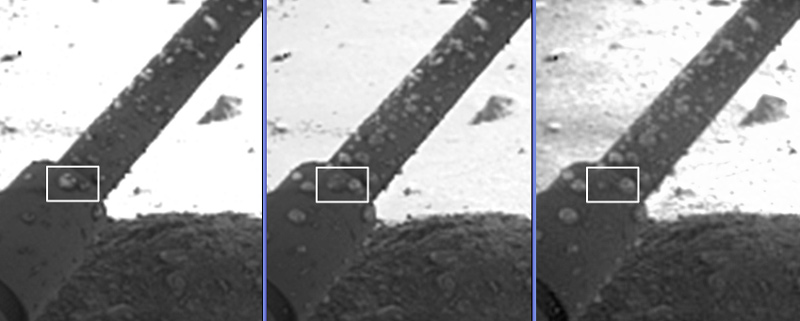
Water droplets appear to be growing on Phoenix's leg shortly after landing on Mars (NASA)
Water droplets appear to be growing on Phoenix’s leg shortly after landing on Mars (NASA)

NASA scientists are currently trying to understand a set of images taken by the Phoenix Mars Lander shortly after it landed on the Red Planet in May 2008. The images in question show one of the robot’s legs covered in what appears to be droplets of liquid water. The droplets remain on the lander for some time, appearing to get larger and changing shape.

By now, we know that liquid water (apparently) hasn’t existed on the Martian surface for hundreds of millions of years; the atmosphere is currently too thin and too cold to support liquid water. However, the confirmed presence of perchlorate in the regolith may provide an important clue as to what might be going on…
Continue reading “Liquid Water on Mars?”

The MSL is Too Expensive? Who Cares! We’re Searching For Life!

$2.2 billion eggs. One basket. The MSL "Skycrane" lowers the 850kg rover to the Martian surface (NASA)
$2.2 billion eggs. One basket. The MSL Skycrane lowers the 850kg rover to the Martian surface (NASA)

Don’t get me wrong, I am incredibly excited about any planetary mission, no matter how much it costs. However, there is something about the Mars Science Laboratory (MSL) that makes me uneasy. The project may be delayed (the MSL is scheduled for a 2011 launch) and it may be costing more than NASA projected, but it’s not these factors I’m worried about.

The MSL is built on a “bigger and better” mentality; it dwarfs both of the Mars Exploration Rovers Spirit and Opportunity, plus it is packing a rather impressive suite of 10 complex scientific instruments to carry out an unprecedented campaign in the Martian dirt. Oh, and did I mention it will be powered by radioisotope thermoelectric generators (RTGs), a complete departure from the tried and tested solar panelled rovers? Oh hold on, as the MSL weighs nearly a tonne, a brand new method of landing the thing is required (simply parachuting, air bag bouncing or rocket thruster powered landings are now passé). The “Skycrane” that looks like one of those hoverboards from Back to the Future II has been invented to gently lower the MSL (pictured above).

Still, I’m not too concerned, NASA has proven itself countless times at overcoming technological challenges. That’s why NASA is there, to research and develop new technologies and science. But what if the MSL has gone too far? What if the technology is too untried and untested? Unfortunately, it looks like the recent turn of events have taken even the MSL program manager by surprise
Continue reading “The MSL is Too Expensive? Who Cares! We’re Searching For Life!”

A Windy Day on Mars Gives Spirit an Energy Boost

On Mars, there are no car washes, no windscreen wipers, no rain, no fans... you get the picture... (NASA)
On Mars, there are no car washes, no windscreen wipers, no rain, no fans... you get the picture. (NASA)

By far the biggest difficulty for robotic operations on the Martian surface are Sun-blocking dust storms. Not only do red-tinted dust clouds block the Sun from penetrating the atmosphere, the dust grains fall on solar panels, creating a layer of dusty sunscreen, reducing the amount of light falling on the photovoltaic cells. This is a special problem for long-term missions on the Red Planet. The rovers Spirit and Opportunity have been pottering around in the Martian regolith for over five years, mission planners had little idea their tough explorers would live much beyond their designed 3 month lifespan; long-term accumulation of dust was of no concern… until now.
Continue reading “A Windy Day on Mars Gives Spirit an Energy Boost”

Mars Gets Hit By Cosmic Buckshot

Bolide breakup and impact on the surface of Mars (HiRISE/NASA)

Earth has been hit numerous times in recent months by some large chunks of space rock. One of the larger meteoroids to enter the atmosphere was the November fireball over Saskatchewan, Canada. In this case, an estimated 10 tonne meteorite slammed into the atmosphere, creating a bright bolide (fireball), exploding into fragments. Fortunately, eyewitnesses were able to pinpoint the location of possible debris. Sure enough, after an extensive search in the rural area of Canada, meteorite fragments were found.

However, these fragments did not impact the ground at the hyper-velocities that the original fireball was travelling at, the Earth’s thick atmosphere created an efficient barrier, through air resistance, breaking up the bolide. In this case, an energetic explosion was observed for miles around. Fragments from the fireball then fell at a maximum speed of terminal velocity, bouncing off the ground. Some fragments sat proudly on top of frozen ponds – the debris final kinetic energy was so low that little damage would have been done even if the small rocks scattered over a populated area (unless, of course, someone got hit on the head – they would have had a very bad day).

OK, so we’re well protected from most bits of junk space can throw at us. Most meteoroids, from the size of a grain of sand to the size of a small bus, will burn-up, break-up or explode high in the atmosphere, scattering bits on the ground. But what about Mars? What if Mars gets hit by a sufficiently-sized meteoroid?

Even if the meteoroid does break apart, unfortunately the atmosphere is too thin to slow the debris sufficiently. A lack of air resistance makes for more impressive impact craters. Watch your heads future Mars colonists, you could be faced with a shotgun blast from space
Continue reading “Mars Gets Hit By Cosmic Buckshot”

Gravitational Waves and Gravity Waves, What’s the Difference?

grav_waves

I’ve received this question so many times, so I thought I’d post, for reference purposes, the difference between a gravitational wave and a gravity wave. Yes, they are different creatures (although many authors would have you believe otherwise).

Gravitational waves are theoretical perturbations (ripples) in space-time. Much work is going into the discovery of gravitational waves using gravitational wave detectors like the US Laser Interferometer Gravitational-Wave Observatory (LIGO) or German-British GEO600, but so far, they have proven to be very elusive. In a previous Astroengine post, there is a new theory that perhaps gravitational wave detectors have reached a limit on their precision (i.e. the quanta of space-time, leading to the holographic universe conjecture). Gravitational waves, as predicted by Einstein’s theory of general relativity, are thought to exist, but have yet to be detected. There are indirect observations of gravitational waves, from observations of the slowing period of binary stars; energy is most likely being lost through gravitational wave generation. Gravitational waves are thought to be generated also by black hole collision, pulsars and supernovae. More on Gravitational Waves…

Gravity waves are physical perturbations driven by the restoring force of gravity in a terrestrial environment. A common example of this are waves formed at an air-water boundary (i.e. the surface of the ocean). Wind creates an instability in the ocean, the restoring gravity force pulls down on the water, while the buoyancy of the water pushes it back up. A perturbation then propagates (i.e. ocean waves). Extreme examples include tsunamis and tides. Perturbations in the atmosphere can also be caused by gravity, where rising/falling air tries to regain equilibrium (after being forced over a maintain range, say), but gravity and buoyancy forces will cause it to propagate as a wave. More on Gravity Waves…

So, gravitational waves are perturbations in space-time (over universal scales). Gravity waves are perturbations in atmospheres (planetary scale). They most certainly are not the same thing.

Twitter Journalism: Methane on Mars, The Signature of Life?

The distribution of atmospheric methane originating from three principal regions on the Martian surface (NASA)

Today, NASA held a press conference detailing some significant discoveries from observations made of the Martian atmosphere. Using NASA’s Infrared Telescope Facility and Keck Telescope, scientists from the University of Hawaii and NASA were able to deduce the spectroscopic fingerprint of methane. Although scientists have known for a long time that methane exists in the Martian atmosphere, the big news is that there is lots of it, it appears to be constantly replenished and it is a huge indicator of biological processes under the surface.

Fortunately, I was able to watch the NASA TV broadcast of the press conference at 11am (PST), so I thought I’d try, for the first time, to do some live microblogging of the announcements using Twitter. So, rather than going into vast detail about today’s methane news (as the web has exploded with articles on the subject anyway), I thought I’d publish my Twitter feed during the conference
Continue reading “Twitter Journalism: Methane on Mars, The Signature of Life?”

Frosty Phoenix Not Snowed Under… Yet.

The Mars Reconnaissance Orbiter's HiRISE instrument spots the dead Phoenix Lander on December 21st (NASA/HiRISE)

NASA lost contact with the Phoenix Mars Lander at the start of November 2008, as its batteries were drained and sunlight began to dwindle. With no sunlight came no charge for the batteries from Phoenix’s solar panels, and the robot’s fate was sealed: a sun-deprived coma. A dust storm hastened the lander’s fate, but it certainly wasn’t premature. The Phoenix mission was intended to last three months, but in the same vein as the Mars Exploration Rovers, Phoenix’s mission was extended. In the high latitude location of the Martian Arctic, a dark winter was fast approaching, so Phoenix didn’t have the luxury of time and it transmitted its last broken signal before the cold set in, sapping the last volt of electricity from its circuits…

Although there was some excitement about the possibility of reviving the lander next summer, it is highly unlikely Phoenix will be in an operational state, even if it did have an abundant source of light to heat up its solar panels once more. No, Phoenix is dead.

However, that doesn’t mean the orbiting satellites won’t be looking out for it. So long as there is a little bit of light bouncing off the frosted Martian surface, the Mars Reconnaissance Orbiter can image Phoenix, keeping track of the encroaching ice around its location. The HiRISE team seem to be assembling a series of images throughout the change in seasons at the landing site, so it will be interesting to see the full set…

Source: HiRISE blog