The space station as reflected in John “Danny” Olivas’ spacesuit visor on September 3, 2009 (NASA)
When I came across this image in NASA’s Human Space Flight gallery, I stopped. I was looking for the “perfect” shuttle image during the STS-128 mission to the International Space Station earlier this month, but I got sucked into browsing through the hundreds of EVA photographs NASA has stockpiled in their archives.
This particular scene was taken by NASA astronaut John “Danny” Olivas when he was out on a spacewalk installing a new Ammonia Tank Assembly. The EVA was over six hours long and Olivas was able to do some digital photography in that time. This picture shows his spacesuit helmet visor, with a reflection of the camera at arms length below.
Also visible in the reflections in the visor are various components of the station and European Space Agency astronaut Christer Fuglesang, mission specialist, anchored to a Canadarm2 mobile foot restraint. —NASA
The reflection captures so much detail. The curvature of the Earth can be seen in the distance, with space station solar arrays jutting in front. Even the two docked Soyuz vehicles (TMA-14 and TMA-15) are in shot. To top it all off, ESA astronaut Fuglesang is dangling in the vacuum of space attached to a robotic arm.
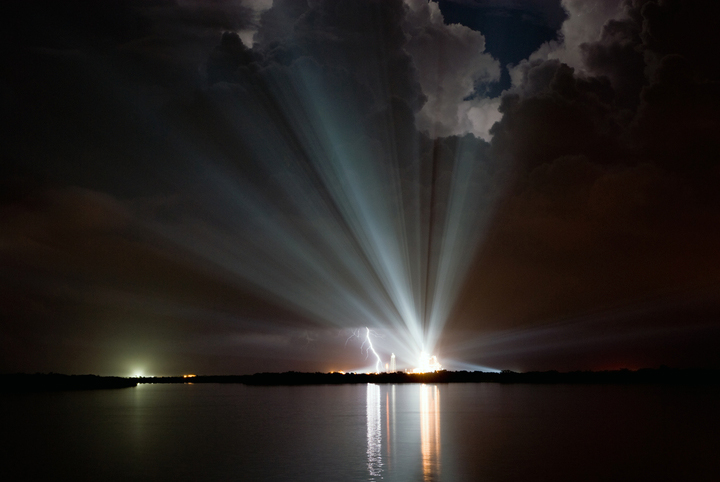
Discovery on Launch Pad 39A... Friday launch? (NASA)
To be honest, I wasn’t going to post an update on the progress of Discovery’s continuing delay, but when I saw this photo I couldn’t resist. In the shot, you can see the pad floodlights and a flash of lightning. Outstanding.
So, the next launch window is looking like it’s going to be at 11:59pm (EDT) Friday night. This will give launch crews some time to analyse results from tests they are carrying out on the potentially faulty valve that caused the previous launch scrub. However, NASA is hopeful the fault is with the sensors giving false readings rather than an engineering fault with the valve itself.
The ~400 meter moonlet casts a 25 mile shadow across Saturn's B-ring (NASA)
As Saturn approaches its August 11th equinox (during which the Sun will be directly above the gas giant’s equator at noon for 27 months), the Cassini Equinox Mission can do some moonlet spotting. During this time, sunlight will cast long shadows of any object protruding from the 10 metre-thick rings.
In this case, hidden inside Saturn’s B-ring, a moonlet with a diameter of approximately 400 metres becomes obvious when sunlight hits the rings edge-on. The result is a very obvious 25 mile-long shadow. This discovery wouldn’t have been possible during any other time, as Cassini can only see the small rock because of its shadow. If the Sun was above or below the rings, no shadow would be cast, and therefore no moonlet would be visible.
Saturn experiences an equinox twice every Saturnian year (once every 15 terrestrial years), and NASA planned the Cassini mission to coincide with this interesting period to economise on the position of the Sun, spotting small objects like this little satellite…
The completed Ares I first stage five-segment solid rocket booster in Promontory, Utah on July 21st (NASA/ATK/RedOrbit)
Development of the Constellation Program pushes ahead with the announcement that the first stage motor of the Ares I crew launch vehicle will be fired in the Utah desert on August 25th. The Ares I five-segment first stage booster is based on the design of the shuttle’s four-segment booster, but it will deliver a far meatier 3.6 million pounds of thrust. A single shuttle booster delivers 2.8 million pounds of thrust (but remember, there are two of them attached to the shuttle at lift-off).
Naturally, the ATK/NASA Utah test will be a huge event, a major milestone towards the construction and assembly of the rocket that will carry the Orion spaceship into orbit. This is in addition to the continuing developments of Orion.
So, to promote the event ATK has released this snazzy movie-style trailer ahead of this historic rocket test, and to be honest, I’m impressed:
Although Constellation is hitting wave upon wave of setbacks and criticism, it seems the tests are pushing ahead, and we are beginning to see the physical embodiment of the Ares I/Orion combo take shape.
The National Space Society has done great work in the realms of space science outreach and project funding, and to be honest, I’m behind any non-profit that whips up enthusiasm and furthers mankind’s efforts in space. They are outspoken critics of space policy and NASA, which is usually pretty fair.
However, the NSS blog has dropped a few clangers of late, making me question whether they are on the right track.
Previously on the NSS blog, described in a misguided (yet well-made and undoubtedly enthusiastic) video, that by magically revisiting the Apollo era, the US can begin re-industrializing and build rockets. What happens then? A million jobs are created! Wow, why didn’t the NSS think of this years ago? Actually, as Greg Fish points out of Weird Things, snazzy videos and a triumphant call for factories to build stuff is a little naive at best.
Then there was the case of the publication of the draft Unified Space Vision headed by Buzz Aldrin that was picked up by New Scientist, only for the post to be hastily pulled from the NSS blog when it started to get all the wrong kinds of press (the draft letter was here, but now it’s not).
Assume that President Obama doesn’t care about NASA. When there was a talk of a missile gap [during the Cold War] NASA was important to show our technical prowess in a non-threatening way. NASA hasn’t been important to the President since. Presidents want NASA to demonstrate America’s technological leadership and not kill any one, that seems to be about it.
It is time for NASA to grow up and take responsibility for its self and its accomplishments, and do so within a flat budget. Don’t expect to see Apollo level funding again. Don’t expect a President with 2 wars going on, a third one possibly on the horizon, the worst economic crisis in the last 80 years, and a health care crisis to worry about NASA.
Barrak [sic] Obama put NASA in the able hands of Charlie Bolden and Lori Garver so he wouldn’t have to care about NASA and could simply make speeches about the wonderful things NASA is accomplishing during his administration.
Yey! Go US spaceflight! Woohoo! Doesn’t that make you feel all warm and fuzzy inside?
It’s one thing to criticise NASA and US space policy, but this is incredibly defeatist for an organization that should be working harder to promote the importance and shape the future of NASA science. Come on NSS! I’d happily see more enthusiastic videos about how a new spaceflight industry will save the economy (even if it’s unrealistic) rather than read someone’s depressing, and frankly limited, opinion that Barack Obama (note the correct spelling) doesn’t give a toss about NASA.
[ UPDATE:The site has now been updated with the correct spelling of the President’s name, but here’s the original post (thanks to Keith at NASAWatch and SpaceRef.com) ]
This blog post was picked up by NASAWatch.com, and Keith Cowling makes an interesting observation:
Ouch, this is rather gloomy and depressing talk from the National Space Society’s official blog given that two of its former Executive Directors are at NASA – one being Deputy Adminstrator and the other being Chief of Staff – and hold opposite, hopeful views of what lies ahead for NASA. It is also odd that the webmaster of this blog does not even bother to spell the President’s name correctly.
NASA is an easy target for critics, and the agency certainly has its problems, but I think this is a surprising cheap shot from a blog of the biggest US space advocacy non-profits.
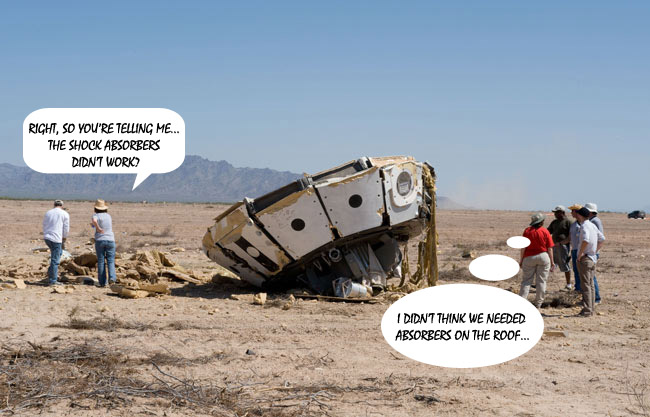
Although there are doubts about Constellation, and NASA recently announced a “plan B” launch option for a return trip to the Moon, Orion development continues as planned. Next up is the development of the Orion shock absorbers, intended to take the sting out of the return capsule’s landing.
Tests are currently being carried out at the Landing and Impact Research Facility in NASA’s Langley Research Center on the seat pallet that will protect the Orion astronauts’ from the shock of touch-down. It is hoped Orion will be a land-anywhere capsule, including land and water. In fact, I am a little bit excited about the planned landing spot in the Pacific Ocean, not far from Catalina Island, off the Los Angeles coastline. That’s just down the road and a small swim from me!
To test the pallet and its “energy-absorbing struts,” the 20,000-pound test article is dropped 18 feet onto a crushable honeycomb material designed to simulate different landing surfaces. —Aviation Week
The seat shock absorbers won’t only be used for landing, it is hoped they will mitigate much of the launch vibration effects caused by the Ares I crew launch vehicle. These tests are a result of studies of how much vibration crew members can take before it becomes difficult to read instrumentation displays and react to situations during launch.
This is an unlikely comparison if I ever saw one. According to ex-NASA Administer Mike Griffin, the US spends more money on pizza in a year than it does on the US space agency. If you thought that was funny, the best has yet to come…
…polls have concluded that most US citizens believe NASA receives 24% of the annual $3 trillion federal budget. In actuality, NASA receives… wait for it… less than 1% ($18 billion).
Now stand up, and stop rolling around on the floor laughing hysterically. No wonder people get so pissed with NASA when they think 24% of the national annual budget is invested into the exploration of space! No guys, 1%. Is that really too much to pay for the advancement of science, exploration, technology and human ingenuity? Fancy donating few percent of your annual pizza budget to NASA?
“What we do is huge, and we do it for chump change – less than the annual market for pizza,” Griffin said earlier in the week during a New York presentation to aerospace businessmen. The annual US market for pizza is $27 billion.
$27 billion? Wow.
I’ve always liked Griffin. He was a pretty strong leader of NASA and he’s a tireless manned space exploration advocate. He was also instrumental in the creation of the Commercial Orbital Transportation Services (COTS), thus stimulating the private sector to start pushing into space, carrying out NASA contracts to the International Space Station.
When the NASA budget is being dwarfed by the annual sales of a product consisting of a doughy base and three toppings, I can’t help but think commercial space options are the way forward…
The cargo bay of the shuttle, a valuable in-orbit repair station (NASA)
On the flight back from Washington D.C. last night, United Airlines had the wonderful sense to play the fourth episode of the documentary When We Left Earth: The NASA Missions. It couldn’t have come at a better time, having just watched Mall Cop, The Office, Big Bang Theory and then How I Met Your Mother, I was in dire need for a good documentary.
I was actually returning from a visit to the Discovery Channel HQ after meeting my amazing Discovery.com team for the first time, so I was in the mood to watch something about space. The best thing about When We Left Earth is that when watching it you can’t help but feel inspired and moved (coincidentally, it was produced by the Discovery Channel). In part 4, the Apollo missions (from 12-17) and Skylab are documented, and I must admit, I was a little vague on a lot of the facts that were presented.
Probably the best bit for me was watching the converted Saturn V, resembling a high caliber bullet, blast into the sky in May 1973, taking Skylab into orbit. However, the story that ensued came as a surprise to me, I’d forgotten just how revolutionary Skylab really was. During launch, the space station sustained serious damage, causing loss of the sunshield and damage to the solar panels. If astronauts weren’t launched to repair Skylab, the mission would be lost, cooked from the inside-out, and losing energy fast.
The first crew of Skylab became a space station rescue mission. A small Saturn IB rocket carried Charles Conrad, Jr, Paul J. Weitz and Joseph P. Kerwin to rendezvous with Skylab. In space, the trio overcame all the odds and carried out a risky in-orbit repair on the crippled station, ultimately saving it and allowing two more Skylab missions to be carried out (SL-3 and SL-4) until February 1974.
Skylab launches atop a converted Saturn V in May 1973 (NASA)
It was a story of space adventure and discovery to the highest degree; Skylab changed our understanding of the Sun and gave us an incredible opportunity to study the human physiology for long periods in space.
Then I started to think about what we are capable of today. We can routinely send a team of seven astronauts, to a 19 year old space telescope, to carry out a servicing mission to prolong the observatory’s life for another five years. If I think about that too hard, I start to feel a little dizzy. From sending three heroic individuals on one of the first emergency in-orbit repairs to save a space station in 1973 to sending a sophisticated space shuttle (with a space workshop in its cargo bay) to carry out a carefully choreographed engineering task in microgravity, our technology has come a long way, but one thing has remained the same. The heroism of our men and women in space has not changed; space travel may seem to be routine, but being an astronaut is still a highly dangerous profession.
So when I read Irene Klotz’s Discovery News article Need Satellite Repairs? Don’t Call NASA, I feel sad. Although the Space Shuttle has its faults and its endless supply of critics, it has enabled us to do unprecedented science and engineering tasks in space. When the shuttle is retired, NASA will no longer have the capability of capturing or docking with a satellite to carry out complex repairs and then send it on its way. Even when the Constellation Program launches, we wont have this facility. For me, that feels like one huge step backwards for our ability as a space-faring race; NASA will be prevented from carrying out complicated repairs in orbit.
It’s been a long wait, but has President Obama chosen the next NASA Administrator?
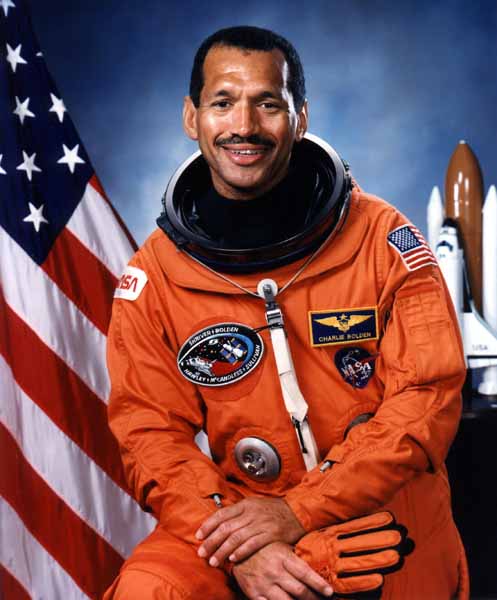
According to several news sources, it would appear a former astronaut may be taking the most senior NASA position. Retired Marine Major General Charles F. Bolden will travel to the White House on Monday to meet with the President and discuss the appointment.
Bolden is an experienced astronaut, having served on four Shuttle missions from 1986 to 1994, clocking up a total of 680 hours in Earth orbit.
Earlier this year there was some speculation that Charles F. Bolden Jr.’s name was being mentioned more often than the other contenders in the race replace ex-Administrator Michael Griffin. Judging by today’s press coverage, it appears the speculation was accurate and President Obama has decided on Griffin’s successor.
Bolden joined the space agency in 1981 and served on four Space Shuttle missions, including STS-61C (Columbia, 1986), STS-31 (Discovery, 1990), STS-45 (Atlantis, 1992) and STS-60 (Discovery, 1994).
In 1994, Bolden left NASA and became Deputy Commandant of Midshipmen at the US Naval Academy. In 2003, he left the Marine Corps as a Major General.
If this decision becomes official on Monday, Bolden will be faced with the toughest challenge he has ever had to confront. The political and financial challenges he will have to overcome as leader of the US space agency will be incredible. We face uncertain times, especially with the retirement of the Shuttle looming and the continuing flack the Constellation Program is receiving.
In many ways Charlie, I don’t envy you. But in others, how cool would it be to be in command of a space agency?!
Today’s launch of Space Shuttle Atlantis went according to plan and the crew of seven astronauts are now chasing the Hubble Space Telescope for its final servicing mission.
As I’m a little behind the curve on reporting this story, I thought I’d assemble some links to other sites who covered the launch far more expertly that I can at this late stage. However, not to be outdone, I wanted to share this incredible high definition video of the launch. If you want to watch the embedded HD version, look below, but if you want the full, i’m-on-the-edge-of-the-launchpad-oh-my-god-i-can-feel-the-heat wide-screen version, check out the awesome, fully-loaded YouTube HD video.







 astroengine.com
