On Sol 34, Curiosity’s Mars Hand Lens Imager (MAHLI) captured images of the rover’s dusty wheels. Credit: NASA/JPL-Caltech
Late on Sunday night, NASA’s Mars Science Laboratory (MSL) website had a surprise in store: Curiosity’s recently un-capped robotic arm-mounted Mars Hand Lens Imager (MAHLI) snapped some incredible photographs of the rover’s undercarriage and its calibration target. Shown above is my favorite pic, detailing dust on two of the rover’s wheels. Shown below is an image of Curiosity’s set of front Hazcams (left and right pairs).
Curiosity’s front Hazcams as imaged by the robotic arm-mounted MARDI camera. Credit: NASA/JPL-Caltech
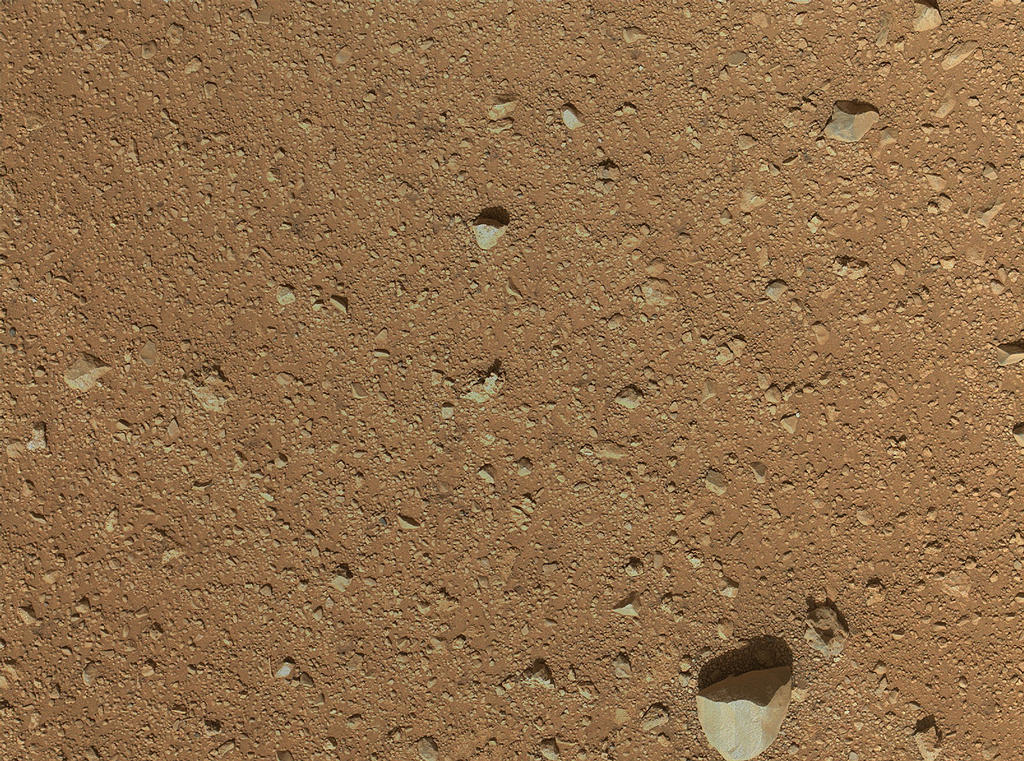
Although the dust cap has been in place up until now, the camera was used to grab Curiosity’s first fuzzy color landscape pic and, only last night, it was used to snap a fuzzy “self portrait” of Curiosity’s “head” — but that was achieved by looking through the semi-transparent dust cap still attached to the lens. Today, the very first crystal-clear “open” MAHLI image has been acquired after mission controllers sent the command for the re-closable dust cap to swing open. The picture shows a patch of Mars dirt next to the rover measuring about 86 centimeters across. The large pebble at the bottom of the frame is about 8 cm wide.
This may be a very preliminary image, but the MSL team are already using it to do science. “Notice that the ground immediately around that pebble has less dust visible (more gravel exposed) than in other parts of the image,” says the image description on the MSL mission site. “The presence of the pebble may have affected the wind in a way that preferentially removes dust from the surface around it.”
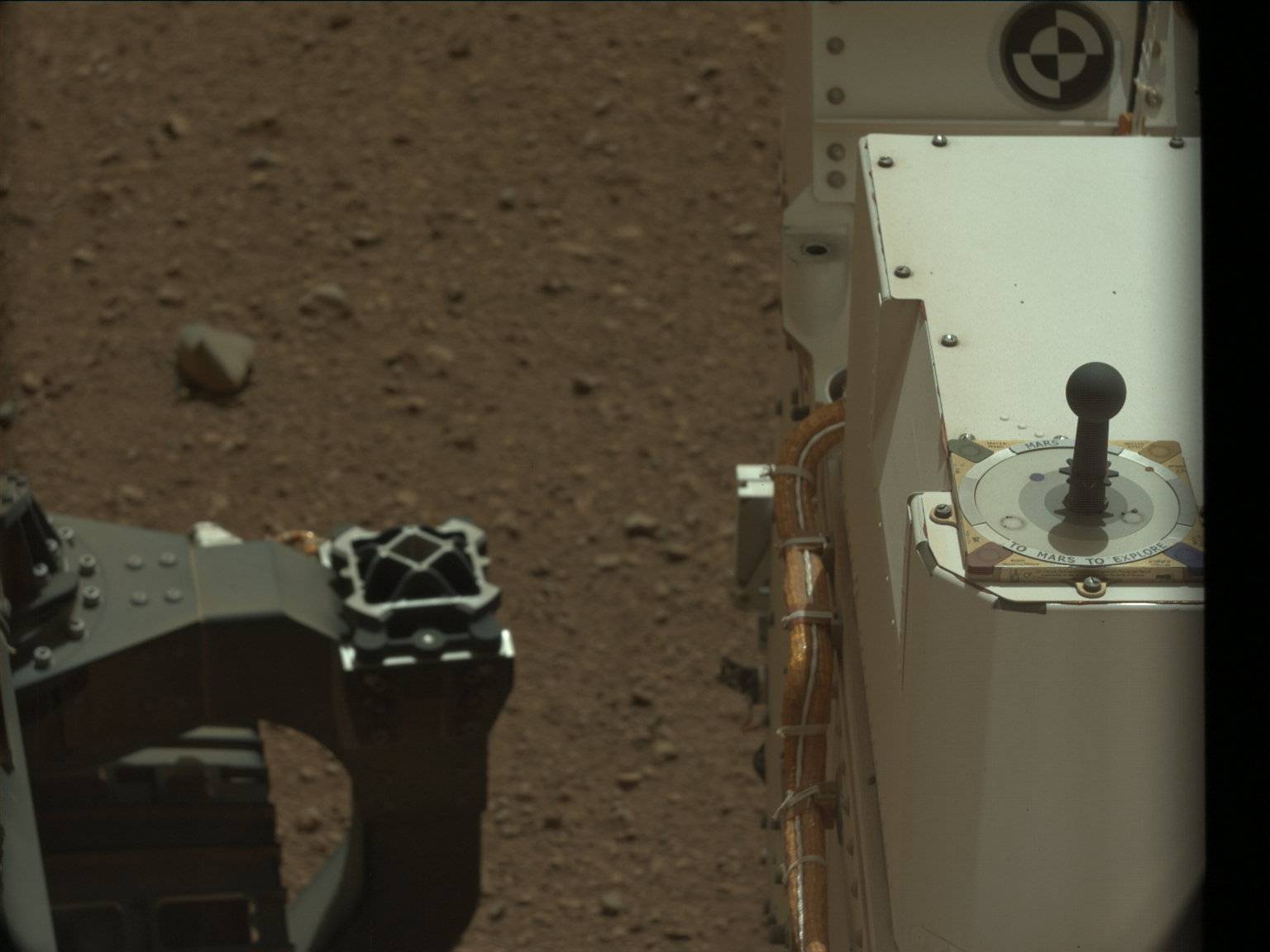
The left eye of the Mast Camera (Mastcam) on NASA’s Mars rover Curiosity took this image of the camera on the rover’s arm, the Mars Hand Lens Imager (MAHLI), during the 30th sol of the rover’s mission on Mars (Sept. 5, 2012).
During the Sept. 6 press conference from NASA’s Jet Propulsion Laboratory (JPL) in Pasadena, Calif., Mars Science Laboratory (MSL) mission scientists discussed updates from Curiosity’s progress in Gale Crater. It’s hard to keep up with the incredible deluge of images and scientific data as the six-wheeled rover roves toward its first target — a geologically interesting location called “Glenelg.” Mission managers hope to use Curiosity’s drill for the first time when the rover arrives. Expect mission updates and some pretty cool photos to appear on Discovery News throughout the day.
There was one photograph, however, imaged by the rover’s Mastcam that was showcased in today’s briefing that fascinated me. Shown above, the Mars Hand Lens Imager (MAHLI) can be seen on the rover’s robotic arm (with dust cap still in place). All the instrumentation and wiring has a very cool Steampunk-esque quality to it.
When I “met” Curiosity at the JPL clean room last year, I was also fascinated by its ugly functionality. By “ugly,” I don’t mean repulsive, I actually fell in love with the robot that day. But with any space mission, function succeeds form and Curiosity is no different. Instruments jut out from a central box; cables snake over all surfaces; gold and silver components are scattered across the deck like opulent jewels; and the whole thing is supported by some seriously heavy duty wheels that wouldn’t look out of place attached to a Bentley cruising through Los Angeles.
Back then, I stared at the Mars exploration machine, whose one purpose is to do science in an alien land, and thought how alien the thing looked. But in all the ugliness of an apparently random assortment of instrumentation, Curiosity has an undeniably beautiful character. Also, it has a WALL-E-like “head” in the form of the blocky ChemCam atop its mast. And now I know what its character is after seeing this latest robotic arm photo; it’s a creation that wouldn’t look out of place in a Steampunk museum or imagined in a H. G. Wells novel. However, this isn’t sci-fi, this is real. We have a nuclear-powered rover on Mars. Sometimes it’s too hard to put such awesomeness into words.
Apollo 11 Commander Neil Armstrong inside the lunar module “Eagle” after his first moonwalk. Credit: NASA
“The important achievement of Apollo was demonstrating that humanity is not forever chained to this planet and our visions go rather further than that and our opportunities are unlimited.” —Neil Armstrong
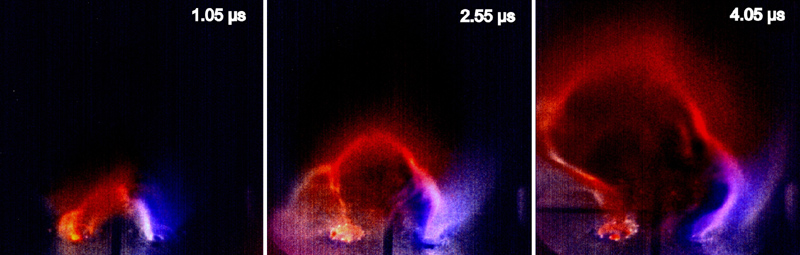
The magnetic loop containing hydrogen and nitrogen plasma evolves over 4 micro-seconds. Credit: Bellan & Stenson, 2012
There’s no better method to understand how something works than to build it yourself. Although computer simulations can help you avoid blowing up a city block when trying to understand the physics behind a supernova, it’s sometimes just nice to physically model space phenomena in the lab.
So, two Caltech researchers have done just that in an attempt to understand a beautifully elegant, yet frightfully violent, solar phenomenon: coronal loops. These loops of magnetism and plasma dominate the lower corona and are particularly visible during periods of intense solar activity (like, now). Although they may look nice and decorative from a distance, these loops are wonderfully dynamic and are often the sites of some of the most energetic eruptions in our Solar System. Coronal loops spawn solar flares and solar flares can really mess with our hi-tech civilization.
A coronal loop as seen by NASA’s Transition Region and Coronal Explorer (TRACE). Credit: NASA
In an attempt to understand the large-scale dynamics of a coronal loop, Paul Bellan, professor of applied physics at Caltech, and graduate student Eve Stenson built a dinky “coronal loop” of their own (pictured top). Inside a vacuum chamber, the duo hooked up an electromagnet (to create the magnetic “loop”) and then injected hydrogen and nitrogen gas into the two “footpoints” of the loop. Then, they zapped the whole thing with a high-voltage current and voila! a plasma loop — a coronal loop analog — was born.
Although coronal loops on the sun can last hours or even days, this lab-made plasma loop lasted a fraction of a second. But by using a high-speed camera and color filters, the researchers were able to observe the rapid expansion of the magnetic loop and watch the plasma race from one footpoint to the other. Interestingly, the two types of plasma flowed in opposite directions, passing through each other.
The simulation was over in a flash, but they were able to deduce some of the physics behind their plasma loop: “One force expands the arch radius and so lengthens the loop while the other continuously injects plasma from both ends into the loop,” Bellan explained. “This latter force injects just the right amount of plasma to keep the density in the loop constant as it lengthens.” It is hoped that experiments like these will ultimately aid the development of space weather models — after all, it would be useful if we could deduce which coronal loops are ripe to erupt while others live out a quiescent existence.
It’s practical experiments like these that excite me. During my PhD research, my research group simulated steady-state coronal loops in the hope of explaining some of the characteristics of these fascinating solar structures. Of particular interest was to understand how magnetohydrodynamic waves interact with the plasma contained within the huge loops of magnetism. But all my research was based on lines of code to simulate our best ideas on the physical mechanisms at work inside these loops. Although modelling space phenomena is a critical component of science, it’s nice to compare results with experiments that aim to create analogs of large-scale phenomena.
The next test for Bellan and Stenson is to create two plasma loops inside their vacuum chamber to see how they interact. It would be awesome to see if they can initiate reconnection between the loops to see how the plasma contained within reacts. That is, after all, the fundamental trigger of explosive events on the Sun.
Hi-res self-portrait of Curiosity — taken with the mast-mounted Navcams. Debris can be seen scattered across the deck. Credit: NASA/JPL-Caltech
During Mars rover Curiosity’s dramatic landing on Aug. 5, the rocket-powered sky crane blasted debris onto the rover’s deck. The first question that came to mind concerned the safety of exposed and potentially vulnerable instrumentation. I was in the very fortunate position to raise my concerns during the Aug. 9 NASA news briefing. The response from MSL mission manager Mike Watkins was cautious optimism that little to no damage was caused by the unexpected ejection of material from the ground.
“It does appear that some small rocks became lofted in the winds that were generated by the plumes during landing and probably just fell upon the rover deck,” said Curiosity deputy project scientist Ashwin Vasavada, with NASA’s Jet Propulsion Laboratory in Pasadena, Calif., during a conference call on Tuesday (Aug. 21).
“Some of these rocks may have fallen on these exposed circuit boards and damaged the wires. That’s just one potential cause. We don’t know for sure and we don’t really have a way of assessing that at this point any further,” he added.
It appears that one of the booms on the Mars Science Laboratory’s Rover Environmental Monitoring Station (REMS) — located on the rover’s mast — may have been the hardware that got sandblasted or smashed by Mars rocks. REMS now only has one (of two) booms operational. The booms’ purpose is to take measurements of wind speed on the Martian surface. Although this is a setback (and, so far, the ONLY setback), mission scientists are confident they’ll find a workaround.
“We’ll have to work a little harder to understand when the wind may be coming from a direction that would be masked by (Curiosity’s) mast … but we think we can work around that,” Vasavada said.
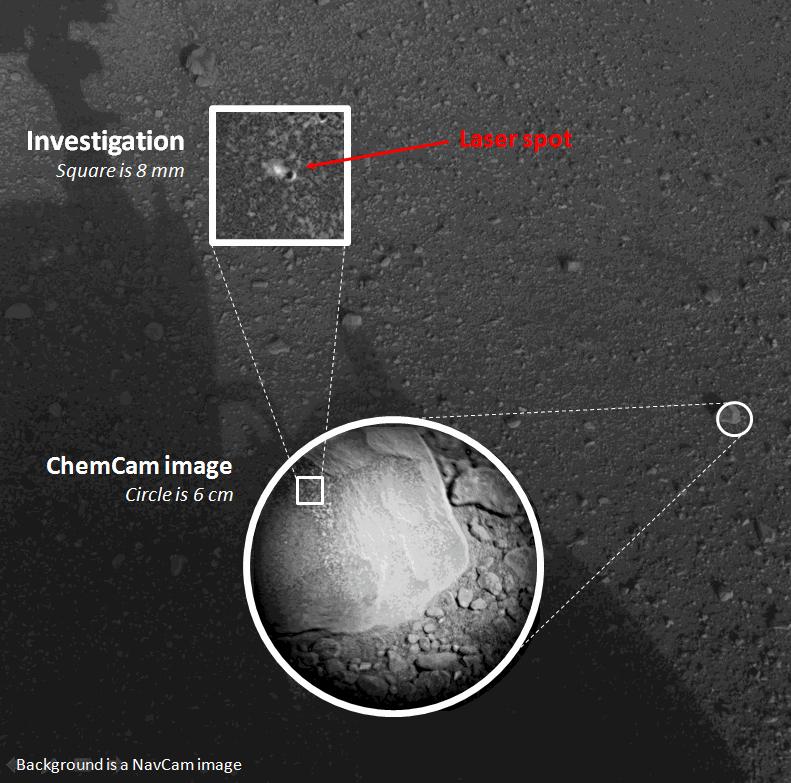
The laser-zapped rock “Coronation” — inset image was taken by the ChemCam instrument, featuring the small laser burn. Credit: NASA/JPL-Caltech
After Mars rover Curiosity’s thunderous landing on Aug. 5/6, any hypothetical Martian on the surface would have been forgiven for being a little confused.
Setting down on the flat plain called Aeolis Palus inside Gale Crater, the six-wheeled, one-ton, nuclear-powered rover would have looked more like an alien battle tank being dropped off by a rather ominous-looking “Flying Saucer” than a scientific mission. But after the famous “sky crane” maneuver that lowered the rover with the precision of a Harrier Jump Jet, the “alien” robot didn’t start rolling over the Martian landscape zapping Mars rocks with its laser. Instead, it just sat there. For days. Occasionally there’d be a bit of action — such as Curiosity’s cameras swiveling, mast raising and high-gain antenna tracking the sky — but apart from that, our hypothetical Martians would probably not have thought much of this lack-luster invasion by an airdropped tank.
But that all changed today. Curiosity blasted a rock with its laser, marking the beginning of Curiosity’s Mars domination! Shock and awe, Mars rover style.
Alas, this isn’t a military exercise, but it is significant. Today marks the first day that one of our interplanetary robotic emissaries have used a laser on another planet in the name of science. NASA mission operators gave the go-ahead to carry out a test-run of the Chemistry and Camera instrument, or ChemCam, targeting a small rock (called “Coronation”) with 30 pulses of its laser over a 10-second period. According to the JPL press release, each pulse delivered more than a million watts of power for about five one-billionths of a second.
The fist-sized Mars rock — called “Coronation”, previously designated “N165” — has become the first casualty of war scientific target of Curiosity’s ChemCam instrument. Credit: NASA/JPL-Caltech
“We got a great spectrum of Coronation — lots of signal,” said ChemCam Principal Investigator Roger Wiens of Los Alamos National Laboratory, N.M. “Our team is both thrilled and working hard, looking at the results. After eight years building the instrument, it’s payoff time!”
The laser works by vaporizing the surface layers of exposed rock. Under the intense heating by such focused energy, a tiny sample of material rapidly turns into plasma. The the flash of light generated by the small, rapidly dissipating cloud of plasma can then by analyzed from afar by the ChemCam’s spectrometer. The light reveals what kinds of elements are contained in the sample, aiding Curiosity’s studies of the Red Planet. And the best thing is that ChemCam appears to be working better than expected.
“It’s surprising that the data are even better than we ever had during tests on Earth, in signal-to-noise ratio,” said ChemCam Deputy Project Scientist Sylvestre Maurice of the Institut de Recherche en Astrophysique et Planetologie (IRAP) in Toulouse, France. “It’s so rich, we can expect great science from investigating what might be thousands of targets with ChemCam in the next two years.”
Rocks and regolith strewn over the ground near Mars rover Curiosity. Credit: NASA/JPL-Caltech
It looks like rocks and dust, right? Actually, it resembles the dusty parking lot near a beach where my family used to holiday when I was young — a sandy, ruddy, dusty patch devoid of grass where cars had worn down the top layer of dirt, exposing smoothed rock underneath. However, this isn’t a parking lot. Actually, scrub that, it IS a parking lot — Mars rover Curiosity’s parking lot in Aeolis Palus, a remarkably smooth plain inside Gale Crater on Mars.
“The Science Store had a parking lot.” Re: The wonderfully flat Curiosity landing zone inside Gale Crater. #MSLa-eng.in/NtElto
I don’t have an awful lot to say about these new high-resolution images that have just been uploaded to the Mars Science Laboratory (MSL) mission site except that I really wish I were a geologist! I get the feeling that these images from a never before seen region of Mars will keep geologists busy for some time to come.
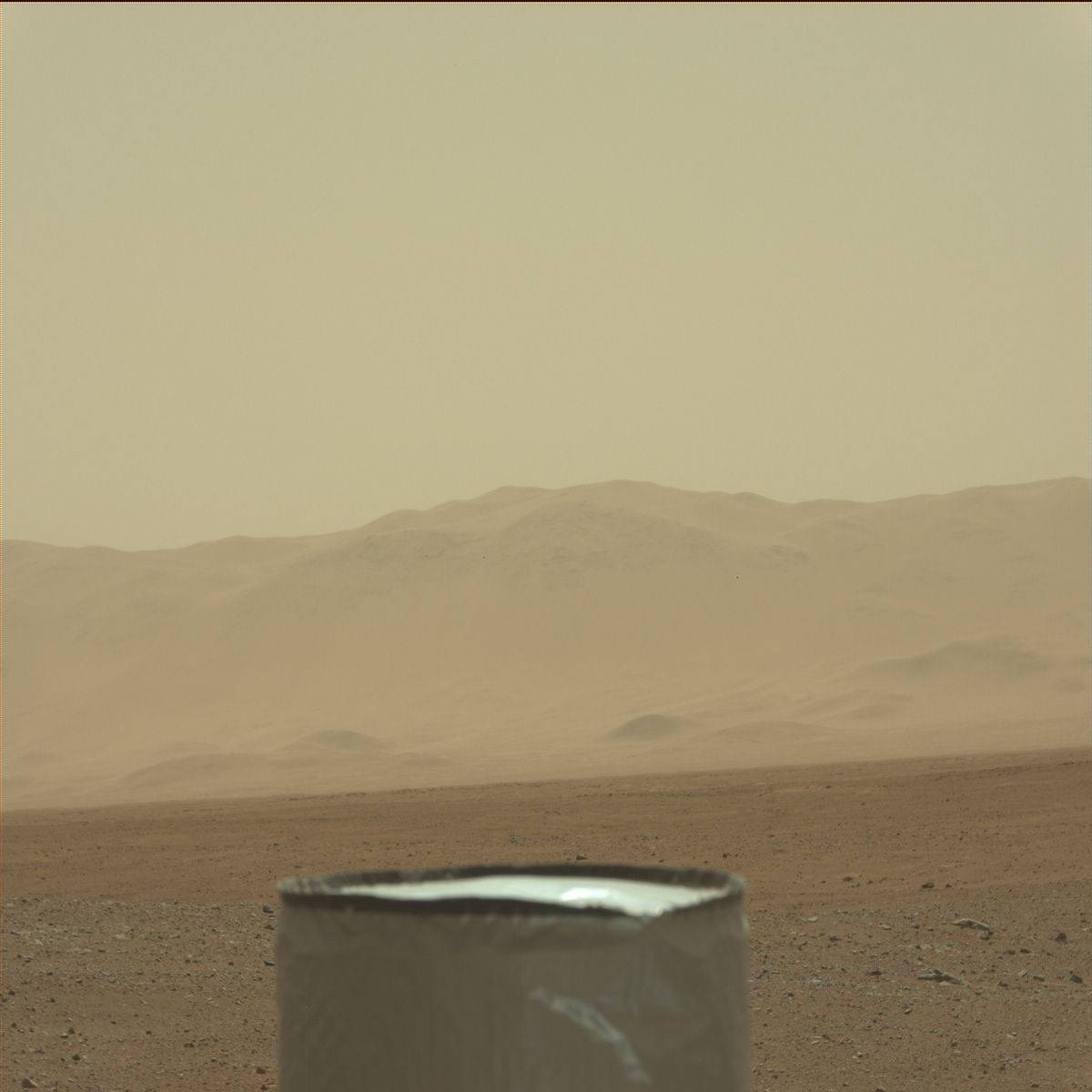
As Curiosity undergoes a software upgrade preparing it for surface operations, we’ve been patiently waiting for the mission site to upload new images (beyond the color thumbnail teasers) of the surrounding area. And it seems that on Saturday night that happened. Here are some of my favorite views from Curiosity’s Mastcam:
Curiosity’s sundial on its deck reads: “Mars 2012 — To Mars To Explore”Discoloration in the top soil in the location of a crater formed by Curiosity’s Sky Crane rockets. Credit: NASA/JPL-CaltechThe deployed high-gain antenna. Credit: NASA/JPL-CaltechThe crater rim and detail of undulating terrain — possibly dunes. Credit: NASA/JPL-Caltech
The view through Curiosity’s left (A) and right (A) Navcams, looking down on the deck of the rover. Credit: NASA/JPL-Caltech (levels adjusted)
UPDATE (Aug. 9, 2012): During Thursday’s NASA press briefing, I asked MSL mission manager Mike Watkins about the likely impact the debris atop the rover may have on the mission. Although the debris was unexpected, it’s not thought to affect any of the rover’s instrumentation. Read more on Discovery News: “Unexpected Debris atop Curiosity Not a Problem.“
On Sol 2 of NASA’s Mars Science Laboratory mission, we’re certainly not short of new things to look at. Early on Wednesday, the JPL team released images from the rover’s raised mast. Atop the mast is the blocky ChemCam laser, two Mastcams and four Navcams — a collection of equipment that is colloquially referred to as the rover’s “head.” As soon as the mast was deployed, mission controllers switched on the Navcams and commanded Curiosity to look around its new home.
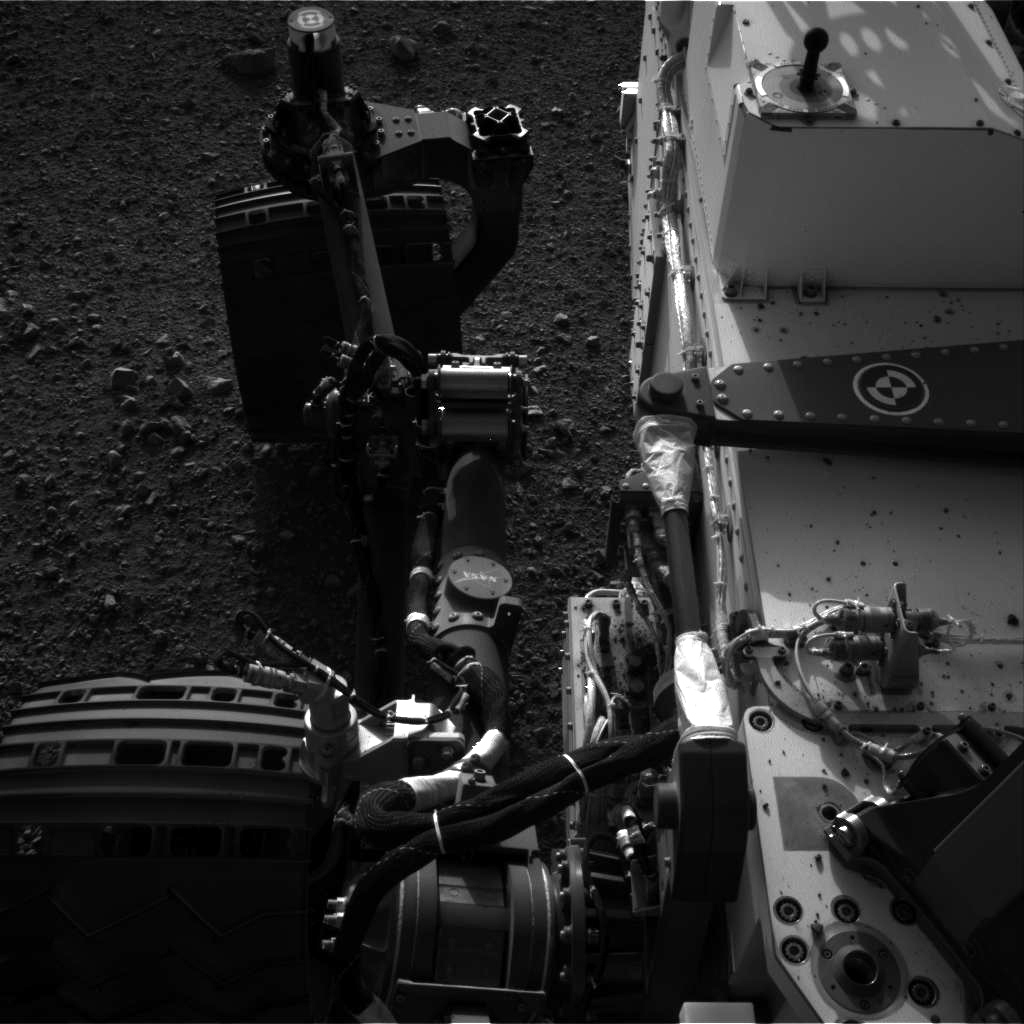
During Curiosity’s descent and landing on Sunday night, the famous Sky Crane maneuver was used to lower the rover to the surface. In doing so, the rockets attached to the platform blew away the surface layers of regolith and small rocks, exposing what appears to be bedrock. The craters generated by the rocket thrust is clearly seen in a couple of Navcam images. Although dust was bound to be thrown into the air, inevitably settling on the rover, small rocks also appear to have been blasted onto the rover’s deck. The largest rock pieces appear to be no bigger than the size of a dime — when comparing them with the dimensions of the Radiation Assessment Detector (RAD) instrument (in the top left of both frames in the image above). The RAD’s circular “window” is roughly the size of a coaster.
Could the small rocks cause issues with the operation of instrumentation mounted on the rover’s deck? Were they expected to be blown from the ground onto the deck? It will be interesting to hear what will be discussed by the MSL team during Thursday’s 10 a.m. PDT press briefing.
The high-gain antenna that will be used for direct communication with Earth is operational. Credit: NASA/JPL-Caltech (levels adjusted)Curiosity’s wheels as imaged by Navcam Left A. Credit: NASA/JPL-Caltech (levels adjusted)
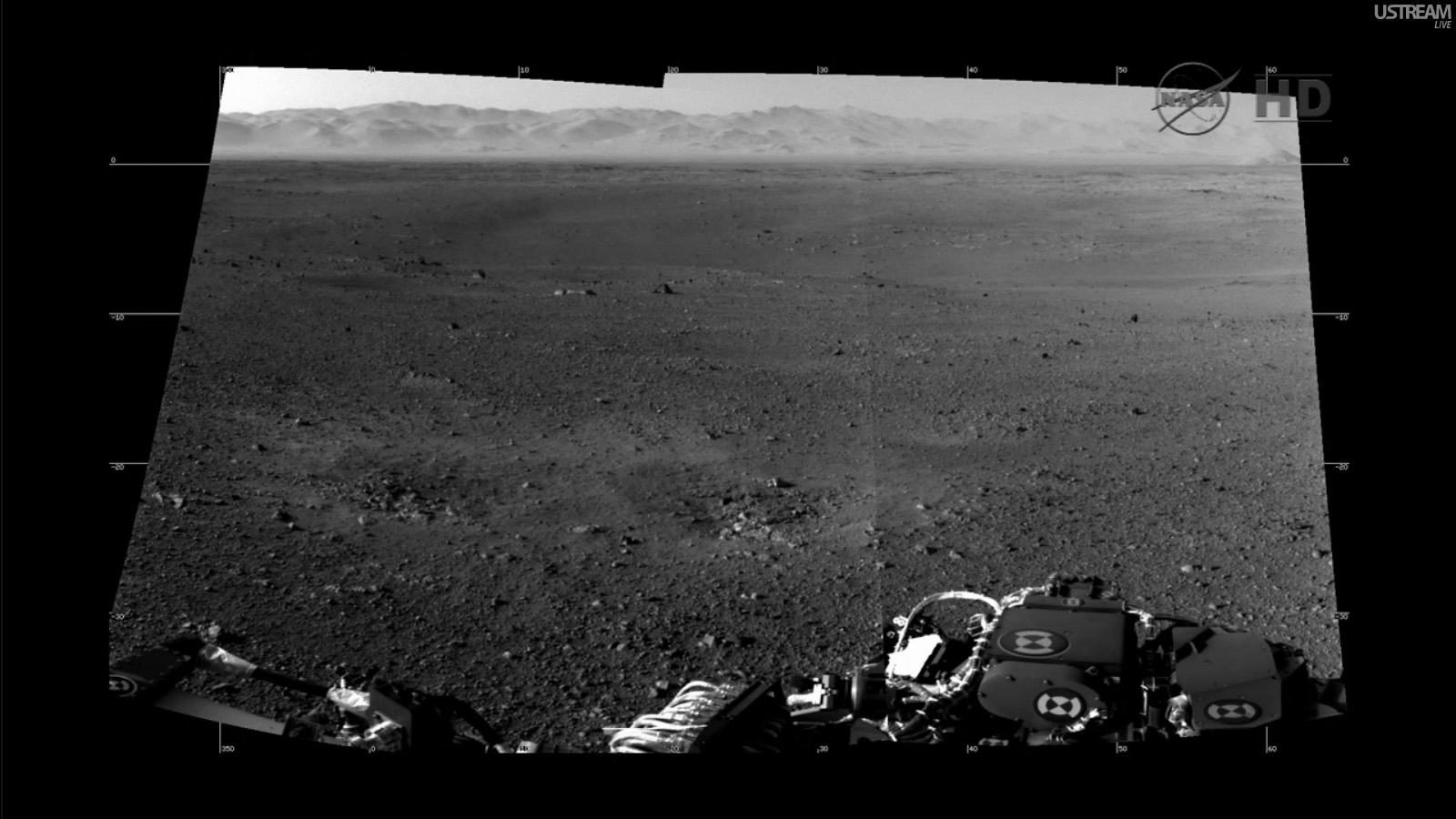
The view from Curiosity’s Navcam — panorama mosaic of Gale Crater. Credit: NASA/JPL-Caltech
NASA’s Mars Science Laboratory is only just beginning its mission and it is already showing us a completely different Martian landscape. However, the rover’s mast has just been raised and returned an eye-level view through the mission’s Navcam to reveal a landscape that looks like the… Mojave Desert. During Wednesday’s NASA press briefing, Curiosity’s Chief Scientist John Grotzinger remarked on the striking familiarity of the “Earth-like” plain with the crater rim in the distance. There is even a little haze in the air that Grotzinger likened to “LA smog.”
While we wait for more incredible views of Mars seen through the eyes of our robotic emissary, it’s easy to get lost in this raw image and imagine how familiar this scene will look when we see it in color.












 astroengine.com