Astroengine Live Show #15: The Carnival Of Space… Live!

promo11

Show 15 of Astroengine Live is going to be a first. A first for me and a first for the Carnival of Space. I’m going to do it live. I was actually contemplating doing it 99% live, just having the entries for the 96th Carnival embedded in some show notes, but no, that wouldn’t be fair, I’d have to do two versions, one online and another on the air. I suppose the best thing about preparing the jumbo 96th Carnival before Astroengine Live is that at least I’ve read all the entries, in depth and thoroughly… erm… yeah, I did that, right? Well, I did, but having glanced through the entries, I’ve forgotten the details of many of them. So I’m going to run into Wednesday’s show and hope for the best, discussing the Carnival and whatever else comes to mind.

One thing is for sure, it’s going to be a rich and varied experience! I think there were 30 entries in the end, with only a few duplicates. That is either a blessing or a curse, but then again, I’ll only find out when I’m in front of the microphone.

So! See you at 4pm (PST), 5pm (MST), 6pm (CST), 7pm (EST)… or midnight GMT!

Get Involved!

Have any articles or stories you want to contribute? Have an opinion on anything in the world of space? Email me on astro@wprtradio.com and I’ll be sure to give it a mention. Eventually, I hope to have telephone call-ins, but for now, email will do.

Listen to Astroengine Live using the Paranormal Radio player. Or, pick up the podcast feed to activate your favourite audio software.

Return of the Bouncing Boulder: Debris After a Martian Landslide

The debris after a landslide on Mars (NASA/HiRISE/Stuart Atkinson)

Mars is far from being geologically active when compared with the Earth, but it isn’t geologically dead either. In a stunning visual study by Stuart Atkinson over at Cumbrian Sky, he has done some desktop detective work on high-resolution HiRISE images of the Martian surface and turned up some astounding images. One scene shows a huge chunk of material, slumped down a slope, but in the detail are the familiar divots etching out the tracks of bouncing boulders after being disturbed by the Martian avalanche…
Continue reading “Return of the Bouncing Boulder: Debris After a Martian Landslide”

NASA May Be Prosecuted for Death of Brian the Bat

Multi-million dollar anti-bat mesh to be built around Ares rocket before launch.

Artist impression of the multi-million dollar anti-bat mesh to be added to the Constellation launch tower to prevent another Brian the Bat tragedy (NASA)

NOTE: The message that follows was part of the Universe Today’s April Fools. I hope you had a giggle. However, the Brian Bat Foundation is real, and the little animal will be forever remembered

Well, I didn’t see this coming. On setting up the Brian Bat Foundation, I was sure NASA was not to blame for Brian’s sad demise. However, a Florida state official has started legal proceedings against the space agency.

According to Florida transport law, if a truck hits an endangered animal on state highways, the company is liable. As NASA is the state’s (actually, the world’s) largest “logistics company”, it too falls under the umbrella of this little known animal protection technicality.

NASA enjoys total freedom of the airspace above the state, however the agency must still abide by the laws of the state, no matter how insignificant the rules may appear when compared with the endeavors of US activities in space.” — Statement by the District Attorney’s Office, Florida

Brian the Discovery Bat holds onto the external tank moments before launch (NASA/Damaris B. Sarria)

In response to the surprise legal action, NASA has already put together a solution that will rid the future Constellation launchpad of any more roosting bats like Brian. There are also plans in place to hinder access to the pad by smaller mammals and reptiles. According to a Cape Canaveral launch safety officer, a lot of time is spent on the gruesome task of removing the carcasses of rats, mice, gophers and rabbits. “If you thought roadkill was bad, imagine it roasted,” the officer added. The proposed Ares anti-bat mesh suddenly seems like a step in the right direction (pictured top).

So, it would appear Brian was only the tip of the iceberg. Perhaps the well publicised death of the little guy wont be in vain after all…

For more details on this breaking news story, check out “NASA Could be ‘Criminally Negligent’ Over Brian the Bat Death,” at the Universe Today.

The Carnival of Space Week 96

Hello and welcome to the 96th Carnival of Space on Astroengine.com!

zz_moon_base

Before we begin, I want to wish the Universe Today a Happy 10th Birthday! Fraser Cain started the website way back on March 23rd, 1999 (have a look to see what it used to look like) and he hasn’t looked back since. I am proud to be writing for the premium space news blog on the web that pulls in two million visitors per month. I love working with Fraser, Nancy, Tammy, Nick, Mark, and now our newest addition to our ace team, Anne. Here’s to the next decade!

So, for this week’s Carnival, as there were so many quality entries, I decided to pose a question for each entry. You can take a look at the questions below, and before you click on the link, try to guess the answer. Otherwise, just scroll down and read through the entire list. (Many of the answers may not be too obvious.) Failing that, you can listen into Astroengine Live on Wednesday April 1st for the first ever “live” Carnival of Space!

Thank you Fraser for allowing me to host this week’s Carnival, it really has grown since the last time I played host way back on the Carnival of Space #51 in April 2008! I hope to do it justice. If your entry isn’t here, be sure to drop me a comment below and I’ll get you online ASAP. Cheers!

Ready? Let’s roll….

The Questions

Continue reading “The Carnival of Space Week 96”

A Subtle Reminder: Earth Hour, Tonight, 8:30pm

©Jason Zuckerman
©Jason Zuckerman

To raise awareness about global climate change, at 8:30pm local time wherever you are in the world (I realise as I post this, half of the world has already passed this time, sorry), switch your lights off for one hour. Communities the world over are doing this to save energy, but primarily to bring awareness to the damage we are causing to the environment by our insatiable desire to use unnecessary lighting and electrical hardware.

For more information about Earth Hour, check out Mang’s Bat Cave »

For more artwork by Jason Zuckerman, check out Jay Zuck’s Sketch of the Day »

I can think of many thrilling things you could be doing during this hour of darkness, if you have any suggestions, feel free to leave them in the comment box below… keep it clean… or not, it’s up to you.

The Striking Similarity Between Ghostbusters and 2012

It’s funny, because it’s true

world-of-psychic

It’s been one of those days, where I had a list of things to do and I didn’t tick off one item. That’s not to say I haven’t done anything. I wrote an article about the cosmos throwing a Molotov cocktail at us, wrote another article about something a lot more scary (creationism) and then watched some TV at lunch. To my delight, a childhood classic was on daytime TV while I was nursing a headache: Ghostbusters II, from 1989. Oh yes! I love this “work from home” thing.

Anyhow, I had all but forgotten about the film, so there were a lot of surprises and a lot of laughs. They sure made good comedies in the late 80’s (at a time when I was of single-digit age). As I’m sure you remember, we pick up five years after the Ghostbusters crossed-the-streams in the first film (back in the “old days” of 1984), destroying the Stay Puft Marshmallow Man in a fireball of gloopy sugary joy, ridding New York of the Sumerian God: Gozer the Gozerian. Now, reality has set in and all the Ghostbuster crew have settled into regular jobs. However, I cracked up when watching Pete Venkman (played by the excellent Bill Murray) present his not-so-prime-time “World of the Psychic” TV show.

This served as a reminder that although we are facing the mother of all doomsday pseudo-science/profit-making/nonsensical prophecies (this time in the guise of the year 2012), we’ve heard it all before. And Ghostbusters 2 had this wonderful sketch I had to share…
Continue reading “The Striking Similarity Between Ghostbusters and 2012”

The Universe Could Soon Be 6,000 Years Old… In Texas

Yesterday, some strange stuff went down in Texas. It may not be a surprising development, especially if you have been following Phil Plait’s articles at Bad Astronomy, but it is still… strange. I don’t usually discuss creationism on Astroengine.com as I’ve always considered much of the wrangling to be an evolution/intelligent design “debate” (debate? Really? Which century are we in again?). To be honest, I’m glad I work and write in a field that can sidestep a lot of creationist bunkum. But hold up there, it’s not that simple. It would appear that some individuals in the Texan educational board have taken it upon themselves to give schools “the option” to teach, in astronomy classes, an ‘alternative’ to Big Bang theory. OK, that’s cool, what alternative scientific theory can be put forward?

That’s the problem, there isn’t a scientific alternative. Big Bang theory is solid, and with the help of WMAP we know the Big Bang occurred 13.73 billion years ago (+/-120 million years). Unfortunately, one member of the Texas Educational Board wants the state’s science classes to teach creationism alongside cosmology, meaning students will have one of the most confusing and damaging cosmology lessons I can possibly imagine.

Guess what kids, the Universe is somewhere between 6,000 to 13,730,000,000 years old. Yes, it’s looking like creationism will be taught alongside cosmology
Continue reading “The Universe Could Soon Be 6,000 Years Old… In Texas”

Star Formation: The Game

starformation

Dave Mosher, I’m pointing my finger at you for this late night effort! Usually I stay up late to write articles, but for the last 30 minutes I’ve been playing this game after Dave sent a message on Twitter saying he had been playing a “simple” and “addictive” star formation game. No kidding! I shouldn’t have even clicked the link. But like a caffeine-infused moth to a super-shiny flame, off I went for some simple star-creation fun.

It looks like the Star Formation game is part of Discover Magazine’s featured article about the mysteries of star birth (it’s a great read, check it out). The game is simple, yet captivating (despite a few minor bugs). You play the role of supernova progenitor, dropping some massive star fury on an unsuspecting nebulous cloud of hydrogen. According to the game developers, the situation is physically accurate, it is just up to you to create the perfect conditions for stars to form in the dense cloud. It would appear the lectures I attended on star formation paid off, as I speak I’m on top of the leaderboard with a whopping 21122 points (see the screengrab above, I saved it posterity, I doubt I’ll be at #1 for much longer).

I’m all for games with an educational element, and I can’t think of a better way to spend an evening (well, I can, but if you’re stuck in the office, this is a great alternative to work). I’m off to create some more stars, check out Discover so you can do the same (just you try to knock me from the #1 slot!).

“Mars” by Jason Zuckerman (AstroArt)

"Mars" by Jason Zuckerman
“Mars” by Jason Zuckerman

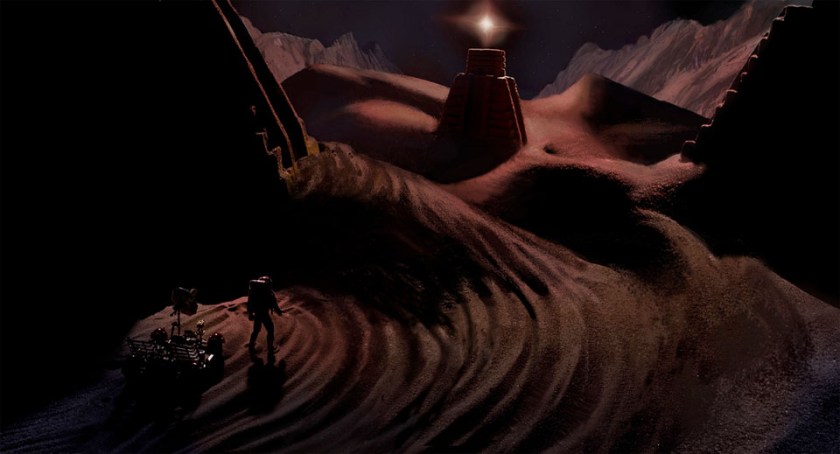
I’ve been writing a science fiction novel about Mars for the best part of a decade. I have always had a fascination with the Red Planet and all the sci-fi possibilities the planet holds for my creative writing. Unfortunately, it’s taken me ten years to put my imagination into words, and it will probably be another ten before it’s completed! No, for now, I’m focusing on factual science writing, hence the forthcoming Astroeconomics book I’m co-authoring with Greg Fish.

This is possibly one of the reasons why I have such a fascination with artists who have a vision and then draw what they see. There’s a faster turn-around than writing, and the results are more vivid. Today, I had the good fortune to have stumbled upon (quite literally) Jason Zuckerman’s “Mars” creation. I have been following Jay’s website (Jay Zuck’s Sketch of the Day) for a while now with the help of his brother and my online buddy, Adam (a.k.a. madhollywood on SU).

Jay is a very talented and productive artist who constantly surprises me, and “Mars” was certainly a surprise! He posted this piece last year, but I thought I’d share even though I missed it first time around. The image portrays a future Mars astronaut standing in awe of a Martian structure, totally captivating. Although this is science fiction, it certainly drives my imagination, as I’ve said before, there’s nothing wrong with that

For more, check out Jay Zuck’s Sketch of the Day »

Listening Out for the Magnetospheres of Habitable Exoplanets

Searching for Earth-like exoplanets (© Mark Garlick)
Searching for Earth-like exoplanets (© Mark Garlick*)

Is there a new way to hunt for habitable Earth-like exoplanets? According to a US Naval Research Laboratory researcher there is an obvious, yet ingenious, way of listening for these worlds. Like most Earth-like exoplanet searches, we are looking for characteristics of our own planet. So what do we need to survive on Earth? Obviously we need water and the correct mix of oxygen with other atmospheric gases, but what about the magnetic bubble we live in? The Earth’s magnetosphere protects us from the worst the Sun can throw at us, preventing the atmosphere from being eroded into space and deflecting life-hindering radiation.

Although we have yet to develop sensitive enough radio telescopes, it may be possible in the future to detect the radio waves generated as charged particles in stellar winds interact with Earth-like exoplanetary magnetospheres. If there’s a magnetosphere, there may be a protected atmosphere. If there’s an atmosphere, perhaps there’s life being nurtured below

*This image is copyright Mark A. Garlick and has been used with permission. Please do not use this image in any way whatsoever without first contacting the artist.
Continue reading “Listening Out for the Magnetospheres of Habitable Exoplanets”