The Mars walker taking a stroll across the Red Planets surface (AboveTopSecret.com)
So the new X-Files movie has been released (awesome), there’s been a surge in alien stories (on YouTube, the most reputable scientific resource), NASA astronauts are citing that UFOs are actually extraterrestrials visiting Earth (of course), and now we have beings with big heads having a stroll on the Martian surface. It must be the season for it… Continue reading “Rolling Rock or Walking Martian?”
Chandra observation of Cassiopeia A, a young supernova remnant in our galaxy - a prominant source of high-energy particles (NASA/CXC/MIT/UMass Amherst/M. D. Stage et al.)
There is something strange happening in the core of the Milky Way. A space observatory measuring the energy and distribution of gamma-rays in the cosmos has made an unexpected (and perplexing) discovery. It would seem there is a very high proportion of gamma-ray photons emanating from our galactic core with a very distinctive signature; they have a precise energy of 511 keV (8×10-14 Joules), and there’s a lot of them. So what could possibly be producing these 511 keV gamma-rays? It turns out, 511 keV is a magic number; it is the exact rest mass energy of a positron (the antimatter particle of the electron). So this is fairly conclusive evidence that positrons are dying (i.e. annihilating) in vast numbers in our galactic nuclei. Still, this is of little help to astrophysicists as there is no known mechanism for producing such high numbers of annihilating positrons. Ideas have been put forward, but there’s a new possibility, involving some new particle physics and some lateral thinking… Continue reading “New Exotic Particle May Explain Milky Way Gamma-Ray Phenomenon”
The THEMIS satellites lined up inside the Earth's magnetotail. A reconnection event occurred between the 4th and 5th satellites (NASA)
Although magnetic reconnection is one of the bedrock theories within the field of space plasma physics, it has been very difficult to observe. We know that magnetic instabilities and electric currents operate within the plasma environment, but the triggering mechanism is difficult to understand. Reconnection occurs near the surface of the Sun and it occurs where the solar wind interacts with the sunward geomagnetic field. It also happens in the magnetotail (i.e. in the shadow of the Earth, where the magnetosphere is swept behind our planet by the pressure of the solar wind) and is most commonly linked with a terrestrial phenomenon: the aurora. Now, for the first time, scientists have located the point at which the magnetic field lines snap, blasting a huge amount of energy right at the Earth… Continue reading “Auroral Substorm: THEMIS Pinpoints Location of Magnetic Reconnection in Magnetotail”
When a Carnival starts off with a quote from a classic book, you know you’re in for a treat:
Space is big. You just won’t believe how vastly, hugely, mind- bogglingly big it is. I mean, you may think it’s a long way down the road to the chemist’s, but that’s just peanuts to space.
– Douglas Adams, The Hitchhiker’s Guide to the Galaxy.
This is where we begin with the FlyingSinger (a.k.a. Bruce Irving) who takes us on a journey throughout the space blogosphere stopping at the Sun, Venus, Mars and the occasional black hole. Check out the great website “Music of the Spheres” to read the full contingent of this week’s Carnival. From Astroengine.com, I decided to enter our Sun and why it is so special…
The Lucifer Project: Using the Cassini probe to detonate like a nuclear weapon inside the atmosphere of Saturn… oh dear, here we go again… (NASA/US Dept. of Defence)
Here comes another doomsday scenario, this time from the friendly gas giant Saturn. The story goes like this: NASA is working with secret organizations (such as the Illuminati or the Freemasons) to fulfil their dreams of “playing God” and creating a second Sun in the Solar System. This plan has many aims, but primarily they want to use the Cassini probe to trigger a catastrophic chain reaction inside Saturn so nuclear fusion is possible, generating a mini-Sun. This has been tried before, when the Galileo probe was dropped into the atmosphere of Jupiter in 2003 (but it obviously failed at first attempt). Cassini is carrying about 33 kg of plutonium, making it the ultimate cruise missile aimed at Saturn, atmospheric pressures eventually kick-starting a nuclear explosion in two years time.
Whilst this makes for interesting reading, yet again, the science is deeply flawed. We can expect this doomsday scenario (and yes, it is predicting the end of the world) to gain some strength before the Cassini mission is terminated in 2010…. only this time the Devil (Lucifer) is involved…
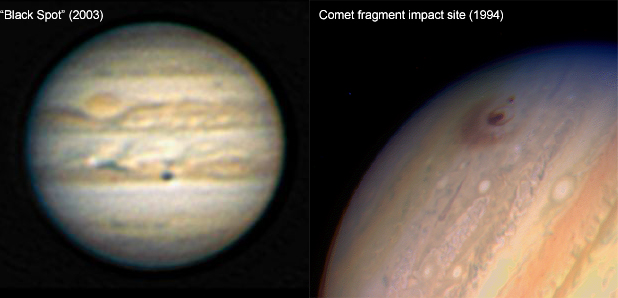
In the first part of this mini-series on the Universe Today, I look into the science behind a doomsday scenario known as The Lucifer Project (or simply Project Lucifer). I have heard of variations on this theme for many years, and at first it sounds possible, but then simple logic dictates that turning Jupiter or Saturn into a Sun is rather more sci-fi than sci-fact. In fact, the transformation of Jupiter into a second Sun is not a new idea. In the novel and movie 2010: Odyssey Two (notice the correlation with the date?) created by the late, great Arthur C. Clarke, Jupiter is the focus of the mysterious storyline. Black monoliths breed inside the gas giant’s atmosphere, at first creating a big black spot (again, notice the similarity with the 2003 black spot observation?), increasing its density and mass to a point where nuclear fusion can be sustained. The movie finishes with various views of the new binary solar system. A great movie.
A scene from the movie 2010 where a black spot appears on Jupiter
So, it would seem, Project Lucifer is loosely based on Arthur C. Clarke’s novel (minus Galileo creating a nuclear chain reaction). Obviously, the 2003 Galileo collision with Jupiter had no lasting effect on the planet, conspiracy theorists are now looking at the 2010 Cassini collision with Saturn for their story. Therefore, last night I wrote Project Lucifer: Will Cassini Turn Saturn into a Second Sun? (Part 1) to address some of the technical reasons why a Cassini re-entry into Saturn’s atmosphere (or Galileo’s re-entry into Jupiter in 2003 for that matter) cannot miraculously pull all the tiny pieces of plutonium (non-weapon grade by the way) together to form a crude nuclear weapon. In the next part, I’ll look into the physics behind a star and look at why gas giants such as Jupiter and Saturn are called “failed stars”…
A mosaic of the position of the Sun above the Martian landscape over 11 sols (NASA/JPL)
Phoenix is still working hard on the surface of Mars, scraping and digging into the frozen regolith, preparing samples for the next TEGA bake. This next sample to be dropped into one of the eight on board ovens will intensify the excitement for the confirmation of water ice (in abundance) on the Martian surface. The Phoenix Mars lander has been working on the Red Planet for 57 Sols (a.k.a. Martian days) since it landed on May 25th, the robot has pretty much operated as planned, exceeding all expectations (to be honest, I was relieved it touched down in one piece, anything else was a bonus!). But today, the lander releases a stunning image from its Surface Stereo Imager that really brings the whole mission into perspective: Martian midnight Sun… Continue reading “Midnight Sun on Mars by Phoenix”
Russian firm RKK Energia's new manned space vehicle (RKK Energia)
NASA’s Constellation Program may be faltering, but the next Russia/ESA manned space vehicle set to replace the reliable Soyuz vehicle has been unveiled in the UK. It is designed to transport astronauts to the International Space Station and it has a unique soft-landing thruster mechanism that will make re-entry a little less dramatic. The new design has been designed by Russian manufacturer RKK Energia and a first look at the 4-6 man capsule was showcased at the annual Farnborough Air Show in the UK last week. ESA has been discussing the collaboration with the Russian space agency Roscosmos on the Crew Space Transportation System (CSTS) since 2006 and now it seems that this vehicle may rival the Orion/Ares system being developed by NASA. What’s more, the CSTS is designed to transport a crew of four to the Moon… Continue reading “New Russian-European Manned Space Vehicle Announced”
As we near the Large Hadron Collider’s (LHC) maiden relativistic collision later this year, speculation and excitement continues to mount. There are a host of possibilities as to what we may observe from the most powerful, focused collisions ever carried out in a laboratory environment. Fundamentally, the search for the Higgs boson will be taken to a new level, but there may be a few surprises for the particle physicists analysing the detector data. What if the LHC uncovers an alternative to the Higgs boson? What if the “standard model” of quantum theory isn’t to a universal standard? Putting the Higgs boson to one side, forgetting the exciting possibility of a micro-black hole (and confirmation of Hawking Radiation) and leaving the production of wormholes and stranglets in the “unlikely” drawer, what possibility intrigues me the most? The discovery of microscopic, curled-up dimensions the LHC may unravel as it focuses its energy on scales previously unthinkable… Continue reading “Will the LHC Peel Open Some New Dimensions?”
The EAS as photographed by the ISS crew in 2007 (NASA)
On July 23rd, 2007, the crew of the International Space Station did some orbital fly-tipping. They dumped a double refrigerator-sized piece of equipment overboard and sent it toward Earth. Mission control at the time assured the public that it would orbit for about 300 days and most of it would burn up. The first issue is that, a year on, it is still orbiting and it is expected to do so until the end of 2008 at the earliest. Second issue is that a large portion of the kit will survive re-entry. Uncontrolled re-entry like this is by nature hard to predict where it will impact. Although the ISS had little option but to dump the used Early Ammonia Servicer (EAS), was there a better, safer alternative? Continue reading “Huge Refrigerator-Sized Space Station Debris Observed From Earth – Where will it Land?”
Could the ISS be modified to travel to Mars? Credit: NASA/Ian O'Neill
Now this is a cool idea: Strap rockets and a steering system to the International Space Station and send it to the Moon. Is this an insane plan? Up till yesterday I would have said yes, in fact before yesterday I hadn’t thought of the idea. Then I read the Washington Post online and find a science writer has been giving this a lot of thought. What’s more it kinda makes sense! So why isn’t this an option in NASA’s mind? And what’s the point anyway? Continue reading “The International Space Station as the International Space Ship? Why Not?”




 astroengine.com