

For the big week six-oh, we take a novel approach at doing the Carnival, and I must admit, I found it quite entertaining. Over at Slacker Astronomy, the 60th Carnival of Space, our host Michael takes the week’s news from the blogosphere and literally hard-wires it straight onto the web. Every week we send Fraser our little messages with a link to our little works of web space text, and each week those messages get lost in the host’s inbox. Not any more! For the world to see, Michael has lovingly displayed our messages, plus links. Good on you Michael, I was wondering how this week’s Carnival could stand out from the crowd. Some great entries too! Plus my entry is right near the top! Happy days 🙂
Are Primordial Black Holes Antimatter Factories?

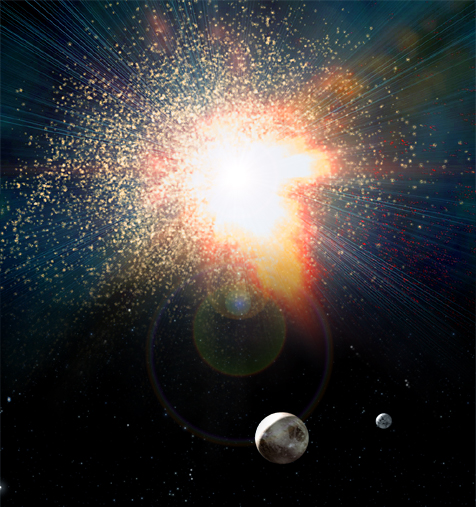
Could small, primordial black holes be efficient antimatter generators? It is well known that cool planetary bodies, surrounded by equal numbers of protons and electrons in thermal equilibrium, will eventually become positively charged. Why? Because electrons, with their low mass, have a higher velocity than the larger protons. Although they undergo the same gravitational acceleration, electrons are able to attain “escape velocity” more readily as the more massive protons get stuck in the gravitational well. The result? The planet has a net positive charge as more electrons, than proton escape into space.
Primordial black holes are thought to exist in our Universe (left-overs from the Big Bang), and although they may be small, they may influence ionized cosmic clouds in the same way, more electrons escape than protons left behind. However, should a threshold be reached, the extreme gravitational force surrounding the black hole could set up a powerful electrostatic field, kick-starting a strange quantum phenomenon that generates the electron’s anti-matter partner (the positron) from the vacuum of space…
Continue reading “Are Primordial Black Holes Antimatter Factories?”
Why is the LHC so Important? I’ll let Brian Cox Explain…
I’ve only just stumbled on this fantastic presentation Brian Cox did in Monterey, California in March this year explaining the stunning science behind CERN’s newest addition. I have followed the progress of the Large Hadron Collider (LHC) intently and I personally cannot wait until the accelerator is turned on. There has been much debate about the safety of the LHC and there have been some seriously nutty theories about the bad things that the LHC could (never) do. So, rather than waste any more time on the (impossible) negatives, let’s take a look into how the LHC is going to alter mankind’s view on the Universe forever with the help of Brian Cox at his best…
Continue reading “Why is the LHC so Important? I’ll let Brian Cox Explain…”
AstroPhoto #2: Low Elevation

In 2002, I spent five months on the Arctic island of Spitsbergen, in the Svalbard archipelago, studying the aurora and upper polar atmosphere. It was one of those life-changing experiences I will never forget. One day, during 24 hour daylight in Arctic spring, I found some time to have a walk across a plateau near the town of Longyearbyen, to collect my thoughts. Till that point, I didn’t realise just how flat and desolate Plateau Berget was. Fortunately, the weather was clear and the Sun was shining, so I explored across several kilometres of ice and snow, seeing mountains in the far distance (reminded me of the Star Wars: Empire Strikes Back Hoth battle scene). Eventually I stumbled across the SvalSat installation where I took several pictures of the satellite dishes. This is one small dish, at low elevation, watching for one of the few polar orbiting communications satellites. Such wonderful memories…
Continue reading “AstroPhoto #2: Low Elevation”
No Doomsday in 2012: The Reason Why Science Will Not Win
I’ve been busy compiling two new articles about the 2012 doomsday scenario. This time I’ve investigated why Planet X is not the same thing as the Sumerian planet “Nibiru”, and why a “killer solar flare” will not be possible in the year 2012. This brings the 2012 series up to its fourth edition, and the feedback has been very interesting. Probably the most important thing I want to emphasise about this whole 2012 prophecy stuff is that I am not trying to stamp on anyone’s beliefs. There are many reasons why 2012 may hold significant spiritual or religious meaning, and I am not disputing this in any way. I want to present the science facts, not the science “facts” that seem to overwhelm many of the end of the world scenarios. Alas, I suspect that I’m fighting a losing battle. I got it wrong, debunking the doomsayers who are doing this for financial gain are not concerned whether their evidence adds up, they are using one tool that I cannot influence. Fear.
Continue reading “No Doomsday in 2012: The Reason Why Science Will Not Win”
Paranormal Radio’s “2012 Just Another Day” Show Now Available (Update)
On June 10th, I was invited on Captain Jack’s Paranormal Radio show to chat about the various 2012 Doomsday scenarios. We had a great time for three hours talking about everything from the Mayan calendar and Planet X to the Phoenix Mars Mission and Saturn. The show has just been made available as an MP3 that should be easy to listen to on your podcast-grabbing equipment, or your favorite media player on your computer.
Download the Paranormal Radio “2012 Just Another Day” show with Captain Jack and myself:
- Paranormal Radio Part 1 (.mpg, 28MB)
- Paranormal Radio Part 2 (.mpg, 22MB)
- Paranormal Radio Part 3 (.mpg, 22MB)
Enjoy! And in case you missed it, the first radio show I did with Colin Knight on Terra Chat (dated June 8th) is still online.
I’ve been invited back to both Paranormal Radio and Terra Chat for future shows, so I’ll post any news as I get it.
Yes, Phoenix has Found Water on Mars

Finally, proof that water has been found on Mars. The Phoenix Mars lander took a scoop of regolith on Sol 20 (June 19th), exposing a white powdery substance. Immediately, scientists announced that the substance was either some form of ice or salt deposits. The prime mission objective for Phoenix is to look for evidence for water, past and present, in the uppermost layers of the surface. Although tests on excavated material are ongoing inside the onboard oven instrument (the Thermal and Evolved Gas Analyzer, or TEGA), baking the sample and analysing the vapour produced, Phoenix scientists have discovered water ice simply by taking two photographs four days apart…
I found the “Got Water?” image very apt and the T-shirt design can be found over at Tastes Funny…
Continue reading “Yes, Phoenix has Found Water on Mars”
Carnival of Space Week 59 @Green Gabbro

We’re on week 59 of the Carnival and we have a great edition this week over with Maria Brumm at Green Gabbro. From black holes that go “bweep!” to the end of the Universe, we have everything! I’ve entered my solar article about the detection of axions, a possible component of dark matter.
Go to Green Gabbro end enjoy the rich mix of cosmic goodness…
NASA and Disney-Pixar Promote Space Exploration with WALL-E

As a science public outreach advocate, I am totally behind a new deal between NASA and animation experts Disney-Pixar. Using the new movie WALL-E, a story about the last robot-rover on Earth exploring space (with all the fuzzy, heart-warming Disney stuff in between), NASA has signed a deal with the film making heavyweight to promote NASA’s science and technology to school children. Too many times have I seen kids cartoons characters used to sell junk food, this move is very refreshing. Promoting science education though a cute robot is great in my books and may dispel any doubts in the younger generation that space exploration is dull.
Great move NASA, looks like a superb film Pixar! WALL-E will be released in the US on June 27th and in the UK on July 18th…
Continue reading “NASA and Disney-Pixar Promote Space Exploration with WALL-E”
AstroPhoto #1: Goonhilly Down

I’ve always wanted to merge my love of space exploration and my passion for photography. Looking through my collection of pictures I’ve taken through the years, I appear to have quite a few space-related photos, so thought I’d share them between the physics publications and space news articles.
To kick-off this new section of Astroengine, I’ll begin with “Goonhilly Down”. It’s a shot of one of the satellite dishes at the Goonhilly Earth Station in Cornwall, UK. The photo was taken in 2007, and I generated my own starfield to blend into the shot as its “sky”. I also overlaid an archived image of the comet Hale-Bopp from a NASA photograph. This is in tribute to the amazing achievements of the world’s largest satellite Earth station that is now downscaling operations and moving to another location in the UK…
Continue reading “AstroPhoto #1: Goonhilly Down”
 astroengine.com