Mars Crater’s Cracked Frosting

Subliming ice from the crater's edge (NASA/JPL/University of Arizona)
Subliming ice from the crater edge (NASA/JPL/University of Arizona)

This image looks like the frosted top of an over-baked muffin, but it’s actually the side of a crater on Mars covered with ice. Taken by NASA’s Mars Reconnaissance Orbiter (MRO) High Resolution Imaging Science Experiment (HiRISE) over the Martian south pole, this example demonstrates an active process of weathering acting on the red landscape. According to the HiRISE site, the ice layer is approximately 3 km thick.

In regions situated closer to the equator, craters aren’t open to erosion by ice (not surface ice in any case), but in polar regions it’s a different story. Due to the Martian thin and cold atmosphere, water ice rarely melts into a liquid; it bypasses the liquid phase and turns straight into a gas. This process is known as sublimation. There are terrestrial examples of sublimation too, including frozen carbon dioxide (or “dry ice”) which sublimes at room temperature, generating a carbon dioxide vapour.

For this particular crater, it is obvious where there is a higher rate of sublimation than others. As the Sun illuminates the crater edge from the bottom right, the rim of the crater receives the most sunlight, heating up the darker regolith and causing more ice loss. The large cracked-like structure within the crater is most likely a combination of darker material under the ice receiving preferential heating and shrinkage of the subliming ice pack.

This seasonal freezing of water vapour and sublimation of water ice erodes the sides of these polar craters, wearing them down season after season.

I never tire of seeing HiRISE images of the Red Planet, especially when they include active atmospheric processes that continue to shape the landscape of this alien world.

Source: HiRISE

Spirit And The Amazing Technicolour Dust Devils

spirit_dust_devils

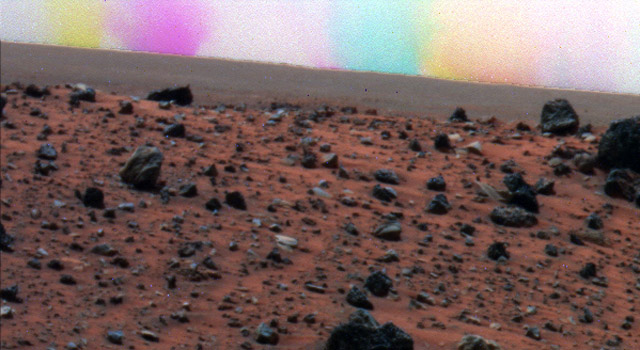
What are they? I’ve seen some odd photos from the Martian surface, but when I first saw this image, the pinks, blues and yellow smudges looked… alien. The surprise probably comes from the fact that we are so used to the rusty red pictures to come from the various rovers, landers and satellites, that any colour not a variation of red comes as a shock.

Although it looks odd, there is in fact a sensible answer to these ghostly splodges on the horizon. This photo was snapped by Mars Expedition Rover (MER) Spirit back on sol 1919 of the MER mission on May 27th, 2009.

Using its panoramic camera (Pancam), Spirit performed a number of exposures, each one using a different colour filter. With some luck during the photography session of the Martian landscape, a dust devil (a mini whirlwind) meandered through the Pancam’s field of view. In each frame taken with different filters, the only feature moving would have been the swirling dust, so that’s why it appears as a different hue than the surrounding landscape.

Dust devils occur on both Mars and on Earth when solar energy heats the surface, resulting in a layer of warm air just above the surface. Since the warmed air is less dense than the cooler atmosphere above it, it rises, making a swirling thermal plume that picks up the fine dust from the surface and carries it up into the atmosphere. This plume of dust moves with the local wind.NASA/JPL

Dust devils have provided some unexpected fun for the rovers, often tuning up unannounced. These make for interesting observations of local weather conditions, but they also provide an essential mini-undusting service for the wheeled robot’s solar panels.

And now they’ve been pictured in technicolour. How nice.

Source: NASA/JPL

I See Mars Faces… Everywhere

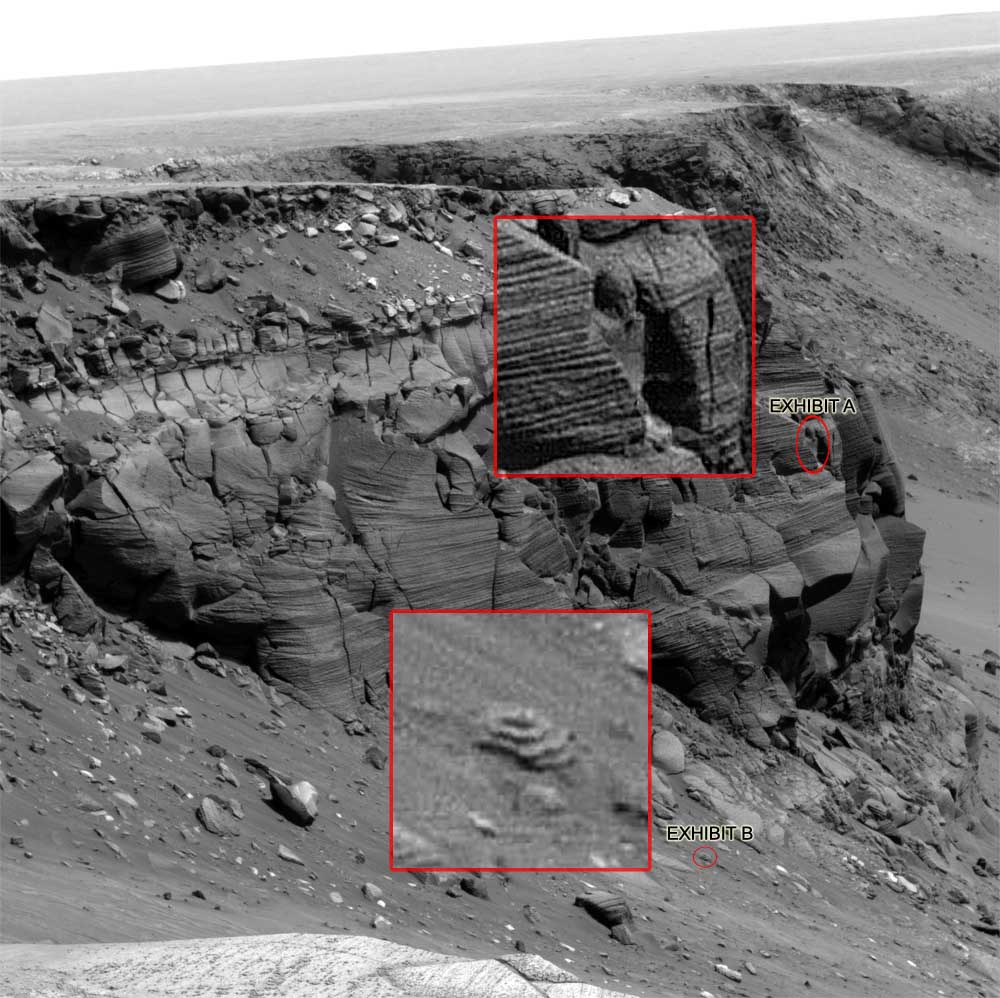
The two suspect shapes spotted by Mars conspiracy theorists. Exhibit 1: The Egyptian statue. Exhibit 2: ??

During my search for material for last week’s Wide Angle: Mars Roving on Discovery, I was looking for images snapped by the Mars Exploration Rovers (MER) Spirit and Opportunity. During my trawl around Google Images, I managed to find a high-resolution picture of the rocky outcrop on the side of Victoria Crater when Opportunity was imaging the area in 2006.

I’ve always loved these Victoria images; you can easily see layering in the exposed rock and boulders strewn below. In fact, this could be a black and white picture of the Utah desert, or a wide angle view of the Grand Canyon. But no, this is Mars; lifeless Mars.

Or is it?

One version of the Opportunity image can be found on a conspiracy website, where a ‘study’ has been carried out. And guess what they found?

Oh yes, apparently a Martian civilization worshiped the pharaohs of ancient Egypt, carving a statue more commonly associated with pyramids into the crater wall (“Exhibit A” in the image above). Also, there’s a curiously shaped multi-layer disk on the ground — obviously some kind of alien artifact (“Exhibit B”).

Please.

Normally I’d ignore something like this, but I thought I’d have a little fun one evening (because my evenings simply aren’t exciting enough, it seems). Inspired by Phil Plait’s visions of Miss Piggy in a Mars mesa last week, I wanted to test myself and go on a pareidolia hunt of my own, armed with the Victoria crater pic, my imagination and questionable eyesight.

The human brain is a strange old thing at times, creating recognizable features out of random, inanimate objects, and that is exactly what some people use as “proof” of their nutty theory or visions of the second coming. People see Jesus in burnt toast, Michael Jackson in cloud formations and, in this case, ancient Egyptian statues carved into crater rims on Mars.

So have a look at this, I impressed myself (note the outstanding use of Photoshop):

Mars faces:

What I discovered in this single NASA Mars image:

A: Exhibit A – the Egyptian statue.
B: Exhibit B – some other artifact.
C: Admiral "It’s a trap!" Ackbar from Star Wars: The Empire Strikes Back.
D: Audry II, the blood-drinking plant from Little Shop of Horrors.
E: Jabba the Hutt, or an angry toad.
F: A gorilla’s head (kinda).
G: Can’t remember what I saw in this… but it’s kinda alien looking… right?
H: Insane-looking face. Could be the Mad Hatter?
I: Weird-looking Picasso face.
J: The alien from Predator.
K: Human head.
L: Another Egyptian statue, head part.
M: Humanoid skull!

I’ve even got a full-resolution version in case you can’t see the fruits of my imagination (all 4MB of it). But who cares if you can’t see Jabba, Ackbar, skulls or statues? That’s not the point; most conspiracy sites skew the facts to convince the reader to believe their false claims anyway. Hmmm… I’m quite good at this, perhaps I should start my own ‘Mars Faces’ conspiracy, only including characters from Star Warshmmm.

I’m personally most impressed with the “humanoid skull” (M), “Admiral Ackbar” (C) and the “insane face” (H). Obviously the ancient Martian civilization were a part of the Empire (not so far, far away), carried out sacrifices on humanoids (bones now littering the plains), worshipped Egyptian kings and had killer rock sculpting skills. Obviously.

Want more Mars faces? We have some puzzles on the subject over at Discovery Space! What are the odds…

Slow News Day: Alien Skull On Mars

PD*28522608

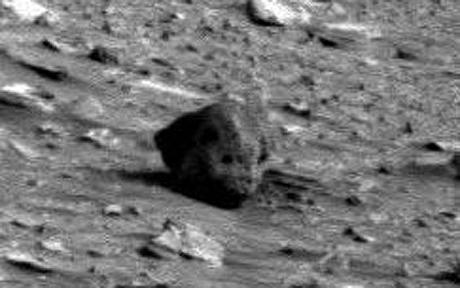
This just came in from the Telegraph, apparently Mars Exploration Rover Spirit has spotted a random skull on the Martian surface. This is obviously the only interpretation… as we know what an alien looks like, don’t we? Big head, big eyes, pasty grey skin. Something like this? Or, more likely, like this? Or this? Wow, it could be any one of them.

However, it’s not quite that exciting.

It’s a rock, as you may have already guessed. And no, the Telegraph isn’t taking it seriously either. (Although The Sun’s microreport could be taken either way.)

Although the newspaper’s article resembles a badly conditioned April Fools gag, there is one glaring error, well two actually. No, three.

Firstly, Spirit is not a camera – it’s a whole robot with a camera attached (called the Panoramic Camera, or Pancam for short). If it was just a camera, could you imagine the movie location costs?

Second, I’m not sure why this was filed in “Science News”. It obviously needs to be filed under “It’s a Slow News Day, We’ll Report Anything”.

And thirdly, I seriously doubt this image got “space-gazers talking”. When I last looked at one of Opportunity’s panoramic shots, I could see all kinds of strange things in the Mars dirt. If I was a conspiracy theorist, I’d love poking around the shapes and shadows, thinking I could see skulls, flying hubcaps and mysterious plant-like features. But I’m not a conspiracy theorist, I’m a “space-gazer”, but I’m not “talking”.

As it’s late, I’ve given up trying to find the source of the article (no links – come on Telegraph, if you’re gonna play blogging for the day, at least reference your lead!). Apparently some “UFO hunters” were being serious, but then joking, about this rock that looks like a skull. So, what the Telegraph is really trying to tell us is:

A stone. On Mars. Might look like a skull. Doesn’t really. Even ufologists don’t take it seriously. So it’s not really news. Move along.

I’m not suggesting the Telegraph isn’t a good newspaper, on the contrary, but really, what’s the point?

Why did I even bother to report on this? Oh yeah: It’s a stone that looks like a bunny skull. Now try explaining how a rabbit got up there…

In 1911, Martians Were Building Canals

Martians Build Two Immense Canals In Two Years

On August 27th, 1911 the New York Times Sunday magazine ran an article entitled “Martians Build Two Immense Canals In Two Years”. Astronomer Percival Lowell had been studying the Red Planet and sketched what he saw, in this case, a growing complex of apparent canals on the Martian surface. There was even a nice little story that went along with this canal-building alien civilization theory. Lowell said, “The whole thing is wonderfully clear-cut,” that the Martian civilization was dying and they were building canals to reach the water ice in the Martian poles.

It turns out he was right about the water ice, but there’s no trace of this canal-building race on Mars… in fact there’s little trace of anything biological on the Red Planet. So apart from a few historic anecdotes, there’s still no life on Mars. The search continues.

Canals a thousand miles long and twenty miles wide are simply beyond our comprehension. Even though we are aware of the fact that … a rock which here weighs one hundred pounds would there only weigh thirty-eight pounds, engineering operations being in consequence less arduous than here, yet we can scarcely imagine the inhabitants of Mars capable of accomplishing this Herculean task within the short interval of two years. — Excerpt from the 1911 New York Times article.

Source: The Futility Closet (an awesome site)

Return of the Bouncing Boulder: Debris After a Martian Landslide

The debris after a landslide on Mars (NASA/HiRISE/Stuart Atkinson)

Mars is far from being geologically active when compared with the Earth, but it isn’t geologically dead either. In a stunning visual study by Stuart Atkinson over at Cumbrian Sky, he has done some desktop detective work on high-resolution HiRISE images of the Martian surface and turned up some astounding images. One scene shows a huge chunk of material, slumped down a slope, but in the detail are the familiar divots etching out the tracks of bouncing boulders after being disturbed by the Martian avalanche…
Continue reading “Return of the Bouncing Boulder: Debris After a Martian Landslide”

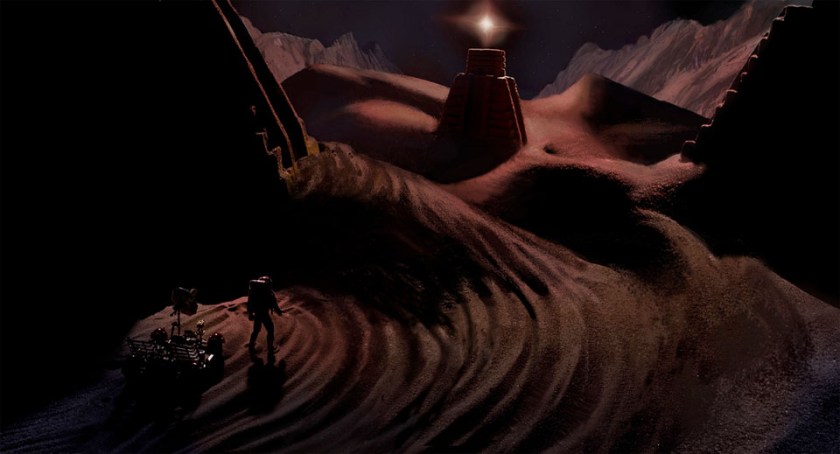
“Mars” by Jason Zuckerman (AstroArt)

"Mars" by Jason Zuckerman
“Mars” by Jason Zuckerman

I’ve been writing a science fiction novel about Mars for the best part of a decade. I have always had a fascination with the Red Planet and all the sci-fi possibilities the planet holds for my creative writing. Unfortunately, it’s taken me ten years to put my imagination into words, and it will probably be another ten before it’s completed! No, for now, I’m focusing on factual science writing, hence the forthcoming Astroeconomics book I’m co-authoring with Greg Fish.

This is possibly one of the reasons why I have such a fascination with artists who have a vision and then draw what they see. There’s a faster turn-around than writing, and the results are more vivid. Today, I had the good fortune to have stumbled upon (quite literally) Jason Zuckerman’s “Mars” creation. I have been following Jay’s website (Jay Zuck’s Sketch of the Day) for a while now with the help of his brother and my online buddy, Adam (a.k.a. madhollywood on SU).

Jay is a very talented and productive artist who constantly surprises me, and “Mars” was certainly a surprise! He posted this piece last year, but I thought I’d share even though I missed it first time around. The image portrays a future Mars astronaut standing in awe of a Martian structure, totally captivating. Although this is science fiction, it certainly drives my imagination, as I’ve said before, there’s nothing wrong with that

For more, check out Jay Zuck’s Sketch of the Day »

Welcome to my Sinkhole, Premium Martian Real Estate

A sinkhole in Tractus Fossae, created by tectonic activity (HiRISE/NASA)

It might not look like much from space, but this depression in the Martian landscape might be considered to be a priceless feature when viewed by future Mars colonists.

In December 2008, the Mars Reconnaissance Orbiter (MRO) flew silently over the Tharsis bulge, the location of a series of ancient volcanoes. The High Resolution Imaging Science Experiment (HiRISE) captured what appears to be a deep hole. This kind of feature has been seen before, like a Martian pore, deep and foreboding. Usually these sinkholes aren’t as deep as they look, but they are deeper than the surrounding landscape. They are also similar to their terrestrial counterparts in that they have very steep sides (unlike the gentle, eroded slopes of crater rims) and they are caused by a lack of material below. On Earth, sinkholes often form due to water flowing beneath, removing material, causing the overlying rock/soil to slump, forming a sudden hole. In the example above, the sinkhole (or “collapse pit”) was caused by tectonic activity. In this case, it is likely that the material dropped into a void left over by magma-filled dykes (lava tubes from old volcanoes).

A stretched and image processed version of the sinkhole; the bottom of the hole is visible (HiRISE/NASA)

The result is a hole with very steep sides. It has been suggested that these sink holes may be useful to future Mars colonists, as they can use the natural feature for shelter. On Mars, humans would be subject to an increased dosage of radiation (due to the tenuous Martian atmosphere and lack of a global magnetic field), so it is preferable to find any form of natural shelter to build your habitat. The depth of this kind of sinkhole will afford some protection, and drilling into the cavern side would be even better. Perhaps even put a dome over the top? No need to build walls around your building then. Also, there’s the interesting–if a little frightening–prospect of accessing underground lava tubes. Therefore, colonists won’t need to dig very far to create a subterranean habitat with all the radiation protection they’ll ever need (the insulation would also be impressive).

Although this scenario might be a little far-fetched, and probably only suitable for an established human presence on Mars (after all, the numerous valleys would probably suffice for most permanent habitats drilled into cliff faces), it does go to show that the current missions in orbit around Mars are doing a great job at seeking out some possible housing solutions for our future Mars settlers…

Source: HiRISE, Marspedia

Reality, Virtual

Computer technology is reaching new levels of sophistication, limited only by our imagination (and that pesky Moore’s Law). As we develop faster and more powerful processors, an exponential increase in the number of calculations can be done per second, providing advanced software with the capability to deliver complex applications to the user. In fact, some computer operations are becoming hard to distinguish from basic human interactions (neural networks hold particular promise).

Naturally, this continuing advance in technology has stimulated the Internet, allowing users worldwide to interact at great speed, where virtual worlds have been created, and people can project themselves as an avatar (a virtual ambassador for their real-world personalities). These virtual worlds have become so immense that millions of users can interact, and the boundary of the universe is only limited by how many networked computers you have running the show. These virtual universes are known as Massively Multiplayer Online Role Playing Game (MMORPG), and NASA hopes to release their universe (Astronaut: Moon, Mars and Beyond) some time next year.

User interfaces are advancing too. Gone are the days of simple gaming feedback features (such as a rumbling joypad when your 3D animated cartoon character suffers a blow on your 2D TV screen), virtual reality is starting to live up to its name, where the virtual world is overlapping with our real world. Now a 5-sense virtual reality system is undergoing tests, and its implications for NASA’s MMORPG and future space exploration could be huge…

When does virtual reality become… reality?

Imagine: You’ve just completed your expedition inside the Hellas impact basin on the surface of Mars. You can smell the new plastic inside your spacesuit and hear the hiss of your air supply in the back of your bulbous helmet. Looking out over the crater bottom, the 9 km high wall of Martian rock restricts your view of the planet; there’s a feeling that you are closed into a huge hole dug out by an unimaginably large shovel. Looking down, you survey the scattered rocks and rusty regolith. Although your suit isn’t as bulky as what is needed on the Moon or during an EVA, it still restricts your movement as you bend over to collect more fist-sized rocks for your research. Surprisingly, the ground is very frosted and you spot small collections of water ice. It hasn’t sublimed into the air.

As you are so deep, the air pressure is nearly twice as high as the atmospheric average. According to orbital measurements, it may even get warm enough for liquid water to exist on the surface. This is why you’re here, to seek out signs of seasonal weathering on the samples, and to look for signs of large quantities of water to be used in your habitat. Looking around, this isn’t just a gentle winter frosting, water is here, and there’s lots of it…

As we may not be sending man to Mars for a long time yet, the above scenario could be just as well played out in virtual reality as in real life. As there is little political incentive for a NASA-led manned mission to the Red Planet any time soon (and no, an Apollo 2.0 to Mars to save the ailing US economy isn’t the incentive we are looking for), could a virtual Mars be constructed for training and exploration purposes?

As it turns out, NASA is currently working with a group of software companies to release “Astronaut: Moon, Mars and Beyond” (reminds me of the awesome 1999 “X: Beyond the Frontier” first-person space adventure game). The scheduled rollout date is sometime in 2010, but it looks like the MMORPG is already a long way down the road of development. This new NASA universe will be based in a near-future reality where online subscribers can play the role of explorer, doing “mundane” astronaut tasks in low-Earth orbit, to setting up colonies on the Moon and Mars. Although I doubt the NASA universe will be able to compete with online fantasies such as Second Life or World of Warcraft, it may invigorate space science outreach to the largest audience available. A worthy project in my view, Astroengine will be watching developments very closely.

Then, yesterday, GearCrave posted an article about the development of a “5-sense virtual reality system”. We all remember those cumbersome head boxes that promised to be the “dawn of a new age” in computer visualization back in the ’80’s and ’90’s. Unfortunately, little had changed as the hardware simply wasn’t there to display anything close to a “virtual reality” (giving the user a bout of nausea and unrealistic graphics). Also, the user feedback was very one-dimensional. However, as time has moved on, and the gaming industry has driven graphic hardware into a new era, we suddenly have a suite of user feedback systems (such as a rumbling joypad or the sense of touch through a special glove). Now there is the desire to move from the 2D TV screen, immersing the user inside a more realistic “virtual reality”. In fact, this new development provides user feedback via several senses: sight, sound, smell, taste and feelings.

Researchers from York and Warwick universities are developing the ultimate virtual reality headset, that won’t directly manipulate the brain (via electrode-induced agony) but manipulate the senses to induce an emotional response. This will be achieved through the use of hi-tech smell and taste sprayers. Also, the visual element will be stunning. The screen will naturally be in high definition, with far greater light and dark limits. To say the view will be crisp is an understatement.

So, we now have the ability to create our own virtual universes. We are fast approaching the point where fully-immersive virtual reality may be a possibility (although the brain can be tough to trick at times, the VR would have to be VERY good to fool us wily humans). Computer systems are becoming so advanced that “graphics” may be a bad description of the world you are participating in looks like you are in a real world. Also, the spin-off technology from the Large Hadron Collider (LHC) could effectively make the Internet transparent (the only limit on speed would be the speed of light when uploading/downloading files, imagine that).

Personally, I cannot imagine a future where mankind is stuck on Earth, just sending probes to do the exploration of space for us, but say if these robotic missions could do something a little more than basic reconnaissance missions? What if the unmanned rovers, landers and satellites become so advanced that they can collect all the data we’ll ever need from the planets in the Solar System? This data could be used in a sufficiently advanced distributed network on Earth, allowing Internet users to collaborate (in the spirit of existing online projects such as Galaxy Zoo, but powered by a fully immersive MMORPG system), exploring a virtual reality universe based primarily on real data, but with intelligent algorithms that fill in the details and known physical/biological processes. However, in this virtual reality, users will be able to see, smell, hear, taste and feel, with physical feedback mechanisms.

This kind of project would have a vast array of practical applications; from doing science with real data, to training astronauts/settlers ahead of a real mission to Mars. However, there are two mind-bending philosophical questions that are attached to this eventuality:


When Cosmic Rays Attack: The MRO in Safe Mode

mars_reconnaissance_orbiter21

I always get concerned when I hear about one of our invaluable robotic explorers switching into safe mode. This time, it is the turn of NASA’s Mars Reconnaissance Orbiter (MRO) that re-booted itself after an “event” in Mars orbit. It seems likely that a direct cosmic ray hit could be to blame…
Continue reading “When Cosmic Rays Attack: The MRO in Safe Mode”