The Next Great “Bad Science” Conspiracy: Project Lucifer

The Lucifer Project
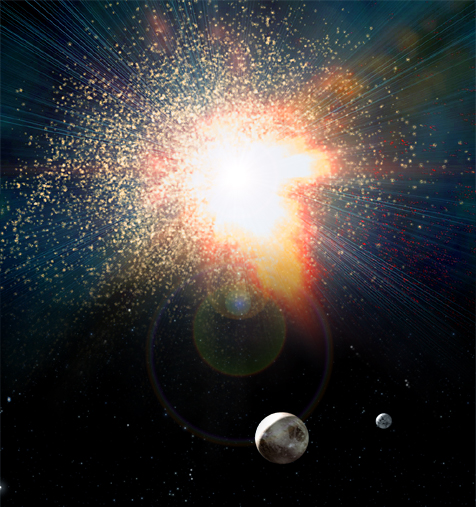
The Lucifer Project: Using the Cassini probe to detonate like a nuclear weapon inside the atmosphere of Saturn… oh dear, here we go again… (NASA/US Dept. of Defence)

Here comes another doomsday scenario, this time from the friendly gas giant Saturn. The story goes like this: NASA is working with secret organizations (such as the Illuminati or the Freemasons) to fulfil their dreams of “playing God” and creating a second Sun in the Solar System. This plan has many aims, but primarily they want to use the Cassini probe to trigger a catastrophic chain reaction inside Saturn so nuclear fusion is possible, generating a mini-Sun. This has been tried before, when the Galileo probe was dropped into the atmosphere of Jupiter in 2003 (but it obviously failed at first attempt). Cassini is carrying about 33 kg of plutonium, making it the ultimate cruise missile aimed at Saturn, atmospheric pressures eventually kick-starting a nuclear explosion in two years time.

Whilst this makes for interesting reading, yet again, the science is deeply flawed. We can expect this doomsday scenario (and yes, it is predicting the end of the world) to gain some strength before the Cassini mission is terminated in 2010…. only this time the Devil (Lucifer) is involved…

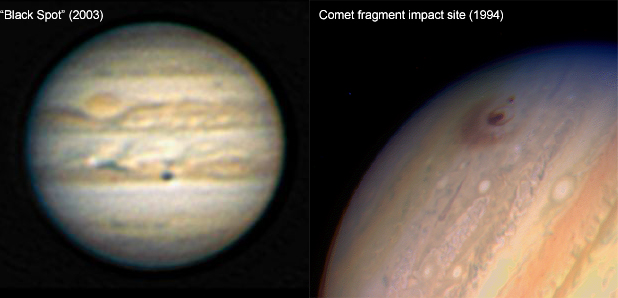
In the first part of this mini-series on the Universe Today, I look into the science behind a doomsday scenario known as The Lucifer Project (or simply Project Lucifer). I have heard of variations on this theme for many years, and at first it sounds possible, but then simple logic dictates that turning Jupiter or Saturn into a Sun is rather more sci-fi than sci-fact. In fact, the transformation of Jupiter into a second Sun is not a new idea. In the novel and movie 2010: Odyssey Two (notice the correlation with the date?) created by the late, great Arthur C. Clarke, Jupiter is the focus of the mysterious storyline. Black monoliths breed inside the gas giant’s atmosphere, at first creating a big black spot (again, notice the similarity with the 2003 black spot observation?), increasing its density and mass to a point where nuclear fusion can be sustained. The movie finishes with various views of the new binary solar system. A great movie.

A scene from the movie 2010 where a black spot appears on Jupiter

So, it would seem, Project Lucifer is loosely based on Arthur C. Clarke’s novel (minus Galileo creating a nuclear chain reaction). Obviously, the 2003 Galileo collision with Jupiter had no lasting effect on the planet, conspiracy theorists are now looking at the 2010 Cassini collision with Saturn for their story. Therefore, last night I wrote Project Lucifer: Will Cassini Turn Saturn into a Second Sun? (Part 1) to address some of the technical reasons why a Cassini re-entry into Saturn’s atmosphere (or Galileo’s re-entry into Jupiter in 2003 for that matter) cannot miraculously pull all the tiny pieces of plutonium (non-weapon grade by the way) together to form a crude nuclear weapon. In the next part, I’ll look into the physics behind a star and look at why gas giants such as Jupiter and Saturn are called “failed stars”…

How Long Would it Take to Travel to Proxima Centauri?

Project Orion - Using nuclear explosions as pulsed propulsion (NASA)

This is one of those articles I’ve been meaning to write for a long time: How long would the interstellar transit be from Earth to the nearest star (and no, I don’t mean the Sun)? It turns out that there is no practical way, using today’s available technology that we can travel to Proxima Centauri (a red dwarf star, 4.33 light years from the Solar System). This is a shame as there are so many stars and so many exoplanets to explore, which space enthusiast wouldn’t want to envisage interstellar space travel? However, there may be help at hand, using modern technology and materials; we might be able to mount a manned expedition to Proxima lasting a little under a century…
Continue reading “How Long Would it Take to Travel to Proxima Centauri?”

2012 Doomsday Article Now Available in Portuguese

A Mayan pyramid, but did the Mayans really forecast doomsday?

With a special thanks to Nisia Chaves at Chá de Camomila, my original “No Doomsday in 2012” article published on the Universe Today has been carefully translated into Portuguese. This is great as it extends the readership to countries such as Portugal, Angola, Brazil, Cape Verde, East Timor, Guinea-Bissau, Chinese S.A.R. of Macau, Mozambique and São Tomé and Príncipe. Alas, my Portuguese is a bit rusty, so this might be a good chance to learn some important phrases from the 6th most popular language in the world. So lets start with “Nada de Juízo Final em 2012” – No Doomsday in 2012 😉
Continue reading “2012 Doomsday Article Now Available in Portuguese”

No Doomsday in 2012: The Reason Why Science Will Not Win

Why Planet X is not Nibiru...
Why Planet X is not Nibiru…

I’ve been busy compiling two new articles about the 2012 doomsday scenario. This time I’ve investigated why Planet X is not the same thing as the Sumerian planet “Nibiru”, and why a “killer solar flare” will not be possible in the year 2012. This brings the 2012 series up to its fourth edition, and the feedback has been very interesting. Probably the most important thing I want to emphasise about this whole 2012 prophecy stuff is that I am not trying to stamp on anyone’s beliefs. There are many reasons why 2012 may hold significant spiritual or religious meaning, and I am not disputing this in any way. I want to present the science facts, not the science “facts” that seem to overwhelm many of the end of the world scenarios. Alas, I suspect that I’m fighting a losing battle. I got it wrong, debunking the doomsayers who are doing this for financial gain are not concerned whether their evidence adds up, they are using one tool that I cannot influence. Fear.
Continue reading “No Doomsday in 2012: The Reason Why Science Will Not Win”

A Fun Couple of Days for Writing…

Coke in space. Much like beer in space. Too many bubbles, too much mess (NASA)

It’s been a flood, a flood I tell you! The last week has been a full-on space news week, especially with the landing of Phoenix on Mars on Sunday. But not only this, we’ve had news from all over the globe and it’s been hard to keep up. Over at the Universe Today we’ve been trying to give a good cross section of topics (with a heavy dose from Mars, naturally), and mine have been pretty eclectic. From Japanese space beer, stunning Very Large Telescope (VLT) images of the iconic Eta Carinae, cool space lasers, hot laboratory lasers and a crazy-spinning asteroid to name a few. It’s just a shame I didn’t have time to write more. So here they are, the last couple of days of articles I’ve written for the Universe Today…
Continue reading “A Fun Couple of Days for Writing…”

No Mayan Prophecy Doomsday in 2012 (Sorry)

A Mayan pyramid, but did the Mayans really forecast doomsday?

(Update: It seems people agree with my 2012 article and it hit the front page of Digg just before 1am (GMT) on Wednesday. Join the fun!)

The Mayan Prophecy seems to predict the end of the world, or at least a large potion of humans on Earth. As a race we appear to have side-stepped many previous doomsday events in the past (how can you forget the crazed predictions of the Y2K bug), so what makes December 21st 2012 so special? Why is it going to be this date that will kill us all off? Actually, and I doubt this will surprise all the level-headed thinkers out there, there is very little evidence that anything will happen on that date. I can’t really talk for the predictions that there will be nuclear Armageddon, a plague outbreak or an ultra-credit crunch, but as far as any astro-threats are concerned, I have good news (we’re in the clear)…
Continue reading “No Mayan Prophecy Doomsday in 2012 (Sorry)”

Daily Roundup: From Pancake Stars to Suspended Animation for Astronauts

As I’m going to be away for a week, Astroengine is going to be quiet for seven days. I’m heading down to Cornwall, UK where I hope to go to Goonhilly Earth Station (on the Lizard) to try to get some more information on its shutdown. Last year I was shocked to hear that the station and its operations were being moved to the South East, so the majority of the satellite dishes will be dismantled. This is such a shame; those dishes are synonymous with the Cornish countryside. When they’re gone it will be like a good old English cream tea, but without the scone… but hey, everything changes, but I want some answers, so I intend to get some!

So, to keep you occupied, I’ll give a rundown of my picks of the stories I’ve done for the Universe Today in the past few days…
Continue reading “Daily Roundup: From Pancake Stars to Suspended Animation for Astronauts”

Daily Roundup: SpaceX are Moving into Cape Canaveral, Colliding Black Holes and Global Warming

Colliding galaxies can force the supermassive black holes in their cores together (NCSA)

Just a quick update on todays articles I’ve posted on the Universe Today: Titan Launch Pad Tower Blown Up at Cape Canaveral (Gallery), Supermassive Black Hole Kicked Out of Galaxy: First Ever Observation, Global Warming is Accelerating Faster than can be Naturally Repaired

For me, the most incredible story was the colliding black hole research to come out of the Max Planck Institute. They have observed a black hole being “kicked out” of its host galaxy during a galactic merger event. Two supermassive black holes collided, causing a huge recoil, ejecting a black hole of several hundred million solar masses into intergalactic space. Stunning science.

Daily Roundup: Jules Verne, Space Sports and Why we Shouldn’t Tamper with Sulphites

The ATV giving the ISS a boost (ESA)
It’s been a busy day of article writing at the Universe Today with three articles:

ATV Jules Verne Boosts Space Station to Higher Orbit (Video)
Space Golf and Other Zero-G Sports on the ISS
Potential Global Warming “Fix” Will Damage the Ozone Layer

Also, my recent Soyuz Hard Landing article got picked up by Slashdot and appears to be getting a lot of attention. I hope to write a summary article about the “ballistic re-entry” of the Russian Soyuz descent module on astroengine.com soon, but for now, check it out on the Universe Today

Cheers! Ian

Supermassive Black Hole Flare Lights Up Mysterious Molecular Torus

Artists impression of a light echo from the surrounding torus of a supermassive black hole (Max Planck Institute)

Theoretically, supermassive black holes that occupy the centre of galaxies (including our own) are surrounded by a vast cloud of gas. Depending on the angle you are viewing this molecular torus will obscure the supermassive black hole’s bright accretion disk. Until now, this vast doughnut of matter has never been observed, but with the help of the supermassive black hole accretion disk and a dying star, there’s a possibility that the molecular torus will not only be observed, but also mapped…
Continue reading “Supermassive Black Hole Flare Lights Up Mysterious Molecular Torus”