A bolt of lightning strikes over Strasbourg, France (Ian O'Neill)
As you may have noticed, things have been rather quiet on Astroengine of late. This is partly due to my pan-European trek and my work on Discovery News, but mainly due to my horrid affliction of procrastination. Hence why I’m late in posting this pretty awesome picture of a lightning bolt blasting across the French skies.
It was an incredible experience and I got to meet some incredible people. Hoping to get a blog post up about the whole thing some time over the coming days, but for now, I’ll leave you with this picture of the storm that hit Strasbourg while I was there. For the full set, check out my Posterous gallery.
Oh yes, and that little dot ahead of the falling debris? That’s the sample return capsule before it was found int he Outback safely. Thank goodness its parachute worked (presumably).
Hayabusa re-enters over the Australian Outback, generating a bright fireball (screen grabs from the JAXA video feed)
Staring hard at the live streaming video of the black Australian skies, I was hoping to see a faint streak of light glide across the camera’s field of view.
But no, it wasn’t that subtle.
Shortly after 9:51 am EDT on Sunday morning (or, for me, a far more civilized 2:51 pm GMT), the Japanese space agency’s (JAXA) Hayabusa’s mission officially came to an end, burning up in the atmosphere. However, a few hours before, the spacecraft released a 40 cm-wide capsule, sending it ahead of the main spacecraft. This sample return capsule would have a very different re-entry than its mothership.
As I watched the small dot of light on the horizon of the streaming video getting brighter and brighter — feverishly hitting the PRTSC button and using some rapid cut&paste-fu in Photoshop — suddenly it erupted, shedding light on the distant clouds that had been invisible in the night.
Far from the re-entry being a faint or dull event, it was dazzling (as seen in the screen grabs to the right).
So, after seven dramatic years in space, the Hayabusa mission has come to an end.
For the full story about how Hayabusa got hit by the largest solar flare in history, limped to visit an asteroid called Itokawa and how its sample-collecting kit malfunctioned, have a read of my main article on Discovery News: Hayabusa Generates Re-Entry Fireball Over Australia
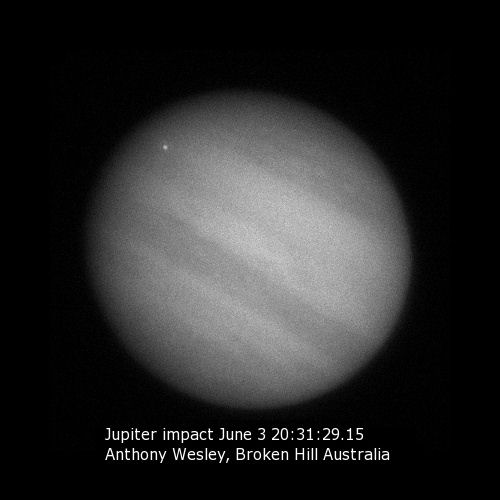
Anthony Wesley’s first event was the famous July 2009 observation of what was thought to have been the immediate aftermath of a comet impact in the Jovian atmosphere. His second happened on Thursday at 20:31 UTC when he was observing Jupiter when something hit the atmosphere, generating a huge fireball.
It is not known whether this event was caused by a comet or asteroid, but in a bizarre case of serendipity, earlier on Thursday Hubble released more information on his original impact event. The July 2009 “bruise” in the gas giant’s atmosphere is now thought to have been caused by an asteroid, and not a comet.
The Hubble press release included details on how researchers deduced that it was actually more likely that a 500 meter-wide asteroid hit Jupiter in 2009. One clue was that newly installed cameras on the space telescope detected little dust in the halo surrounding the impact site — a characteristic that was detected after the impact of the shards of comet Shoemaker-Levy 9 in July 1994. Also, the calculated trajectory of the 2009 event indicated the object didn’t have an orbit commonly associated with comets. If the 2009 event was an asteroid, that means Wesley saw something never seen before: the site of a recent asteroid impact on a celestial body.
And now, less than a year after being the first to see that impact aftermath, Wesley has done it again. Another amateur astronomer, Christopher Go, was quick to confirm Thursday’s fireball with a video of the 2 second flash in Jupiter’s upper atmosphere.
These impact events serve as a reminder about Jupiter’s fortuitous role in our Solar System. As the gas giant is so massive, its gravitational pull has a huge influence over the outer planets, dwarf planets, comets and asteroids. Acting like an interplanetary ‘vacuum cleaner’ Jupiter can block potentially disastrous chunks of stuff from taking a dive into the inner Solar System. It is thought that this distant planet has helped Earth become the thriving world it is today, preventing many asteroids and comets from ruining our evolution.
The Moon, Space Shuttle Atlantis, an aurora plus Kibo, all in one breathtaking scene (Soichi Noguchi)
The instant I saw this photograph I realized I was seeing something so beautiful, I’d have a hard job writing something to accompany it.
Coming straight from the Twitter feed of Soichi Noguchi, Japanese astronaut and social-media-in-space-photography-guru, this single photograph has captured the moon, an aurora hanging above the Earth’s limb, a docked space shuttle Atlantis and the International Space Station’s Kibo module (plus a bonus robotic arm and solar panel).
This picture is awesome on so many levels. And to be honest, this should be the photograph of Atlantis’ final mission. It encapsulates so much; a testament to what mankind is capable of and a tribute to the men and women who are currently in space, risking their lives for the advancement of our race.
My impression as to how a black hole 'aurora' might look like near an event horizon (Ian O'Neill/Discovery News)
Usually, aurorae happen when the solar wind blasts the Earth’s atmosphere. However, black holes may also have a shot at producing their very own northern lights. What’s more, we might even be able to observe this light display in the future.
Accretion Disks and Magnetic Fields
Simulating a rapidly spinning black hole, two researchers from Japan modeled an accretion disk spinning with it.
Inside this disk would be superheated plasma and as it rotates it might act like a dynamo, charged particles generating a magnetic field looping through the disk. But this magnetic field wont stay confined to the disk for long. Due to inertial effects, the magnetic field would be dragged into the event horizon, causing the magnetic fieldlines to ‘attach’ themselves to the black hole.
Assuming the accretion disk continues to generate a continuous magnetic field, a global black hole ‘magnetosphere’ would result.
A diagram of the black hole's magnetosphere (Takahashi and Takahashi, 2010)
A Plasma Hosepipe
As you’ve probably seen in the striking imagery coming from the high-definition movies being produced by the Solar Dynamics Observatory, magnetic fieldlines close to the solar surface can fill with solar plasma, creating bright coronal loops. This hot plasma fills the loops, feeding around the magnetic field like a hosepipe filling with water.
The same principal would apply to the black hole’s magnetosphere: the looped magnetic field feeding from the accretion disk to the event horizon filling with plasma as it is sucked out of the disk (by the black hole’s dominating gravitational field).
As you’d expect, the plasma will fall into the black hole at relativistic speeds, converted into pure energy, blasting with intense radiation. However, the Japanese researchers discovered something else that may happen just before the plasma is destroyed by the black hole: it will generate a shock.
As predicted by the model, this shock will form when the plasma exceeds the local Alfven speed. For want of a better analogy, this is like a supersonic jet creating a sonic boom. But in the plasma environment, as the plasma flow hits the shock front, it will rapidly decelerate, dumping energy before continuing to rain down on the event horizon. This energy dump will be converted into heat and radiation.
This fascinating study even goes so far as predicting the configuration of the black hole magnetosphere, indicating that the radiation generated by the shock would form two halos sitting above the north and south ‘poles’ of the black hole. From a distance, these halos would look like aurorae.
Very Large Baseline Interferometry
So there you have it. From a spinning black hole’s accretion disk to shocked plasma, a black hole can have an aurora. The black hole aurora, however, would be generated by shocked plasma, not plasma hitting atmospheric gases (as is the case on Earth).
This all sounds like a fun theoretical idea, but it may also have a practical application in the not-so-distant future.
In a paper written by Vincent Fish and Sheperd Doeleman at the MIT Haystack Observatory, results from a simulation of several radio telescopes as part of an international VLBI campaign were detailed. The upshot was that the more radio antennae involved in such a campaign, the better the resolution of the observations of the ‘shadow’ of the black hole’s event horizon.
If the black hole’s event horizon could be observed by a VLBI campaign, could its glowing aurorae also be spotted? Possibly.
The interstellar probes are still operational (NASA)
The Voyager 2 spacecraft has been speeding through the Solar System since 1977 and it’s seen a lot. Besides scooting past Jupiter, Saturn, Uranus and Neptune, the probe is now passing through the very limit of the heliosphere (called the heliopause) where it has begun to detect a magnetic field beyond the Solar System. The fact we have man-made objects exiting our star system is something that makes me goosebumpily.
For some perspective, Voyager 2 is so far away from Earth that it takes nearly 13 hours for commands sent from Earth to reach the probe.
After decades of travel, the NASA spacecraft continues to relay data back to us, making it one of the most profound and exciting space missions ever launched. Perhaps unsurprisingly, the aging explorer recently experienced a glitch and the data received by NASA was rather garbled.
Naturally, the conspiracy theorists were out in force quickly pointing their sticky fingers at a possible encounter of the 3rd kind. How these ‘aliens’ found the probe in the first place and reprogrammed the transmission for it to appear corrupt Earth-side is beyond me, but according to an ‘expert’ in Germany, aliens (with an aptitude for reprogramming 30 year old Earth hardware, presumably) were obviously to blame.
One of the alien implication articles came from yet another classic ‘science’ post thrown together by the UK’s Telegraph where they decided to take the word of a UFO expert (obviously a viable source) without any kind of counter-argument from a real expert of real science. (But this is the same publication that brought us other classics such as the skull on Mars and the Doomsday Turkey, so it’s not too surprising.)
As I discussed in a recent CRI English radio debate with Beyond Beijing hosts Chris Gelken and Xu Qinduo, the Voyager-alien implication is beyond funny; an entertaining sideline to poke fun at while NASA worked out what actually went wrong. But the big difference was that Chris and Xu had invited Seth Shostak (from the SETI Institute) and Douglas C. Lin (from the Kavli Institute for Astronomy and Astrophysics at Peking University) to join the fun. No UFO expert in sight, so the discussion was biased toward science and logic, not crazy talk.
So what did happen to Voyager 2? It turns out that aliens are not required to answer this cosmic mystery.
On Tuesday, NASA announced that Voyager 2 had flipped one of its bits of memory the wrong way. “A value in a single memory location was changed from a 0 to a 1,” said JPL’s Veronia McGregor.
This glitch was thought to occur in the flight data system, which formats information for transmission to Earth. Should something go wonky in its memory allocation, the stuff it transmits can be turned into gibberish.
Although it isn’t known how this single bit was flipped (and we may never know, as Voyager 2 is an awful long way from home), it sounds very much like a cosmic ray event interfering with the onboard electronics. As cosmic rays are highly energetic charged particles, they can penetrate deep into computer systems, causing an error in calculations.
And this situation isn’t without precedent either. Recently, NASA’s Mars Reconnaissance Orbiter (MRO) was hit by a cosmic ray event, causing the onboard computer to switch to “safe mode.” Also, Voyager 2 is beginning to exit the Sun’s outermost sphere of influence, where turbulence and confused magnetic fields rule. If I had to guess, I’d say — statistically-speaking — the probe might have a greater chance of being hit by the most energetic cosmic rays from deep space.
Just because something “mysterious” happens in space doesn’t mean aliens, the Illuminati or some half-baked doomsday phenomenon caused it. Before jumping to conclusions it would be nice if certain newspapers and UFO experts alike could look at the most likely explanation before pulling the alien card.
Alas, I suspect that some things will never change.
Astroengine.com is now being syndicated by The Christian Science Monitor! The CSM has been around for ever (well, since 1908) and it’s a publication that’s won seven Pulitzer Prizes. That’s all kinds of awesome. Personally, I’ve been following CSMonitor.com for some time and their coverage of all things science is excellent — I’m very excited to be a part of their new “Cool Astronomy” section.
But I’m not alone! You’ll find many familiar faces in this new superblog, many of which you can see in Astroengine’s blogroll.
What does this mean for Astroengine? Well, nothing is going to change, except I’ll be less lazy and write more. My plan for Astroengine’s global domination is on track!
*I stole this title from a Chipotle ad, but it’s a great ad (and an awesome Mexican take out), so why not? Unfortunately the burritos aren’t free in the Astroengine Universe.
In its haste to become the first newspaper to print the “NASA: Evidence of Life on Mars” headline, the UK’s Sun website caused a stir last week. Not only was this headline incorrect, it was a wee bit irresponsible.
For starters, no evidence for life has been found on the Red Planet. Second, NASA has not proclaimed such a discovery. In fact, The Sun riled the U.S. space agency so much, this headline prompted NASA spokesman Dwayne Brown to issue the following statement:
“This headline is extremely misleading. This makes it sound like we announced that we found life on Mars, and that is absolutely, positively false.”
So where did it all go so wrong?
This story stems from an astrobiology conference celebrating the 50th anniversary of the search for alien life. At this conference, findings by NASA’s Mars Exploration Rover Opportunity were reviewed. One of these findings was the tantalizing discovery of sulfates by the rover in 2004. Where there’s sulfates, water once existed. Where there’s water, life might have existed.
In an exciting twist to this discovery, scientists studying sulfate deposits on Earth (known as gypsum) were asked by scientists in the Mars Program to investigate terrestrial gypsum deposits more closely. Up until now, it was thought that gypsum contained no fossils, but on closer inspection it turns out that ancient gypsum deposits from the Mediterranean Sea (dated to about 6 million years old — when the sea was actually dry) are stuffed full of microscopic fossils of algae and phytoplanktons.
So, on Mars we have sulfates. On Earth we have sulfates (gypsum) full of fossils of aquatic microscopic life. If we know the terrestrial deposits of gypsum contain fossils of basic life forms, perhaps sulfate deposits on Mars would be a good place to start looking for basic ancient extraterrestrial life.
Of course, for the tabloid newspaper, these Martian sulfate deposits became “pond scum” and therefore “evidence” for life on Mars.
In actuality, the text of The Sun article wasn’t that misleading and actually did a good job of reporting the science (apart from the “pond scum” bit). Unfortunately, the title of the article let the rest of the article down, ultimately undermining the journalists’ work.
But, coming from the same publication that printed the silly “Pictures show life on Mars” article from 2008, the “Evidence for life on Mars” headline is pretty tame.
However, no meteorite remnants have been recovered from the scene. While it’s possible that the meteorite vaporized on impact, I strongly doubt there would be much of a house left after such an energetic blast.
Djamaluddin does point out that perhaps the meteorite had a “fragile structure,” a potential reason why there’s no fragments left. But that begs the question: If the meteorite was that fragile, could it really slam through the roof, destroy the second floor, explode, excavate a crater in the first floor and cause damage to two neighboring properties?
I’m not totally discounting the idea that this might have been a meteorite impact, but the evidence remains as sketchy as last week. So I’m sticking with my original thought that this “blast” was more likely terrestrial and not extraterrestrial in origin. But on the outside chance this was a meteorite, the neighborhood had a very lucky escape in that the space rock was big enough to cause significant property damage, yet small enough to stay contained.




 astroengine.com