Astroengine Live Show #17: Not-So-Brown Dwarf

promo12

In today’s show, I’ll be giving brown dwarfs some airtime. They may be considered to be “failed stars”, but are they? Also, I’ll be giving a rundown of the week’s space news with some surprises thrown in. Be sure to tune in at 4pm PST/7pm EST!

Get Involved!

Have any articles or stories you want to contribute? Have an opinion on anything in the world of space? Follow me on Twitter to send me live input when I’m on the air, or email me on astro@wprtradio.com and I’ll be sure to give it a mention. Eventually, I hope to have telephone call-ins, but for now, email will do.

Listen to Astroengine Live using the Paranormal Radio player. Or, pick up the podcast feed to activate your favourite audio software.

Could Active-SETI Learn From… Twitter?

twitter_earth

The Search for Extraterrestrial Intelligence (SETI) has been an ongoing endeavour for the last 50 years. Detecting radio communications from an alien civilization would be the most profound event in mankind’s history; its effect would change the way we view our origin and our place in the Universe. It could mean that far from “being alone” we could be existing in a cosmic ecosystem, where life is more common than not and advanced extraterrestrial civilizations are no longer science fiction. A positive SETI signal would affect us globally; science, religion, society, daily life would alter radically.

Unfortunately, SETI is currently drawing up blanks. Apart from one or two inconclusive signs, it looks like we live in a dead part of the galaxy. Life As We Know It™ is an Earth-only affair. Who knows, we might be searching for another five decades and still be no closer to answering the question “are we alone?

Not to be too downhearted, scientists have been trying to make our presence felt by reversing SETI; we’ve been Messaging Extraterrestrial Intelligence (METI, a.k.a. “Active-SETI”) ever since we attached a plaque depicting the human form and a handy galactic map to Earth to the side of the Pioneer probes in the 1970s. Now we send a variety of radio signals to the stars in the hope of attracting ET’s attention.

But what signal do we send? Do we send a message with only good stuff from Earth? Or should we send a more gritty message, detailing our flaws as well as achievements? What actually makes a “good” METI signal in the first place?

Perhaps SETI could take some advice from the evolving social media scene, after all, when done right, there’s no more efficient way of conveying a clear message via 140 characters or less…
Continue reading “Could Active-SETI Learn From… Twitter?”

Brown Dwarfs: “Over-Achieving Jupiters” not “Failed Stars”

browndwarf3

Why is the term “failed star” synonymous with brown dwarfs? On the one hand, brown dwarfs lack the mass to sustain nuclear fusion in their cores. On the other hand, who said brown dwarfs were trying to be stars? Who ever said that becoming a star was the pinnacle of stellar living? Perhaps brown dwarfs are perfectly happy the way they are. In a world of equality and political correctness, brown dwarfs could be viewed as “over-achieving Jupiters”, or gas supergiants
Continue reading “Brown Dwarfs: “Over-Achieving Jupiters” not “Failed Stars””

An Explanation For Solar Sigmoids

Hinode X-ray observation of a solar sigmoid (David McKenzie/Montana State University)

Sigmoids in the solar corona have been studied for many years, but little explanation of their formation or why they are often the seed of powerful solar flares have been forthcoming. Using high-resolution X-ray images from the Japanese-led solar mission Hinode (originally Solar-B), solar physicists have known that these very hot S-shaped structures are composed of many highly stressed magnetic flux tubes filled with energized plasma (also known as ‘fibrils’), but until now, little was known about the formation and flare eruption processes that occur in sigmoids.

Now, a team of solar physicists from the University of St Andrews believe they have found an answer using powerful magnetohydrodynamic (MHD) computer models, aiding our understanding of coronal dynamics and getting us one step closer to forecasting space weather…

Continue reading “An Explanation For Solar Sigmoids”

Are Brown Dwarfs More Common Than We Thought?

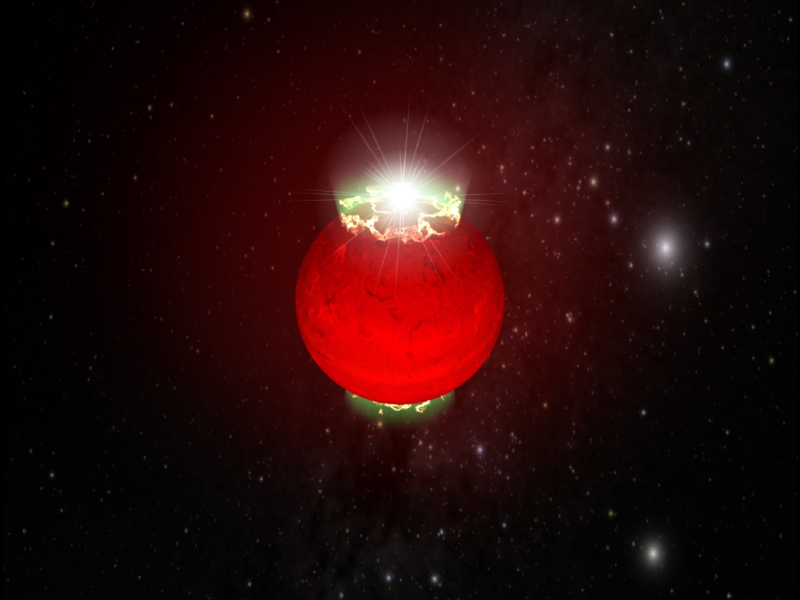
A brown dwarf plus aurorae (NRAO)

In 2007, a very rare event was observed from Earth by several observers. An object passed in front of a star located near the centre of the Milky Way, magnifying its light. Gravitational lensing is not uncommon in itself (the phenomenon was predicted by Einstein in 1915), but if we consider what facilitated this rare “microlensing” event, things become rather interesting.
Continue reading “Are Brown Dwarfs More Common Than We Thought?”

Astroengine 3.0

ae31

Now we’re cookin’… Welcome to the new-look Astroengine.com!

As you may have noticed I’ve been a little patchy with blog posts of late and now you can see why. I decided to migrate the entire Astroengine installation to a brand new server after the site suffered some serious downtime after a recent article (“Where is Planet X? Where is Nemesis?“) was slammed by Digg traffic. Now we are on a sparkling new server with a brand new design. I told you this year was going to be a big year for Astroengine, this officially marks the beginning of a new era

After asking readers about suggestions for a new direction in design, it was Darnell Clayton (Colony Worlds) who came up with the winning suggestion. He pointed me in the direction of the designs by Elegant Themes and once I saw a design called StudioBlue, I was hooked. A few modifications later and I arrived at what you see here, Astroengine 3.0. It has a fresher, more magazine/blog vibe, so I hope you like it.

With all the technical stuff calming down, I can now get back to what I’m here for. Expect a tonne of space science articles over the coming months – 2009 is going to be a big year.

Thank you for your support (and patience!).

Cheers, Ian

A Change Is Coming…

Apologies for the break in Astroengine transmission, a change is brewing.

I’m currently migrating my WordPress installation over to a brand new server. This is primarily due to the huge increase in traffic Astroengine has been experiencing in recent months. All great news, but something had to give and it was my shared hosting account that eventually broke.

To celebrate the new server and faster delivery of content, I’ve also been working on a redesign. Expect a big change sometime between now and whenever I finish uploading the thousands of files to their new home (hopefully within the next day).

Thank you for your continuing loyal support.

A new era for Astroengine.com awaits…

Cheers, Ian

In the Cosmos/Iridium Collision, Which Satellite Won?

©Stratfor Global Intellegence

When two satellites collide at 790 km above the Earth’s surface, who really cares which satellite “won”? It’s going to be a mess; chunks of metal and shards of solar panels exploding to life after their once-solid satellite structures impacted at a velocity of 11 km/s (that’s kilometres per second). Both satellites are losers, twisted, shattered remains of their former selves, cluttering Earth-orbit, causing all kinds of stress for other vehicles flying around in orbit.

However, when the Iridium communications satellite was hit by the defunct Russian Cosmos 2251 on February 10th, it turns out there was a “winner” in the satellite demolition derby (although I am using the word “winner” very loosely)…
Continue reading “In the Cosmos/Iridium Collision, Which Satellite Won?”

Space Experts to Discuss Threat of Asteroid Impact

Artist impression of a gravitational tractor deflecting the path of an NEO (Dan Durda/B612 Foundation)

Imagine you’re an astronomer who discovered an asteroid. Happy days, you might be able to name it after yourself (99942 O’Neill has a certain ring to it, don’t you think?). At first you feel little concern, after all, we are getting better at spotting near-Earth objects. But when you get news from another observatory that they had been tracking the same object weeks earlier, your interest is piqued. On the one hand, you didn’t technically discover it, but you did confirm its existence. Unfortunately this is probably the one observation you really didn’t want to make. It turns out that this chunk of rock is heading in our direction. And unlike the Earth-grazers that have come before, this asteroid isn’t going to drift past our planet, it isn’t even going to skip off our atmosphere, it’s going to hit us.

Now imagine you are the president of a nation determined to stop the asteroid from hitting Earth. What do you do? Naturally you’d call your team of oil drillers scientific advisors to present your options. One space scientist suggests sending a rocket to the asteroid, strapping it on in the hope it might be nudged out of harms way. The astronomer who made the discovery of the killer asteroid is having a nervous break down in the corner of the room. Your military advisor is urging you to attach a nuclear warhead to your most powerful rocket, in an attempt to obliterate the target. The Secretary of State is calling for restraint; we need to collaborate with other nations, blasting nuclear missiles in to space would violate all kinds of international treaties, wars have been started for less, perhaps someone else has a better idea…?

Although I doubt we’ll ever be fully prepared to act swiftly and decisively in the event of discovering a civilization-ending asteroid, we can at least try. Defending the planet against the ever-present threat of impact is one of the most critical abilities we must develop as a race, ensuring the long-term future of our species. Fortunately, a team of scientists, engineers, policy makers and lawyers (lawyers?) are teaming up to confront this problem…
Continue reading “Space Experts to Discuss Threat of Asteroid Impact”

Colbert Report: Stephen Receives the Bittersweet News About Node 3

The Colbert Report aired last night and astronaut Suni Williams appeared on the show to announce the official name of Node 3. Like breaking news to a 5 year-old that Christmas has been cancelled, Williams did her best to be as gentle as she could be. Fortunately, Stephen Colbert soon cheered up when he found out that the “shoes inside the box” (the new treadmill) would be named after him. As always, very funny.

Unfortunately, I can’t help but think that “Tranquility” is a little lame. It just adds to the forgettable names of the other nodes I don’t remember…

…what’s the name of that node again?

Thanks Bente for the tip off!