Was Voyager 2 Hijacked by Aliens? No.

The interstellar probes are still operational (NASA)

The Voyager 2 spacecraft has been speeding through the Solar System since 1977 and it’s seen a lot. Besides scooting past Jupiter, Saturn, Uranus and Neptune, the probe is now passing through the very limit of the heliosphere (called the heliopause) where it has begun to detect a magnetic field beyond the Solar System. The fact we have man-made objects exiting our star system is something that makes me goosebumpily.

For some perspective, Voyager 2 is so far away from Earth that it takes nearly 13 hours for commands sent from Earth to reach the probe.

After decades of travel, the NASA spacecraft continues to relay data back to us, making it one of the most profound and exciting space missions ever launched. Perhaps unsurprisingly, the aging explorer recently experienced a glitch and the data received by NASA was rather garbled.

Naturally, the conspiracy theorists were out in force quickly pointing their sticky fingers at a possible encounter of the 3rd kind. How these ‘aliens’ found the probe in the first place and reprogrammed the transmission for it to appear corrupt Earth-side is beyond me, but according to an ‘expert’ in Germany, aliens (with an aptitude for reprogramming 30 year old Earth hardware, presumably) were obviously to blame.

One of the alien implication articles came from yet another classic ‘science’ post thrown together by the UK’s Telegraph where they decided to take the word of a UFO expert (obviously a viable source) without any kind of counter-argument from a real expert of real science. (But this is the same publication that brought us other classics such as the skull on Mars and the Doomsday Turkey, so it’s not too surprising.)

As I discussed in a recent CRI English radio debate with Beyond Beijing hosts Chris Gelken and Xu Qinduo, the Voyager-alien implication is beyond funny; an entertaining sideline to poke fun at while NASA worked out what actually went wrong. But the big difference was that Chris and Xu had invited Seth Shostak (from the SETI Institute) and Douglas C. Lin (from the Kavli Institute for Astronomy and Astrophysics at Peking University) to join the fun. No UFO expert in sight, so the discussion was biased toward science and logic, not crazy talk.

(It was an awesome show by the way, and you can check out the recording via my Discovery News article.)

So what did happen to Voyager 2? It turns out that aliens are not required to answer this cosmic mystery.

On Tuesday, NASA announced that Voyager 2 had flipped one of its bits of memory the wrong way. “A value in a single memory location was changed from a 0 to a 1,” said JPL’s Veronia McGregor.

This glitch was thought to occur in the flight data system, which formats information for transmission to Earth. Should something go wonky in its memory allocation, the stuff it transmits can be turned into gibberish.

Although it isn’t known how this single bit was flipped (and we may never know, as Voyager 2 is an awful long way from home), it sounds very much like a cosmic ray event interfering with the onboard electronics. As cosmic rays are highly energetic charged particles, they can penetrate deep into computer systems, causing an error in calculations.

And this situation isn’t without precedent either. Recently, NASA’s Mars Reconnaissance Orbiter (MRO) was hit by a cosmic ray event, causing the onboard computer to switch to “safe mode.” Also, Voyager 2 is beginning to exit the Sun’s outermost sphere of influence, where turbulence and confused magnetic fields rule. If I had to guess, I’d say — statistically-speaking — the probe might have a greater chance of being hit by the most energetic cosmic rays from deep space.

Just because something “mysterious” happens in space doesn’t mean aliens, the Illuminati or some half-baked doomsday phenomenon caused it. Before jumping to conclusions it would be nice if certain newspapers and UFO experts alike could look at the most likely explanation before pulling the alien card.

Alas, I suspect that some things will never change.

Then Spitzer Imaged Baby Stars in the Orion Nebula…

The Orion Nebula's star-forming region (NASA)
The Orion Nebula's star-forming region (NASA).

Firstly, apologies that it’s been over a month since last posting to Astroengine.com. Call it slacking off, call it a sabbatical, either way, it’s not good. I’ve actually prepared several half-finished articles, but I just never got around to completing them. However, I have been on writing overdrive over at Discovery News, so if I go quiet over here, you know where to find me.

Speaking of Discovery News, I’ve just posted an incredible image of the heart of the Orion Nebula as seen by the Spitzer Space Telescope, so I can’t think of a better way to kick-start Astroengine with an image filled with awesomeness.

Although Spitzer has entered a new phase of operations since it depleted the liquid helium coolant used to maintain its instrumentation, that doesn’t mean its stopped producing some awe-inspiring imagery. In a new vista released on Thursday, a bustling star formation region in Orion is detailed, showing some 1,500 young stars the observatory watched for 40 days. This is an unprecedented study, allowing rapid variations in these baby stars to be tracked by Spitzer.

Young stars are generally highly variable in their brightness, a characteristic that is of huge interest to astrophysicists. If we can understand the mechanisms causing this variation, we can gain an insight to stellar evolution, possibly even understanding the history of our own Solar System.

As Spitzer observes in infrared wavelengths, it’s very sensitive to clouds of dust being heated by these young stars. Therefore, the proto-planetary disks surrounding these million year old stars glow brightly. Not only does this give an indication to the conditions surrounding the star, it also provides astronomers with an idea to how these disks of dust clump together, slowly evolving into exoplanets. And now Spitzer has data sets spanning weeks, dynamic changes in the emissions from the stars and their evolving planetary systems can be studied.

But science aside, the Spitzer imagery is a thing of beauty, reminding us how complex our cosmos really is. Don’t believe me? Take a look for yourself (click the pic to dive right in):

The star forming region in Orion as studied by Spitzer, rotated 90 degrees (NASA/JPL/Caltech)

Could P/2010 A2 be the First Ever Observation of an Asteroid Collision?

Something rather bizarre was observed in the asteroid belt on January 6. Ray Villard at Discovery News has just posted an exciting article about the discovery of a comet… but it’s not your average, run-of-the-mill kinda comet. This comet appears to orbit the Sun, embedded in the asteroid belt.

Comets don’t usually do that, they tend to have elliptical and inclined orbits, orbits that carry them close to the Sun (when they start to heat up, creating an attractive cometary tail as volatile ices sublimate into space, producing a dusty vapor). They are then flung back out into the furthest reaches of the Solar System where the heating stops and the comet tail disappears until the next solar approach.

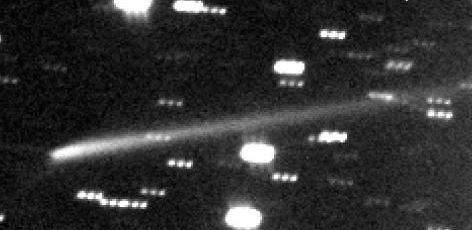
But P/2010 A2 — discovered by the Lincoln Near-Earth Asteroid Research (LINEAR) sky survey — has a circular orbit and it still appears to be venting something into space.

P/2010 A2 (LINEAR): A comet or asteroid debris? (Spacewatch/U of Arizona)

There is the possibility that it is a member of a very exclusive bunch of objects known as main belt comets (MBCs). MBCs are confused asteroid/comet hybrids that appear to spontaneously vent vapor and dust into space and yet stay confined to the asteroid belt. But, if P/2010 A2 is confirmed to be one of these, it will only be the fifth such object to be discovered.

So what else could it be? If the potential discovery of an MBC doesn’t excite you enough, it could be something else entirely: the dust produced by a hyper-velocity impact between two asteroids. If this is the case, it would be the first ever observation of an asteroid impact in the Solar System.

The asteroid belt isn’t the same asteroid belt you might see in science fiction; although there are countless rocky bodies in our asteroid belt, it is rare that these rocky bodies encounter each other. Space is very big, and although the density of asteroids in this region might be considered to be “high”, this is space we’re talking about, you can fly a spaceship through the region without having to worry that you’ll bump into something. The average distance between asteroids is huge, making it a very rare occurrence any two should hit. But given enough asteroids, and enough time, eventually asteroid collisions do happen. And in the case of P/2010 A2, we might have been lucky.

Asteroid collisions: Rare, but possible.

The chatter between comet/asteroid experts is increasing, and on one message board posting, Javier Licandro (Instituto de Astrofísica de Canarias, Spain) reports observing a secondary asteroid traveling with the cloud-like P/2010 A2.

The asteroid moves in the same direction and at the same rate as the comet,” reports Licandro on The Minor Planet Mailing List. “In addition, the P/2010 A2 (LINEAR) image does not show any central condensation and looks like a ‘dust swarm’.”

A short lived event, such as a collision, may have produced the observed dust ejecta.”

Therefore, this ‘comet’ may actually be the debris that was ejected after a collision between two asteroids. Although these are preliminary findings and it’s going to take some serious observing time to understand the true nature of P/2010 A2, it’s exciting to think that we may just have observed an incredibly rare event, 250 million miles away.

Source: Discovery News

Warning, Over-Hyped Title Alert: But It’s A Frackin’ SUPERNOVA!

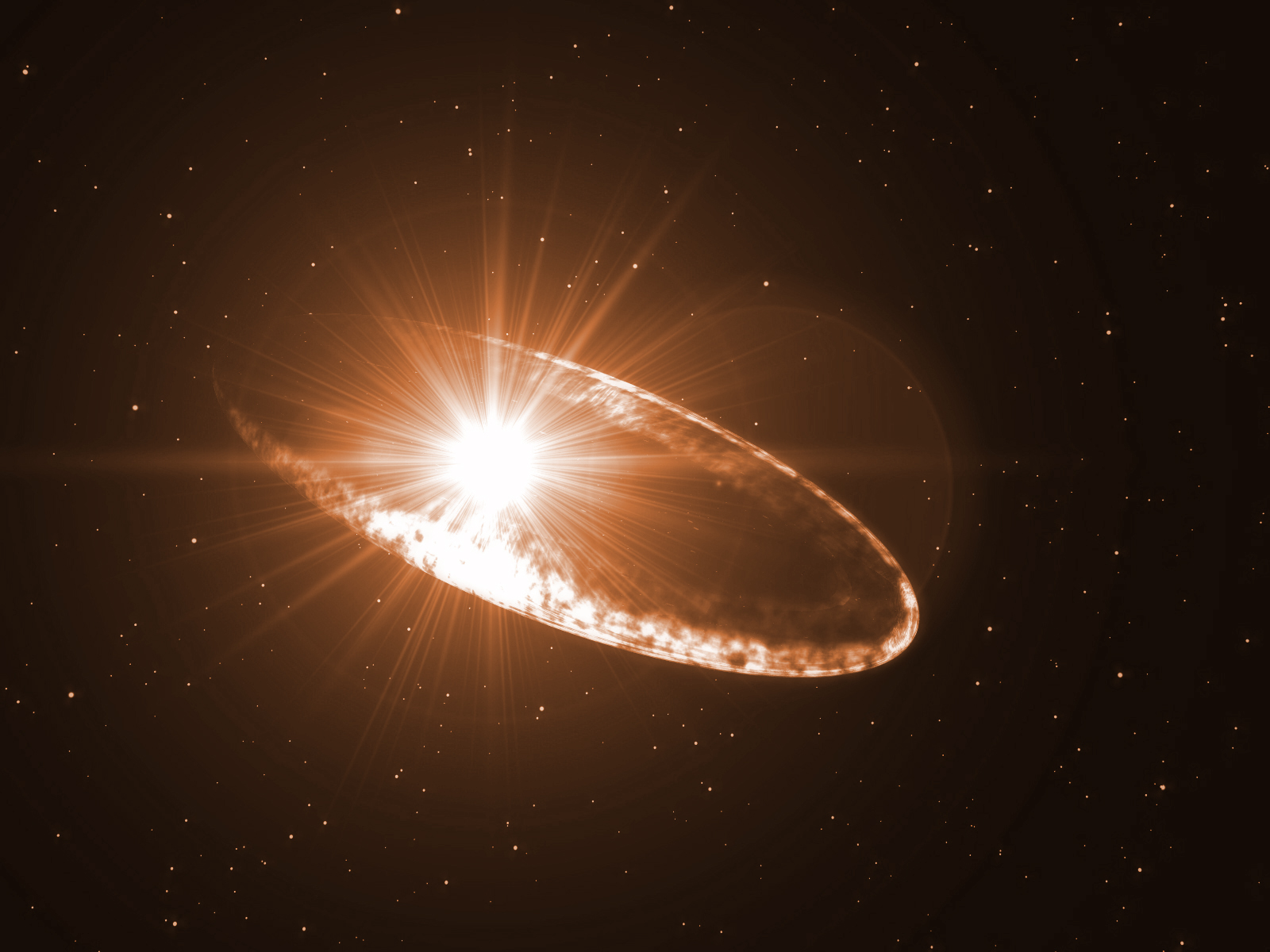
"SuperNova" by Shadow-Trance (DeviantArt)

I’m not kidding, last week was a huge mess of a supernova doomsday circus. It was like whispering “there’s a bomb under your chair” to the person next to you in a crowded theater and then watching the resulting flood of people slam into the fire escape. It was internet chaos. And there was no stopping it.

I am of course talking about the first, great doomsday scare of 2010: T Pyxidis.

Luckily for me, the first headline I saw was in the UK’s Telegraph that read “Earth ‘to be wiped out’ by supernova explosion.” Uh oh, that title sounds rather definite. Immediately, the bullshit sensor in my brain was tripped so I stopped flicking through the embarrassing excuse for a UK newspaper and had a read.

According to the article, some star (that I can’t pronounce) was “set to self-destruct” (as a big hairy supernova), a little over 3,000 light years away. Global chaos will therefore ensue. The ozone layer will be stripped away… and the Earth will be “wiped out.” (I still can’t work out how the Earth will be “wiped out.”)

I’m only picking on the Telegraph.co.uk as my skepticism knives were already sharpened after a series of idiotic woo-fueled articles (here, here and here) the website has played host to in recent months, but they weren’t the only news outlet to go batshit crazy with the “WE’RE ALL GONNA DIE” angle.

But who was really to blame for this mess? After all, the media was just the messenger, they must have gotten their lead from somewhere. Ah yes, the scientists… what did those guys really say?

You can find out how I got to the bottom of the science behind the hype in my Discovery News article “Will Earth ‘Be Wiped Out’ by a Supernova?” but cutting to the chase, it turns out that the scientists may have been a little hasty in their attempt to make international headlines.

As my mate Phil Plait mentions in his excellent write up (about my write up) of the T Pyxidis debacle on Bad Astronomy, this isn’t just a simple case of media hype, a lot of the blame should lay with Edward Sion et al. from Villanova University in Philadelphia.

Sure, some of the numbers didn’t add up (mistakes happen), but issuing a press release with a huge wad of inaccurate doom wrapped inside is pretty irresponsible. Have a read for yourself:

An interesting, if a bit scary, speculative sidelight is that if a Type Ia supernova explosion occurs within [that distance] of Earth, then the gamma radiation emitted by the supernova would fry the Earth, dumping as much gamma radiation (~100,000 erg/square centimeter) into our planet [sic], which is equivalent to the gamma ray input of 1000 solar flares simultaneously. –Excerpt from the Villanova press release, “THE LONG OVERDUE RECURRENT NOVA T PYXIDIS: SOON TO BE A TYPE Ia SUPERNOVA?”

“…fry the Earth”? Come on, that’s not even an accurate scientific term about what would happen if we were hit by a surge of gamma-rays. What’s wrong with saying “…the Earth would be at the receiving end of a Death Ray”? If you’re going to do the job of the tabloid press, hyping up your own research before the tabloid press has even read the release, you may as well be accurate.

And speaking of accuracy, my colleague Ray Villard was at the AAS and confirmed that Sion’s numbers were out by a factor of 10. “A supernova would have to be 10 times closer [to Earth] to do the damage described,” Ray said.

Although I was tough on the Telegraph in my Discovery News article (let’s face it, with an inaccurate and inflammatory title like that, they had it coming), in this case I think the main issue lies with Sion and co.

Why over-hype your research to get attention, when the research was interesting enough without declaring doomsday? By me even writing about the subject again, I think I just answered my own question.

But on a plus point, at least everyone knows what T Pyxidis is now…

Vote Discovery News for a Shorty Award…

…otherwise some Twilight fan site might win. And that would be bad.

I don’t really get the whole smoldering vampire craze that’s going on at the moment, but the movies New Moon and Twilight certainly have fans going nutty about fangs and moody teenagers. I actually saw Twilight the other day, and it was the first film I’ve ever seen acted through… awkward glances. I felt embarrassed watching it. Not because it was bad; it’s that you really feel the teenage angst ooze from the DVD. For that reason alone it was certainly well acted. Will I watch the sequel New Moon? Probably, if I tripped, fell and found myself in a theater with a jumbo bag of popcorn. Of course not! (Might do.)

Anyhow, this Twilight thing has gotten out of hand, and in the “Oscars of Twitter” (the Shorty Awards), a Twilight fan club is powering up the charts in the #news category. Yes, that’s #news (note the bold hashtag there).

As none of the mainstream news heavyweights appear to be in contention for the #news title, Team Discovery News has decided to dominate this category, aiming to at least catch up with the teeny vampire fan club. But it’s not going to be easy, they have 450 votes. We have… 16. But from small acorns, a Discovery News Shorty Award may grow! Plus we only started campaigning today, so anything could happen.

So, if you’re a fan of the sci-tech news we produce at Discovery News, and you’ve been following our informative, witty, awesome tweets, please consider voting for us by tweeting:

I nominate @Discovery_News for a Shorty Award in #news because [insert reason here]

For example: “I nominate @Discovery_News for a Shorty Award in #news because their science news rocks my cosmos,” or “I nominate @Discovery_News for a Shorty Award in #news because vampires suck cheese.” You get the picture.

Alternatively you can place your vote on the Shorty Awards page and keep track on how @Discovery_News is doing.

As always you can also follow my awesome tweeting action on @Discovery_Space and @astroengine. My pet rabbit has also taken to microblogging, so you might want to get the inside scoop from him too: @Barney_Bunny.

Thanks to our Discovery News sustainable tech writer Alyssa Danigelis for the tip-off!