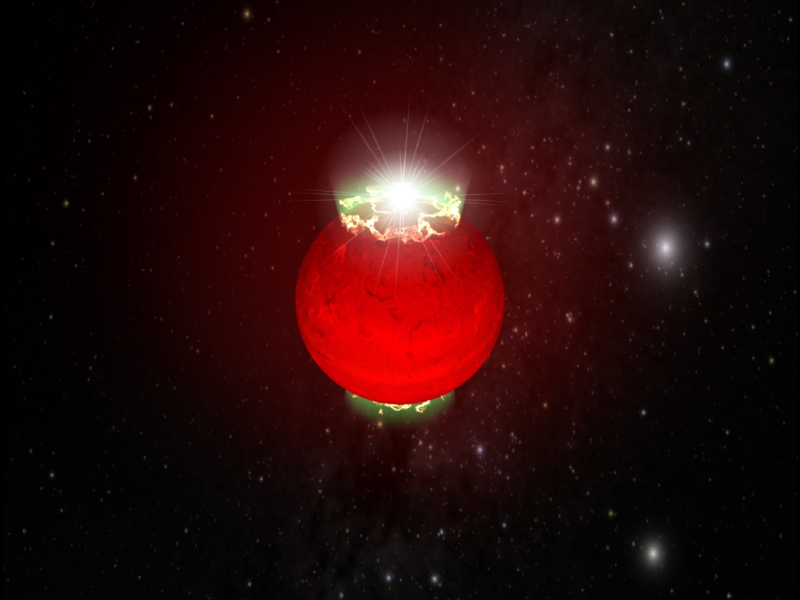
Brown Dwarfs: “Over-Achieving Jupiters” not “Failed Stars”

browndwarf3

Why is the term “failed star” synonymous with brown dwarfs? On the one hand, brown dwarfs lack the mass to sustain nuclear fusion in their cores. On the other hand, who said brown dwarfs were trying to be stars? Who ever said that becoming a star was the pinnacle of stellar living? Perhaps brown dwarfs are perfectly happy the way they are. In a world of equality and political correctness, brown dwarfs could be viewed as “over-achieving Jupiters”, or gas supergiants
Continue reading “Brown Dwarfs: “Over-Achieving Jupiters” not “Failed Stars””

An Explanation For Solar Sigmoids

Hinode X-ray observation of a solar sigmoid (David McKenzie/Montana State University)

Sigmoids in the solar corona have been studied for many years, but little explanation of their formation or why they are often the seed of powerful solar flares have been forthcoming. Using high-resolution X-ray images from the Japanese-led solar mission Hinode (originally Solar-B), solar physicists have known that these very hot S-shaped structures are composed of many highly stressed magnetic flux tubes filled with energized plasma (also known as ‘fibrils’), but until now, little was known about the formation and flare eruption processes that occur in sigmoids.

Now, a team of solar physicists from the University of St Andrews believe they have found an answer using powerful magnetohydrodynamic (MHD) computer models, aiding our understanding of coronal dynamics and getting us one step closer to forecasting space weather…

Continue reading “An Explanation For Solar Sigmoids”

Are Brown Dwarfs More Common Than We Thought?

A brown dwarf plus aurorae (NRAO)

In 2007, a very rare event was observed from Earth by several observers. An object passed in front of a star located near the centre of the Milky Way, magnifying its light. Gravitational lensing is not uncommon in itself (the phenomenon was predicted by Einstein in 1915), but if we consider what facilitated this rare “microlensing” event, things become rather interesting.
Continue reading “Are Brown Dwarfs More Common Than We Thought?”

C.A.T. Scans of the Solar Wind

Guest article by Dr. Mario M. Bisi (Research Focus)

A cut in the ecliptic plane through a 3D reconstruction on 08 November 2004 at 0000 UT using white-light data from SMEI. The view is from directly North of the ecliptic; the Sun is at the centre marked by a +, the Earth is on the right marked with a ⊕ along with its orbit as a black near-circular line around the Sun (the Earth orbits anti-clockwise around the Sun from this point of view). The darker the colour, the greater the density of material in the ecliptic.  (©Dr. Mario M. Bisi)
A cut in the ecliptic plane through a 3D reconstruction on 08 November 2004 at 0000 UT using white-light data from SMEI. The view is from directly North of the ecliptic; the Sun is at the centre marked by a +, the Earth is on the right marked with a ⊕ along with its orbit as a black near-circular line around the Sun (the Earth orbits anti-clockwise around the Sun from this point of view). The darker the colour, the greater the density of material in the ecliptic. (©Dr. Mario M. Bisi)

The Computer Assisted Tomography (C.A.T.) technique has been used for many years now and is well known for use on people where certain health conditions need more thorough, detailed, and deeper scans into the human body and the need for three-dimensional (3D) reconstructed imaging. However, similar such scans can also be used on the solar wind to discover the shapes and sizes of structures near Earth and throughout the inner heliosphere in three dimensions. These scans have been carried out for some time, pioneered in the most part by those at the Center for Astrophysics and Space Sciences (CASS), University of California, San Diego (UCSD) in La Jolla, CA, U.S.A. in close-collaboration with the Solar-Terrestrial Environment Laboratory (STELab), Nagoya University, Toyokawa, Japan…
Continue reading “C.A.T. Scans of the Solar Wind”

WR 104: Not The Killer It Used To Be

WR 104. A killer? Not so much.

It’s interesting how astronomical harbingers of doom have the ability to pop up more than once on the ‘net. However, the doom isn’t quite as terrifying when you’ve sat through a conference presentation by a scientist who has exhaustively given every reason as to why this particular killer won’t hurt you.

Enter WR 104.

To be honest, if it wasn’t a Wolf-Rayet star, I probably wouldn’t be writing about it (as we all know, or you should know, Wolf-Rayets are my favourite stellar objects), but this little fact combined with the fact that I know the Earth is no longer on the WR 104 hit-list, I feel compelled to correct an article that has just popped up on the web referencing out-of-date source material.

So, let’s wind this back the clock to January 2009 when I sat in on a very reassuring this-star-isn’t-actually-going-to-kill-us-after-all astro presentation…
Continue reading “WR 104: Not The Killer It Used To Be”

Star Formation: The Game

starformation

Dave Mosher, I’m pointing my finger at you for this late night effort! Usually I stay up late to write articles, but for the last 30 minutes I’ve been playing this game after Dave sent a message on Twitter saying he had been playing a “simple” and “addictive” star formation game. No kidding! I shouldn’t have even clicked the link. But like a caffeine-infused moth to a super-shiny flame, off I went for some simple star-creation fun.

It looks like the Star Formation game is part of Discover Magazine’s featured article about the mysteries of star birth (it’s a great read, check it out). The game is simple, yet captivating (despite a few minor bugs). You play the role of supernova progenitor, dropping some massive star fury on an unsuspecting nebulous cloud of hydrogen. According to the game developers, the situation is physically accurate, it is just up to you to create the perfect conditions for stars to form in the dense cloud. It would appear the lectures I attended on star formation paid off, as I speak I’m on top of the leaderboard with a whopping 21122 points (see the screengrab above, I saved it posterity, I doubt I’ll be at #1 for much longer).

I’m all for games with an educational element, and I can’t think of a better way to spend an evening (well, I can, but if you’re stuck in the office, this is a great alternative to work). I’m off to create some more stars, check out Discover so you can do the same (just you try to knock me from the #1 slot!).

What Will Happen When the Sun Turns into a White Dwarf?

Strong tidal interactions are thought to shred any asteroids or comets as they get too close to a white dwarf (NASA)

All the way back in January, I had the great fortune to attend the American Astronomical Society’s (AAS) conference in Long Beach, California. I had a lot of fun. However, between the free beer and desperately searching for wireless Internet signal, I also did some work. During my travels, I spent some time browsing the poster sessions, trying to get inspiration for an article or two. You’d think that when presented with hundreds of stunning posters that inspiration wouldn’t be that far away. However, I was repeatedly frustrated by information overload and defaulted to a clueless meander up and down the pathways walled with intense science debates.

But then I saw it, right at the end of one of the poster walls, a question that got my imagination bubbling: “Will The Sun become a Metal Rich White Dwarf After Post Main Sequence Evolution?” The Sun? After the Main Sequence? Metal rich? To be honest, these were questions I’d never really pondered. What would happen when the Sun turns into a white dwarf? Fortunately, I had Dr John Debes to help me out with the answers…
Continue reading “What Will Happen When the Sun Turns into a White Dwarf?”

When the Sun is So Boring, Anything Becomes Interesting

Caption: So boring it doesn't deserve a caption (NASA/SOHO)

You know when you have those unremarkable days, those periods of time you experience you know you’ll forget tomorrow? It’s either “just another” day at work, another commute, or a Sunday where you had a beer, fell asleep, only to wake up again to realise it was too late to get up so you stayed in bed till Monday? (And no, I don’t make a habit of that. I’m sure to have at least two beers.) Most days aren’t like that for me, usually I can think of one noteworthy event that sets apart one day from the next, but sometimes it’s as if Stuff Happens™ doesn’t.

It would appear the Sun is having an extended period of time where Stuff Happens™ is at a premium, so you have to make the most of when something really does happen. In this case, the Sun released a crafty CME, thinking we wouldn’t see it…
Continue reading “When the Sun is So Boring, Anything Becomes Interesting”

Reality, Virtual

Computer technology is reaching new levels of sophistication, limited only by our imagination (and that pesky Moore’s Law). As we develop faster and more powerful processors, an exponential increase in the number of calculations can be done per second, providing advanced software with the capability to deliver complex applications to the user. In fact, some computer operations are becoming hard to distinguish from basic human interactions (neural networks hold particular promise).

Naturally, this continuing advance in technology has stimulated the Internet, allowing users worldwide to interact at great speed, where virtual worlds have been created, and people can project themselves as an avatar (a virtual ambassador for their real-world personalities). These virtual worlds have become so immense that millions of users can interact, and the boundary of the universe is only limited by how many networked computers you have running the show. These virtual universes are known as Massively Multiplayer Online Role Playing Game (MMORPG), and NASA hopes to release their universe (Astronaut: Moon, Mars and Beyond) some time next year.

User interfaces are advancing too. Gone are the days of simple gaming feedback features (such as a rumbling joypad when your 3D animated cartoon character suffers a blow on your 2D TV screen), virtual reality is starting to live up to its name, where the virtual world is overlapping with our real world. Now a 5-sense virtual reality system is undergoing tests, and its implications for NASA’s MMORPG and future space exploration could be huge…

When does virtual reality become… reality?

Imagine: You’ve just completed your expedition inside the Hellas impact basin on the surface of Mars. You can smell the new plastic inside your spacesuit and hear the hiss of your air supply in the back of your bulbous helmet. Looking out over the crater bottom, the 9 km high wall of Martian rock restricts your view of the planet; there’s a feeling that you are closed into a huge hole dug out by an unimaginably large shovel. Looking down, you survey the scattered rocks and rusty regolith. Although your suit isn’t as bulky as what is needed on the Moon or during an EVA, it still restricts your movement as you bend over to collect more fist-sized rocks for your research. Surprisingly, the ground is very frosted and you spot small collections of water ice. It hasn’t sublimed into the air.

As you are so deep, the air pressure is nearly twice as high as the atmospheric average. According to orbital measurements, it may even get warm enough for liquid water to exist on the surface. This is why you’re here, to seek out signs of seasonal weathering on the samples, and to look for signs of large quantities of water to be used in your habitat. Looking around, this isn’t just a gentle winter frosting, water is here, and there’s lots of it…

As we may not be sending man to Mars for a long time yet, the above scenario could be just as well played out in virtual reality as in real life. As there is little political incentive for a NASA-led manned mission to the Red Planet any time soon (and no, an Apollo 2.0 to Mars to save the ailing US economy isn’t the incentive we are looking for), could a virtual Mars be constructed for training and exploration purposes?

As it turns out, NASA is currently working with a group of software companies to release “Astronaut: Moon, Mars and Beyond” (reminds me of the awesome 1999 “X: Beyond the Frontier” first-person space adventure game). The scheduled rollout date is sometime in 2010, but it looks like the MMORPG is already a long way down the road of development. This new NASA universe will be based in a near-future reality where online subscribers can play the role of explorer, doing “mundane” astronaut tasks in low-Earth orbit, to setting up colonies on the Moon and Mars. Although I doubt the NASA universe will be able to compete with online fantasies such as Second Life or World of Warcraft, it may invigorate space science outreach to the largest audience available. A worthy project in my view, Astroengine will be watching developments very closely.

Then, yesterday, GearCrave posted an article about the development of a “5-sense virtual reality system”. We all remember those cumbersome head boxes that promised to be the “dawn of a new age” in computer visualization back in the ’80’s and ’90’s. Unfortunately, little had changed as the hardware simply wasn’t there to display anything close to a “virtual reality” (giving the user a bout of nausea and unrealistic graphics). Also, the user feedback was very one-dimensional. However, as time has moved on, and the gaming industry has driven graphic hardware into a new era, we suddenly have a suite of user feedback systems (such as a rumbling joypad or the sense of touch through a special glove). Now there is the desire to move from the 2D TV screen, immersing the user inside a more realistic “virtual reality”. In fact, this new development provides user feedback via several senses: sight, sound, smell, taste and feelings.

Researchers from York and Warwick universities are developing the ultimate virtual reality headset, that won’t directly manipulate the brain (via electrode-induced agony) but manipulate the senses to induce an emotional response. This will be achieved through the use of hi-tech smell and taste sprayers. Also, the visual element will be stunning. The screen will naturally be in high definition, with far greater light and dark limits. To say the view will be crisp is an understatement.

So, we now have the ability to create our own virtual universes. We are fast approaching the point where fully-immersive virtual reality may be a possibility (although the brain can be tough to trick at times, the VR would have to be VERY good to fool us wily humans). Computer systems are becoming so advanced that “graphics” may be a bad description of the world you are participating in looks like you are in a real world. Also, the spin-off technology from the Large Hadron Collider (LHC) could effectively make the Internet transparent (the only limit on speed would be the speed of light when uploading/downloading files, imagine that).

Personally, I cannot imagine a future where mankind is stuck on Earth, just sending probes to do the exploration of space for us, but say if these robotic missions could do something a little more than basic reconnaissance missions? What if the unmanned rovers, landers and satellites become so advanced that they can collect all the data we’ll ever need from the planets in the Solar System? This data could be used in a sufficiently advanced distributed network on Earth, allowing Internet users to collaborate (in the spirit of existing online projects such as Galaxy Zoo, but powered by a fully immersive MMORPG system), exploring a virtual reality universe based primarily on real data, but with intelligent algorithms that fill in the details and known physical/biological processes. However, in this virtual reality, users will be able to see, smell, hear, taste and feel, with physical feedback mechanisms.

This kind of project would have a vast array of practical applications; from doing science with real data, to training astronauts/settlers ahead of a real mission to Mars. However, there are two mind-bending philosophical questions that are attached to this eventuality:


Ceres: Life? Pluto: Not So Much

The dwarf planet soap opera continues

The dwarf planet Ceres. Fuzzy (NASA/Hubble)

Could the dwarf planet Ceres maintain life? Possibly, says a scientist from a German university. According to new research, this ex-asteroid (who did a deal with the IAU to sell out Pluto, trading in its asteroid status to become a dwarf planet, at the expense of Pluto being demoted from being a planet. Obviously) may have harboured microbial life near geothermal vents in hypothetical liquid oceans (I emphasise hypothetical). Not only that, but Ceres’ chilly microbes could have been kicked into space by meteorites, spreading life throughout the Solar System. Forget Mars (you’re looking too hard), forget Europa (a moon? With life? Pah), the new giver of life could be Ceres, the dwarf planet we know next to nothing about.

Then there’s Pluto. Not much chance of life there either (although it would be fun to speculate, there is methane there after all), but the hard-done-by newly-christened dwarf planet has a rather bizarre atmosphere. Its temperature profile is upside down. Oh, and Pluto has just been reunited with its planetary status… in Illinois only (because a governor really does know more about planets than 400 members of the International Astronomical Union).
Continue reading “Ceres: Life? Pluto: Not So Much”