What Type of Star is Our Sun?

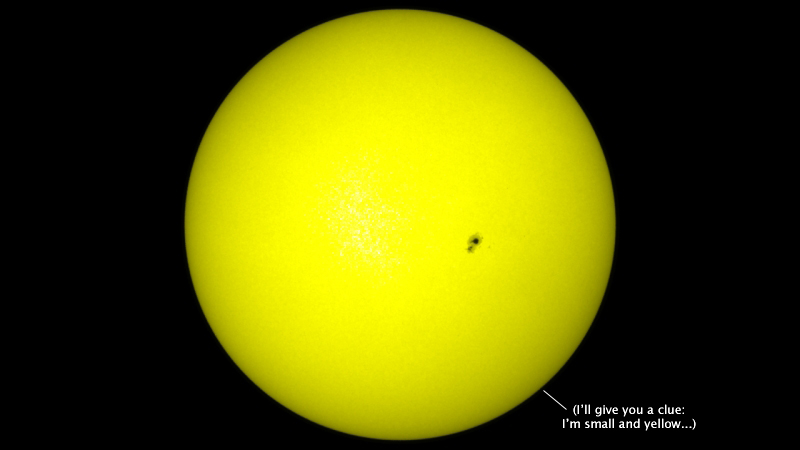
High-spatial and temporal resolution view from the Hinode SOT G-band filter (NASA)

Our Sun is often called an “average” or “unremarkable” star. This is a little unfair, after all this unremarkable specimen is responsible for generating all the energy for all the planets in the Solar System and it has nurtured life on Earth for the past four billion years. We are also very lucky in that the Sun (or “Sol”) is comparatively stable with a periodic cycle. What’s more, it is alone, with no binary partner complicating matters. We live in a very privileged corner of the Milky Way, within the “Goldilocks Zone” (i.e. “just right” for life – as we know it – to thrive) from Sol, where there is a unique and delicate relationship between our star, the Earth and interplanetary space. This is all great, but in the star club, how does Sol measure up? Is it really just an average, boring star?

I noticed in the comments of my article Observing an Evaporating Extrasolar Planet that some readers were discussing the classification of our Sun. This was in response to the subject of the exoplanet called HD 209458b orbiting the yellow dwarf star HD 209458 in the constellation of Pegasus. I happened to point out that HD 209458 was “…not too dissimilar to our Sun (with 1.1 solar masses, 1.2 solar radii and a surface temperature of 6000 K),” but also highlighted that HD 209458 was a yellow dwarf star. To be honest, I didn’t think about the connection until Jerry Martin asked why our Sun is never referred to as a yellow dwarf star? Helpfully, Dave Finton posted a link to Wikipedia that discusses this topic. For the full wiki treatment, have a look at Wikipedia:G V star, otherwise read on…

The Hertsprung-Russell diagram – stars plotted by their absolute magnitude, luminosity, classification, and effective temperature.

In the Hertzsprung-Russell Diagram, all known stars fall into one of six broad classifications depending on their luminosity and surface temperature. Observed stars can either be classed as (from big to small) a super-giant, bright giant, giant, sub-giant, main sequence or white dwarf. Within those classifications are spectral sub-classes from “O” (surface temperature of 30,000K), “B”, “A”, “F”, “G”, “K” to “M” (at 3,000K). However, for the sake of keeping this article on-topic, we’ll focus on our star, Sol (which is Latin for Sun).

Granted, our Sun has a surface temperature of around 6,000K, giving it a spectral classification of “G”. On the luminocity scale, our Sun scores a “V”. So, the Earth orbits a “G V star” which is otherwise known as a Yellow Dwarf star (although their actual colour ranges from white to slightly-yellow). Why is Sol considered to be “average”? That’s because in the Hertzsprung-Russell Diagram, yellow dwarfs can be found right smack-bang in the centre of the chart, half-way down the Main Sequence. Using this chart gives an idea about where our star came from and where it is going. For the moment, it is a hydrogen-burning star, converting 600 million tonnes of hydrogen into helium per second. This “hydrogen burning phase” generally lasts for about 10 billion years (Sol is about half-way through this phase) until all the hydrogen fuel is exhausted. When this happens, a yellow dwarf will puff up into a Red Giant, eventually shedding its outer layer, producing a planetary nebula. Eventually, the core will cool and compress into a long-living white dwarf star.

So, to answer the question, the Sun is a yellow dwarf star… and it certainly is not unremarkable

Could Warp Drive Become a Reality?

The physics behind the warp drive (Richard Obousy and Gerald Cleaver)

In science fiction, the “warp drive” helps Captain Kirk, Jean-Luc Picard, Commander Janeway and Benjamin Sisko potter around space with ease. Without warp speed, TV episodes of Star Trek would stretch into months and seasons would last decades. Alas, even science fiction succumbs to the laws of relativity: Nothing, not even light (or a Klingon) can travel faster than the speed of light. As I researched for a recent Universe Today article, the space between the stars is prohibitively large, even the nearest star is over 4 light years away (Proxima Centauri), so how could it be possible for USS Enterprise to flit from one star system to the next without putting a dent in Einstein’s theory of relativity? The answer comes if we realise that although light speed is a physical limit on how fast things can travel through space-time, there is no limit on how fast space-time can travel if it is warped. Suddenly we have a theoretically possible means of travelling between the stars by altering the fabric of the Universe in a warp “bubble”…
Continue reading “Could Warp Drive Become a Reality?”

Recoiling Supermassive Black Holes and Stellar Flares

Simulation of black holes colliding. In a word, awesome (Max Planck Group)

Astrophysicists love to simulate huge collisions, and they don’t get much bigger than this. From the discoverers of the first ever observed black hole collision back in April, new observational characteristics have been researched and Max Planck astrophysicists believe that after two supermassive black holes (SMBHs) have collided, they recoil and drag flaring stars with them. By looking out for anomalous X-ray flares in intergalactic space, or off-galactic nuclei locations, repelled black holes may be spotted powering their way into deep space at velocities of up to 4000 kms-1
Continue reading “Recoiling Supermassive Black Holes and Stellar Flares”

Observing Red Dwarf Stars May Reveal Habitable “Super-Earths” Sooner

A planet orbiting a red dwarf (NASA)

OK, so if you’re an exoplanet hunter, which stars would you focus your attention on? Would you look at bright blue young stars? Or would you look at dim, long-lived red stars? If you think about it, trying to see a small exoplanet eclipse (or transit) a very bright star would be very hard, the luminosity would overwhelm any attempt at seeing a tiny planet pass in front of the star. On the other hand, observing a planet transiting a dimmer stellar object, like a red dwarf star, any transit of even the smallest planet will create a substantial decrease in luminosity. What’s more, ground-based observatories can do the work rather than depending on expensive space-based telescopes…
Continue reading “Observing Red Dwarf Stars May Reveal Habitable “Super-Earths” Sooner”

Poll: In Your Opinion, What Will be the First LHC Landmark Discovery?

Working on the LHC (CERN)

The first experiments to be carried out by the Large Hadron Collider (LHC) at CERN are on the horizon. Some people are frightened by this historic particle accelerator, but the science community is abuzz with anticipation and excitement. Although some of the conditions of the Big Bang will be recreated, it is important to remember a second “Bigger Bang” will not be generated – although the LHC is powerful, it’s not that powerful!

There is a rich variety of experiments that will be carried out by a variety of LHC detectors in the 27 km circumference ringed accelerator. These experiments include ATLAS, CMS, ALICE, LHCb, TOTEM, and LHCf. All have their own specific goals, but a few possible discoveries stand out as being revolutionary for particle physics and cosmology alike. I’ve written a host of articles about the LHC and I have my own personal hopes for what could be discovered, but I’d be interested to get your views too…
Continue reading “Poll: In Your Opinion, What Will be the First LHC Landmark Discovery?”

Wolf-Rayet Star: My Favourite Stellar Object

Artist impression of a Wolf-Rayet star (NASA)

Wolf-Rayet (WR) stars are my favourite stellar objects bar none. Due to the excitement factor I find them even more interesting than black holes, pulsars and quasars. Why? Well, they are a significant period of a massive star’s lifetime making its violent, self-destructive death, possibly culminating in a supernova or gamma ray burst (GRB). WR stars blast out dense stellar winds creating a bubble of matter that completely obscures the star’s surface from any attempts at observation. They are also very noisy neighbours, disrupting binary partners and messing up huge volumes of space. If you thought a star might die quietly, the WR phase ensures this isn’t the case and astronomers are paying attention, making some of the most detailed observations of WR stars yet…
Continue reading “Wolf-Rayet Star: My Favourite Stellar Object”

Are Primordial Black Holes Antimatter Factories?

A black hole, artist impression (NASA)

Could small, primordial black holes be efficient antimatter generators? It is well known that cool planetary bodies, surrounded by equal numbers of protons and electrons in thermal equilibrium, will eventually become positively charged. Why? Because electrons, with their low mass, have a higher velocity than the larger protons. Although they undergo the same gravitational acceleration, electrons are able to attain “escape velocity” more readily as the more massive protons get stuck in the gravitational well. The result? The planet has a net positive charge as more electrons, than proton escape into space.

Primordial black holes are thought to exist in our Universe (left-overs from the Big Bang), and although they may be small, they may influence ionized cosmic clouds in the same way, more electrons escape than protons left behind. However, should a threshold be reached, the extreme gravitational force surrounding the black hole could set up a powerful electrostatic field, kick-starting a strange quantum phenomenon that generates the electron’s anti-matter partner (the positron) from the vacuum of space…
Continue reading “Are Primordial Black Holes Antimatter Factories?”

Why is the LHC so Important? I’ll let Brian Cox Explain…

I’ve only just stumbled on this fantastic presentation Brian Cox did in Monterey, California in March this year explaining the stunning science behind CERN’s newest addition. I have followed the progress of the Large Hadron Collider (LHC) intently and I personally cannot wait until the accelerator is turned on. There has been much debate about the safety of the LHC and there have been some seriously nutty theories about the bad things that the LHC could (never) do. So, rather than waste any more time on the (impossible) negatives, let’s take a look into how the LHC is going to alter mankind’s view on the Universe forever with the help of Brian Cox at his best…
Continue reading “Why is the LHC so Important? I’ll let Brian Cox Explain…”

Supermassive Black Holes are Not Fussy Eaters

The core of M81 (Chandra/NASA)

By combining observations from a multitude of observatories, all looking at spiral galaxy M81, astronomers have taken a very close and intimate look at a supermassive black hole’s feeding habits. As supermassive black holes (of tens of millions of solar masses) and stellar black holes (of a few solar masses) exist in entirely different environments, astrophysicists were uncertain as to what supermassive black holes feed on. Stellar black holes eat away at the gas from companion stars, creating an accretion disk, generating a range of emissions as stellar gas falls into the disk. But where do supermassive black holes get their food? It turns out they feed off gas in the central region of galactic cores, generating similar emissions as their smaller stellar cousins. What’s more, this finding supports Einstein’s theory that all black holes, regardless of mass, share the same characteristics…
Continue reading “Supermassive Black Holes are Not Fussy Eaters”

Is the Sun a Dark Matter Factory?

Hinode X-ray observation of a solar sigmoid (David McKenzie/Montana State University)
The hypothetical axion is a particle that might help scientists work out where the bulk of dark matter may be held in the Universe. So far, there has been much talk about the search for another type of hypothetical particle, the weakly interacting massive particle (WIMP), and little attention has been paid to the lowly axion. WIMPs are very appealing to scientists as proving they exist will help patch some holes in quantum theory. What’s more, WIMP detectors need to be huge, large volumes of underground caverns filled with hi-tech sensors and cleaning fluid – this makes for a cool funding proposal; think up and grand idea, explain that it will prove our understanding of the Universe and then receive a multi-billion $/£/€ cheque (it’s not quite as easy as that, but there are socioeconomic and political reasons for building such an awesome structure).

So how do you go about finding an axion? Surely this exotic particle will need an even bigger detector, especially as it has zero charge, very low mass and cannot interact via the strong and weak nuclear forces? Actually, a large WIMP-type detector would be useless for axion detection. Fortunately axions have a neat interaction with magnetic fields that can be detected with existing instrumentation. What produces the strongest magnetic field in the Solar System? This is where the Sun can help out…
Continue reading “Is the Sun a Dark Matter Factory?”