It’s been a while since I last posted as I’ve been flying from the US to the UK and have only just gotten my office up and running. That’s not to say I haven’t been writing. On the Universe Today, I’ve posted quite a few articles ranging from quite an elaborate April Fools story (but not quite as elaborate as Virgin and Google’s Virgle prank), to a black hole hiding in the middle of Omega Centauri, to rocks rolling around on Mars… here’s a round up of the most interesting…
Continue reading “Astroengine.com Roundup and Opinion”
Category: Physics
What’s Going on with These Sunspots? Are they from Solar Cycle 23 or 24?
On posting the story “The Sun Bursts to Life: Sunspots, Flares and CMEs” on the Universe Today, something was strange about my source material. Although the Sun had started Solar Cycle 24 back in January of this year, the new sunspots recently observed were the “leftovers” from the previous cycle and not new ones from this cycle. Something is strange. Surely one cycle ends and another begins? Think again…
Continue reading “What’s Going on with These Sunspots? Are they from Solar Cycle 23 or 24?”
How do you Build a Laser with a Black Hole?

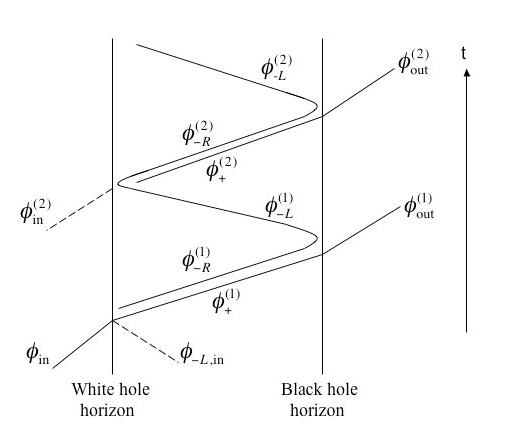
Lasers. Very cool and exciting toys. They have also revolutionized science and technology. Through a comparatively simple process, photons are bounced backward and forward within an optical cavity. Stimulated emission from the quantum states of the material within the cavity causes more and more photons to be generated. Eventually a threshold is reached and laser emission results, producing a collimated beam of a defined wavelength.
So where do black holes come into all this? Well, it is theorized that black hole event horizons produce radiation. Hawking radiation, although not yet proven, is probably responsible for the only emission from a black hole. It may even cause the black hole to evaporate. But what if this radiation could be used in the ultimate laser cavity? Some Scottish researchers think it might be possible… in theory…
Continue reading “How do you Build a Laser with a Black Hole?”
Daily Roundup: Astrium Spacecraft Mass Production, Saturn’s Rings and Quantum Communications
It looks like things are really beginning to develop for the space tourism era. European rocket manufacturer Astrium has announced plans to develop the next generation of small space planes capable of sending 5 people into space. This design is different from the rest as it will take-off and land conventionally and will use jets for atmospheric flight but blast into space with a powerful oxygen-methane rocket. The promo video is also pretty exciting, documenting the two hour flight by means of a simulation…
Continue reading “Daily Roundup: Astrium Spacecraft Mass Production, Saturn’s Rings and Quantum Communications”
Artificial Cosmogenesis – Building a Virtual Universe
The Universe as we know it could be in big trouble. I have reported before on situations where our universe may be changing beyond the realms of “normal” physics, but the “heat death problem” could be a physical situation where the Universe will eventually expand so far that all energy will dissipate and be lost. Thermodynamics will eventually catch up with all the stars in the cosmos, ensuring they extinguish, all energy ebbing away into frozen space. Even the last of the supermassive black holes will evaporate after 10150 years. What’s left then? Well… nothing. So the question is: if a sufficiently advanced incarnation of the human race can beat the increasing entropy of the cosmos, can the future “us” continue to live beyond the heat death? Some rather philosophical ideas have come to light, including the creation of a virtual universe…
Continue reading “Artificial Cosmogenesis – Building a Virtual Universe”
How do you catch a Supernova in the Act? Build a Neutrino Detecting, Early Warning Device.
Observing a supernova as it happens is a very tough thing to do. If you blink, you’ll miss it. Astronomers are constantly trying to find ways to look in the direction of a massive star just before it blows, but supernova prediction is a very young science. Now, combining the sensitivity of neutrino detectors and attempting to make the data as “real time” as possible, the SuperNova Early Warning System (SNEWS) is born, sending you a neutrino weather forecast direct to your inbox hours before a star explodes.
Continue reading “How do you catch a Supernova in the Act? Build a Neutrino Detecting, Early Warning Device.”
Supermassive Black Holes Can’t Swallow Dark Matter
Apparently, black holes and dark matter don’t play well together. Broadly speaking, black holes can be considered to be a significant portion of the “missing mass” in the universe, but dark matter is distinguished as “non-baryonic matter”. It seems that this mysterious non-baryonic matter is being used to explain a huge number of unexplained cosmic mysteries, but in the case of supermassive black holes, dark matter plays a very small role insofar as being used as black hole food…
Continue reading “Supermassive Black Holes Can’t Swallow Dark Matter”
Could Mars Quakes, Seasonal Temperature Changes or a Chance Meteorite Impact Cause Mars Avalanches?
It doesn’t get much better than this. A robotic orbiter snaps a photo hundreds of miles above the surface of an alien planet, capturing a geological event as it happens. Yes, we’ve seen Io’s immense volcanoes erupt, and we’ve seen huge storms rage on Jupiter, but often these large-scale planetary events are too massive for us to put into context and so we file them under “astronomy”. But, when we see an event like an avalanche on Mars, we can relate it with events on Earth, we have a “feel” for what this means. Suddenly an avalanche on Mars holds a special meaning to us; we instantly have a connection with other planets in our Solar System.
And now for the question… what caused the four near-simultaneous avalanches recently observed by the Mars Reconnaissance Orbiter?
Continue reading “Could Mars Quakes, Seasonal Temperature Changes or a Chance Meteorite Impact Cause Mars Avalanches?”
The Mischievous Nature of Primordial Black Holes
Primordial black holes are strange little critters. They’re not the product of a massive star recently gone supernova and they’re not as exotic as a wormhole, tunnelling a gateway into another dimension. They are very, very old remnants of the very beginning of our Universe. Much like the foamy bubbles left over from washing the dishes, a few bubbles stubbornly hang around on the side of the sink for an hour or so after the water has long gone. Primordial black holes (or PBHs for short) are just that, the leftovers from the very energetic (and very bubbly) Big Bang 14 billion years ago…
…but they’re not done causing trouble quite yet…
Continue reading “The Mischievous Nature of Primordial Black Holes”
Snippet: Where Science and Art Meet – The Internet “Universe” Frozen in Time
This striking image has been created by tracking the round-trip times of data packets sent from a web site in Virginia to thousands of nodes around the World Wide Web. Using a new technique, this visualization method (3D “hyperbolic geometry”) allows the viewer to analyse large amounts of data mapped around a sphere. Not only does it give an insight to where data travels around the Internet – like an electronic dye highlighting the route packets of data take – it has also become a work of art…
Continue reading “Snippet: Where Science and Art Meet – The Internet “Universe” Frozen in Time”