Jupiter Got Smacked, Again

Quite frankly, I’m stunned.

An Australian amateur astronomer has just observed his second ‘once-in-a-lifetime’ event: an impact in the atmosphere of Jupiter. Phil Plait was very quick to get the news out, describing it as a “major coincidence,” and he ain’t wrong!

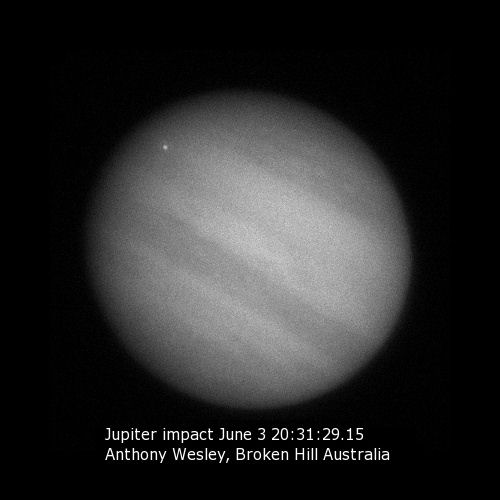
Anthony Wesley’s first event was the famous July 2009 observation of what was thought to have been the immediate aftermath of a comet impact in the Jovian atmosphere. His second happened on Thursday at 20:31 UTC when he was observing Jupiter when something hit the atmosphere, generating a huge fireball.

It is not known whether this event was caused by a comet or asteroid, but in a bizarre case of serendipity, earlier on Thursday Hubble released more information on his original impact event. The July 2009 “bruise” in the gas giant’s atmosphere is now thought to have been caused by an asteroid, and not a comet.

The Hubble press release included details on how researchers deduced that it was actually more likely that a 500 meter-wide asteroid hit Jupiter in 2009. One clue was that newly installed cameras on the space telescope detected little dust in the halo surrounding the impact site — a characteristic that was detected after the impact of the shards of comet Shoemaker-Levy 9 in July 1994. Also, the calculated trajectory of the 2009 event indicated the object didn’t have an orbit commonly associated with comets. If the 2009 event was an asteroid, that means Wesley saw something never seen before: the site of a recent asteroid impact on a celestial body.

And now, less than a year after being the first to see that impact aftermath, Wesley has done it again. Another amateur astronomer, Christopher Go, was quick to confirm Thursday’s fireball with a video of the 2 second flash in Jupiter’s upper atmosphere.

These impact events serve as a reminder about Jupiter’s fortuitous role in our Solar System. As the gas giant is so massive, its gravitational pull has a huge influence over the outer planets, dwarf planets, comets and asteroids. Acting like an interplanetary ‘vacuum cleaner’ Jupiter can block potentially disastrous chunks of stuff from taking a dive into the inner Solar System. It is thought that this distant planet has helped Earth become the thriving world it is today, preventing many asteroids and comets from ruining our evolution.

Thank you Jupiter!

Life on Mars? Only in The Sun.

In its haste to become the first newspaper to print the “NASA: Evidence of Life on Mars” headline, the UK’s Sun website caused a stir last week. Not only was this headline incorrect, it was a wee bit irresponsible.

For starters, no evidence for life has been found on the Red Planet. Second, NASA has not proclaimed such a discovery. In fact, The Sun riled the U.S. space agency so much, this headline prompted NASA spokesman Dwayne Brown to issue the following statement:

“This headline is extremely misleading. This makes it sound like we announced that we found life on Mars, and that is absolutely, positively false.”

So where did it all go so wrong?

This story stems from an astrobiology conference celebrating the 50th anniversary of the search for alien life. At this conference, findings by NASA’s Mars Exploration Rover Opportunity were reviewed. One of these findings was the tantalizing discovery of sulfates by the rover in 2004. Where there’s sulfates, water once existed. Where there’s water, life might have existed.

In an exciting twist to this discovery, scientists studying sulfate deposits on Earth (known as gypsum) were asked by scientists in the Mars Program to investigate terrestrial gypsum deposits more closely. Up until now, it was thought that gypsum contained no fossils, but on closer inspection it turns out that ancient gypsum deposits from the Mediterranean Sea (dated to about 6 million years old — when the sea was actually dry) are stuffed full of microscopic fossils of algae and phytoplanktons.

So, on Mars we have sulfates. On Earth we have sulfates (gypsum) full of fossils of aquatic microscopic life. If we know the terrestrial deposits of gypsum contain fossils of basic life forms, perhaps sulfate deposits on Mars would be a good place to start looking for basic ancient extraterrestrial life.

Of course, for the tabloid newspaper, these Martian sulfate deposits became “pond scum” and therefore “evidence” for life on Mars.

In actuality, the text of The Sun article wasn’t that misleading and actually did a good job of reporting the science (apart from the “pond scum” bit). Unfortunately, the title of the article let the rest of the article down, ultimately undermining the journalists’ work.

But, coming from the same publication that printed the silly “Pictures show life on Mars” article from 2008, the “Evidence for life on Mars” headline is pretty tame.

Now, time for the same news with a more appropriate headline by Irene Klotz on Discovery News: “Earth Fossil Find May Lead to Martian Discoveries

Thanks to Astroengine.com reader Judy Mason for inspiring this post.

Mars Rover Spirit Becomes “Mars Base Spirit”

Sorry Spirit, you're not coming home (see the full xkcd comic strip).

As far as space missions go, you couldn’t find a better epic tale than that of Mars Expedition Rover Spirit. Designed to last 3 months, roved for six years; lost the use of a wheel, turned it into a nifty trench-digging tool; nearly died, came back to life; had memory problems, shrugged them off… the list could go on for ever. However, it’s now official, this is one challenge the little wheeled warrior couldn’t beat; she’s stuck in the sand and there’s nowhere to go.

Mars Rover Spirit is now “Mars Base Spirit.”

Naturally when NASA broke the news that Spirit was going to remain stuck in a hole in Gusev crater for the rest of her days, we weren’t surprised, but everyone was sad. That little robot has captivated the world with all her escapades, and although she’s a machine, we’ve all personified Spirit. She’s the little rover that could.

And she‘s a girl, obviously.

But wait! Spirit is not dead quite yet. Spirit will hopefully become a stationary science probe if she makes it through winter (but that’s a big “if”). Once the Sun dips closer to the horizon during the winter months, less sunlight will hit the rover’s solar panels. Depending on how much energy Spirit has in reserves and how much dust coats the panels (making them less efficient at collecting the dwindling light), we could be looking at the end of the mission all together. Assuming she makes it through till spring, it’s conceivable that Spirit can be used as a weather outpost and, intriguingly, a tracking beacon to measure Mars’ wobble. The tiny wobble could lead scientists to understand the interior of the planet.

“We think we can actually determine whether the core of Mars is liquid or molten,” said Cornell University’s Steve Squyres, the lead scientist of the Mars rover program. “There’s compelling evidence that Mars once had a pretty powerful internally generated magnetic field and that probably required a core of iron that was liquid.”

If Spirit can make it through the winter and help NASA understand the interior of Mars, that would be the icing on the cake. Although Spirit may not be dominating the surface of Mars like her sister rover Opportunity (who’s notched up over 12 km so far and still going strong), perhaps she can dominate the interior of Mars by remaining stationary in the sand.

Tethys Plays Hide and Seek with Cassini

Which planet does Tethys orbit again?

I do admit, I’m terrible with names, but I never forget a face. In this case, the face I didn’t forget was a little moon orbiting Saturn (it’s the one that looks like the Death Star from Star Wars). However, after seeing this photo, I doubt I’ll ever forget Tethys’ name again.

In a photo snapped by the awesome Cassini Equinox mission back in November, the little moon with characteristic impact crater carved into its crust can be seen to be drifting behind Titan. Tethys only disappears for 18 minutes behind Titan’s thick atmosphere, but it was enough to ignite my interest in the icy world.

It’s strange how a simple photograph and perfect timing can ignite the imagination, as I doubt “just another moon shot” would have the same effect. No, this is a moon drifting in front of another moon as seen by a veteran spaceship orbiting the second largest planet in the solar system millions of miles away. Sometimes words are insufficient to describe the enormity of what we are doing in space.

So, sod the words and look at this, you won’t be disappointed:

And 18 minutes later:

Lovely.

Source and full-res images: NASA, Discovery News

Has Kepler Discovered a New Class of Celestial Object?

The strange objects orbiting the two stars could be mangled white dwarfs... but the jury is still out (NASA)

The first results from NASA’s Kepler exoplanet hunter are in and a perplexing early result has been announced. Yes, the space telescope is working fine, and no, it hasn’t spotted an alien homeworld (yet), but the Kepler team have uncovered something pretty cool.

Kepler may have discovered a new class of celestial object (possibly).

But before we start scratching our heads in confusion or popping the champagne corks in celebration, let’s try to work out what Kepler has observed.

Kepler is currently monitoring 100,000 stars in an effort to seek out extra-solar planets (or “exoplanets”) orbiting these stars. Although Kepler was only launched in March 2009 and early doubts about the observatory’s capabilities caused some low-level concern, Kepler appears to be functioning well and mission controllers are already reporting early results.

Five new exoplanet discoveries by Kepler were announced at the American Astronomical Society (AAS) meeting in Washington D.C. on January 4th, and all seem to have very strange characteristics. Fortunately Discovery News blogger Ray Villard was on the scene at the AAS to hear what the Kepler team had to announce:

In sifting through the Kepler data taken so far, postdoctoral student Jason Rowe found a very curious light signature. When an object passed behind its central star, the light from the system dropped significantly. This means the object — called KOI 74b — must be glowing fiercely with its own light that was blocked out when the object was eclipsed.

Hold up, the light dimmed when the exoplanet passed behind its parent star? Something’s not right here. Kepler detects exoplanets when the worlds pass in front of their parent stars, thereby dimming the starlight, not vice versa!

Actually, this is exactly what’s happened. The “exoplanets” orbiting two otherwise ordinary stars appear to be brighter — and hotter — than their host stars. It’s as if the roles of the stars and the exoplanets have been reversed; the stars are dimming the exoplanetary light as the exoplanet passes behind the star.

Needless to say, there is currently no stellar model that predicts this kind of behavior from extra-solar planetary systems.

This means the object — called KOI 74b — must be glowing fiercely with its own light that was blocked out when the object was eclipsed […] It is seething at 70,000 degrees Fahrenheit while the parent star is 17,000 degrees Fahrenheit. The strange object can’t be a star because the transit data show that it is no bigger than Jupiter.Ray Villard, Discovery News.

One theory is that KOI 74b (and the other strange object, KOI 81b) could be a white dwarf star that migrated close to its stellar partner. Through binary interactions, the white dwarf was stripped of some of its mass, causing it to puff up and appear like a gas giant exoplanet. That would certainly go to some way of explaining why these two “exoplanets” are so hot.

Of course, the other option is that Kepler has made a groundbreaking discovery and identified a whole new class of celestial object… but I suspect there are other, more mundane reasons for these observations.

I suppose we’ll just have to wait and see until followup observations are made…

Source: Discovery News

Spirit Suffers Another Bout of Amnesia. Spirit Suffers Another Bout of Amnesia.

"Oh, that's a nice view, I hadn't noticed that hill before. Hey, that's a pretty-looking rock!"

NASA’s Mars Exploration Rover Spirit is suffering from amnesia, again.

This is hardly surprising if we consider that the lifespan of Spirit should have been 3 months, the fact that it has lasted 69 months (so far) is nothing short of miraculous. In rover-mission-lifetime years, doesn’t that make Spirit and her twin sister Opportunity 1380 years old? (I decided that a “lifetime” is 60 years, in case you were wondering.) Perhaps that’s not how it works, but for NASA to build a robot that has lived 23 times longer than the mission specified is pretty damn impressive. No wonder Spirit is losing her memory. I’m surprised she hasn’t lost the will to live.

Spirit has lost the use of one of her wheels and remains stuck in the sand… so she is showing her age. But still, 23× longer than planned? When I’m 1380 years old, I hope I’m only suffering amnesia every now and again.

Source: Physorg.com

Rolling (Mars) Stone

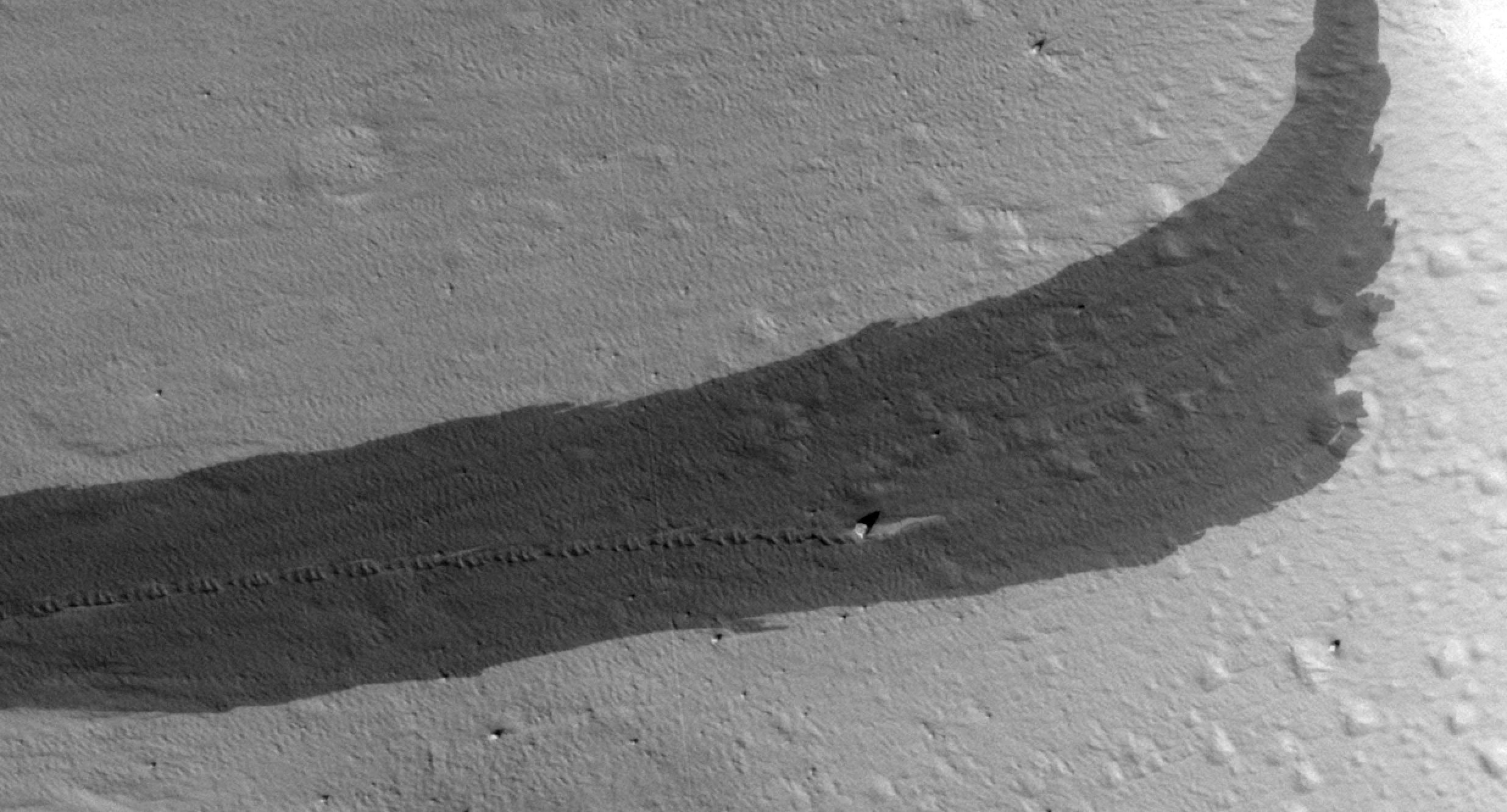
The 6 meter-wide boulder as imaged by HiRISE (to supersize the pic, click on it - 9MB)

It may only be a large rock, but images like this drive home the significance of the HiRISE instrument on board NASA’s Mars Reconnaissance Orbiter; it enables us to see recent geological activity on a planet we often view as being “dead.”

This boulder (approximately 6 meters-wide) had come to a stop at the bottom of the sloping wall of an impact crater. The path the boulder took is obvious as it left a series of prints in the Martian regolith as it bounced and rolled. The darker material that appears to have flowed around the rock is relatively fresh dry dust and sand that has also been dislodged from the top of the slope, falling as an avalanche, settling as a dark streak. As time goes on, the streak will age and blend in with the surrounding regolith.

It is suspected that seismic activity or a weather event (such as a dust devil) may have triggered the avalanche. As for the boulder, it looks like it rolled down the slope before the sand/dust avalanche, so it may have originated from the same destabilization event, or it happened earlier. As the source of the streak and boulder appear to originate from the same location, I suspect the former might be the case.

Regardless, it goes to show Mars is still active, and the MRO is in the perfect location to capture the Red Planet proving that fact.

Source: HiRISE

Mars Crater’s Cracked Frosting

Subliming ice from the crater's edge (NASA/JPL/University of Arizona)
Subliming ice from the crater edge (NASA/JPL/University of Arizona)

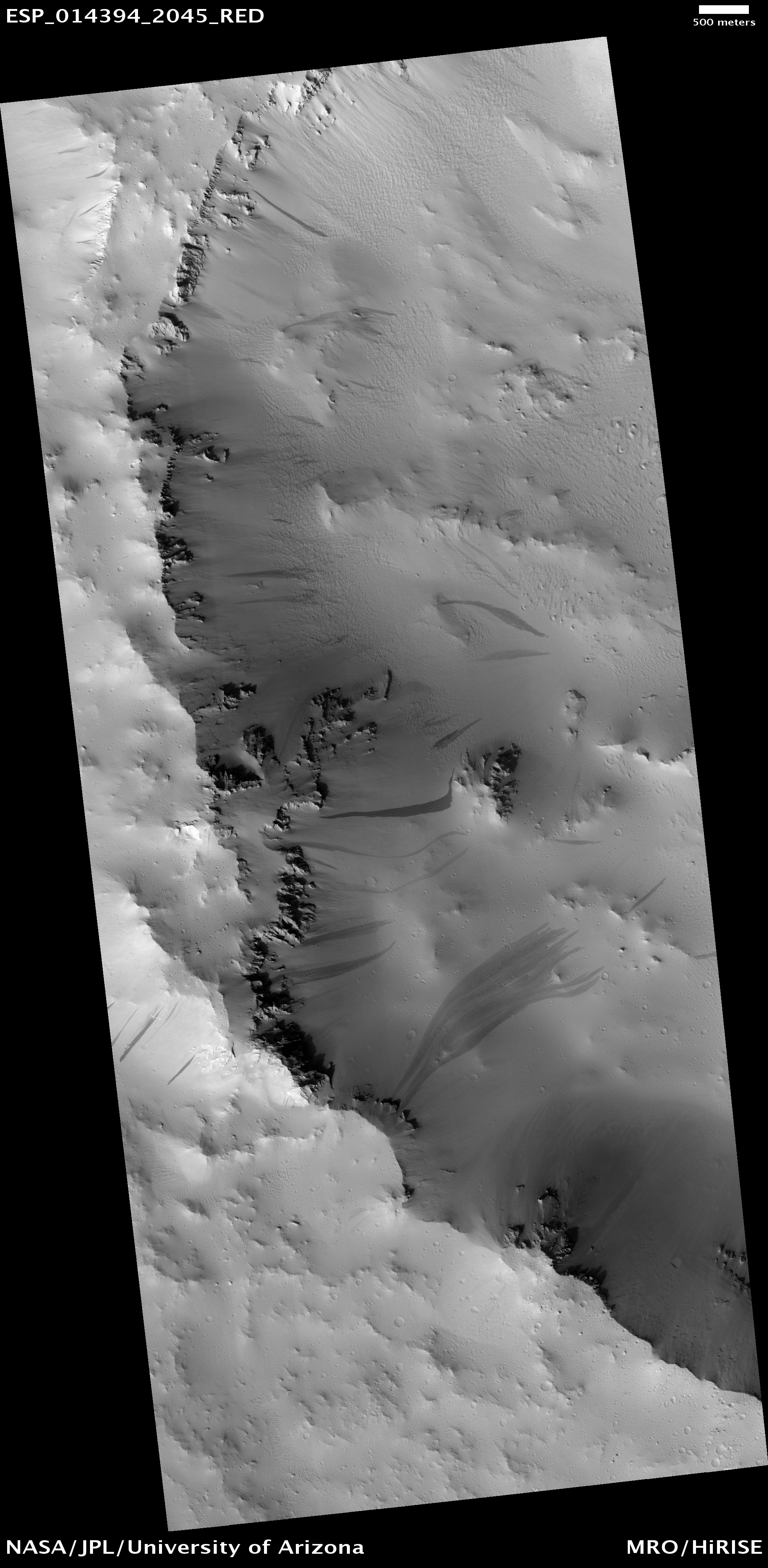
This image looks like the frosted top of an over-baked muffin, but it’s actually the side of a crater on Mars covered with ice. Taken by NASA’s Mars Reconnaissance Orbiter (MRO) High Resolution Imaging Science Experiment (HiRISE) over the Martian south pole, this example demonstrates an active process of weathering acting on the red landscape. According to the HiRISE site, the ice layer is approximately 3 km thick.

In regions situated closer to the equator, craters aren’t open to erosion by ice (not surface ice in any case), but in polar regions it’s a different story. Due to the Martian thin and cold atmosphere, water ice rarely melts into a liquid; it bypasses the liquid phase and turns straight into a gas. This process is known as sublimation. There are terrestrial examples of sublimation too, including frozen carbon dioxide (or “dry ice”) which sublimes at room temperature, generating a carbon dioxide vapour.

For this particular crater, it is obvious where there is a higher rate of sublimation than others. As the Sun illuminates the crater edge from the bottom right, the rim of the crater receives the most sunlight, heating up the darker regolith and causing more ice loss. The large cracked-like structure within the crater is most likely a combination of darker material under the ice receiving preferential heating and shrinkage of the subliming ice pack.

This seasonal freezing of water vapour and sublimation of water ice erodes the sides of these polar craters, wearing them down season after season.

I never tire of seeing HiRISE images of the Red Planet, especially when they include active atmospheric processes that continue to shape the landscape of this alien world.

Source: HiRISE

Cassini Discovers a New Moonlet in Saturn’s Rings

The ~400 meter moonlet casts a 25 mile shadow across Saturn's B-ring (NASA)

As Saturn approaches its August 11th equinox (during which the Sun will be directly above the gas giant’s equator at noon for 27 months), the Cassini Equinox Mission can do some moonlet spotting. During this time, sunlight will cast long shadows of any object protruding from the 10 metre-thick rings.

In this case, hidden inside Saturn’s B-ring, a moonlet with a diameter of approximately 400 metres becomes obvious when sunlight hits the rings edge-on. The result is a very obvious 25 mile-long shadow. This discovery wouldn’t have been possible during any other time, as Cassini can only see the small rock because of its shadow. If the Sun was above or below the rings, no shadow would be cast, and therefore no moonlet would be visible.

Saturn experiences an equinox twice every Saturnian year (once every 15 terrestrial years), and NASA planned the Cassini mission to coincide with this interesting period to economise on the position of the Sun, spotting small objects like this little satellite…

Source: Wired, thanks to Helen Middleton (@herroyalmaj).

Opportunity Investigates Possible Martian Meteorite

opportunity_meteorite2

On its epic journey to Endeavour Crater, Mars Expedition Rover (MER) Opportunity passed a suspect looking boulder on July 18th. Dubbed “Block Island” by MER controllers, this dark rock looks very different from its surroundings, so Opportunity has been ordered to go off its planned route by 250 meters and have closer look.

Measuring approximately 0.6 meters across, the jagged specimen could be a meteorite, giving the rover a chance to carry out an in-situ analysis of its composition, determining whether or not this is indeed of extra-martian origin.

The odd-shaped and dark rock sits atop the regolith, and Opportunity will use its APXS instrument to determine its composition (NASA)

The next step is for the rover to extend its robotic arm, pressing the Alpha Particle X-Ray Spectrometer (APXS) up against the rock’s surface. The spectrometer will basically give the sample a blast of radiation, consisting of alpha particles and X-rays. The analysis of scattered alpha particles (after they have bounced off the material) will reveal the mass of the elements they collide with and the emission of X-rays will also reveal a lot about the material.

So could this be a meteorite? We’ll have to wait until the little robot has carried out its experiment… she may be getting old, but Opportunity is still carrying out some awesome science.

Source: NASA