What Will It Take To Blow Up Pluto?

“25 billion of your biggest bombs please. I’ll pay credit, thanks!”

"I love the smell of venting volatiles in the morning..."

The Pluto debate frustrates me, as you may have noticed. It’s not that I have particularly strong views about whether it should be called a planet or a dwarf planet or a plutoid or pygmy planetoid, it’s that I really don’t care; I actually see Pluto’s “demotion” as exciting progress in the field of Solar System science rather than any derogatory gesture aimed at Pluto. Pluto is still Pluto; it hasn’t been knocked out of orbit, it hasn’t even been “bombed” (unlike our poor old Moon), it’s just being filed under a different category.

A King Amongst Dwarfs

In my opinion, calling Pluto a “planet” was unworkable, especially after a bigger dwarf planet was discovered in 2005 by a team of astronomers led by Dr. Mike Brown. This dwarf planet was named Eris (or 136199 Eris) and at first it seemed like we had gained a tenth planet.

The “ten planets” thing was short lived, however. In recognition that Eris probably represented the beginning of a spate of discoveries of welterweight worlds, the International Astronomical Union (IAU) took a vote in 2006 and decided to redefine what constitutes a planet. Pluto was in the firing line, became a rounding error and was dropped from the planetary club.
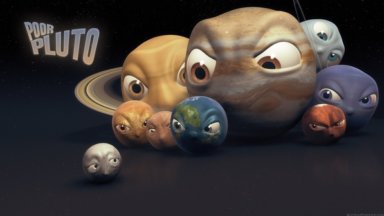
Kicked out and nowhere to go.

But it wasn’t all bad for the little guy. Pluto was designated king of all “plutoids” (trans-Neptunian dwarf planets) in 2008, meaning another three dwarf planets now orbited the Sun with this designation (Eris, Haumea, and Makemake in addition to Pluto).

In a previous Astroengine article, I made the point (and I’m going to quote myself because I can):

Just so my opinion is known, I don’t care what Pluto is called. If NASA decided to explode Pluto as part of a Kuiper belt clearing project, then yes, I might be a bit annoyed; I’d even start a blog titled “Save Pluto.” But calling Pluto a dwarf planet (or the rather cute plutino) really doesn’t bother me.

I haven’t really thought much about this statement until, today, @PlutoKiller himself (Mike Brown) tweeted, “Seriously, what just happened? The entire discussion is on placing explosives in the solar system. Pluto has not even been mentioned.” I then fired off a reply saying something about building a New Horizons 2 and packing it with plutonium to which @PlutoKiller said, Evil Santa-style: “Just in time for Xmas.”

And then the penny dropped.

Kuiper Belt Cruelness

To be honest, I’m astonished I haven’t thought of this before. Looking at Mike’s Twitter feed should have been enough inspiration, but until I wondered down the bombing Pluto => plutonium enrichment => lets fly a shedload of plutonium to Pluto path, that I asked the question: How much energy is needed to completely destroy Pluto?

Now we’re talking! Time for some Kuiper belt mayhem!

It might seem quiet now...

I’m not talking about simply bombing Pluto and making a big crater, I’m not even talking about fire bombing all the volatiles out of its frozen surface, I want to remove Pluto from existence. Why do I want to do this? Well, for fun, and because @PlutoKiller himself said so. And it’s Halloween, so why not?

So how much energy is required to do this?

For this gargantuan task, I cheated and looked up the method used by Matt Springer over at Built on Facts to derive how much energy was required by the Star Wars Death Star to shred Earth. In that case, 2.2 × 1032 Joules was needed to totally erase our planet (that’s a week’s-worth of solar output). That’s a lot, right?

Plutoid Killing Equation

Now, energy is energy and mass is mass, let’s give Pluto the same treatment. Using the following equation (known henceforth as the “Plutoid Killing Equation”, or simply PluKE), we can find out how much energy we need to erase Pluto:

The equation that can turn a dwarf planet into dust, as derived by Matt Springer.

This equation is the total gravitational binding energy of a sphere of mass, M and radius, R. G is the Gravitational Constant. For Pluto, a sphere, its vital statistics are:

MPluto = 1.305 × 10²² kg

RPluto = 1.153 × 10⁶ m

and

G = 6.673 × 10⁻¹¹ m3 kg-1 s-2

Plugging the numbers into PluKE, we can derive the total energy required to kill Pluto, literally:

EPluto(dead) = 5.914×1027 Joules

Oops, who put those WMDs there?

But what does this number mean? This is the bare minimum energy required to match the gravitational binding energy of Pluto. If you want to rip the dwarf planet apart (plus pyrotechnics and speeding debris), you’ll need a lot more energy. However, nearly 6×1027 Joules (that’s a 6 followed by 27 zeros) delivered into Pluto in one second should give the little world a very bad day.

Tsar Very Much

But how can we “deliver” this vast quantity of energy in one second? I suspect that any super-advanced civilization hell-bent of wiping out planets will have a better idea of this than me, but using weapons that are available to modern man might be a good place to start. Forget the uber-powerful death ray emitted by the Death Star, that’s sci-fi. It may not be sci-fact, but how about sending some nuclear bombs to the Kuiper belt?

How many bombs will we need? Ten? Ten dozen? A thousand?

The most powerful nuclear weapon tested was the Soviet 58 MT Tsar Bomba in 1961. So if we know how much energy is released by one of those beasts, we should be able to work out how many we’ll need to send to the unsuspecting Pluto.

1 MT = 1 megaton of TNT = 4.184×10¹⁵ Joules

therefore, a single Tsar Bomba has the potential to release an energy of:

58 MT = 58 × 4.184×1015 Joules = 2.427×10¹⁷ Joules

We needed 6×1027 Joules to wipe out Pluto, obviously the 2.4×10¹⁷ Joules a single bomb can deliver is woefully short of our goal. So how many Tsar Bomba weapons do we need?

(6×1027 Joules) / (2.4×10¹⁷ Joules) = 2.5×10¹⁰

We need to build 25,000,000,000 nuclear bombs. 25 billion. Ouch.

Obviously, looking at this estimation, it is impossible to destroy a dwarf planet as puny as Pluto using the most powerful weapon known to man. Also, it’s worth keeping in mind that this is the bare minimum of energy that needs to be applied to Pluto to match its gravitational binding energy, so to destroy it, you’ll need a lot more bombs.

There’s also the question of how to distribute the weapons. Would you put them all in one place? Distribute them all around the globe? Perhaps burrow into the centre of the body? I suppose putting all the bombs in one place might be impressive, kicking a chunk of plutoid into space.

Now I must report these findings to @PlutoKiller himself, I fear he won’t be happy with the outcome of my calculations

Triton’s Ice Won’t Mix

Triton_sm

Triton, Neptune’s largest moon, hasn’t been studied in detail since Voyager 2 did a flyby in 1989. That was until a team headed by Will Grundy, a Lowell Observatory planetary scientist, did a 10-year study into the distribution of the moon’s ices.

Soon to be published in the journal Icarus, the team has found that concentrations of nitrogen and carbon monoxide mix together and form a covering of ice on the Neptune-facing side of Triton. This is in contrast to the methane content of the atmosphere. For some reason, methane is concentrated on the non-facing Neptune hemisphere of the moon. It appears that methane doesn’t like to mix with the other volatile ices.

This is in stark contrast to the non-volatile ices, such as water and carbon dioxide. Both appear to have a homogeneous distribution, regardless of phase or geographical location.

These are incredible observations of a moon that was once a Kuiper Belt Object. However, the infrared analysis carried out on Triton could be a test-run before observations are carried out on other, more exotic, targets.

This type of long-term, detailed analysis would be equally valuable for small icy planets like Pluto, Eris, and Makemake, all of which are similar to Triton in having volatile ices like methane and nitrogen on their surfaces,” said Grundy. “We have been monitoring Pluto’s spectrum in parallel with that of Triton, but Eris and Makemake are quite a bit fainter. It is hard to get time on large telescopes to monitor them year after year. We expect that Lowell Observatory’s Discovery Channel Telescope will play a valuable role in this type of research when it comes on line.”

Source: Space Disco, Discovery Channel (yeah, I’m referencing myself), Lowell Observatory

Moon Water, Confirmed

moon-water

The biggest factor hanging over human settlement of other worlds is the question of water. We need it to drink, we need it to cultivate food, we need it for fuel (indeed, we need it for the first lunar microbrewery); pretty much every human activity requires water. Supplies of water could be ferried from Earth to the Moon, but that would be prohibitively expensive and ultimately futile. For us to live on the Moon or further afield, H2O needs to already be there.

Ever since the Apollo lunar landings when samples of rock were transported to Earth we’ve been searching for the mere hint of this life-giving molecule. There have been indications that the lunar regolith may indeed contain trace amounts of the stuff, but on the whole, scientific endeavour has yet to return evidence of any large supply of water that could sustain a colony.

Until today.

Up until now, scientists haven’t been able to seriously entertain the thought of water on or near the surface of the Moon, apart from in the depths of the darkest impact craters. However, data from the recently deceased Indian Chandrayaan-1 mission has supported data taken by the Cassini probe (when it flew past the Moon in 1999 on its way to Saturn) and NASA’s Deep Impact probe (which made several infrared observations of the lunar surface during Earth-Moon flybys on its way to the 2010 rendezvous with Comet 103P/Hartley 2). Both Cassini and Deep Impact found the signature of water and hydroxyl, and now, a NASA instrument on board Chandrayaan-1 reinforces these earlier findings.

The NASA-built Moon Mineralogy Mapper (M3) on board the Indian satellite detected wavelengths of light reflected off the surface that indicated hydrogen and oxygen molecules. This is convincing evidence that water is either at, or near, the lunar surface. As with the previous measurements, the water signal gets stronger nearer the lunar poles.

So what does this mean for the future of manned space exploration? Although water has been detected, this doesn’t mean there are huge icy lakes for us to pitch a Moon base and pump out the water. In actuality, the signal indicates water, but there is less water than what is found in the sand of the Earth’s deserts (you can pack away the drinking straws now).

It’s still pretty damn dry, drier than anything we have here. But we’ve found this dynamic, ongoing process and the moon was supposedly dead,” University of Maryland senior research scientist Jessica Sunshine told Discovery News. “This is a real paradigm shift.”

If there are widespread water deposits (despite the low concentrations), even in regions constantly bathed in sunlight, there is huge potential for water deposits in those mysterious, frozen craters. Interestingly, these measurements indicate that the water may not have just been deposited there by comets; the interaction between the solar wind and the existing lunar mineralogy could be a mechanism by which lunar ice is constantly being formed.

Every place on the moon, at some point during the lunar day, though not necessarily at all times, has water and OH [hydroxyl],” Sunshine said.

We may see self-sufficient lunar colonies yet. But the saying “getting blood out of a stone” should probably be replaced with “getting water out of the lunar regolith”

Next up is NASA’s LCROSS mission that is scheduled to impact a crater in the south pole on October 9th. Analysis from the impact plume will supplement this positive Chandrayaan-1 result, hopefully revealing yet more water in this frozen region.

Sources: Discovery News, Space.com, Times.co.uk

xkcd: Probably Not The Best Way To Deal With An Asteroid

asteroid_xkcd

I hope we never see this day in the future, when the newscaster calmly informs us that an asteroid is on a collision course with Earth.

In any case, if this scenario did unfold, I’d like to think we’ll have the in-space technological capability to deal with the threat — but if we didn’t, I’m sure we’d work on it pretty damn quickly (given enough warning… if not… well, I’m out of ideas).

But please… don’t go strapping a nuclear warhead to the rock… it might not end quite so well.

Source: xkcd

Confirmed! Jupiter Was Hit By Something (Update)

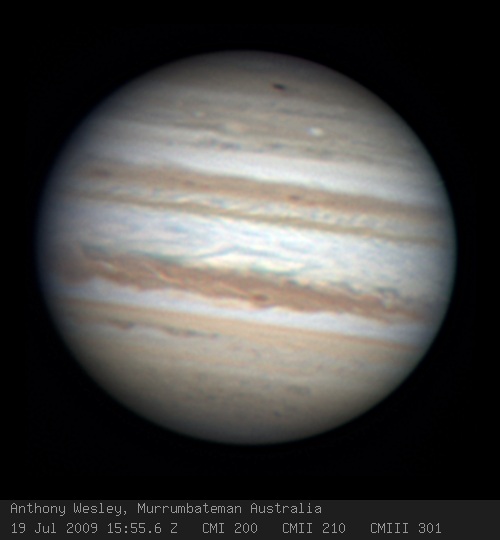
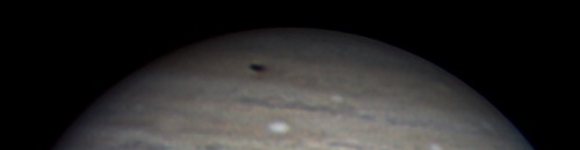
Image captured by Anthony Wesley on 19th July 2009 at 1554UTC from Murrumbateman Australia.

On Sunday, SpaceWeather.com reported that an amateur astronomer from Australia had noticed a dark spot rotate into view on the Jovian surface:

The jet-black mark is near Jupiter’s south pole (south is up in the image). I have imagery of that same location from two nights earlier without the impact mark, so this is a very recent event. The material has already begun to spread out in a fan shape on one side, and should be rapidly pulled apart by the fast jetstream winds.” — Anthony Wesley

Although this was all very exciting, and conjured up memories from the Shoemaker-Levy 9 Jupiter impact in 1994 (as documented by Hubble), I think the majority of blogs and news websites were initially reluctant to proclaim that this new dark spot was the site of an impact by a comet or asteroid. Why? Well, these events aren’t supposed to happen very often. That’s why the Shoemaker-Levy 9 impact was termed “a once in a lifetime” event.

But, 15 years later (a dog’s lifetime, perhaps), it’s been confirmed by JPL (pending an official release) that the dark patch is in fact an impact site, and not some crazy weather system:

Glenn Orton from JPL has imaged this site using the NASA Infrared Telescope on Hawaii and confirms that it is an impact site and not a localised weather event.Update by Anthony Wesley

UPDATE (14:00 PST): Sky & Telescope Magazine is tracking developments, and reports that Leigh Fletcher, a scientist at the InfraRed Telescope Facility in Hawaii, is tweeting his findings from analysis of the Jupiter impact site. From the high infrared emissions in reflected sunlight off the dark spot, it is almost conclusive that the spot was caused by an impact by a comet or asteroid.

This has all the hallmarks of SL-9 in 1994 (15 years to the day!). High altitude particulates, looks nothing like weather phenom.” —@LeighFletcher

The most astounding thing for me is that this impact was initially observed by an amateur astronomer, and not a space agency. We await further word from Glenn Orton at JPL and Leigh Fletcher at Hawaii, but all indications suggest this black patch IS another impact crater…

A later image of the Jupiter impact (Anthony Wesley)

More news to follow

Source: Anthony Wesley’s site

Crop Circles Do Not Predict Solar Storm on July 7th…

Stunning art, UFOs not included (© Lucy Pringle)

Alternative title: “Jumping to Conclusions and Bullshit”

Crop circles are amazing. They are, quite literally, works of art. And like all other known forms of art, they are constructed by people with time on their hands. No UFOs have been braiding our crops, no aliens have been playing let’s-confuse-the-stoopid-humans-with-this-cryptic-message-we-travelled-hundreds-of-light-years-to-deliver. Crop circles are made by hoaxers and enthusiasts.

So yesterday, I read a terribly fascinating, yet terribly painful article that seamlessly combines three disparate facts to arrive at a terribly flawed conclusion: a coronal mass ejection (CME) will hit us on July 7th, possibly causing global damage, according to a crop circle prediction.

This may seem a little shocking, considering this equivalent of a micro-doomsday is only two days from now, but the “Exopolotics Examiner” Dr. Michael Salla discusses it with great excitement:

The Alert is for Sunspot 1024 which suddenly appeared on July 3 and 4 […] It typically takes CMEs, traveling at around a million miles per hour, three to four days to reach the Earth. So if Sunspot 1024 does generate CMEs towards the Earth, they would arrive right on the predicted date of July 7.

Apparently, we now have an infallible space weather prediction method. Sunspot 1024 could generate a CME directed toward Earth, therefore fulfilling the prediction that we are going to get hit by a CME in two days. Amazing right? Obviously Salla is referring to the work of a solar physicist, with a new hi-tech computer simulation, or with access to cutting-edge observational data. Wow, it looks like we have found the Holy Grail of sunspot characterization methods!

(Guess again)

Actually, the July 7th prediction is purely based on crop circles at Milk Hill, in Wiltshire, UK. How do we know these flattened fields of corn predict a CME? Actually, they don’t. Even the crop circle experts make no convincing connection with crop circles and the Sun, apart from pointing out that the patterns resemble an orrery — but even if it is an orrery, the corn has been flattened by a team of hoaxers, they could make it mean anything. (I’m still waiting for a massive Micky Mouse crop circle.)

Although I find all this highly entertaining, the thing that made me laugh the most was the point that the Milk Hill patterns were made in “3 Phases.” However, looking at the incredibly beautiful design of that thing, it’s little wonder the aliens had to build the design in shifts. After all, extraterrestrials need tea-breaks too… perhaps their little feet got tired stomping all that corn… or perhaps it was constructed by slacking crop circle hoaxers who couldn’t get it all done in one night?

My money is on the latter.

So, there is a dubious link between the crop circle and the Sun (apart from ‘it faces that way,’ directly along the tractor tracks… hmm, interesting), what could Salla be talking about? Oh that’s it! The Earth’s magnetosphere has a hole in it! Hell, dig your lead-lined bomb shelters now!

Now this is one point I’m actually a little annoyed about. Apparently Dr. Salla is also qualified in solar-terrestrial physics, as he seems to dredge up some pretty compelling science recently published by NASA. Salla says:

Importantly, scientists will be able to directly study the impacts of large amounts of solar plasma penetrating a breach in the magnetosphere first reported by NASA scientists in December 2008 […] If the interpretations of crop circle researchers are correct, then we will shortly directly observe the impact of solar energy from CMEs passing through the magnetosphere breach. –Dr Salla (emphasis not added by me, used for dramatic effect I suspect).

Now this is good stuff, perhaps this guy is on to something. In summary:

  1. The Milk Hill crop circle predicts a solar storm on July 7th (but it’s not very clear where in the corn this is printed).
  2. An active sunspot has appeared at a high latitude on the solar surface (this is true, although only B Class solar flares have been detected… not in Earth-killing leagues I’m afraid).
  3. This sunspot could generate an Earth-directed CME (this is true, again, but the odds are pretty damn low).
  4. The CME will hit us on July 7th (read #3).
  5. Now that NASA has detected a hole in our magnetosphere, deadly solar particles could penetrate our atmosphere!

In other words, Salla has strung together some dubious “signs” from a crop circle, tied it into this new sunspot, gotten all excited that it could generate some pretty feeble CMEs, somehow assumed they will be Earth-directed and then chucked in a very incorrect opinion as to what this “hole in the magnetosphere” means.

Although the magnetospheric breach is certainly an amazing discovery — made by the Time History of Events and Macroscale Interactions during Substorms (THEMIS) satellites in 2008 — I think Salla misses the point. The magnetospheric breach hasn’t just appeared, it wasn’t caused by human activity (like the hole in the ozone layer, which I think he thinks this is), it’s always been there in some way, shape or form.

NASA’s five THEMIS spacecraft have discovered a breach in Earth’s magnetic field ten times larger than anything previously thought to exist. Solar wind can flow in through the opening to “load up” the magnetosphere for powerful geomagnetic storms. But the breach itself is not the biggest surprise. Researchers are even more amazed at the strange and unexpected way it forms, overturning long-held ideas of space physics.NASA release.

Obviously overcome with the NASA terminology “giant breach,” Salla assumes this is a new hole in the magntosphere leaving us open to the ravages of the Sun. Actually it doesn’t, it’s simply an observation of a previously unknown piece of magnetospheric dynamics. Yes, the breach is linked with solar storms and the aurora, but there’s every likelihood this phenomenon has always existed, even when the Earth’s magnetic field was battered by X-class solar flares and jumbo CME’s during the last solar maximum (are we still here? Yes, I think we are). To think we are going to even notice a make-believe low-energy CME produced by a feeble region of the Sun generating B-class solar flares is laughable.

So the physics is flawed, the prediction is totally far-fetched, and apparently you need a PhD in exopolitics to understand how crop circles come into it. It’s just a fear-mongering article that is becoming all too common on the Examiner these days.

No, this is another huge FAIL for the Examiner… where are all the Skeptical, Science and Common Sense Examiners?

Thank you @mactavish for reminding me to finish this article!

Mining Asteroids: Not At Those Overheads

Where shall we start diggin'?

In The Future™, when mankind is Sufficiently Advanced®, nations, companies and entrepreneurs will be shuttling huge cargo spaceships to and from the asteroid belt. Asteroid mining is going to be the first REAL gold rush, “thars gold in them thar rocks!” But not only gold, we’ll be able to consume asteroids of all their constituents; platinum, iridium and silicon (silicon?). Global economies will be flooded with a new-found wealth being fed by the new Solar System’s bounty. Times will be good, after all, this is The Future™.

Although asteroid mining looks good on paper, once you do a little bit of adding up, you suddenly realize it’s actually one hell of an undertaking. Looking at the economics of asteroid mining is especially daunting, and believe me, my co-author Greg Fish has done the number crunching.

When Greg and I started out researching our book, Astroeconomics: Making Money from the Vacuum of Space, we initially made the assumption that the key way to make vast wads of cash in space is from asteroid mining. This assumption was purely based on… well, an assumption. A quick glance on the various space advocacy websites will demonstrate just how accepted asteroid mining is as a future industry. After all, science fiction has been telling us this for years. Given a sufficiently advanced technology, we’ll be able to build a spaceship, with a mining platform, send it to the asteroid belt (obviously a very short distance), fill up the cargo hold with ore (or, if we are that advanced, refined precious metals) and be back on Earth by a week next Friday.

However, when we looked at the situation, we decided to focus on the economics of the beast (in all honesty, Greg did the calculations, I can barely balance my own books, let alone the books of an entire space-faring industry).

Naturally, we assume it’s going to be businesses (not governments) wanting to mine asteroids, and we assume mining/spaceflight technologies that could possibly be available within the next few decades (and no, we didn’t consider nanotech; I’m thinking rock-eating nanobots wont be available in stores for a long while yet). We also assumed these space mining companies will want to make a profit (we might be wrong). Unfortunately, asteroid mining doesn’t make an awful lot of sense from a business perspective. The risk is too high, the overheads are whopping, and the payback — while impressive — won’t pay the bills. And then there’s nasties like space pirates and industrial accidents to consider, adding to the ‘risk’ factor.

All in all, it’s not a very attractive business proposition to build a mining fleet and send it on an interplanetary joyride; most businesses would rather set up a mining installation in the middle of Antarctica. But we’re not pouring cold water on the whole venture either, we’ve worked out a few ways future businesses can actually turn asteroid mining into an industry.

So, today, Greg contributed a guest article to my “other” blog, Space Disco on Discovery Space. If you want to find out more about the ins and outs of asteroid economics, have a read of Mining Asteroids And Getting Rich (Or Not)

Enjoy!

Deflecting Doomsday Asteroids… and Plundering Them

A metorite impact would be very bad, but using asteroid deflection techniques could provide mankind with a lucrative opportunity (©Discovery Channel)

I’ve always found asteroids to be fascinating. They are often surprisingly big, they contain a wealth of information about the history of the Solar System… and, let’s be honest, they’re frightening.

There are thousands of asteroids out there, often collecting in clearly defined belts or gravitationally stable regions known as Lagrangian points. However, many are not so well behaved; they seem to have their own agenda, flying around the Solar System in their own orbits, sometimes buzzing the Earth.

Fortunately, the vast majority of these rocks are harmless; if they hit our atmosphere they might create a dazzling light show, burning up, possibly even exploding as a fireball. Sometimes though, a big asteroid might be observed and astronomers become a little concerned. The next known threat that might hit us is the famous asteroid named Apophis that is expected to make an uncomfortably close encounter with Earth on April 13th, 2036. The odds of Apophis hitting us in 2036 (not 2029 as quoted in the above video) are 45,000:1, which may sound fairly unlikely, but if you start comparing those odds with dying in a plane crash, or being hit by a car, you’ll see that actually, a one in 45,000 chance are the kind of odds you’d happily quote when placing a bet in a Vegas casino. I have a chance!

Yes, and there’s also a chance of a 350 metre-wide asteroid hitting us in 2036, so perhaps we should start planning for the worst?

Fortunately, we have some lead time on Apophis, and we’ll learn more about the chunk of rock when it flies past the Earth in 2029. And that’s what it’s all about: lead time. If mankind spots a potentially deadly asteroid approaching us, we’ll need as much time as possible to nudge it off course.

In a video I just stumbled across on Discovery.com, Joseph A. Nuth III from NASA Goddard Spaceflight Center shares his views on what we could do to prevent a potential asteroid catastrophe. By developing asteroid deflection techniques, we’ll also be presented with an opportunity. As pointed out by Nuth, if we have the ability to deflect an asteroid, perhaps we can steer it into lunar orbit, so we can carry out mining operations…

Is Pluto Affected by the Pioneer Anomaly?

From Pluto, looking at its icy moons in the Kuiper belt (NASA)

The Pioneer Effect is a mysterious observation of a number of man-made probes that venture through and beyond the Solar System. Originally noticed in the slight drift of the Pioneer 10 and Pioneer 11 spacecraft (launched in 1972 and 1973) from their calculated trajectories, scientists have been at a loss to explain the tiny, yet constant, extra-sunward acceleration.

Some theories suggest that invisible clouds of dark matter are slowing these probes down, causing them to be influenced by the Sun’s gravity more than expected. Other suggestions include ideas that Einstein’s theory of General Relativity needs to be tweaked when considering interplanetary distances.

However, there are other, more mundane ideas. Perhaps there is a tiny fuel leak in the probes’ mechanics, or the distribution of heat through the spacecraft is causing a preferential release of infrared photons from one side, nudging them off course.

Finding an answer to the Pioneer effect probably won’t surface any time soon, but it is an enduring mystery that could have a comparatively simple explanation, within the realms of known science, but there’s also the possibility that we could also be looking at some entirely new physics.

In an attempt to single out whether the Pioneer anomaly is an artefact with the spaceships themselves, or unknown in the physics of the Universe, astronomers decided to analyse the orbits of the planets in the outer Solar System. The rationale being that if this is a large-scale influence, some observable periodic effects should be evident in the orbit of Pluto.

So far, no effect, periodic or otherwise, has been observed in the orbit of Pluto. If the effect isn’t big enough to influence Pluto, does this mean we can narrow the search down to spaceship-specific artefacts?

Not so fast.

Gary Page and John Wallin from George Mason University in Virginia and David Dixon from Jornada Observatory in New Mexico, have published a paper pointing out that the suggestion that the Pioneer effect doesn’t influence Pluto is flawed. Pluto’s orbit is far less understood than the orbits of the inner Solar System planets, as, let’s face it, Pluto is far away.

We simply don’t possess the data required to cancel out the Pioneer effect on planetary bodies in the outer-Solar System to reach the conclusion the anomaly doesn’t influence Pluto.

Of course, this does not mean that the Pioneer effect exists. It does mean that we cannot deny the existence of the Pioneer effect on the basis of motions of the Pluto as currently known.” — Page et al., 2009

So, back to the drawing board. This is a fascinating study into a true Solar System mystery; bets are on as to the real reason why our interplanetary probes are being knocked off course…

Source: The Physics arXiv Blog

Introducing Little SDO

The Solar Dynamics Observatory (NASA)

Playing on our love for WALL-E, our amazement for the Pixar Lamp and some great animation, Chris Smith, an employee at NASA Goddard Flight Center, has given the upcoming Solar Dynamics Observatory a personality.

Apart from obviously having too much time on his hands, Smith is a very talented guy (as all NASA employees are) and is showing that, once again, the space agency is doing a fantastic job of reaching out to the public.

As proven by the efforts of the Phoenix Mars Lander team in 2008, communication goes a long way and by harnessing social media, NASA can make its missions household names. Phoenix was tweeting, blogging and podcasting to its hearts content for five months, from touchdown to frozen death; it was Big Brother for robots living on Mars.

Now most NASA missions have Twitter feeds and devoted blogs, ensuring everyone’s interest is piqued. It also helps to have a Twitter feed talking in first-person, giving these brave rovers, landers, orbiters and probes a much needed personality.

So now, Chris Smith has done something very cool with the SDO; he’s given it an animated personality in a short animation reminiscent of a movie teaser for an upcoming Disney-Pixar feature film. Behold, the Little SDO:

It’s a really fun little piece,” says Wade Sisler, a television producer for NASA. “And we’re hoping to use it as a way of waking some kids and folks up to solar science.”

And so NASA should, I like it! It’s going to get people interested in a comparatively small mission, and let’s face it, the satellite lacks character (the boxy 4-eyed robot doesn’t do much for me). However, now that Smith has added squeaky solar panel wings, and blinking “eyes” (without changing the design of the craft at all), he’s boosted the SDO’s likeability. Suddenly I care for the little guy. I hope he doesn’t get hit by a solar flare.

Due for launch in October, the SDO will be inserted into a geosynchronous orbit above New Mexico, gathering data from the Sun, so solar physicists can better understand space weather. The cool thing is that with those four eyes, the SDO will capture high-definition images of the Sun continuously.

It might not have the dazzle of the Phoenix Mars Lander, but it has a personality and people will love him (I await the Twitter feed).

Learn more about the Solar Dynamics Observatory »

Source: Wired Science