What happens when you put a snowball in front of an open fireplace? It melts. What happens when you throw a comet at the Sun? Erm… it doesn’t end well. In fact, as this daredevil comet proves, comets get vapourized very quickly. And the Solar and Heliospheric Observatory (SOHO) captured the whole event, here’s a video.
Sungrazing comets are spotted fairly regularly and this particular comet spotted over the weekend is likely a member of the Kreutz sungrazer family. This group of comets are thought to have been spawned when a giant comet broke up over 2000 years ago. However, the larger Kreutz fragments usually make a close approach to the Sun 3 or 4 times a year, but there have been 3 such events in 2010 so far.
As noted by Spaceweather.com, this could just be a statistical anomaly, but it could be that these fragments are a part of a swarm of comets approaching perihelion (closest approach to the Sun).
Either way, if you’re a comet, don’t venture too close to the Sun, you might get eaten.
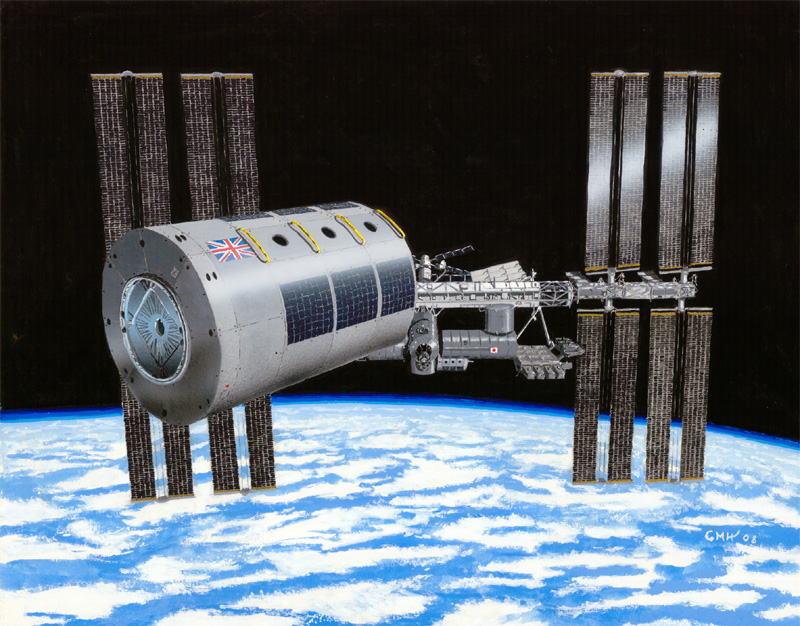
The Habitation Extension Module (HEM) proposed by UK engineers (University of Bristol)
The UK has started its own space agency (at long last) and the agency has a logo. The latter is the big news here.
At a time when motivation for manned spaceflight by NASA is dwindling and yet private industry is forcing its foot in the door of getting stuff into space, it’s nice to hear that the UK government felt the need to keep up with the rest of the world and set up an agency of their own. That’s not to say the UK hasn’t been involved in space programs before now, it’s just that our involvement has always been a piecemeal approach; hitching rides on other nation’s rockets with occasional probes (erm, well, the Mars Beagle 2 lander is the only one that comes to mind). Personally, I blame Maggie Thatcher (I have my reasons).
Awesome, so we now have an agency rather than an office cubicle tagged “Space.” This is a bona fide agency that has lunar aspirations (yep, really, we’re that original) and a funky logo to boot.
However, not everyone is impressed with the logo. In fact, Ken Carbone, a graphic designer who writes for the website Fast Company, thinks it’s dull:
The design recipe is simple, right? Take a square, add a Union Jack, thrust an arrow through it and BAM!
This logo is anything but tasty. The net result looks terribly fractured and unstable. Not the ideal visual for space flight.
To make matters worse, the U.K. Space Agency will have the inevitable and unfortunate acronym “U.K.S.A.” which sounds like something translated into Pig Latin.
But say if “fractured and unstable” is exactly the impression we were trying to give, huh? But, in all fairness, he does point out that all space agency logos are dull.
Let’s have a look the offending logo. Prepare yourself, it’s a disgrace:
Woah! Hold on a second. I thought it was supposed to be crap? As far as logos go, that’s one I can believe in. I mean, it’s a re-worked version of our proud national flag. It also has a gert red arrow, pointing up. What more do you need?
Admittedly, I think the acronym isn’t much cop. U.K.S.A. sucks cheese, “BritSpace” is far superior in my humble opinion (Science Minister Lord Drayson, consider that a suggestion), but as for the logo, I’m proud of that, I think it means business. Look at that arrow. It’s red. Pointing up. Masculine. Grrr.
That’s the logo of an aspiring space faring nation if I ever saw one.
And now for my least favorite space agency logo. Ladies and Gentlemen, please avert your eyes for the Croatian Space Agency:
But hey, what do I know, I’m not a graphic designer.
In all honesty, I like the UKSA logo, but I’m especially happy that the UK actually has an agency now rather than being just a player in the European Space Agency (ESA). But will it motivate a solution to the summering STFC debacle? That remains to be seen.
Sure, NASA is a government agency, but can you think of any other agency with the power to inspire a nation? That’s the gist of Neil deGrasse Tyson’s presentation at the University of New York at Buffalo on March 31st, certainly worth watching.
Firstly, apologies that it’s been over a month since last posting to Astroengine.com. Call it slacking off, call it a sabbatical, either way, it’s not good. I’ve actually prepared several half-finished articles, but I just never got around to completing them. However, I have been on writing overdrive over at Discovery News, so if I go quiet over here, you know where to find me.
Although Spitzer has entered a new phase of operations since it depleted the liquid helium coolant used to maintain its instrumentation, that doesn’t mean its stopped producing some awe-inspiring imagery. In a new vista released on Thursday, a bustling star formation region in Orion is detailed, showing some 1,500 young stars the observatory watched for 40 days. This is an unprecedented study, allowing rapid variations in these baby stars to be tracked by Spitzer.
Young stars are generally highly variable in their brightness, a characteristic that is of huge interest to astrophysicists. If we can understand the mechanisms causing this variation, we can gain an insight to stellar evolution, possibly even understanding the history of our own Solar System.
As Spitzer observes in infrared wavelengths, it’s very sensitive to clouds of dust being heated by these young stars. Therefore, the proto-planetary disks surrounding these million year old stars glow brightly. Not only does this give an indication to the conditions surrounding the star, it also provides astronomers with an idea to how these disks of dust clump together, slowly evolving into exoplanets. And now Spitzer has data sets spanning weeks, dynamic changes in the emissions from the stars and their evolving planetary systems can be studied.
But science aside, the Spitzer imagery is a thing of beauty, reminding us how complex our cosmos really is. Don’t believe me? Take a look for yourself (click the pic to dive right in):
The star forming region in Orion as studied by Spitzer, rotated 90 degrees (NASA/JPL/Caltech)
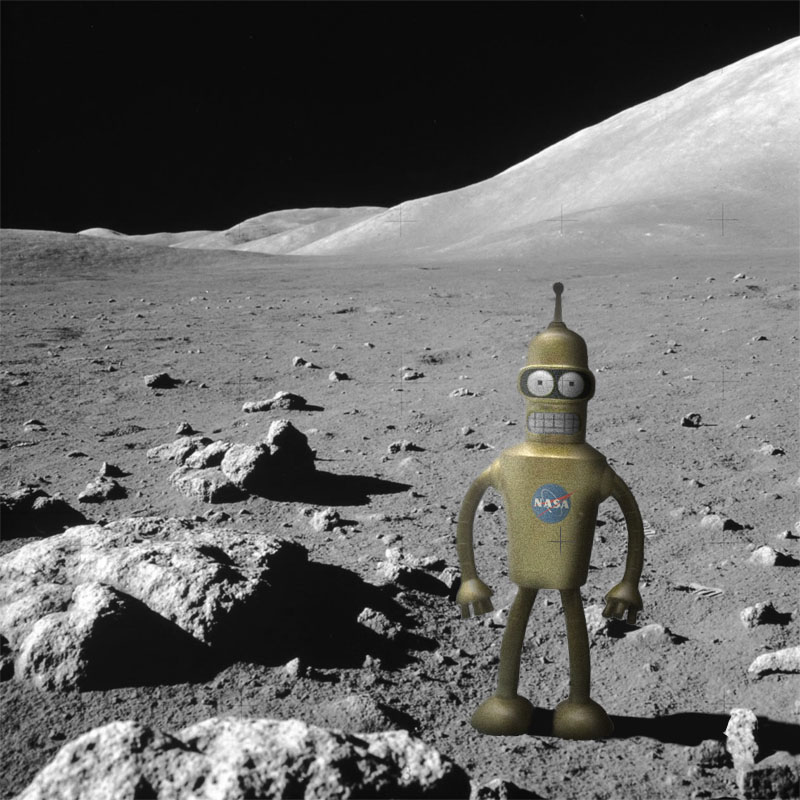
The Project M android... haven't I seen you somewhere before?
As you know, I’m highly dubious about this “Project M” that has just surfaced on the intertoobs (I strongly suspect it’s a hoax). But doubts aside, I kept looking at that android throwing stones on the lunar surface thinking I’d seen that guy somewhere before. At first, I thought C3PO from Star Wars… but no! It’s this guy:
It's uncanny! Bender from Futurama explores the lunar surface (NASA/20th Century Fox/Ian O'Neill).
I think Futurama’s Bender would do a fine job exploring the moon.
Doing for NASA what Star Wars did for sci-fi, send C3PO to the Moon! Huh?
OK, so I have little idea about this project because there’s not much information circulating, but I hope it’s not real.
It looks like NASA’s Johnson Space Center is heading up a robotic mission to the Moon. No big surprises there as that plan is pretty much in alignment with the “Flexible Path” for the future of space exploration for the U.S. space agency. Also, now the Constellation Program has bitten the dust, we’re not going to see man return to the Moon any time soon.
So what’s the answer? Send a robot that looks like a human to the Moon instead!
As I said, there’s little information about “Project M” apart from what’s been posted on AmericaSpace:
Project M is a JSC Engineering Directorate led mission to put a lander on the moon with a robot within a 1,000 days starting Jan 1., 2010. “M” has significance in two ways. First, it is the Roman numeral for 1,000. And “M” is the first letter for “Moon”.
How is Project M different from past NASA projects?
No prime contractors.
No roadblocks.
Just use the best engineers in the world to get the job done on time.
There will be full press on this… including embedded media, full multimedia and social networking. Can you say “The Apprentice goes to Space?”
When will Project M begin? Next month? Next year? No, Project M has been “go” since Monday, November 9th.
But “M” is the first letter of “Missing the Point” too, but that hasn’t been mentioned.
The enthusiasm for a robotic mission to the lunar surface sounds fine and dandy, and it’s to be expected, but if they really intend to send a bipedal robotic man to the Moon within 1000 days, then NASA hasn’t learnt anything from the Constellation debacle. This smells like a publicity stunt with little to no direction and it would be a shame if serious funding is being put into it.
Could the bipedal robot just be a metaphor for the project? Possibly, but I’d have to question the common sense in doing that too.
Also, where’s the incentive (indeed urgency) to create a Manhattan Project-style group of engineers to rush this project to completion within 3 years? If the members of Project M think they can avoid the cumbersome red tape and cost overruns that NASA and its contractors have faced in the past, then great, but I don’t think that’s a reality for such an ambitious project that lacks direction.
Sure, there’s funding being ploughed into humanoid robot technology — such as the “Robonaut” that is being developed by JSC engineers and the car maker GM — but the real-world application of androids (robots designed to look and act like a human) is that they can assist human operators. Bipedal androids such as the one depicted in this promo video would be exploring (read: “picking up stones”) space by themselves. There are no humans working along side them and therefore no real reason to create them in the inefficient form of a human.
The human body isn’t exactly an optimized one for space exploration. The next robotic missions to the Moon and Mars will be rovers, with wheels, because guess what? That makes more sense than revolutionizing android technology, sending it to the Moon within 1000 days, only for it to fall over and not be able to stand back up. (I’m sure Project M would counter this argument and say that the technology would have matured to such an extent that the android would be able to stand up again, but why let it fall over at all?) The center of gravity needs to be low for stability and no matter how big you make a robot’s feet, it’s simply not going to be able to explore as efficiently as a wheeled or multi-legged all-terrain vehicle.
What you see here is something mankind has never seen before, the aftermath of an asteroid collision. This conclusion comes after the Hubble Space Telescope was commanded to take a closer look at a strange comet-like object pottering around in the asteroid belt between the orbits of Mars and Jupiter.
“The truth is we’re still struggling to understand what this means,” said David Jewitt, a planetary physicist from UCLA. “It’s most likely the result of a recent collision between two asteroids.”
After P/2010 A2 was discovered in January, Jewitt managed to get observation time on Hubble to get a closer look of what was thought could be a rare asteroid-comet hybrid.
In the image, the object named P/2010 A2 has a very obvious “X” on its surface shaped pattern in its tale, possibly the location where a smaller body slammed into it at high speed. The result of this hyper-velocity impact produced a lot of debris and scientists think the comet-like tail being swept back by the pressure of the solar wind is dust and outgassing volatiles (like subliming water ice).
Although this kind of event has never been observed before, over the lifetime of the evolving solar system, events like this occur on a regular basis, in fact asteroid collisions have shaped the asteroid belt. Interestingly, it is thought this impact was caused by a collision of a “Flora family” asteroid, a type of object that may have wiped out the dinosaurs 65 million years ago. (Don’t worry, this collision won’t affect Earth in any way, the dinosaur thing is simply an interesting connection!)
What an incredible discovery, it’s fortunate that we have Hubble’s excellent eyesight to peer deep into the asteroid belt…
As far as space missions go, you couldn’t find a better epic tale than that of Mars Expedition Rover Spirit. Designed to last 3 months, roved for six years; lost the use of a wheel, turned it into a nifty trench-digging tool; nearly died, came back to life; had memory problems, shrugged them off… the list could go on for ever. However, it’s now official, this is one challenge the little wheeled warrior couldn’t beat; she’s stuck in the sand and there’s nowhere to go.
Mars Rover Spirit is now “Mars Base Spirit.”
Naturally when NASA broke the news that Spirit was going to remain stuck in a hole in Gusev crater for the rest of her days, we weren’t surprised, but everyone was sad. That little robot has captivated the world with all her escapades, and although she’s a machine, we’ve all personified Spirit. She’s the little rover that could.
And she‘s a girl, obviously.
But wait! Spirit is not dead quite yet. Spirit will hopefully become a stationary science probe if she makes it through winter (but that’s a big “if”). Once the Sun dips closer to the horizon during the winter months, less sunlight will hit the rover’s solar panels. Depending on how much energy Spirit has in reserves and how much dust coats the panels (making them less efficient at collecting the dwindling light), we could be looking at the end of the mission all together. Assuming she makes it through till spring, it’s conceivable that Spirit can be used as a weather outpost and, intriguingly, a tracking beacon to measure Mars’ wobble. The tiny wobble could lead scientists to understand the interior of the planet.
“We think we can actually determine whether the core of Mars is liquid or molten,” said Cornell University’s Steve Squyres, the lead scientist of the Mars rover program. “There’s compelling evidence that Mars once had a pretty powerful internally generated magnetic field and that probably required a core of iron that was liquid.”
If Spirit can make it through the winter and help NASA understand the interior of Mars, that would be the icing on the cake. Although Spirit may not be dominating the surface of Mars like her sister rover Opportunity (who’s notched up over 12 km so far and still going strong), perhaps she can dominate the interior of Mars by remaining stationary in the sand.
Comets don’t usually do that, they tend to have elliptical and inclined orbits, orbits that carry them close to the Sun (when they start to heat up, creating an attractive cometary tail as volatile ices sublimate into space, producing a dusty vapor). They are then flung back out into the furthest reaches of the Solar System where the heating stops and the comet tail disappears until the next solar approach.
But P/2010 A2 — discovered by the Lincoln Near-Earth Asteroid Research (LINEAR) sky survey — has a circular orbit and it still appears to be venting something into space.
P/2010 A2 (LINEAR): A comet or asteroid debris? (Spacewatch/U of Arizona)
There is the possibility that it is a member of a very exclusive bunch of objects known as main belt comets (MBCs). MBCs are confused asteroid/comet hybrids that appear to spontaneously vent vapor and dust into space and yet stay confined to the asteroid belt. But, if P/2010 A2 is confirmed to be one of these, it will only be the fifth such object to be discovered.
So what else could it be? If the potential discovery of an MBC doesn’t excite you enough, it could be something else entirely: the dust produced by a hyper-velocity impact between two asteroids. If this is the case, it would be the first ever observation of an asteroid impact in the Solar System.
The asteroid belt isn’t the same asteroid belt you might see in science fiction; although there are countless rocky bodies in our asteroid belt, it is rare that these rocky bodies encounter each other. Space is very big, and although the density of asteroids in this region might be considered to be “high”, this is space we’re talking about, you can fly a spaceship through the region without having to worry that you’ll bump into something. The average distance between asteroids is huge, making it a very rare occurrence any two should hit. But given enough asteroids, and enough time, eventually asteroid collisions do happen. And in the case of P/2010 A2, we might have been lucky.
Asteroid collisions: Rare, but possible.
The chatter between comet/asteroid experts is increasing, and on one message board posting, Javier Licandro (Instituto de Astrofísica de Canarias, Spain) reports observing a secondary asteroid traveling with the cloud-like P/2010 A2.
“The asteroid moves in the same direction and at the same rate as the comet,” reports Licandro on The Minor Planet Mailing List. “In addition, the P/2010 A2 (LINEAR) image does not show any central condensation and looks like a ‘dust swarm’.”
“A short lived event, such as a collision, may have produced the observed dust ejecta.”
Therefore, this ‘comet’ may actually be the debris that was ejected after a collision between two asteroids. Although these are preliminary findings and it’s going to take some serious observing time to understand the true nature of P/2010 A2, it’s exciting to think that we may just have observed an incredibly rare event, 250 million miles away.
I do admit, I’m terrible with names, but I never forget a face. In this case, the face I didn’t forget was a little moon orbiting Saturn (it’s the one that looks like the Death Star from Star Wars). However, after seeing this photo, I doubt I’ll ever forget Tethys’ name again.
In a photo snapped by the awesome Cassini Equinox mission back in November, the little moon with characteristic impact crater carved into its crust can be seen to be drifting behind Titan. Tethys only disappears for 18 minutes behind Titan’s thick atmosphere, but it was enough to ignite my interest in the icy world.
It’s strange how a simple photograph and perfect timing can ignite the imagination, as I doubt “just another moon shot” would have the same effect. No, this is a moon drifting in front of another moon as seen by a veteran spaceship orbiting the second largest planet in the solar system millions of miles away. Sometimes words are insufficient to describe the enormity of what we are doing in space.
So, sod the words and look at this, you won’t be disappointed:










 astroengine.com
