Deconstructing Doomsday

Alex Young in front of the cameras in the post-Apocalyptic setting of a Brooklyn building site.

The funny thing about being involved in a doomsday documentary is trying to find a suitable balance between entertainment and science. This is the conclusion I reached after the interview I did for KPI productions in New York for the upcoming 2012 documentary on the Discovery Channel last week (just in case you were wondering why Astroengine.com was being a little quiet these last few days).

Apparently, the Apocalypse will be very dusty.

Naturally, the production team was angling for what it might be like to be hit by a “killer” solar flare, what kinds of terror and destruction a brown dwarf could do to Earth and what would happen if our planet’s magnetic poles decided to do a 180°. It’s always fun to speculate after all. However, I wasn’t there to promote half-baked theories of 2012 doom, I was there to bring some reality to the nonsensical doomsday claims. But with real science comes some unexpected concerns for the safety of our planet — not in 2012, but sometime in the future.

An added bonus to my NYC trip was meeting the awesome Alex Young, a solar physicist from NASA’s Goddard Space Flight Center. Alex was asked to New York for the same reasons I was, but he has a current and comprehensive understanding of solar dynamics (whereas my solar physics research is so 2006). He actually works with SOHO data, a mission I have massive respect for.

Alex Young and myself... very excited about doomsday.

My interview was carried out on Wednesday morning, and Alex’s was in the afternoon. The KPI guys were great, a joy to be involved in such a professional project. The documentary producer, Jonathan, asked me the questions in a great location, a huge Brooklyn building that was undergoing renovation. Very dusty with a post-apocalyptic twist. If I was going to shoot a movie about the end of the world, this building would be it.

The KPI documentary will certainly be very different from the Penn & Teller: Bullshit! episode I was involved with, but it was just as much fun, if not more so (it was like a day-long science fest).

Of particular note was Alex’s sobering words about the woeful lack of funds in solar physics (i.e. Earth-damaging solar flares and CMEs). I hope his closing statement about NOAA space weather prediction funding makes the final cut; it was nothing less than chilling.

Jon and Sarah from KPI on the set.

Although we both hammered home the point that the fabled Earth-killing solar flare wont happen in 2012 (let’s face it, our Sun is still going through an epic depression, why should solar maximum be anything spectacular?), it is probably the one theory that holds the most scientific merit. In fact, as both Alex and I agreed, for a civilization that depends on sensitive technology in space and on the ground, we really need to prepare for and understand solar storms far better than we do at present.

I won’t go into any more details, but the documentary will be on the Discovery Channel in November, so I’ll give plenty of warning to fire up those DVRs.

Thank you Sarah, Jonathan and the rest of the crew from KPI for making the New York visit so memorable…
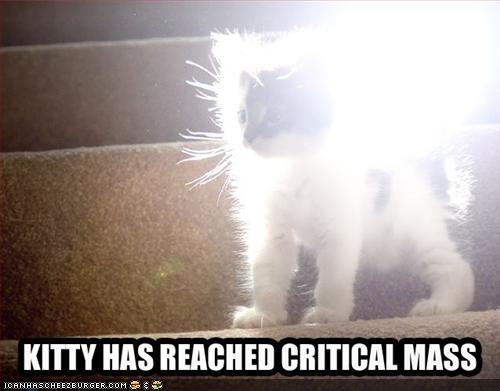
Feline Physics

funny-pictures-cat-reaches-critical-mass

I thought this was funny, so I thought I’d share and in the process prove to the intertoobs that Astroengine is still alive and well. Just returned from an uber-cool trip to New York, so I’ll be writing a blog post about that later.

But for now, beware the glowing kittens, a couple of neutrons here or there and more than just fur will fly…

Source: ICanHasCheezburger.com

The Naked Singularity Recipe: Spin a Black Hole, Add Mass

naked_singularity

The event horizon of a black hole is the point of no return. If anything, even light, strays within the bounds of this gravitational trap, it will never escape. The event horizon is what makes a black hole black.

But say if there was a way to remove the event horizon, leaving just the black hole’s singularity to be “seen” by the rest of the universe? What if there is a special condition that would allow this infinitely small, yet massive point to become naked?

Generally physicists agree that this is a physical impossibility, but the mathematics says otherwise; a naked singularity could be possible.

Previously on Astroengine, one “special condition” was investigated when an extreme black hole collision was simulated by a Caltech researcher. In this case, the black hole pair was smashed together, head-on, at a velocity close to the speed of light. The gravitational waves travelling away from the collision were then modelled and characterized. It turns out that after this insanely energetic impact, 14% of the total mass was converted into gravitational wave energy and both black holes merged as one.

While this might not be very realistic, it proved to be a very useful diagnostic tool to understand the conditions after the collision of two black holes. As an interesting observation, the Caltech researchers found that although the collision was extreme, and there was a huge amount of mass-energy conversion going on (plus, I’d imagine, a rather big explosion), neither black hole lost their event horizons.

Case closed, wouldn’t you think?

Actually, another theory as to how a black hole could be stripped naked has been knocking around for some time; what if you added mass to a black hole spinning at its maximum possible rate? Could the black hole be disrupted enough to shed its event horizon?

It turns out there’s a natural braking system that prevents this from happening. As soon as mass is dropped into the black hole, it is flung out of the event horizon by the black hole’s huge centrifugal force, preventing it from coming close to the singularity.

However, Ted Jacobson and Thomas Sotiriou at the University of Maryland at College Park have now improved upon this idea, sending mass in the same direction as the spinning black hole. Only this time, the black hole isn’t spinning at its fastest possible rate, the simulation lets the orbiting matter fall into the event horizon, speeding up its spin. The result? It appears to disrupt the black hole enough to strip away the event horizon, exposing the singularity.

The most interesting thing to come of this research is that swirling matter is falling into black holes all over the universe, speeding up their spin. Jacobson and Sotiriou may have stumbled on a viable mechanism that actually allows naked singularities in the cosmos. Unless nature has found another way to prevent the cosmic censorship hypothesis from being violated that is…

Source: New Scientist

Cassini Discovers a New Moonlet in Saturn’s Rings

The ~400 meter moonlet casts a 25 mile shadow across Saturn's B-ring (NASA)

As Saturn approaches its August 11th equinox (during which the Sun will be directly above the gas giant’s equator at noon for 27 months), the Cassini Equinox Mission can do some moonlet spotting. During this time, sunlight will cast long shadows of any object protruding from the 10 metre-thick rings.

In this case, hidden inside Saturn’s B-ring, a moonlet with a diameter of approximately 400 metres becomes obvious when sunlight hits the rings edge-on. The result is a very obvious 25 mile-long shadow. This discovery wouldn’t have been possible during any other time, as Cassini can only see the small rock because of its shadow. If the Sun was above or below the rings, no shadow would be cast, and therefore no moonlet would be visible.

Saturn experiences an equinox twice every Saturnian year (once every 15 terrestrial years), and NASA planned the Cassini mission to coincide with this interesting period to economise on the position of the Sun, spotting small objects like this little satellite…

Source: Wired, thanks to Helen Middleton (@herroyalmaj).

Ares I First Stage Test Set For August 25th (Video)

The completed Ares I first stage five-segment solid rocket booster in Promontory, Utah on July 21st (NASA/ATK/RedOrbit)

Development of the Constellation Program pushes ahead with the announcement that the first stage motor of the Ares I crew launch vehicle will be fired in the Utah desert on August 25th. The Ares I five-segment first stage booster is based on the design of the shuttle’s four-segment booster, but it will deliver a far meatier 3.6 million pounds of thrust. A single shuttle booster delivers 2.8 million pounds of thrust (but remember, there are two of them attached to the shuttle at lift-off).

Naturally, the ATK/NASA Utah test will be a huge event, a major milestone towards the construction and assembly of the rocket that will carry the Orion spaceship into orbit. This is in addition to the continuing developments of Orion.

So, to promote the event ATK has released this snazzy movie-style trailer ahead of this historic rocket test, and to be honest, I’m impressed:

Although Constellation is hitting wave upon wave of setbacks and criticism, it seems the tests are pushing ahead, and we are beginning to see the physical embodiment of the Ares I/Orion combo take shape.

Source: Fox Business

2012 Has Become the Tweed Jacket of Doomsday Scenarios

Palenque Museum Mayan glyphs (wyattsailing.com)

In a little over three years time, December 21st 2012 will be upon us. For every reason under the Sun, 2012 will be a normal year, with its fair share of trials, tribulations, disasters, deaths, political unrest and pretty much every other setback we’ve been facing this year, last year and all the other years we’ve lived through. Some years are better than others, some are downright bleak, but we can never predict what the year 2012 is going to be like. And no, the Mayans, astrologers, secret government conspirators or tea leaves don’t have a clue either.

No vague doomsday prophesy predicted since the dawn of time has happened, and that’s not going to change.

It’s a little thing called causality. No future event can be seen before it happens, otherwise the whole cause-and-effect thing gets completely screwed up. It’s the way time works, no amount of believing otherwise will change that…

*yawn* Sorry, I fell asleep. Is it me, or is this 2012 bunkum already getting out-dated? Has it become the doomsday equivalent of the tweed jacket of fashion?

I bring this up as the doomsday hype is leaking into every facet of reporting, and today I read an Examiner post that is trying desperately hard to get attention. This time, it’s not about crop circles predicting killer solar flares, it’s the LA Science and Tech News Examiner who couldn’t resist dropping in a mention for the Mayan calendar when reporting about the recent Large Hadron Collider (LHC) woes.

The report goes into some detail about recent LHC problems, pointing out that the particle accelerator probably won’t be operating at full energy until… wait for it[cue doomsday alert!] …2012.

This triggers another doomsday ‘tweed jacket,’ the nonsensical LHC-induced Earth-eating-black-hole pseudo-science theory popularized by Walter “I need some attention” Wagner after he tried (and failed) to sue CERN for endangering the planet with its scary physics.

I’d understand if the report was commenting about real science behind the various silly doomsday scenarios that are being thrown around like confetti, but it isn’t. Fred Gober decided that the LHC wasn’t interesting enough to stand on its own merits and threw in some doom to jazz it up a bit.

It’s true that Gober was just airing opinions, which is perfectly fine, but at least poke fun at the 2012 doomsday hype rather than using it as a reason to try to add some fear to LHC science (although I suspect he might be trying to be funny, didn’t work). Gober also finds it necessary to link to a ridiculous ‘2012 believer’ site (apparently Mel Gibson ‘believes’, shocker).

I also understand that many readers won’t pay much attention to the doomsday reference, but as we found out in the run-up to last year’s first attempt to get the particle accelerator started, some people take this kind of reporting seriously, occasionally with tragic (and bizarre) consequences.

Unfortunately, 2012 will continue to be overused for the next 40 months, so expect more science-based articles like this Examiner post that decide to add some doom to their reporting.

U.S. Navy Intercepts Missile 100 Miles Over the Pacific

navy-missile-02

When you stop to think about it, this bit of news kinda makes last year’s surface-to-satellite shoot-down sound a little… pedestrian. It’s been announced that the U.S. Navy successfully intercepted a short-range ballistic missile 100 miles above the Pacific Ocean.

A ship basically destroyed a missile, in space.

At an altitude of 100 miles.

Wow.

Details are a little sketchy, but the event took place on July 30th and the Navy weapon of choice was a Standard Missile-3 block 1A missile — a similar missile was used during the February 2008 satellite intercept — fired from the USS Hopper. The dummy target ballistic missile was fired from the Hawaiian island of Kauai and it was tracked by the Hopper and USS O’Kane (both destroyers) and consequently shot down.

This marks the 19th successful intercept (out of 23) of high-altitude targets (including the Feb. 2008 spy satellite shoot-down) for the U.S. military’s Aegis Missile Defense system.

To be honest, I was totally floored when I heard the U.S. military had the capability to shoot down a satellite at an altitude of about 130 miles, but to pick out an even smaller target at a comparable altitude is amazing (although the satellite, travelling at 17,000 mph, might have been going faster than a speeding ballistic missile… I might be wrong).

So it looks like the U.S. military is pretty good at taking out ballistic threats after all…

North Korea? Come on, what’s the point?

Source: Space.com

xkcd: Probably Not The Best Way To Deal With An Asteroid

asteroid_xkcd

I hope we never see this day in the future, when the newscaster calmly informs us that an asteroid is on a collision course with Earth.

In any case, if this scenario did unfold, I’d like to think we’ll have the in-space technological capability to deal with the threat — but if we didn’t, I’m sure we’d work on it pretty damn quickly (given enough warning… if not… well, I’m out of ideas).

But please… don’t go strapping a nuclear warhead to the rock… it might not end quite so well.

Source: xkcd

Opportunity Investigates Possible Martian Meteorite

opportunity_meteorite2

On its epic journey to Endeavour Crater, Mars Expedition Rover (MER) Opportunity passed a suspect looking boulder on July 18th. Dubbed “Block Island” by MER controllers, this dark rock looks very different from its surroundings, so Opportunity has been ordered to go off its planned route by 250 meters and have closer look.

Measuring approximately 0.6 meters across, the jagged specimen could be a meteorite, giving the rover a chance to carry out an in-situ analysis of its composition, determining whether or not this is indeed of extra-martian origin.

The odd-shaped and dark rock sits atop the regolith, and Opportunity will use its APXS instrument to determine its composition (NASA)

The next step is for the rover to extend its robotic arm, pressing the Alpha Particle X-Ray Spectrometer (APXS) up against the rock’s surface. The spectrometer will basically give the sample a blast of radiation, consisting of alpha particles and X-rays. The analysis of scattered alpha particles (after they have bounced off the material) will reveal the mass of the elements they collide with and the emission of X-rays will also reveal a lot about the material.

So could this be a meteorite? We’ll have to wait until the little robot has carried out its experiment… she may be getting old, but Opportunity is still carrying out some awesome science.

Source: NASA

“Science Knows It Doesn’t Know Everything… Otherwise It Would Stop.”

I love this video.

Dara O’Brian, Irish comedian, says it the way it is, and as Phil Plait said, “I sometimes think that comedians wield more skeptical leverage than bloggers.” This is true, but it’s up to us bloggers to post cool snippets from skeptical comedian sets and have a good giggle. So here’s the hilarious O’Brian, slamming crackpots across the board (beware the NSFW language):

Source: Bad Astronomy