Of course, 2009 is the International Year of Astronomy, and half-way through this important year, we’ve seen some amazing feats of science. We’ve been fixing telescopes in orbit, assembling space stations, peering deep into the cosmos with a vast suite of telescopes, we’ve acquired new and improved techniques to analyse data and we’re on course for even bigger discoveries in the run-up to 2010.
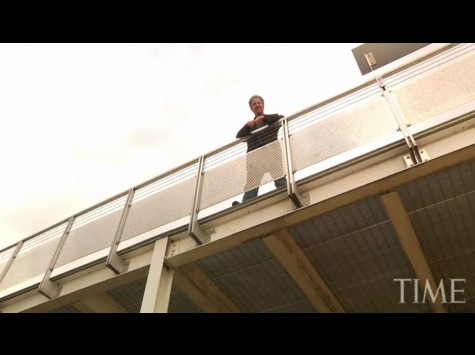
So this evening, I receive word from science comedian Brian Malow that he hosted a TIME.com video all about Galileo and the history of astronomy.
It’s superb!
If you wanted a one-stop overview of the spirit behind IYA2009, this is it. It’s witty, informative and above all, it’s entertaining — all the things this special year for science should be about.
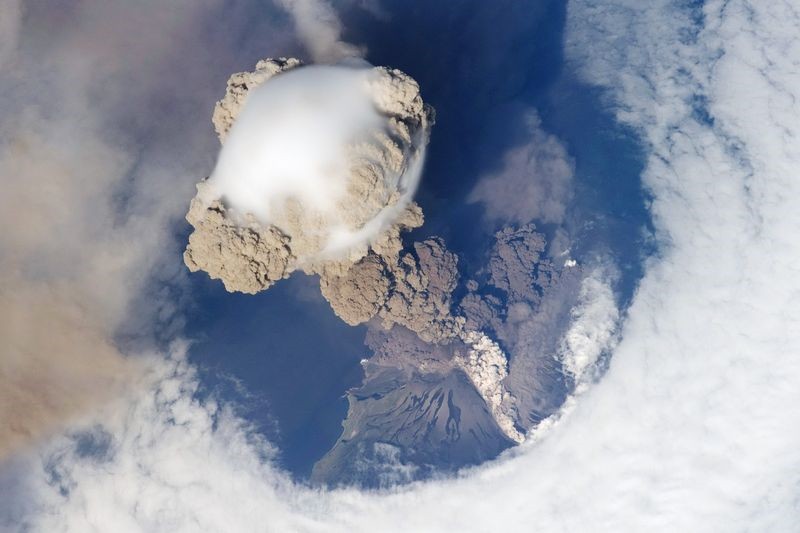
When I first saw this image, I didn’t think too much of it. After all, this isn’t the first time I’ve seen a volcanic plume racing through the atmosphere. However, this picture is awesome on so many levels.
First, as part of NASA’s Earth Observatory program, an astronaut in the International Space Station was fortunate to get the timing just right to witness Russia’s Sarychev Peak volcano in the Kuril Islands explode, blasting a huge plume of ash and smoke high into the atmosphere. Second, the conditions on the ground must have been very still, allowing such a huge vertical structure to reach so high. And thirdly, the image captures two amazing features: a condensing cloud of vapour at its peak (the white, smooth cloud) and a shock wave that pushed all the surrounding cloud away from the eruption.
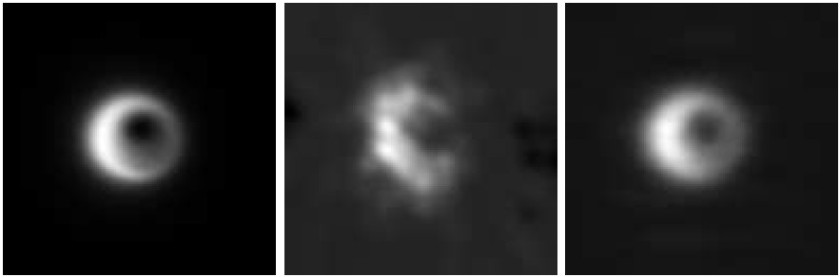
A modelled black hole shadow (left) and two simulated observations using a 7-telescope and 13-telescope array (Fish & Doeleman)
All the evidence suggests there is a supermassive black hole lurking in the centre of our galaxy. We’ve known as much for quite some time, but it wasn’t until recently that we’ve been able to confirm it. As it turns out, most galactic nuclei are predicted to contain supermassive black holes in their cores.
The Milky Way’s supermassive black hole is called Sagittarius A*, a well-known compact radio source used by radio astronomers as an instrumental calibration target. The black hole driving this emission has been calculated to weigh in at a whopping 4×10⁶ solar masses.
So, we’re certain Sgr A* is a supermassive black hole, how can we use it?
Using our Sun as an example, stellar physicists use the Sun as an up-close laboratory so they can better understand stars located many light years away. It is an up-close star that we can study in great detail, gleaning all kinds of information, helping us learn more about how stars work in general.
What if Sgr A* could be used in a similar way, not in the study of stellar physics, but in the pursuit to understand the dynamics of black holes throughout the Universe?
This is exactly the question Vincent Fish and Sheperd Doeleman from the MIT Haystack Observatory ponder in a recent publication. The researchers make an important point early in their paper:
Due to its proximity at ~ 8 kpc [26,000 ly], Sgr A* has the largest apparent event horizon of any known black hole candidate.
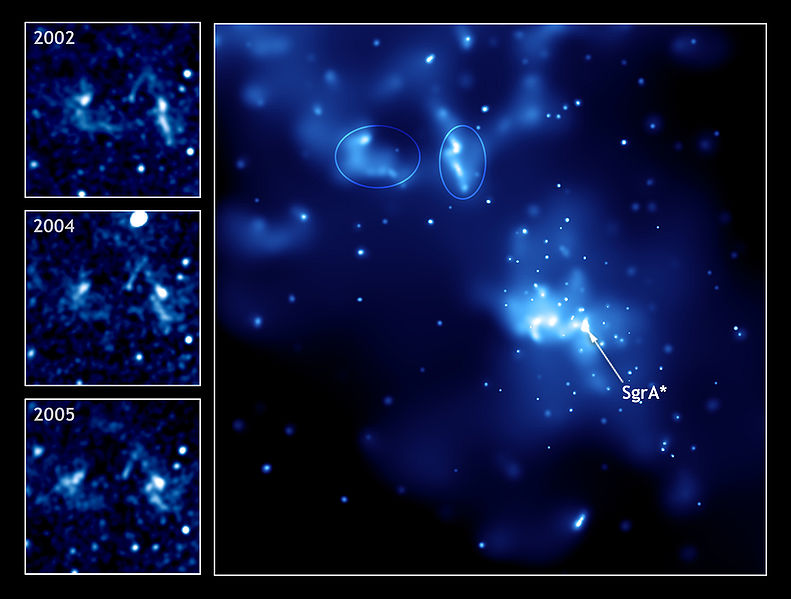
The centre of our galaxy as imaged by Spitzer (NASA)
In other words, the supermassive black hole in the centre of the galaxy is the largest observable black hole in the sky. As Sgr A* is so massive, its event horizon is therefore bigger, providing a sizeable target for Earth-based observatories to resolve.
Although the black hole is quite a distance from us, the size of its event horizon more than makes up for its location, it even trumps closer, less massive stellar black holes. Sgr A* could therefore be our own personal black hole laboratory that we can study from Earth.
But there’s a catch: How do you directly observe a black hole that’s 26,000 light years away? Firstly, you need an array of telescopes, and the array of telescopes need to have very large baselines (i.e. the ‘scopes need to be spread apart as wide as possible). This means you would need an international array of collaborating observatories to make this happen.
The authors model some possible results using many observatories as part of a long baseline interferometry (VLBI) campaign. As Sgr A*’s emissions peak in the millimetre wavelengths, a VLBI system observing in millimetre wavelengths could spot a resolved black hole shadow in the heart of Sg. A*. They also say that existing millimetre observations of Sgr A* show emission emanating from a compact region offset from the centre of the black hole, indicating there is some kind of structure surrounding the black hole.
The results of their models are striking. As can be seen in the three images at the top of this post, a definite black hole shadow could be observed with just 7 observatories working together. With 13 observatories, the resolution improves vastly.
Could we be on the verge of tracking real-time flaring events occurring near the black hole? Perhaps we’ll soon be able to observe the rotation of the supermassive black hole as well as accretion disk dynamics. If this is the case, we may be able to also witness the extreme relativistic effects predicted to be acting on the volume of space surrounding Sgr A*.
The best news is that technological advancements are already in progress, possibly heralding the start of the construction of the world’s first “Event Horizon Telescope.”
Source: Observing a Black Hole Event Horizon: (Sub)Millimeter VLBI of Sgr A*, Vincent L. Fish, Sheperd S. Doeleman, 2009. arXiv:0906.4040v1 [astro-ph.GA]
On reading an article in The Daily Galaxy today, I was interested by what the author had to say. In a nutshell, the article pointed out that it is a big mistake to believe we are the only intelligent life in the Milky Way.
Why is that?
The only reason given was that there are billions of stars, it is therefore foolish to think we are the only example of an advanced species. Unfortunately, there is no evidence to suggest that we aren’t the only intelligent life form in our galaxy. Just because there are hundreds of billions of stars possibly with billions of habitable planets does not constitute evidence that we’re not alone. That’s what science is all about, formulating a theory and then gathering the evidence. Simply saying, “There’s lots of stars, therefore there must be an intelligent species out there,” doesn’t cut it.
Dr Frank Drake toiled with this idea to eventually arrive at the famous Drake Equation, a concept I have never felt at ease with:
At first glance, we could say that the Drake equation really is nonsense (after all, how can any equation predict more than one intelligent civilization in our galaxy, when we only have experience of one: us), and that we are the only kids on the Milky Way block. — from If There’s an Alien Race Living on our Doorstep, Why Can’t We Hear Them?
How can you arrive at the conclusion that we are not the only intelligent life in the galaxy simply because there are a lot of stars?
Familiarity
What can we expect ET to look like?
It is true that the Milky Way contains billions of stars, of which a high percentage probably have exoplanets not dissimilar to Earth orbiting them. There’s every chance that a smaller percentage of those Earth-like terrestrial exoplanets have some kind of basic life form slivering around (or indeed swimming, flying, walking or ‘talking’). Also, there’s the chance that some of these exoplanets have nurtured something that we’d consider to be ‘intelligent.’
Now this is where things start to get a bit tricky.
There are massive international efforts under way to find any kind of extraterrestrial life. We’re toasting soil samples on Mars in the hope of finding the biological signature, and we’re using full-blown antennae scouring the skies for any organized signal from an intelligent alien species. However, whether we are looking for microbial life in the Solar System or something a little more sophisticated beyond, our search for extraterrestrial life is based on only one model: Earth.
It’s all very well saying that we should be looking for other possible forms of life, but if we have no experience of it, how do we know what to look for?
It’s a similar question to, “What is beyond a black hole’s event horizon?” We have no idea, because we cannot experience it, the physics of our Universe simply do not apply beyond an event horizon.
There are a lot of ideas, theories and conjecture but at the end of the day, we have to assume ET will have some trait we are familiar with.
When looking for intelligent extraterrestrials we make the assumption that these civilizations have progressed in a similar way to us, eventually transmitting radio signals (perhaps even laser beacons) to communicate on their home world, between planets with their own kind, or even reaching out into the cosmos, signalling their presence to other life forms capable of receiving interstellar signals.
We’ve been leaking radio signals into space for the last century and we are constantly communicating with our planetary probes. There’s every chance that if there’s an intelligent alien (with a radio receiver) within 100 light years, we may have already been detected. We are also being a bit more proactive these days, using programs such as Messaging Extraterrestrial Intelligence (METI) to make our presence known. (But what should we be saying?)
SETI, METI, SETA… SETT?
The Arecibo radio antenna, used by SETI
Unfortunately, apart from one isolated case, the Search for Extraterrestrial Intelligence (SETI) has drawn up blanks, we don’t think we’ve heard anything in the cosmos that’s originated from an alien.
On this single null result, we could jump to the conclusion that there is no other form of ‘intelligent’ life in our galaxy. Say if the ‘Rare Earth‘ theory is correct, and we are indeed the only form of intelligent life in our galaxy? But there are other explanations. What if ET is signalling via another method? What if there is some interstellar mechanism that is hindering (or even blocking) the transmission of electromagnetic communications? All these questions are valid as there is no scientific evidence to support otherwise. It’s very quiet out there, a fact that is bugging scientists quite a bit, and this problem been dubbed the Fermi Paradox.
The Milky Way is very old, in fact, the oldest star in our galaxy has been burning for 13.2 billion years (compare that with the age of the Universe at 13.74 billion years); you’d logically think that something resembling an intelligent civilization would have popped into existence in that time. If they did, surely we’d have detected them by now, wouldn’t we?
Actually, this spawns yet another debate: Have ancient interstellar alien civilizations come and gone? Was there a frenzy of intelligent life popping up all over the galaxy in the billions of years that our Sun was a proto-star surrounded by a proto-planetary disk? If old alien intelligence has since become extinct, our few thousand years as an evolving civilization is a mere spark in universal time scales. Could it be that we’ll have to wait until we can actually visit interstellar destinations first-hand to do the SETI equivalent of an archaeological dig, looking for alien artefacts? Perhaps SETI should be changed to the Search for Extraterrestrial Artefacts (SETA), where we’d have to look for evidence of alien civilizations past.
There’s another factor to consider. What if an advanced extraterrestrial civilization simply isn’t transmitting? If this is the case, perhaps we should consider a Search for Extraterrestrial Technology (SETT). In this case we could look for alien megastructures, searching for the stuff of science fiction. These structures could include examples of Dyson Spheres, huge alien-made hollow spheres containing a star; a means to harvest all the stellar energy for a vastly advanced civilization.
These are all options, and we shouldn’t close any possibility, no matter how extreme they may be.
Conclusion
There’s a reason why we haven’t received a signal via SETI, but we have no idea about what it could be. We really could be alone in the Milky Way. But then again, there’s a huge number of reasons why we might not be receiving a message from an intelligent species.
SETI may not be an interstellar switchboard, but the reasons for this are far from obvious. The theory that we are alone is just as valid as the theory that we are actually a part of a vast interstellar ecosystem. Until we have scientific evidence, we can’t say either way.
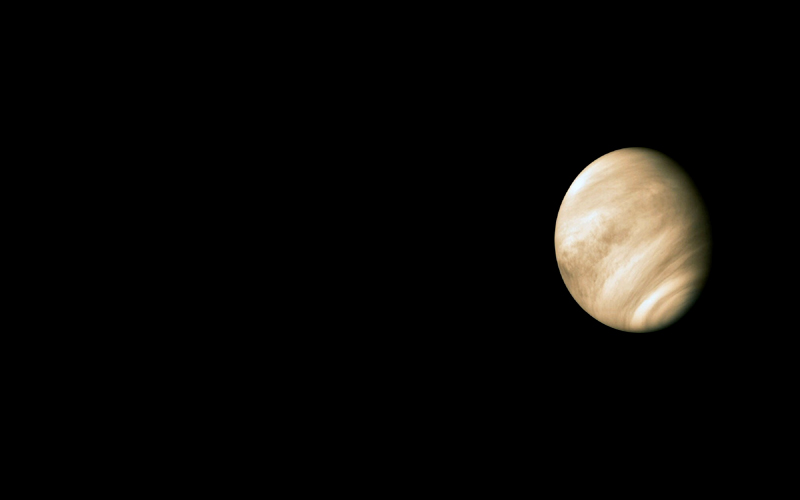
Venus is a hellish world. Although the planet is nearly the same size of Earth, that’s where the similarities end. Having said that, it does have an atmosphere, but it’s not the kind of atmosphere you would ever want to spend time breathing in. Composed of a dense carbon dioxide/nitrogen mix where clouds are made from sulphuric acid, you can forget about Venus as a tropical holiday destination. Even if you found a way to ‘breathe’ on Venus, you’d need to prepare yourself for the scorching 470°C surface temperatures and bone crushing pressures 100 times the pressure we are used to on Earth.
Doesn’t sound like a very nice place does it? Certainly an interesting world, providing us with invaluable science (after all, the reason for the extreme temperatures on Venus is due to a run-away greenhouse effect, it could help us understand the growing problems we are facing with our comparatively mild global warming woes), but an unlikely candidate for human colonization (unless we lived in the clouds).
Venus might not be a popular world for mankind to live on, but it doesn’t seem to be a popular world for natural satellites to orbit around either. It doesn’t have any moons, and astronomers are a little confused as to why this is the case. The only other planet without moons is the innermost terrestrial planet, Mercury. Every other planet in the Solar System has at least one natural satellite.
For hundreds of years, astronomers have been on the lookout for anything orbiting Venus but they’ve had little luck. However, some of the earliest observations of Venus appeared to indicate the presence satellites (in 1645, F. Fontana mentioned the possibility of a satellite discovery, followed by further observations in the late 1600’s and 1700’s). Since 1768, there have been no further reports of any satellite sightings. 1956 was the last published survey for Venusian satellites, using photographic plates, and that survey (published by Gerard Kuiper in 1961) drew up blanks for any satellites measuring over 2.5 km wide.
The lack of Venusian moons is puzzling, as a Venus-moon interacting mechanism has often been invoked as the reason why Venus has a retrograde spin (i.e. viewed from the ‘top’ of the Solar System plane, Venus has a clockwise rotation, whereas the rest of the planets, apart from Uranus — that spins on its side, bizarrely — have an anti-clockwise, or prograde, spin). Perhaps Venus once had a moon, but it has since been lost due to gravitational interactions with other Solar System bodies, or due to tidal instabilities, the innermost terrestrial planets collided with their large satellites a long time ago.
This is where Scott Sheppard from the Carnegie Institution of Washington and Chadwick Trujillo from the Gemini Observatory (Hawaii) step in. In a recent publication titled, “A Survey for Satellites of Venus,” Sheppard and Trujillo pick up where Kuiper left off, and carry out a systematic survey searching for any natural satellites around Venus. Only this time, by using the cutting-edge 6.5 meter telescope and IMACS wide-field CCD imager at Las Campanas observatory in Chile, they looked for objects only a few hundred meters in diameter.
The researchers scanned the interior of the Venusian ‘Hill Sphere’ to see if any undiscovered tiny moons were lurking. The Hill sphere is the volume of space surrounding a planetary body where natural satellites can orbit without being destabilized by the gravitational effects of the Sun. If there are any unforeseen moons, they should be found in stable orbits within the Hill sphere.
Sheppard and Trujillo have drawn blanks. Although a few errant asteroids were detected, no natural satellites down to a diameter of 600 meters were discovered. They surveyed 90% of the Venusian Hill sphere, and 99% of the inner Hill sphere (0.7rH) — the volume of space predicted to contain the stable orbits of natural satellites.
This new survey improves the non-detection of satellites down to a factor of 50 on previous studies, thereby proving Venus either, a) never possessed any satellites over 1km in diameter, or b) the orbits of past large satellites have become unstable and crashed into Venus or flung into space.
Firstly, let’s set the record straight: I love disaster movies.
I don’t care if the Earth is being invaded by aliens, getting hit by comets, being saved by oil drillers or poisoned by angry trees (yes, my brain even shrank through The Happening). It’s fiction, it’s fun and, let’s face it, who doesn’t enjoy a bit of global calamity interwoven with a silly plot.
So, today the extended trailer for the November film 2012 has been released (below), and I do admit, I was mildly excited to see what this budding blockbuster had to offer — although I changed my mind when seeing the horridly Hollywooded ‘science’ and the USS John F. Kennedy flatten the White House after surfing a mega-tsunami at the end. That was no cigarette they were smoking in the Sony Pictures cutting room.
The whole 2012 hype has kept my blogging gene active for the best part of a year, so I know for a fact that 2012 director Roland Emmerich has a lot of material to play with.
According to the CGI-fest of a trailer, have some ancient intrigue with “mankind’s earliest civilization” (the Mayans… a.k.a. not mankind’s earliest civilization) predicting the “end of the world” (are you sure?) with their pesky calendar. We also have something astronomical (yep, Planet X is back) careering toward Earth. We get tsunamis flattening cities, flying giraffe, Noah’s Ark, minivans getting hit by Big Flaming Balls Of Fire™, crying children, earthquakes, fire, more crying children, famine, angry politicians and John Cusack. (What?)
This is going to be oodles of fun if you want to see our planet disintegrate into a tortured dust bowl via computer-generated fury, but could this also be the end of the quintessential disaster movie?
This has been my complaint all along about the insane doomsday scenarios being dreamed up by crackpots and greedy authors: You’re trying too hard! What ever happened to the subtle art of doomsday prophesy?
EXAMPLE: Nostradamus says the world will end some hazy time in the hazy future (get that man a Nobel Prize!); a computer expert says, “Hmm, these microchips might reset when the calendar switches from 1999 to 2000,” followed by the aforementioned crackpots and greedy authors telling the scared populous that we’ll be driven back into the Stone Age… all because of a small, overlooked flaw in computer programming.
I miss those doomsday scenarios. They were simpler times.
Now we have 2012 conspiracy theorists compounding doomsayer dogma, bending science to suit their hopelessly flawed doomsday scenarios. 2012 seems to be a hothouse for every impossible planet killer we could possibly imagine. How the hell Emmerich is going to work Nibiru, Planet X, killer solar flares, polar reversal, galactic alignment and geomagnetic hoopla into the plot I’ll never know.
Impossibly jumbled plot to one side, I will still want to be one of the first to see this movie. I’ve examined the real science behind the proposed end of the world in 2012 since May 2008, and I can assure you, I have yet to come across one single ounce of Planet X matter. No planet-wide calamity is expected on December 21st, 2012, and there isn’t a single shred of scientific or archaeological evidence that suggests otherwise. It will be interesting to see if Emmerich hired a science advisor, to actually add any credibility to doomsday, but if recent examples are anything to go by, I suspect it’s going to be science-lite.
Unfortunately, I am still saddened by Sony Pictures marketing ploy. The Institute for Human Continuity (IHC) viral campaign was very a successful yet short-sighted idea, marketing the movie like a multi-million dollar advertising campaign, but pandering to the anti-science sentiment that flows through the heart of doomsday hoaxers.
All in all, yes, I’ll watch 2012, but I can guarentee I’ll be shaking my head for the most part. The choice of cast is a warning sign. John Cusack as the flawed dad who’ll save the day? Danny Glover as President?? Woody Harrelson? Woody Harrelson?
Apologies for the break in Astroengine Live service. Due to some uber-technical problems, I’m going to have to re-launch the show this time next week. Stay tuned for updates.
It’s been a while, but Astroengine Live is back on the air, TODAY! It’s been a fascinating few weeks, so I want to share some of the stuff I’ve come across. I especially want to go into the current Wide Angle over at Discovery Space, “Surfing Spacetime”.
Wow, look at that title for some keyword stuffing! Stuffing… get it?
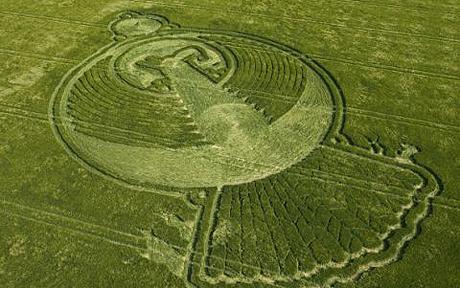
Phoenix? Turkey? They're both birds, so it's close enough (M & Y PORTSMOUTH)
The Telegraph: bedrock of traditional journalism, pinnacle of UK news reporting– I’m sorry, I can’t finish that sentence, I’m too busy crying with laughter.
Seriously. I mean, seriously. Sure, everyone needs to remain competitive in this ultra-fast world of social media and transient online traffic, but there’s a lot to be said for keeping your integrity too. In this master stroke of continued patchy reporting from the UK’s Telegraph we have a serious ‘news’ report about a crop circle, that depicts the Phoenix flying from the ashes. Or is it a turkey?
What could this possibly mean? Oh yes, I might have guessed. Obviously it means the world is going to end on December 21st 2012. What a coincidence, those Mayan fellas have been saying the same thing all along. Now we have crop circles? And crop circle enthusiasts telling us it’s the end of the world? Holy crapcakes, doomsday really is coming. I’ve been such a fool.
The saving grace about this article is that it hasn’t been filed under ‘science’, unlike the “Mars Skull” hilarity a few weeks ago. But that’s the article’s only saving grace.
I’d understand if there was a little scepticism in the tone of the report, or perhaps a little light-hearted banter about aliens and their fetish for bending corn, but unfortunately this is an article that jumps to one huge conclusion:
Crop circles = Doomsday
It really is that simple. Reading signs in bent corn has been the fodder for doomsday theorists for as long as there have been doomsday theories and this report does nothing to challenge that. Is it really that hard to find a skeptic/scientist/logical thinker in Wiltshire these days?
I might be missing something here, but where’s the link between these crop circles and doomsday in 2012? That’s right, there isn’t one.
And I’m now certain that crop circle depicts a turkey…
Source: Telegraph.co.uk(YES, I know! The sodding TELEGRAPH!)
General relativity and quantum dynamics don’t get along too well.
If you had to compare the two it would be like evaluating the differences between a Mac and a PC; both are well-honed examples of modern computing, but both are hopelessly incompatible. In computing, this isn’t too much of a problem, you either use a PC or a Mac, or you buy both for their individual strengths (and then complain about Microsoft regardless). But in physics, when you’re trying to find a unified theory, the fact that gravity has been outcast from the Standard Model club, tough questions need to be asked. Although there is some hope being generated by superstring theory, quantum gravity has a long way to go before it can be proven (although high energy particle accelerators such as the LHC will be able to help out in that department).
As pointed out by KFC at the Physics ArXiv Blog, “physicists have spent little time bothering to find out” how quantum mechanics operates in a curved space-time as predicted by Einstein’s general relativity. But now, a physicist has done the legwork and imagined what a quantum particle would do when faced with one of the most famous loopholes in space-time; the mouth of a wormhole. And what popped out of the equations? Another curious force called the “quantum anticentrifugal force.”
So, what’s that all about?
Rossen Dandolo from the Universite de Cergy-Pontoise, France, decided to focus on the wormhole as this is the most extreme example of curved space-time there is. Wormholes are used over and over in sci-fi storylines because they are theorized to link two locations in space-time (thereby forming a shortcut), or even two different universes. As this is space-time we’re talking about, there’s also some possibility of using wormholes as passages through time. Although wormholes sound like a whole lot of fun, in practical terms, they won’t be of much use without some exotic energy to hold the throat of the wormhole open.
Dandolo, however, isn’t too interested in traversing these holes in space-time, he is interested in finding out how a particle acts when in the locality of the mouth of a wormhole.
Beginning with some bedrock quantum theory, Dandolo uses the Heisenberg Uncertainty Principal that stipulates that you cannot know a particle’s momentum and location at the same time. So far, so good. Now, looking at a prediction of general relativity, the wormhole will warp space-time to the extreme, stretching the space around the hole. This space-time stretching causes an increase in uncertainty in the location of the particle. As uncertainty in location increases, the uncertainty in momentum decreases. Therefore, the closer you get to the mouth of the wormhole, the momentum, and therefore particle energy, will decrease.
This interaction between the stretching of space-time and quantum properties of the particle has some amazing ramifications. If the particle’s energy deceases the closer it gets to falling into the wormhole, the wormhole is acting as a potential well; particles will move to a location with less energy. Therefore, a new force — combining both quantum dynamics and general relativity — is acting on particles that stray close to the wormhole: an anticentrifugal force.
This makes wormholes particle vacuum cleaners, exerting a space-time curvature effect on the quantum qualities of matter.
General relativity and quantum dynamics might have some stronger ties than we think…
A few days ago, I was interviewed by Elizabeth Renzetti from the Canadian publication, The Globe And Mail. As you may have guessed from the title, we weren’t talking about my pet rabbits.
Elizabeth and I had a great chat about 2012, the Mayan calendar and my feelings about the doomsday nonsensestupidity crackpottery, and I think she did a great job with the article. The best thing is, Elizabeth didn’t give any 2012 advocatesmisguided fools crazies any airtime as, obviously, she has a very strong sixth sense for bullsh*t and decided not to interview any of them.
All in all, a very satisfying article that puts the whole 2012 nonsense into perspective. Kinda refreshing.
I actually get the feeling people are tiring of the doomsday mania… but somehow I get the feeling that we ain’t seen nothing yet…




 astroengine.com