Social Media Aggregates Space News For Breakfast

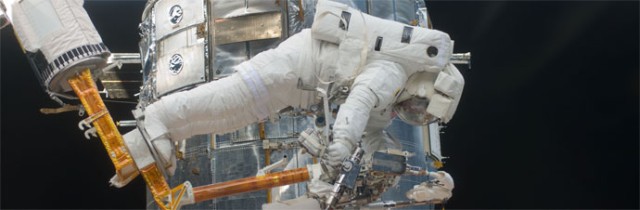
Getting the full experience: Twitter provided a ring-side seat during today's Hubble servicing spacewalk (NASA).

Earlier today, 500 people meandered through Astroengine.com, and I was a little confused as to where they came from. I checked the social bookmarking sites, but this particular page wasn’t listed. Normally, an excess collection of visitors will appear from the aether after quasi-randomly plopping onto my server from StumbleUpon, or blasting my bandwidth during a Digg surge, but this traffic was different. The visitors found my website after clicking a link on a new website called A Portal To The Universe. I knew the site existed, but I hadn’t had the time to check it out. But it is awesome.

Astroengine’s regular readers will know that I have a fascination with the movers and shakers in the world of social media, and I have found various ways to use it for my evil intelligence gathering methods. Also, I’ve met some fantastic people along the way and made very good friends. This time last year, if someone said, “Ian, you will make real friendships online in 12 months,” I would have thought, a) OMG, I’ll be more of a geek than I am now! or b) that is the saddest thing I’ve heard in my life, I never want to see this laptop again.

But then, the web mist cleared, and I saw the light (with a little help from my good friend Avi). Social media isn’t about connecting with a bunch of strangers who have little care for who you are or what you do, it’s about forming social links with like-minded people who have a genuine interest in what you have to say. It’s not quantity (@aplusk-style; why would you want the responsibility of entertaining over a million followers on Twitter anyway?), it’s quality that counts.

Before I realized it, I was collaborating, communicating and collecting space news from real people with real science to distribute. I was tweeting, digging, stumbling, reddit-ting, mixxing and generally socializing my heart out. Along the way, certain platforms fell by the wayside, and now I’m currently enjoying Twitter (more than I should), StumbleUpon and pretty much all the Google applications. Facebook has been steady and so has Digg (for better or worse).

Information reloaded

Building a community is the mainstay of social media, but what do you do if you have too much information flooding your bookmarks? You might use an RSS feed aggrigator, or you might filter your Twitter messages, but wouldn’t it be great if you had a website that helped you find the specific information you are looking for, and helped you find other like-minded people in an ocean of chatter?

But now it would appear space news is welcoming social media with open arms. Two exciting projects have appeared online, using the best information gathering techniques on Web 2.0. Finally, it would appear space science is getting the attention it deserves.

Portal to the Universe

port_uni

In celebration of the International Year of Astronomy 2009 (IYA 2009), the Portal to the Universe was launched at the European Week of Astronomy and Space Science (JENAM 2009), that took place at the University of Hertfordshire, UK, in April.

It is a fantastic news platform with featured news from a range of blogs and news sources. Real-time data is also available from many missions with a wealth of socially generated topics. In the spirit of social media, the Portal grabs community-based space news, displaying all the relevant news to the astronomy and space community. An amazing resource I have been using since it was launched.

Keeping up-to-date with cutting-edge astronomy and space science breakthroughs has just become that much easier, thanks to the Portal To The Universe, the latest Cornerstone project of the International Year of Astronomy 2009 (IYA2009). As a high-tech website embracing Web 2.0 technologies, the Portal To The Universe aims to become a one-stop-shop for astronomy news.Portal to the Universe

AstroSpaceNow

astrospace

This website actually came as a surprise to me. Ricardo J. Tohmé, founder of AstroSpaceNow, contacted me on Twitter and mentioned they were starting up a social astronomy blog. Fortunately, I went to the site to check it out and was impressed with the design of the “coming soon” page. Feeling I’d be left out if I didn’t, I signed myself up for the newsletter and forgot about it.

Then, as promised, a week later, the site went live.

Looking at the pages of AstroSpaceNow, there is a very real Twitter/microblogging feel, and at first, I was a little cautious. There has been a massive surge of the bold-colour/bold-type websites over the last few months, so I didn’t want this to be just another Twitter aggregator with a space twist.

As it turns out, AstroSpaceNow is tremendously powerful. It uses the power and speed of Twitter to keep up to date with key space-related Twitter accounts. Each account is tagged and colour-coded so you can quickly scan through the lists. Each Twitter stream is categorized and the site refreshes every five minutes.

So, if you want to find out what the space news buzz is all about right now, and find the interesting people who are buzzing, this is the site for you. It’s another fantastic resource for space bloggers, as one glance at the pages of AstroSpaceNow and you know exactly what is going on.

A Calculated Love Story: Me and My Casio fx-82D

I call her Casio, Casio fx-82D.

Sitting here at my laptop, like I do most of the time, I see the same stuff on my desk day and night. Occasionally I clean it, but most of the time it’s a mess of the highest order.

If I walked away from my desk, I probably wouldn’t remember what I have on it. I suppose it’s one of those “I remember it like the back of my hand” moments, when you really have no clue what the back of your hand actually looks like. It’s familiar, why would your brain need to remember it anyway?

So, the other day I gave this some serious thought: What item do I have in my life that I, a) can’t live without, b) I take totally for granted and c) I’ve had for a long time.

First thought was my Swiss Army knife. I’ve had that for many years, I take it for granted, but I could live without it. Second thought was my wallet; I take it for granted, but I’ve only had it for a couple of years and, to be honest, I leave it at home most of the time, stashing cash and credit cards into my back pocket. What about my laptop? Nope, I never take it for granted (after seeing the death of many a good computer). My cellphone? Nope, I get through so many phones it’s not funny.

So what else is there? Could I really coast around life without that vital item? Is there anything that fulfils a), b) and c)?

She's been a patient friend

Then I saw it.

The one thing that has sat on my desk for nearly two decades, ready for action, always reliable, necessary, but woefully taken for granted. My Casio fx-82D (FRACTION no less), my first, and only, scientific calculator…

I’m going to start this story with an interesting fact. To my recollection, I’ve only replaced the battery twice. I received my fx-82D some time between 1989 and 1992 for a birthday from my parents, and being a budding scientist I was overwhelmed (it is a scientific calculator after all). So nearly two decades later, to remember replacing the battery twice is astounding.

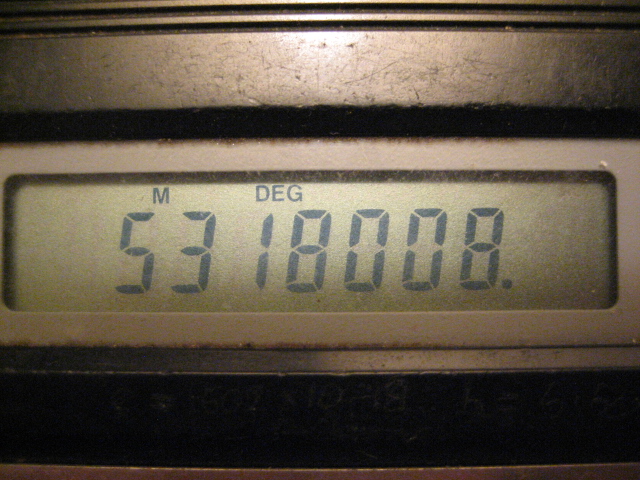
The first thing I ever typed into my Casio. Probably the last thing I typed in too.

It’s not as if I haven’t used it very much either. Not only do I have a problem with numbers, mental arithmetic comes hard, so I have to use trusty old Casio for pretty much everything.

I remember calculating my shopping budget in 1998 during my first week at university; I remember using it to calculate the number of holes there were in the ceiling tile above my head during a particularly boring religious education class in school (I remember being amazed that there were 40×64 = 2560 holes); then there’s the countless exams, thousands of hours sitting in the library studying for finals (instinctively I just used Casio to quickly calculate how many hours there were in a year, just in case the “thousands” of hours in the library didn’t sound reasonable) and huge amounts of time debugging calculations in thousands of lines of code during my PhD.

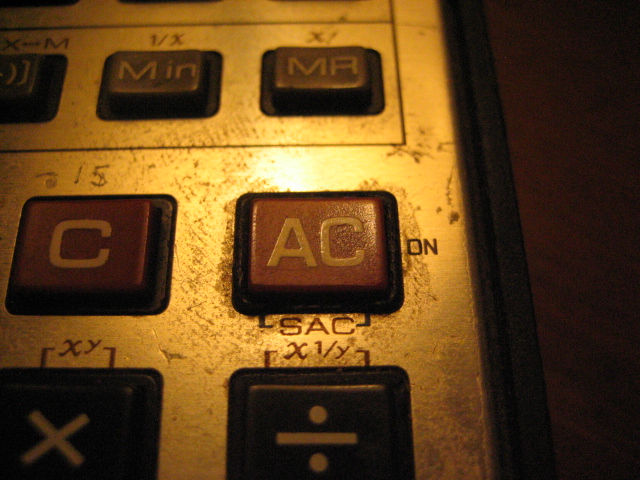
The fingerprints of ancient calculations

I may have achieved a lot in my academic life, but a huge portion of my success is down to the countless key strokes on my fx-82D.

She’s also been my partner in crime on a few occasions.

Did I really just say “she”?

There’s a funny story from my days in college when I was studying for my A Level in physics. For some strange reason, I couldn’t remember unit prefixes (such as the value of nano, micro and pico)…

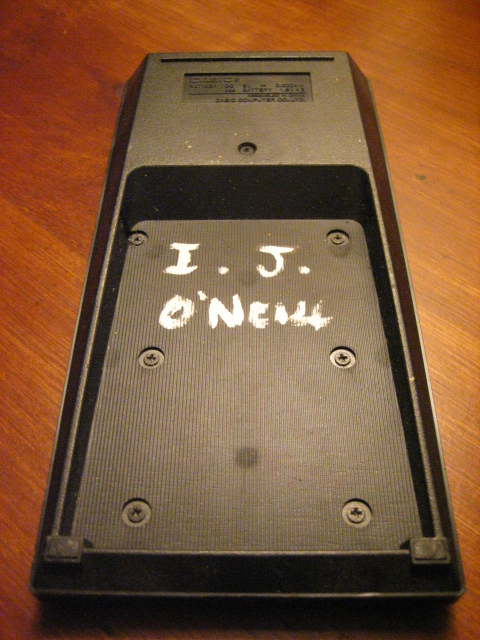
In my defence, the bulky “graphical” calculators that were popping up in school pencil cases that my classmates were using had functions that could automatically abbreviate the exponential number into a unit. So I didn’t feel so bad scoring a mini conversion chart into the aluminium casing with my compass in the front of the calculator. To this day, you can read:

m-3 μ-6 η-9 ρ-12 f-15

She even has her rear tattooed with my name. Dedicated.

It almost looks like mini hieroglyphics. In truth, I don’t think I ever had to use it in an exam situation, but at least I know it’s there, just in case.

All in all my Casio fx-82D FRACTION has been my constant, reassuring mass of two-decade-old microchips, printed circuit boards and basic liquid crystal display. She’s developed with my in my personal mathematical development and calculated everything from shopping lists to complex partial differential equations. She’s shared my voyage of calculating the density of pubs per person in my university town, to arriving at a solution for the final temperature state of my simulated quiescent coronal loops just before I handed in my PhD thesis for review.

If the last two decades are anything to go by, I wonder just how much longer I’ll be using this calculator. Is it the item I hand down to my grandkids? Or, like the Hubble Space Telescope, eventually need too much refurbishment to continue being of much use and then decommissioned?

Did I really just compare my Casio to Hubble?

Long may she continue being that one item I can’t live without, I take for granted and long may she continue to calculate equations no matter how complex or routine.

Welcoming Charles F. Bolden as Next NASA Administrator (Probably)

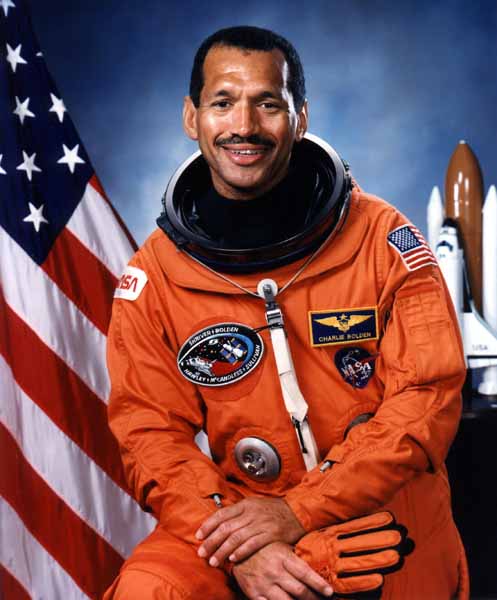
Charles F. Bolden (NASA)
Charles F. Bolden (NASA).

It’s been a long wait, but has President Obama chosen the next NASA Administrator?

According to several news sources, it would appear a former astronaut may be taking the most senior NASA position. Retired Marine Major General Charles F. Bolden will travel to the White House on Monday to meet with the President and discuss the appointment.

Bolden is an experienced astronaut, having served on four Shuttle missions from 1986 to 1994, clocking up a total of 680 hours in Earth orbit.

Earlier this year there was some speculation that Charles F. Bolden Jr.’s name was being mentioned more often than the other contenders in the race replace ex-Administrator Michael Griffin. Judging by today’s press coverage, it appears the speculation was accurate and President Obama has decided on Griffin’s successor.

Bolden joined the space agency in 1981 and served on four Space Shuttle missions, including STS-61C (Columbia, 1986), STS-31 (Discovery, 1990), STS-45 (Atlantis, 1992) and STS-60 (Discovery, 1994).

Interestingly, Bolden was the pilot of Discovery when it delivered the Hubble Space Telescope in April 1990; nearly two decades later, the observatory is still going strong. Today, the STS-125 Atlantis mission carried out the first spacewalk of the final Hubble servicing flight.

In 1994, Bolden left NASA and became Deputy Commandant of Midshipmen at the US Naval Academy. In 2003, he left the Marine Corps as a Major General.

If this decision becomes official on Monday, Bolden will be faced with the toughest challenge he has ever had to confront. The political and financial challenges he will have to overcome as leader of the US space agency will be incredible. We face uncertain times, especially with the retirement of the Shuttle looming and the continuing flack the Constellation Program is receiving.

In many ways Charlie, I don’t envy you. But in others, how cool would it be to be in command of a space agency?!

Special thanks to @SpaceCrazed for the tip!

Sources: MSNBC, SpaceRef

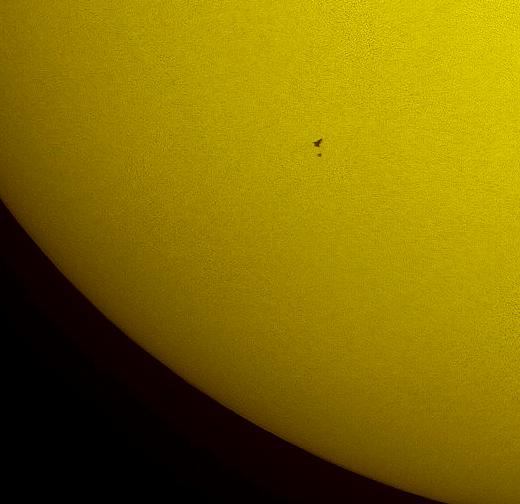
Hubble and Atlantis Transit the Sun (Photo)

The Hubble Space Telescope and Shuttle Atlantis pass in front of the blank Sun. Can't see their silhouettes? Click on the image for the large version and look in the bottom-left-hand corner. That's no sunspot pair... (©Thierry Legault)

Thierry Legault is one highly skilled astrophotographer. The transit of the Hubble Space Telescope and Space Shuttle Atlantis took only 0.8 seconds to clear the disk of the Sun, so Legault rapidly took four pictures per second, starting his series of pictures two seconds before the pair were predicted to pass in front of the Sun.

STS-125 Atlantis and Hubble Solar Transit. The image was captured from Florida at 12:17pm EST on May 13th as the Shuttle approached the orbiting telescope at 600km from Earth (©Thierry Legault)

In the image above, the 35 meter-long Atlantis is easily identifiable, but the tiny speck of the 13 meter-long Hubble isn’t so easy to define, but the result is superb. According to Legault’s website, this is the only picture of the STS-125 and the observatory, orbiting at an altitude of 600 km.

Back in July 2008, Astroengine reported on the transit of the International Space Station across the disk of the Sun. Fortunately, in both cases, the Sun’s face was blank, and no sunspots are prominent enough to ruin the view.

Stunning!

Sources: NASA on Flickr, Astrosurf

Could Genetic Algorithms Boost Space Probe Intelligence?

Voyager carried out a gravitational slingshot manoeuvre past Jupiter (NASA)

Rocket science ain’t easy, but what about celestial navigation? Once you’ve launched your probe into space, surely the hard bit has been done, and we can sit back and relax, happy in the knowledge our technology is out of the Earth’s hefty gravitational well? The robot is coasting through the vacuum of space ready to accomplish some science. Job done. Easy.

As you may have guessed, it isn’t that easy, in fact sending a spaceship on the equivalent of a Solar System-scale game of gravitational ping-pong is highly problematic. What if your launch is delayed? What if the inter-planetary medium (the stuff between the planets) is of a higher density than you expected? Perhaps the Sun has pumped out more particles than you had calculated pre-launch, creating drag and slowing your spaceship down?

Unfortunately, once the spacecraft is on its way, apart from a few minor Earth-commanded corrections allowed by the ship’s thrusters (wasting valuable fuel), the spaceship is by itself, hoping your calculations are as complete as they can be.

When the spaceship in question has to use planetary gravity assists to accelerate or decelerate on its journey to a deep space destination, slight deviations in trajectory than what was calculated can result in inefficient sling-shots or even complete loss of the mission.

Now Ian Carnelli and colleagues from ESA in Noordwijk (Holland) have prepared a publication that details a possible solution using a genetic algorithm. Basically, the computer on board a next generation space probe could simulate multiple autopilots guiding a virtual version of the probe. Each autopilot executes its code and the computer will select which simulated autopilot performs the best (i.e. solutions that waste fuel or find the slowest route will be ignored).

Happy with the best group of simulated solutions, the computer will selectively “breed” them together to develop an optimized pilot, with no need to wait for instructions to be sent from Earth. “After hundreds of generations of the GA you obtain a ‘pilot’ that is an extremely good performer – able to fly the assist trajectory that uses the least propellant while reaching the next target planet faster,” Carnelli says.

Using simulations here on Earth, Carnelli has successfully used his genetic algorithm to optimize the trip of a virtual spaceship to Pluto via Jupiter and another to Mercury via Venus.

Although installing this system on missions in the near future may not be a possibility, it is a tantalizing look into how unnatural selection could be used to optimize, and therefore protecting, expensive pieces of kit in deep space.

Source: New Scientist

The Sun Has An Anti-Climax

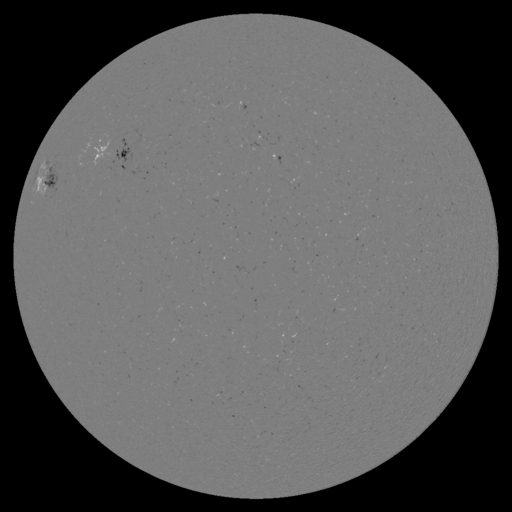
The solar disk on May 11th: Is it? Are they? Not quite (SOHO)

Some recent solar articles are freaking out, proclaiming that the Sun is waiting to unleash it’s fury on the Earth (re: Warning: Sunspot cycle beginning to rise) or that it’s lowering its energy output, possibly kickstarting Maunder Minimum 2.0 (re: New Forecast Calls for Calmer Sun).

So which one is it? Is the Sun just biding its time, waiting for the perfect moment to fire a salvo of flares at us? Or will it remain quiet, well into Solar Cycle 24, impacting our planet like the Maunder Minimum did during the Little Ice Age from the 16th-19th century?

It’s funny actually, both the above articles are based on the same research, and yet two very different conclusions were drawn from the text.

On the one hand, the Sun is acting rather strange; it’s undergoing a sustained solar minimum, the longest period of low sunspot population for the best part of a century. On the other hand, when the Sun does get active, steadily growing to a peak in activity for the 2012-2013 predicted solar maximum, the resulting flares and coronal mass ejections (CMEs) could inflict $2 trillion in damages on global infrastructure (according to a recent study), leaving us to mop up the mess for a decade. It’s these two extremes that are causing such a stir, generating the attention-grabbing headlines.

However, I seriously doubt that we are facing another Little Ice Age and I am highly skeptical of the predictions that the 11 years of Cycle 24 are going to be overly violent. To be honest, we just don’t know. Considering we live so close to the Sun, we actually know very little about it; to even begin trying to predict what it’s going to do next remains problematic.

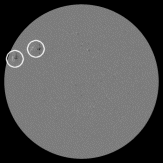
That said, once the Sun starts producing lost of sunspots, this means magnetic activity is on the rise and solar activity is increasing, so when I see sunspots rotate into view, I can’t help but be a little excited. Today, it happened, two active regions appeared on the disk of the Sun. Could this be the real start to the solar cycle?

mag163

Today’s image is a magnetic map of the sun. Two active regions are circled. Their polarity identifies them as members of new Solar Cycle 24, but they lack the dark cores required of true sunspots. So, in spite of these lively magnetic imprints, we must still say “the sun is blank–no sunspots.”SpaceWeather.com

No sunspots, another blank disk day and therefore low magnetic activity still.

How dull.

Atlantis Launch… Infrared-ed

The STS-125 Atlantis launch today, as seen through the lens of an infrared digital camera (Eliot J. Schechter/Getty Images)

I thought I wouldn’t see anything as impressive as the Space Shuttle Atlantis launch in high-definition, but it appears I was wrong. This is probably one of the most unique views of a shuttle launch I’ve seen to date; a high resolution, infrared photograph of the beginning of the STS-125 mission to the Hubble Space Telescope.

This would make a nice wallpaper… yes, it does 🙂

Source: Gawker

Mars Rover Spirit is Stuck in the Regolith

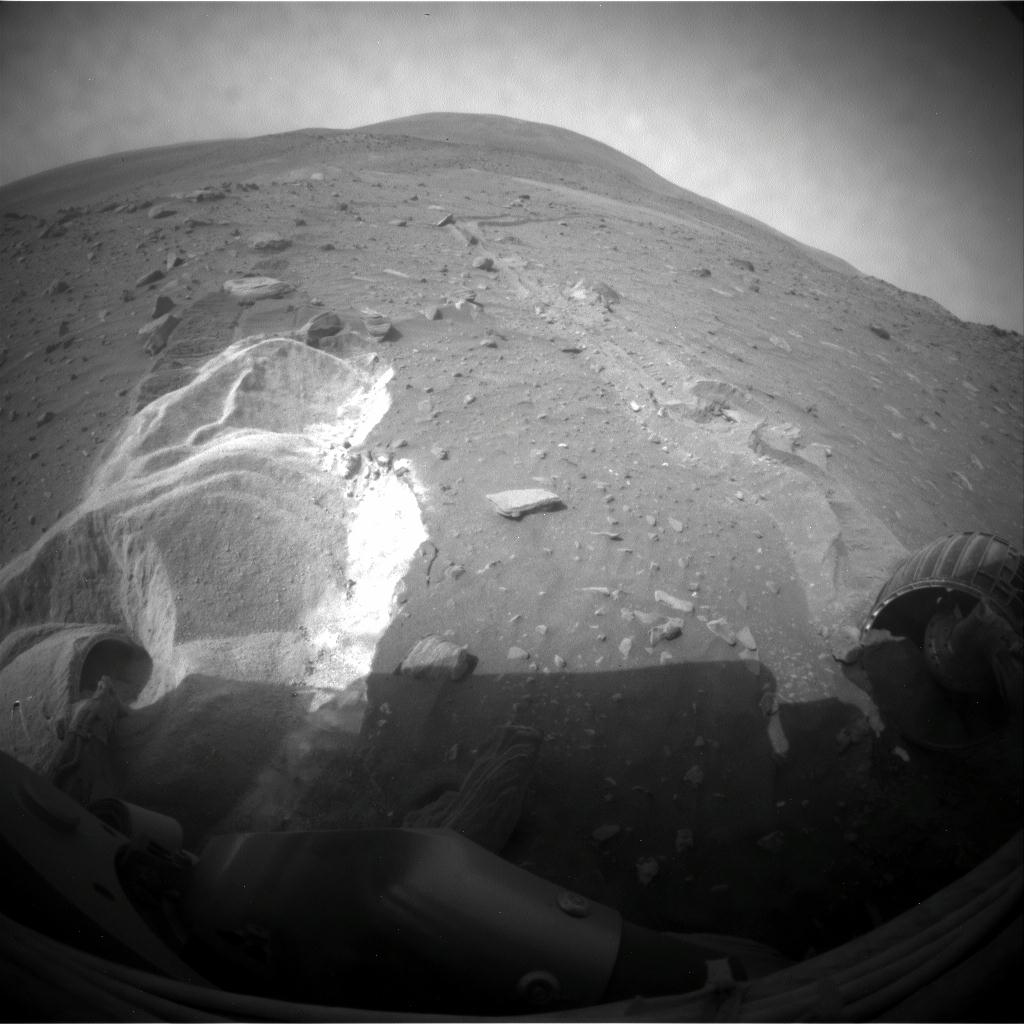
Spirit is stuck (NASA)

Mars Exploration Rover Spirit is in trouble again. She’s stuck.

The tenacious little robot has suffered traction problems before and has even been dragging around a broken wheel for the last three years, leaving the other five to take up the slack. Then there’s the dust storms that have hindered the life-giving solar panels ability to collect sunlight. And most recently, the on-board computers have been rebooting and Spirit’s flash memory has been forgetting to record data.

A little help here? Spirit has driven into soft ground, burying her wheels halfway. Engineers are working plans to extricate her. –A distress tweet from @MarsRovers

One of Spirit's buried wheels as taken by the front hazard-avoidance camera on Sol 1899, May 6th (NASA)

Now, she’s stuck in the Martian dirt after slipping backwards down a slope during a series of backward drives around a plateau called “Home Plate.”

Spirit is in a very difficult situation,” JPL project manager John Callas said. “We are proceeding methodically and cautiously. It may be weeks before we try moving Spirit again. Meanwhile, we are using Spirit’s scientific instruments to learn more about the physical properties of the soil that is giving us trouble.”

At JPL, a team have been assembled to try to find a solution to the problem with a model of the situation here on Earth. Unfortunately the wheels are stuck fast, half-buried, and scientists are increasingly worried that any attempts to free the struggling rover could make matters worse. The concern is for the chassis under the robot. Should it make contact with the rocks underneath, it would effectively beach itself, completely losing traction that could be used to free the wheels. In short, the situation is not good, but NASA is working overtime to find ways to get the rover on the road once more.

Fortunately, wind has helped the ailing rover recently, clearing excess dust off the solar panels, giving Spirit a much needed energy boost, but will it be enough to get her out of this difficult situation? If there’s a way, Spirit will find it, as let’s face it, she’s lived through a lot of hard knocks…

Source: NASA, AP

Watch Space Shuttle Atlantis Launch in HD

sts-125

Today’s launch of Space Shuttle Atlantis went according to plan and the crew of seven astronauts are now chasing the Hubble Space Telescope for its final servicing mission.

As I’m a little behind the curve on reporting this story, I thought I’d assemble some links to other sites who covered the launch far more expertly that I can at this late stage. However, not to be outdone, I wanted to share this incredible high definition video of the launch. If you want to watch the embedded HD version, look below, but if you want the full, i’m-on-the-edge-of-the-launchpad-oh-my-god-i-can-feel-the-heat wide-screen version, check out the awesome, fully-loaded YouTube HD video.

Links: