Gecksteroids! Asteroids and Geckos May Share Common Force

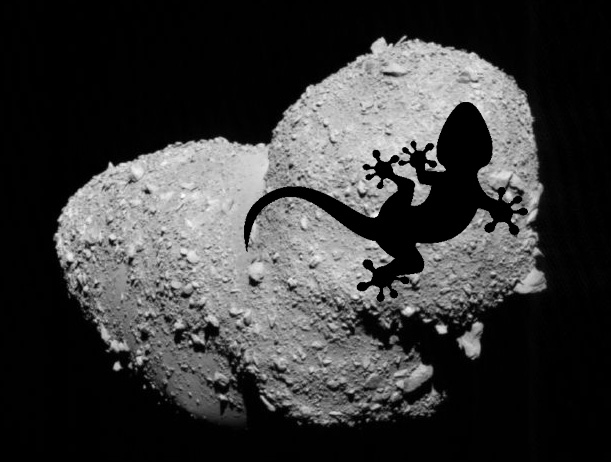
The asteroid Itokawa (as imaged by the Japanese Hayabusa probe) and a gecko tattoo. Bear with me, it'll make sense soon (JAXA)

What do asteroids and geckos have in common? Not a lot, as you’d expect, but they may share a common force.

This rather strange notion comes from research being done by a team of University of Colorado scientists who have been studying the odd nature of the asteroid Itokawa. When the Japanese Hayabusa mission visited the space rock in 2005 (Hayabusa’s sample return capsule is set to return to Earth on June 13th by the way), it noticed the asteroid was composed of smaller bits of rubble, rather than one solid chunk. Although this isn’t a surprise in itself — indeed, many asteroids are believed to be floating “rubble piles” — the rate of spin of the asteroid posed a problem.

Itokawa spins rather fast and if only the force of gravity was keeping the lumps of rock together, they would have been flung out into space long ago. In short, the asteroid shouldn’t exist.

Although plenty of theories have been bandied around, one idea seems to stick.

More commonly found as a force that holds molecules together, the van der Waals force may bind the individual components of the asteroid together, acting against the centripetal force caused by its spin.

But where do the geckos come in?

Geckos are highly skilled in the “climbing up walls” department, and it’s the van der Waals force that makes this happen. Should the body of a gecko be tilted in such a way against a perfectly smooth, “impossible” to climb surface, the gravity acting on the little creature will trigger the force into action. Therefore geckos have evolved to exploit the practical application of van der Waals.

This has some rather interesting ramifications for asteroid evolution too. During early stages of asteroid formation, the larger fragments of rock are flung off; the centripetal force exceeds that of gravity. In the latter stages of development, only the smallest rocks remain behind, their mass small enough to allow van der Waals forces to overcome the spin.

So, there you have it, asteroids do have something in common with geckos. It seems only right to call these space rubble piles “Gecksteroids.”

Thanks to my Discovery News colleague Jennifer Ouellette for drawing the comparison between asteroids and geckos!

Source: Discovery News, arXiv.org

Indonesia ‘Meteorite’ Wiped Out a House… Or Not.

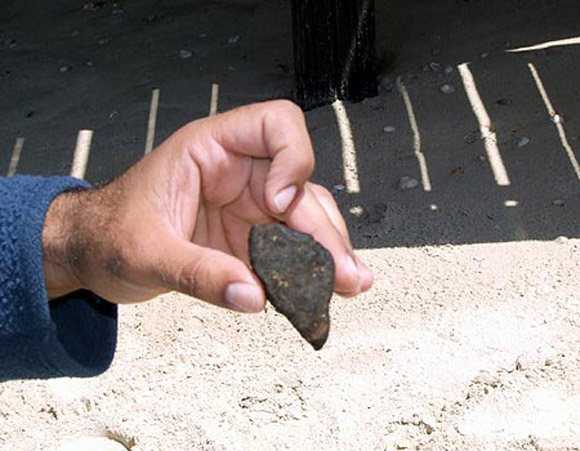
A week after Israel played host to the amazing burning ‘meteorite’, another report is coming in about a ‘meteorite’ strike in East Jakarta, Indonesia. (Note the use of the famous ‘skeptical quotes’.)

On Thursday, a falling object crashed through the roof of a house causing moderate damage. There was also light damage to two adjoining properties. Fortunately, there are no reported injuries.

According to a report in the Jakarta Globe, there was a “blast” that resulted from the impact and there was a deep crater in the floor of the house. After creating the impact crater in the floor, the ‘falling object’ bounced.

I suspect the object impacted at high velocity, hit the floor, bounced back and hit the ceiling, then fell back down,” said a researcher from the Indonesian National Aeronautics and Space Agency (Lapan). “It’s extremely difficult to recover the fragments, what with the rubble and broken glass, and it being so dark in here.”

The article also states that there was evidence for a residual heat footprint and melted items around the crater. Apparently, these facts all point to evidence that a meteorite, or some man-made space junk, was involved.

Although the details are sketchy, there are a few points that concern me about this meteorite report:

First, if this ‘meteorite’ was large enough to create a “deep” crater (there’s no information about the crater’s approximate size), that would suggest it was a hyper-velocity impact. Not only is this kind of impact very rare, I doubt there would be anything left of the building.

Unless “moderate damage” means “there is no house left,” I strongly doubt the crater was caused by a meteorite.

Secondly, according to the Lapan scientist, the space rock “bounced.” While this is possible — take the Virginia meteorite that crashed through the roof of a doctors office, bouncing off the floor of an examination room, for example — if its impact was energetic enough to excavate a sizable crater (and produce a “blast”), then I doubt much of the meteorite would be left to “bounce.” It would have disintegrated, got lodged deep in the bottom of the crater, or not produced a crater at all.

Thirdly, the article states: “the residual heat footprint and melted items pointed to a meteorite.” As I’ve said before, meteorites are usually cold when they make landfall (assuming they are small enough to be slowed by our atmosphere), so this residual heat did not come from the meteorite. If the meteorite was large enough to slam into the house at hyper-velocity speeds, or hit a gas canister, then perhaps there might be some “residual heat.” But in this case, I strongly doubt there would be any house left.

Fourthly, according to Evan Irawan Akbar, from the Bosscha Observatory in Lembang, this event has occurred shortly after the Lyrid meteor shower which ended on Monday. So he rules out any connection. Which is fortunate, as this meteor shower is caused by the Earth passing through a harmless dust tail created by the periodic Comet C/1861 G1 Thatcher.

But then he drops this clanger: “It could, however, be part of the Eta Aquariid meteor shower, which peaks on May 7 and 8.”

The Eta Aquariid meteor shower is caused by dust trail from Halley’s Comet… last time I checked, dust grains from comets have never been linked with house-killing chunks of rock. Comets are made from ice and dust, stuff that easily burns up when hitting our atmosphere. These are meteor showers, not meteorite showers.

The extent of the damaged caused is also a little strange. From the article: “It blasted a hole in the second floor of the house, sending furniture falling to the first floor, and tore big holes in the walls.” Doesn’t that sound like an explosion?

Apparently the police have ruled out speculation that this was a gas canister explosion and although there is “no conclusive proof the damage was caused by a meteorite, it was the most likely explanation.”

Alas, meteorite impacts aren’t likely explanations, terrestrial explanations are the most “likely.” The fact that an Indonesian counter-terrorism squad has been dispatched to the area to look for traces of explosives suggest the authorities aren’t placing all their bets on this being a meteorite impact either.

Thanks to @antonwilliam for the tip!

Source: Jakarta Globe

Israel ‘Meteorite’ Isn’t a Meteorite [UPDATE]

That's no space rock: The Israeli 'meteorite' that never was (Ilan Lilush, Tel Aviv Police).

UPDATE (April 25): The unidentified combustible object has been identified as being “man made” rather than anything cosmic in origin.

“It is definitely not a meteor and not a different natural substance – somebody created it, and it did not appear from outer space,” said Ittai Gavrieli of the Geological Survey of Israel when reporting after analysis of the ‘meteorite.’

Also, it looks like my original assertion that this resembled an incendiary device wasn’t far off. This object contained high quantities of phosphorus, a chemical commonly used in incendiary weapons.

“The object had high concentrations of phosphorus, which is naturally ignited when it comes in contact with air and with inflammatory material,” Gavrieli added.

However, I still stand by my theory that the Moonpeople are behind it.

(Once again, thanks Avi for keeping me in the loop of these meteorite misadventures!)

[Original post below]

ORIGINAL POST: It has all the hallmarks of being a meteorite: It’s on fire! There’s smoke! Hell, even the BBC is reporting about it!

That’s right, isn’t it? When a chunk of rock flies through the Earth’s atmosphere it burns bright, sometimes exploding during re-entry, scattering the ground like a hellish incendiary device? Scary stuff if you’re standing underneath the cosmic fireball.

It seems that some surfers on the beach near the town of Bat Yam, near Tel Aviv, Israel had a lucky escape when an unidentified-smoldering object punched a hole through a surfboard and then sat, for some time, burning amongst the seashells. Lots of excitement ensued, and the whole event was captured on videophone. The Israeli police are investigating, saying the unidentified object “fell from the sky.”

However, looking at the video above, that’s no meteorite.

Sure, when a chunk of space rock enters the Earth’s atmosphere it produces light and flame due to atmospheric ram pressure heating the outer layers, producing a trail of ionized gas. But it’s also worth remembering that space rock is very cold (as it’s been deep frozen in space), so the brief heating during re-entry will not heat the cold rock up substantially when it makes landfall, definitely not enough to make it combust when it lands. Re-entry happens for a very short time, although the shell of the meteorite might heat up a little, the insides of the meteorite remain very cold. Even if the rock was heated up during those few fiery seconds of re-entry, it will decelerate very quickly, falling to the ground at terminal velocity. This would have the effect of cooling it down some more.

In fact, it’s been reported that frost has formed on meteorites as soon as they land. That’s radically different to what we’re seeing here.

Even if this could possibly be a meteorite, what’s burning? Last time I checked, space rock didn’t burn like a firework and produce smoke like a signal flare. And meteorites certainly don’t contain any nitroglycerin. That is unless the Moonpeople are throwing bombs at us again, but I’ll save that theory for another day.

Thanks Avi Joseph for pointing me to this video!

Hubble Conquers Mystic Mountain

Where is that mystical land? (NASA/ESA/HST).
Where is this mystical land? (NASA/ESA/HST).

Sometimes, words are not enough to describe views of the universe when captured through the lens of the Hubble Space Telescope. This is one of those moments.

Kicking off its 20th anniversary (yes, that super-sized telescope has been in space that long — I would say that I remember it being launched, but I don’t, because I was nine, playing with my Star Wars toys), Hubble has published some astonishing images of deep inside the Carina Nebula, some 7,500 light-years from Earth. And, quite frankly, I’m floored.

BIG PIC: Have a look deep inside the Carina Nebula with some of my Discovery News coverage of the event.

The pillar of gas and dust looks like a gnarled tree branch, dotted with sparkling lights. The Hubble press release even describes the structure as a “Mystic Mountain,” and it’s not hard to see why. In this age of computer generated everything, this release of images show that the cosmos contains things that defy our tiny imaginations.

We are looking at a star-forming region, deep inside the nebula, where stars are being born inside the bulbous towers of gas and dust, but on the outside, young stars are battering the tower with intense stellar winds and powerful radiation. The pillar is being eroded away. However, this exterior pressure is seeding the birth of new stars inside the nebulous material.

The mindblowing clarity of this Hubble observation even brings out the fine detail in the jets of ionized gas as it is blasted from the point of the tallest finger of material. This is being generated by a young star, gorging itself on gas, forming a superheated accretion disk, blasting the energized gas out from the stellar nursery.

As Hubble’s 20th anniversary celebrations continue, I think we can expect a lot more where this came from. So brace yourself, this gem of a space telescope may be getting old, but it still has a shedload of cosmos to show us.

Now, lets stand back and get a better view of the incredible floating ‘Mystic Mountain’…

The Carina stellar nursary from afar (NASA/ESA/HST)

NASA’s Asteroid Mission: Scary but Useful

Things have been moving fast for NASA in recent weeks, culminating in President Obama’s inspiring speech at Kennedy Space Center on Thursday. I haven’t commented on the new direction for the US space agency’s direction thus far as I’ve needed some time to digest the ramifications of these plans. But generally, I’m positive about the scrapping of the moon goal in favor of a manned asteroid mission (by 2025) and Mars some time around 2035.

But it hasn’t been easy, especially after the Ares I-X test launch in October 2009.

The Ares I-X was the first new NASA manned vehicle my generation has seen take to the skies (I was only one year old when the first of the shuttle fleet launched, beginning nearly 30 years of low-Earth orbit operations, so that doesn’t count). Despite criticism that this test flight was nothing more than old tech dressed up as a sleek “new” rocket, I was thrilled to see it launch.

The end product didn’t matter on that day. Sure, we’ve been to the Moon before, but it just seemed like the best plan on the table. I was inspired, I felt excited about our future in space. Seeing how astronauts live and work on the lunar surface, using it as a stepping stone for further planetary exploration (i.e. Mars) seemed… sensible. Expensive, but sensible

But the overriding sentiment behind Obama’s new plans was that we’ve been there before, why waste billions on going back? Continuing with the bloated Constellation Program would have used up funds it didn’t have. Cost overruns and missed deadlines were already compiling.

So, the White House took on the recommendations of experts and decided to go for something far riskier than a “simple” moon hop. Things going to plan and on schedule, in the year 2025 we’ll see a team of astronauts launch for a much smaller and far more distant target than the moon.

The asteroid plan has many benefits, the key being that we need to study these potentially devastating chunks of rock up close. Should one be heading in the direction of Earth, it would be really nice to have the technological ability to deal with it. A manned mission may be necessary to send to a hazardous near-Earth asteroid. Think Armageddon but with less nukes, no Bruce Willis, but more science and planning. Besides, if a rock the size of a city is out there, heading right at us, I’m hopeful we’ll have more than 18 days to deal with the thing.

My Discovery News colleague Ray Villard agrees:

“A several month-long human round trip to an asteroid will test the sea legs of astronauts for interplanetary journeys. And, asteroids are something we have to take very seriously in coming up with an Earth defense strategy, so that we don’t wind up going extinct like the dinosaurs.”

Possibly even more exciting than the asteroid plan is what — according to Obama — will happen ten years after that: a manned mission to Mars. I can’t overemphasize my enthusiasm for a mission to the Red Planet; that will be a leap for mankind like no other. Granted, there is plenty of criticism flying around that we need to live on the moon first before we attempt to land on Mars, but looking at the new plan, we won’t be actually landing on Mars any time soon. A 2030’s mission to Mars will most likely be a flyby, or if we’re really lucky, an orbital manned mission.

And that’s why going to an asteroid will be a good first step. Spending months cramped inside a spaceship with a handful of crewmates will likely be one of the biggest challenges facing man in space, so popping over to a near-Earth asteroid first is a good idea. A Mars trip could take over a year (depending on the mission). Now, this is where technological development sure would help.

If NASA can plough dedicated funds into new technologies, new life support and propulsion systems can be developed. Those two things will really help astronauts get places quicker (avoiding boredom) and live longer (avoiding… death). For the “living longer” part, there appears to be genuine drive to increase the life of the space station and do more impressive science on it. As it’s our only manned outpost, perhaps we’ll be able to use it for what it’s designed for.

There are a lot of unknowns still, and Obama’s Thursday speech certainly wasn’t NASA’s silver bullet, but it’s a start. Allocating serious funding for space technology development whilst setting the space program’s sights on going where no human has been before will surely boost enthusiasm for space exploration. In fact, I’d argue that this is exactly what NASA should be doing.

Although I was dazzled by the Ares I-X, I can see that continuing with Constellation would have been a flawed decision. Launching a manned mission to explore an interplanetary threat sounds risky, but considering that asteroids are the single biggest cosmic threat to civilization, it sure would be useful to know we have the technology to send astronauts to asteroids, perhaps even dealing with a potential threat in the near future.

Comet Fights with the Sun. Loses.

The comet death dive (NASA/ESA/SOHO).

What happens when you put a snowball in front of an open fireplace? It melts. What happens when you throw a comet at the Sun? Erm… it doesn’t end well. In fact, as this daredevil comet proves, comets get vapourized very quickly. And the Solar and Heliospheric Observatory (SOHO) captured the whole event, here’s a video.

Sungrazing comets are spotted fairly regularly and this particular comet spotted over the weekend is likely a member of the Kreutz sungrazer family. This group of comets are thought to have been spawned when a giant comet broke up over 2000 years ago. However, the larger Kreutz fragments usually make a close approach to the Sun 3 or 4 times a year, but there have been 3 such events in 2010 so far.

As noted by Spaceweather.com, this could just be a statistical anomaly, but it could be that these fragments are a part of a swarm of comets approaching perihelion (closest approach to the Sun).

Either way, if you’re a comet, don’t venture too close to the Sun, you might get eaten.

I, For One, Welcome Our New BritSpace Overlords

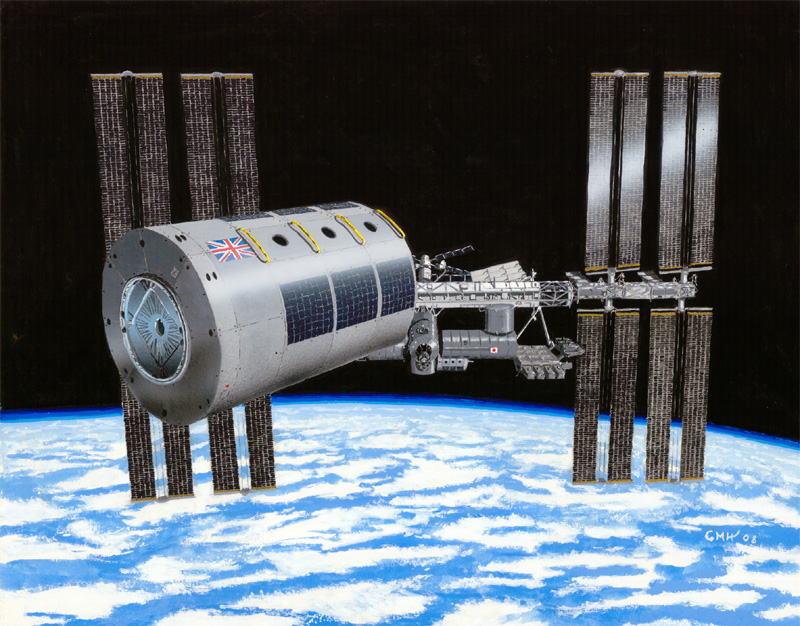
The Habitation Extension Module (HEM) proposed by UK engineers (University of Bristol)

The UK has started its own space agency (at long last) and the agency has a logo. The latter is the big news here.

At a time when motivation for manned spaceflight by NASA is dwindling and yet private industry is forcing its foot in the door of getting stuff into space, it’s nice to hear that the UK government felt the need to keep up with the rest of the world and set up an agency of their own. That’s not to say the UK hasn’t been involved in space programs before now, it’s just that our involvement has always been a piecemeal approach; hitching rides on other nation’s rockets with occasional probes (erm, well, the Mars Beagle 2 lander is the only one that comes to mind). Personally, I blame Maggie Thatcher (I have my reasons).

Awesome, so we now have an agency rather than an office cubicle tagged “Space.” This is a bona fide agency that has lunar aspirations (yep, really, we’re that original) and a funky logo to boot.

However, not everyone is impressed with the logo. In fact, Ken Carbone, a graphic designer who writes for the website Fast Company, thinks it’s dull:

The design recipe is simple, right? Take a square, add a Union Jack, thrust an arrow through it and BAM!

This logo is anything but tasty. The net result looks terribly fractured and unstable. Not the ideal visual for space flight.

To make matters worse, the U.K. Space Agency will have the inevitable and unfortunate acronym “U.K.S.A.” which sounds like something translated into Pig Latin.

But say if “fractured and unstable” is exactly the impression we were trying to give, huh? But, in all fairness, he does point out that all space agency logos are dull.

Let’s have a look the offending logo. Prepare yourself, it’s a disgrace:

Woah! Hold on a second. I thought it was supposed to be crap? As far as logos go, that’s one I can believe in. I mean, it’s a re-worked version of our proud national flag. It also has a gert red arrow, pointing up. What more do you need?

Admittedly, I think the acronym isn’t much cop. U.K.S.A. sucks cheese, “BritSpace” is far superior in my humble opinion (Science Minister Lord Drayson, consider that a suggestion), but as for the logo, I’m proud of that, I think it means business. Look at that arrow. It’s red. Pointing up. Masculine. Grrr.

That’s the logo of an aspiring space faring nation if I ever saw one.

And now for my least favorite space agency logo. Ladies and Gentlemen, please avert your eyes for the Croatian Space Agency:

But hey, what do I know, I’m not a graphic designer.

In all honesty, I like the UKSA logo, but I’m especially happy that the UK actually has an agency now rather than being just a player in the European Space Agency (ESA). But will it motivate a solution to the summering STFC debacle? That remains to be seen.

Then Spitzer Imaged Baby Stars in the Orion Nebula…

The Orion Nebula's star-forming region (NASA)
The Orion Nebula's star-forming region (NASA).

Firstly, apologies that it’s been over a month since last posting to Astroengine.com. Call it slacking off, call it a sabbatical, either way, it’s not good. I’ve actually prepared several half-finished articles, but I just never got around to completing them. However, I have been on writing overdrive over at Discovery News, so if I go quiet over here, you know where to find me.

Speaking of Discovery News, I’ve just posted an incredible image of the heart of the Orion Nebula as seen by the Spitzer Space Telescope, so I can’t think of a better way to kick-start Astroengine with an image filled with awesomeness.

Although Spitzer has entered a new phase of operations since it depleted the liquid helium coolant used to maintain its instrumentation, that doesn’t mean its stopped producing some awe-inspiring imagery. In a new vista released on Thursday, a bustling star formation region in Orion is detailed, showing some 1,500 young stars the observatory watched for 40 days. This is an unprecedented study, allowing rapid variations in these baby stars to be tracked by Spitzer.

Young stars are generally highly variable in their brightness, a characteristic that is of huge interest to astrophysicists. If we can understand the mechanisms causing this variation, we can gain an insight to stellar evolution, possibly even understanding the history of our own Solar System.

As Spitzer observes in infrared wavelengths, it’s very sensitive to clouds of dust being heated by these young stars. Therefore, the proto-planetary disks surrounding these million year old stars glow brightly. Not only does this give an indication to the conditions surrounding the star, it also provides astronomers with an idea to how these disks of dust clump together, slowly evolving into exoplanets. And now Spitzer has data sets spanning weeks, dynamic changes in the emissions from the stars and their evolving planetary systems can be studied.

But science aside, the Spitzer imagery is a thing of beauty, reminding us how complex our cosmos really is. Don’t believe me? Take a look for yourself (click the pic to dive right in):

The star forming region in Orion as studied by Spitzer, rotated 90 degrees (NASA/JPL/Caltech)

The Real Inspiration Behind “Project M”

The Project M android... haven't I seen you somewhere before?

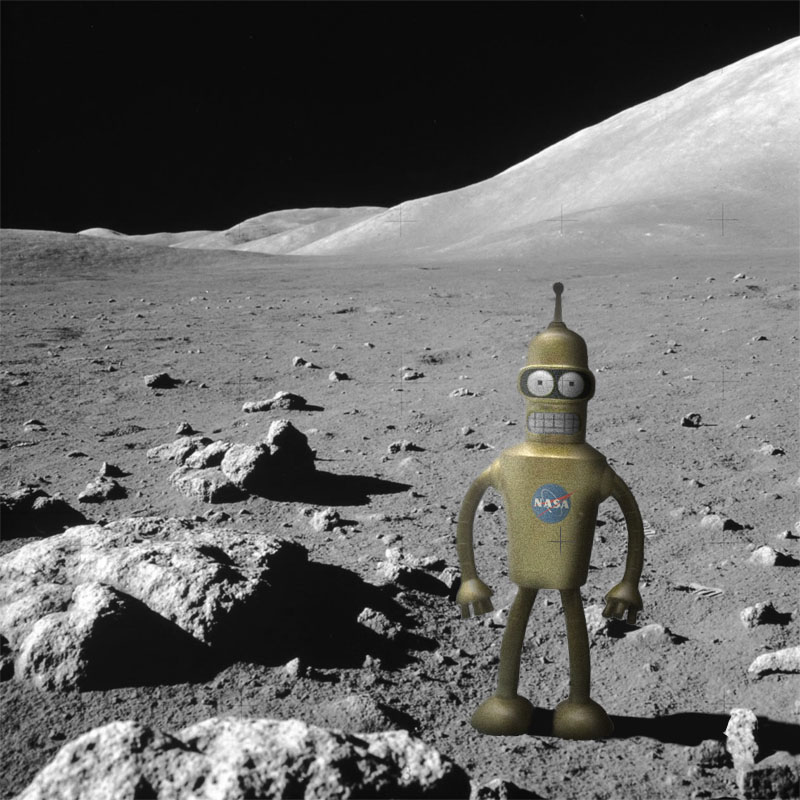
As you know, I’m highly dubious about this “Project M” that has just surfaced on the intertoobs (I strongly suspect it’s a hoax). But doubts aside, I kept looking at that android throwing stones on the lunar surface thinking I’d seen that guy somewhere before. At first, I thought C3PO from Star Wars… but no! It’s this guy:

It's uncanny! Bender from Futurama explores the lunar surface (NASA/20th Century Fox/Ian O'Neill).

I think Futurama’s Bender would do a fine job exploring the moon.