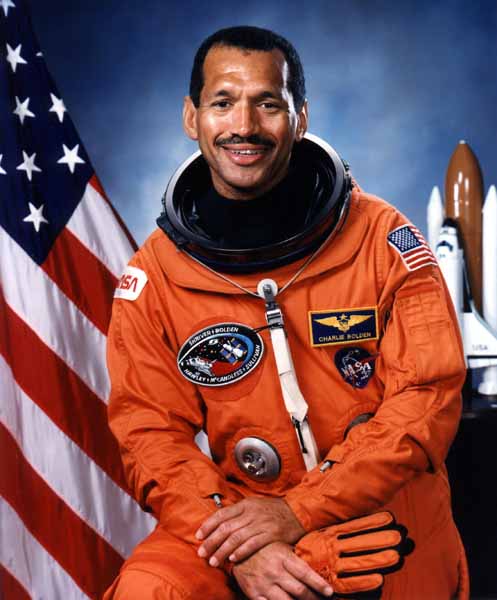
Welcoming Charles F. Bolden as Next NASA Administrator (Probably)

Charles F. Bolden (NASA)
Charles F. Bolden (NASA).

It’s been a long wait, but has President Obama chosen the next NASA Administrator?

According to several news sources, it would appear a former astronaut may be taking the most senior NASA position. Retired Marine Major General Charles F. Bolden will travel to the White House on Monday to meet with the President and discuss the appointment.

Bolden is an experienced astronaut, having served on four Shuttle missions from 1986 to 1994, clocking up a total of 680 hours in Earth orbit.

Earlier this year there was some speculation that Charles F. Bolden Jr.’s name was being mentioned more often than the other contenders in the race replace ex-Administrator Michael Griffin. Judging by today’s press coverage, it appears the speculation was accurate and President Obama has decided on Griffin’s successor.

Bolden joined the space agency in 1981 and served on four Space Shuttle missions, including STS-61C (Columbia, 1986), STS-31 (Discovery, 1990), STS-45 (Atlantis, 1992) and STS-60 (Discovery, 1994).

Interestingly, Bolden was the pilot of Discovery when it delivered the Hubble Space Telescope in April 1990; nearly two decades later, the observatory is still going strong. Today, the STS-125 Atlantis mission carried out the first spacewalk of the final Hubble servicing flight.

In 1994, Bolden left NASA and became Deputy Commandant of Midshipmen at the US Naval Academy. In 2003, he left the Marine Corps as a Major General.

If this decision becomes official on Monday, Bolden will be faced with the toughest challenge he has ever had to confront. The political and financial challenges he will have to overcome as leader of the US space agency will be incredible. We face uncertain times, especially with the retirement of the Shuttle looming and the continuing flack the Constellation Program is receiving.

In many ways Charlie, I don’t envy you. But in others, how cool would it be to be in command of a space agency?!

Special thanks to @SpaceCrazed for the tip!

Sources: MSNBC, SpaceRef

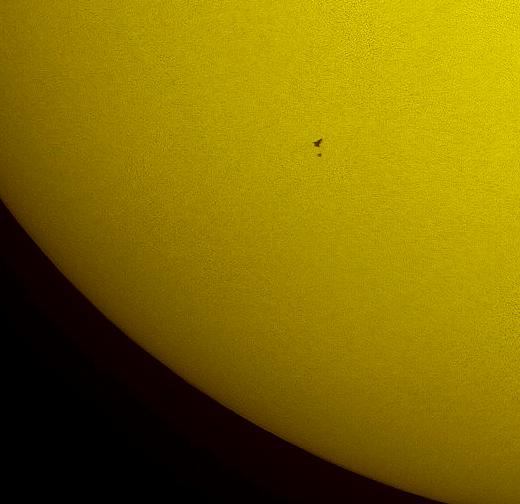
Hubble and Atlantis Transit the Sun (Photo)

The Hubble Space Telescope and Shuttle Atlantis pass in front of the blank Sun. Can't see their silhouettes? Click on the image for the large version and look in the bottom-left-hand corner. That's no sunspot pair... (©Thierry Legault)

Thierry Legault is one highly skilled astrophotographer. The transit of the Hubble Space Telescope and Space Shuttle Atlantis took only 0.8 seconds to clear the disk of the Sun, so Legault rapidly took four pictures per second, starting his series of pictures two seconds before the pair were predicted to pass in front of the Sun.

STS-125 Atlantis and Hubble Solar Transit. The image was captured from Florida at 12:17pm EST on May 13th as the Shuttle approached the orbiting telescope at 600km from Earth (©Thierry Legault)

In the image above, the 35 meter-long Atlantis is easily identifiable, but the tiny speck of the 13 meter-long Hubble isn’t so easy to define, but the result is superb. According to Legault’s website, this is the only picture of the STS-125 and the observatory, orbiting at an altitude of 600 km.

Back in July 2008, Astroengine reported on the transit of the International Space Station across the disk of the Sun. Fortunately, in both cases, the Sun’s face was blank, and no sunspots are prominent enough to ruin the view.

Stunning!

Sources: NASA on Flickr, Astrosurf

Could Genetic Algorithms Boost Space Probe Intelligence?

Voyager carried out a gravitational slingshot manoeuvre past Jupiter (NASA)

Rocket science ain’t easy, but what about celestial navigation? Once you’ve launched your probe into space, surely the hard bit has been done, and we can sit back and relax, happy in the knowledge our technology is out of the Earth’s hefty gravitational well? The robot is coasting through the vacuum of space ready to accomplish some science. Job done. Easy.

As you may have guessed, it isn’t that easy, in fact sending a spaceship on the equivalent of a Solar System-scale game of gravitational ping-pong is highly problematic. What if your launch is delayed? What if the inter-planetary medium (the stuff between the planets) is of a higher density than you expected? Perhaps the Sun has pumped out more particles than you had calculated pre-launch, creating drag and slowing your spaceship down?

Unfortunately, once the spacecraft is on its way, apart from a few minor Earth-commanded corrections allowed by the ship’s thrusters (wasting valuable fuel), the spaceship is by itself, hoping your calculations are as complete as they can be.

When the spaceship in question has to use planetary gravity assists to accelerate or decelerate on its journey to a deep space destination, slight deviations in trajectory than what was calculated can result in inefficient sling-shots or even complete loss of the mission.

Now Ian Carnelli and colleagues from ESA in Noordwijk (Holland) have prepared a publication that details a possible solution using a genetic algorithm. Basically, the computer on board a next generation space probe could simulate multiple autopilots guiding a virtual version of the probe. Each autopilot executes its code and the computer will select which simulated autopilot performs the best (i.e. solutions that waste fuel or find the slowest route will be ignored).

Happy with the best group of simulated solutions, the computer will selectively “breed” them together to develop an optimized pilot, with no need to wait for instructions to be sent from Earth. “After hundreds of generations of the GA you obtain a ‘pilot’ that is an extremely good performer – able to fly the assist trajectory that uses the least propellant while reaching the next target planet faster,” Carnelli says.

Using simulations here on Earth, Carnelli has successfully used his genetic algorithm to optimize the trip of a virtual spaceship to Pluto via Jupiter and another to Mercury via Venus.

Although installing this system on missions in the near future may not be a possibility, it is a tantalizing look into how unnatural selection could be used to optimize, and therefore protecting, expensive pieces of kit in deep space.

Source: New Scientist

The Sun Has An Anti-Climax

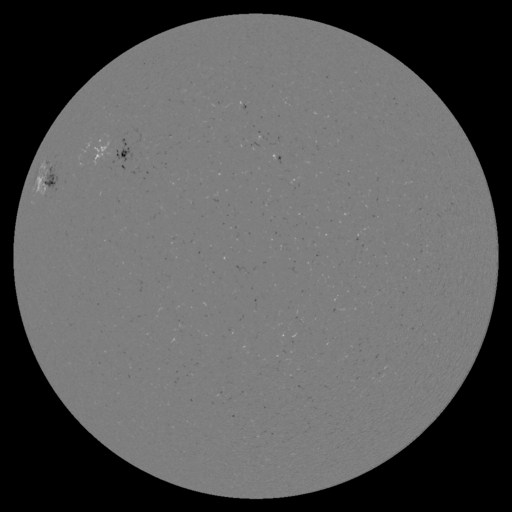
The solar disk on May 11th: Is it? Are they? Not quite (SOHO)

Some recent solar articles are freaking out, proclaiming that the Sun is waiting to unleash it’s fury on the Earth (re: Warning: Sunspot cycle beginning to rise) or that it’s lowering its energy output, possibly kickstarting Maunder Minimum 2.0 (re: New Forecast Calls for Calmer Sun).

So which one is it? Is the Sun just biding its time, waiting for the perfect moment to fire a salvo of flares at us? Or will it remain quiet, well into Solar Cycle 24, impacting our planet like the Maunder Minimum did during the Little Ice Age from the 16th-19th century?

It’s funny actually, both the above articles are based on the same research, and yet two very different conclusions were drawn from the text.

On the one hand, the Sun is acting rather strange; it’s undergoing a sustained solar minimum, the longest period of low sunspot population for the best part of a century. On the other hand, when the Sun does get active, steadily growing to a peak in activity for the 2012-2013 predicted solar maximum, the resulting flares and coronal mass ejections (CMEs) could inflict $2 trillion in damages on global infrastructure (according to a recent study), leaving us to mop up the mess for a decade. It’s these two extremes that are causing such a stir, generating the attention-grabbing headlines.

However, I seriously doubt that we are facing another Little Ice Age and I am highly skeptical of the predictions that the 11 years of Cycle 24 are going to be overly violent. To be honest, we just don’t know. Considering we live so close to the Sun, we actually know very little about it; to even begin trying to predict what it’s going to do next remains problematic.

That said, once the Sun starts producing lost of sunspots, this means magnetic activity is on the rise and solar activity is increasing, so when I see sunspots rotate into view, I can’t help but be a little excited. Today, it happened, two active regions appeared on the disk of the Sun. Could this be the real start to the solar cycle?

mag163

Today’s image is a magnetic map of the sun. Two active regions are circled. Their polarity identifies them as members of new Solar Cycle 24, but they lack the dark cores required of true sunspots. So, in spite of these lively magnetic imprints, we must still say “the sun is blank–no sunspots.”SpaceWeather.com

No sunspots, another blank disk day and therefore low magnetic activity still.

How dull.

Atlantis Launch… Infrared-ed

The STS-125 Atlantis launch today, as seen through the lens of an infrared digital camera (Eliot J. Schechter/Getty Images)

I thought I wouldn’t see anything as impressive as the Space Shuttle Atlantis launch in high-definition, but it appears I was wrong. This is probably one of the most unique views of a shuttle launch I’ve seen to date; a high resolution, infrared photograph of the beginning of the STS-125 mission to the Hubble Space Telescope.

This would make a nice wallpaper… yes, it does 🙂

Source: Gawker

Mars Rover Spirit is Stuck in the Regolith

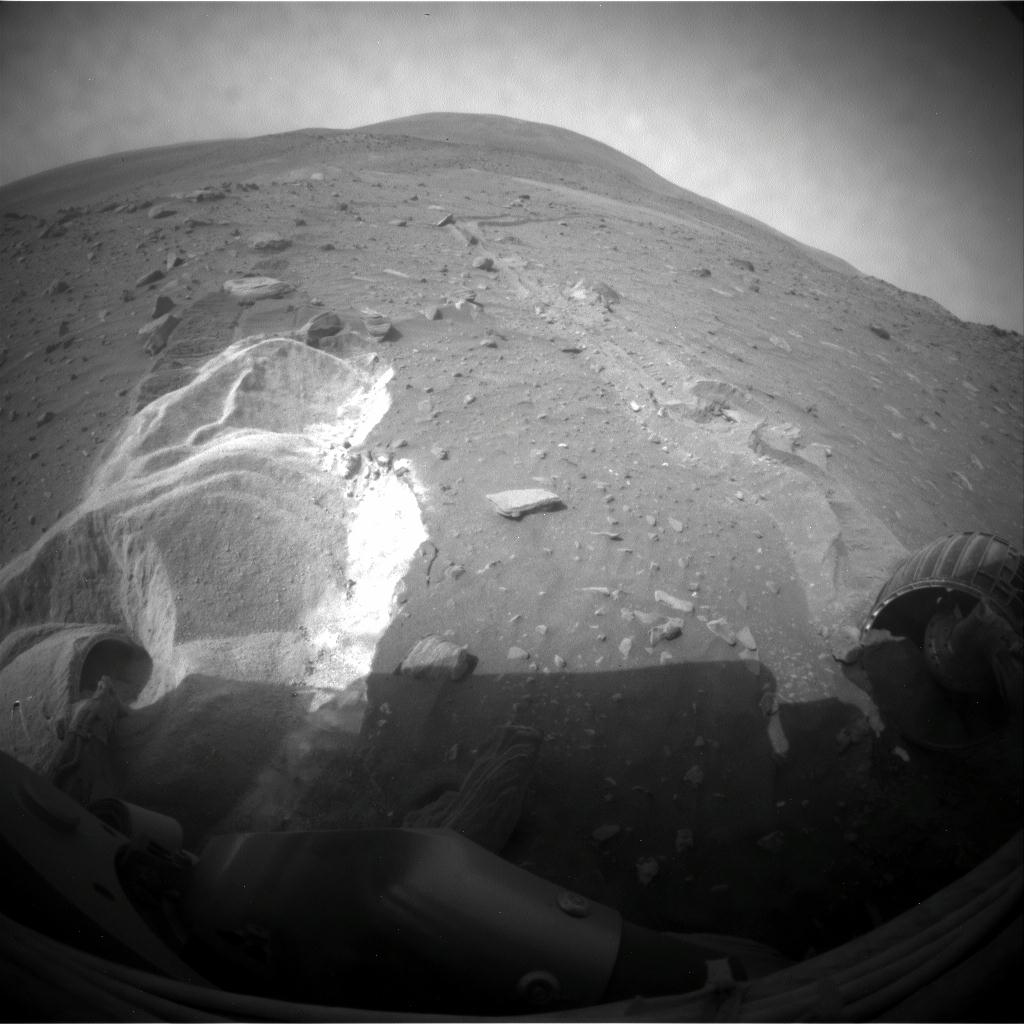
Spirit is stuck (NASA)

Mars Exploration Rover Spirit is in trouble again. She’s stuck.

The tenacious little robot has suffered traction problems before and has even been dragging around a broken wheel for the last three years, leaving the other five to take up the slack. Then there’s the dust storms that have hindered the life-giving solar panels ability to collect sunlight. And most recently, the on-board computers have been rebooting and Spirit’s flash memory has been forgetting to record data.

A little help here? Spirit has driven into soft ground, burying her wheels halfway. Engineers are working plans to extricate her. –A distress tweet from @MarsRovers

One of Spirit's buried wheels as taken by the front hazard-avoidance camera on Sol 1899, May 6th (NASA)

Now, she’s stuck in the Martian dirt after slipping backwards down a slope during a series of backward drives around a plateau called “Home Plate.”

Spirit is in a very difficult situation,” JPL project manager John Callas said. “We are proceeding methodically and cautiously. It may be weeks before we try moving Spirit again. Meanwhile, we are using Spirit’s scientific instruments to learn more about the physical properties of the soil that is giving us trouble.”

At JPL, a team have been assembled to try to find a solution to the problem with a model of the situation here on Earth. Unfortunately the wheels are stuck fast, half-buried, and scientists are increasingly worried that any attempts to free the struggling rover could make matters worse. The concern is for the chassis under the robot. Should it make contact with the rocks underneath, it would effectively beach itself, completely losing traction that could be used to free the wheels. In short, the situation is not good, but NASA is working overtime to find ways to get the rover on the road once more.

Fortunately, wind has helped the ailing rover recently, clearing excess dust off the solar panels, giving Spirit a much needed energy boost, but will it be enough to get her out of this difficult situation? If there’s a way, Spirit will find it, as let’s face it, she’s lived through a lot of hard knocks…

Source: NASA, AP

Watch Space Shuttle Atlantis Launch in HD

sts-125

Today’s launch of Space Shuttle Atlantis went according to plan and the crew of seven astronauts are now chasing the Hubble Space Telescope for its final servicing mission.

As I’m a little behind the curve on reporting this story, I thought I’d assemble some links to other sites who covered the launch far more expertly that I can at this late stage. However, not to be outdone, I wanted to share this incredible high definition video of the launch. If you want to watch the embedded HD version, look below, but if you want the full, i’m-on-the-edge-of-the-launchpad-oh-my-god-i-can-feel-the-heat wide-screen version, check out the awesome, fully-loaded YouTube HD video.

Links:

Sunday Opinion: Astroengine Gets Vaccinated

pin-up-nurse-white

NOTE: This post is a little light on the space science, but keep reading, you’ll see why I’m making such a big thing out of my trip to the doctors…

Yesterday was supposed to be a very productive blog-writing day, however, like all good plans, the day didn’t turn out the way I’d hoped.

For a start, I heard news about a wildfire on my doorstep (it started literally a few hundred metres from my house, and I was only alerted to this fact via Twitter – I wondered what all those helicopters were doing), which prompted me to run outside looking for an ominous smokestack, only to find I was an hour too late and the blaze had been put out by the superb LAFD.

Then I had to play babysitter to Astroengine.com’s server in the hope I was going to get hit by a flood of Digg traffic some… time… soon…

Then I had to let the rabbits out for a run. Barney felt the need to stick his head in the pool, so I decamped my office into the garden so I could make sure he didn’t decide to take a swim. Oh, there’s a lizard! She’s massive! Where’s my camera?

Then I had to run to the bank.

Oh yes, then I had to get to my appointment at the docs to have my tetanus vaccine booster.

Of all the things I hate in the world, syringes come a frightening third after slugs and tall buildings (don’t ask, just look up batophobia). However, these are phobias. If I start using logic and seriously consider all the scary stuff that could happen to me, I’d be most reluctant to become horribly sick and be responsible for infecting others with a nasty, preventable illness.

Hence the vaccine. And the achy arm.

I actually have a strange love for doctors surgeries, as soon as I walk through those doors, I hand all responsibility for my body to the specialists in white white and blue coats. If anything health-wise should happen, at least I have a team that can diagnose me and hopefully repair me. Yes, bad things happen in medical centres, but I’d much rather take my chances with highly professional individuals with years of training and a huge stack of qualifications, than leave things “to chance”.

So there I was sitting in the waiting room, trying to stay calm as I saw the nurse fill up the syringe with fluid from a tiny vial.

Naturally, I started chatting to try to distract myself from thinking too much about the jab. “Do you get many people not wanting to take vaccines?” I asked the nurse.

What do you mean?

Well, there’s this growing anti-vaccination movement I’ve read so much about,” I said, a little surprised she appeared to be genuinely surprised by the notion. “Some celebrities have taken it upon themselves to spread misinformation about the link between vaccines and the onset of autism in children.”

I heard about that,” she said, realizing what I was nervously talking about while staring at the needle in her hands. “But they are crazy, right? I mean, since when did they know anything about medicine?

As it turns out, the only complaint she’d heard from parents about the need to vaccinate their children is the cost, but even then there are options for financial help.

When I left the medical centre with a sore arm, I felt a little different than I had done in the past.

When getting my vaccinations in the UK, it was always a routine affair that required no thought, it was just one of those things you needed to function in society. It’s one of those things I had to do. Looking at my medical records, I received my first vaccine when I was a baby and throughout my life I’ve had regular shots (or as I call them “jabs” which my Mrs Astroengine finds highly amusing). I can quite safely say that I will never catch mumps, measles, rubella, hepatitis and a whole host of other nasties, because my immune system has been bolstered by a history of vaccinations.

Vaccines are highly successful, almost too successful.

Many life-threatening diseases have been wiped out by the widespread use of vaccines, leading to some misinformed individuals to believe vaccines are no longer needed (on the contrary). Then there’s the misplaced (and completely wrong) notion that vaccines are somehow linked with childhood autism. This is a topic that is as insane as it is bewildering, and what’s worse, Los Angeles has become a hothouse of stupid celebrities who think they have every right to be peddling their belief that parents should not vaccinate their kids.

Having seen Jenny McCarthy on the TV a LOT (no red carpet is safe from her Christian Diors), I’m quickly realising the media has a lot of sympathy for her views about the connection between autism and the MMR vaccine. Unfortunately, this makes her extremely vocal in my neck of the woods, and many of her anti-science remarks blend in with her celebritydom, so her message is very well polished, and very… reasonable. People listen to her, and when hubby Jim Carrey wades in with his crazy take of reality on the biggest blogging platforms, even more parents start to think twice about their choice to protect their children against deadly viruses.

If all of this is news to you I urge you to read up on it via Phil Plait’s Bad Astronomy. Phil has been bringing this topic up a lot, and at first I wondered what all the fuss was about. Then I had conversations with neighbours and family and many of them are concerned about Jenny et al.’s views on the topic. Fortunately, they all have the common sense to talk to a medical professional before making any rash decisions about boycotting vaccines. Their concerns were laid to rest by the GPs, nurses and healthcare professionals who don’t have the celebrity soap box so many of the famous are using for their personal crusades. So we need more professionals and scientists like Phil who actually know what they are talking about.

Science is a collection of facts, not a collection of personal opinions and beliefs, a notion many people don’t seem to understand. And judging by the density of palm-readers and psychics in my neighbourhood, there’s a lot of people who choose belief of the paranormal over logic.

So, when I walked away from the medical centre, marvelling at the protective injection I had just received (a little bit proud about how I didn’t pass out at the sight of the needle), I felt sad for the kids out there whose parents deemed it necessary to listen to the idiocy spewing from the plumped lips of an ex-Playboy model. Those children could become ill due to negligence (it is parental negligence), and there are an increasing number of deaths associated with diseases that were once unheard of in modern society.

I don’t have children, but when I do, I’ll make sure I’d read up on all the scientific facts first, but they will certainly be vaccinated. For me, vaccines are imperative for “herd immunity” and essential for a healthy society. Individuals who are un-vaccinated could easily become carriers of deadly diseases. In my eyes, an un-vaccinated child could be viewed as a potential weapon. If they are immunized at an early age, their bodies have the ability to fight off contagious disease, preventing unnecessary suffering and, ultimately, improve the health of society as a whole.

Conclusion

So why did I bother to go off-piste and discuss my concern about antivaxxers?

We live in a revolutionary age for mankind. We are exploring space, we have unbelievable technology, we are processing data at a faster rate than ever before. We communicate globally. Medical technology is helping us live for longer than ever before. We are stronger and more intelligent. On paper, mankind is doing pretty well. Yes, there are massive issues challenging us (climate change, economic crises, disasters, overpopulation etc.), but never before have we been able to confront these problems so well. If we had infinite resources and a strong political direction, the Universe could be our oyster.

But as with the antivax movement, anti-science and religious interference with science could undermine our very existence on this planet. Imagine a future where we have constructed a low-Earth orbit infrastructure, sending probes into deep space; we have quantum computing and fusion power. And yet a large portion of the “developed” world distrusts science at its core. Every year there’s a doomsday prophecy. Despite all the scientific evidence against, classrooms are teaching evolution along-side “intelligent design”. Some kids think the Universe is 6,000 years old, others know it is in fact 13.73 billion years old.

And then there’s the Jenny McCarthy’s of this world, spreading nonsense about why we should fear immunization. The media eats that stuff for breakfast, can you imagine what the media could be eating for dinner in a decade? The physical health of entire nations could be put in jeopardy. Who can advance mankind when borders are closed and our brightest minds are dying because of a pandemic caused by a mutated strain of a virus that should have been controlled decades ago?

Having fought a pitched battle with 2012 doomsday advocates for the last year, I’m seeing a pattern emerge. Anti-science is rocking the foundations of mankind, and if you don’t believe me, you need to spend some more time on the internet (a medium by which everyone has a voice, no matter how insane). For every science website, there’s ten websites with pseudo-science ramblings. Unfortunately, now that bigger entities are finding new and inventive ways to make money from people’s fear, I get the feeling we’ve seen nothing yet…

So, that was my big day of getting vaccinated. Interestingly, the most profound moment came at the medical centre as I was leaving with a Band Aid on my arm. The nurse who injected me, obviously thinking about what we were talking about in the waiting room said something very interesting. She asked me why people thought there was some elevated risk associated with vaccinations, after all, all medication carries some kind of “risk” (but the probability of anything bad happening is very, very small). As researched by my friend Greg Fish, these “toxins” don’t sound half as bad if you understand exactly what those scary-sounding ingredients actually are, and in what quantities they are administered.

Do these people have any idea how many toxins they breathe in every day?” the nurse asked as I walked out the door, referring to McCarthy and Carrey. Pointing at the traffic outside she added, “LA isn’t exactly known for it’s clean air!

Good point, I thought.

See that Red Splodge? That’s Where Captain Jack Is

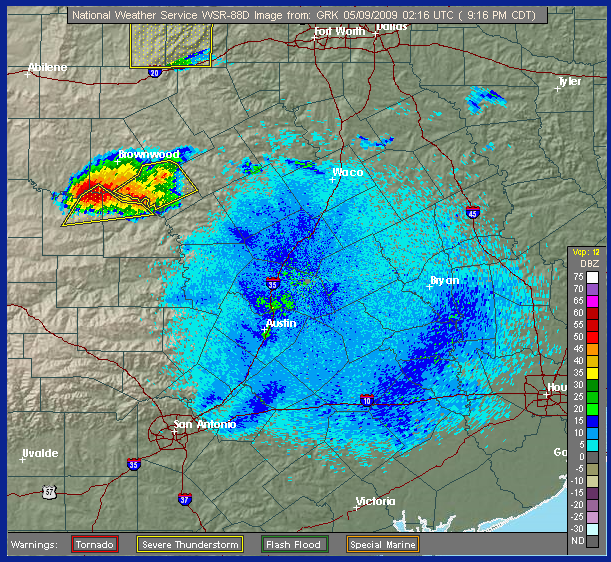
jack_tornado

Captain Jack at Badlands Radio (formerly Paranormal Radio) has been evacuated from the WPRT studios in Central Texas as tornadoes are sweeping through the area. His show is being covered by me until he can return, so be sure to tune in to find out more!

Last thing I heard was that Jack was in Brownwood (in what appears to be some pretty terrible conditions, looking at the radar picture above), attempting to return to the studio…

Listen to Badlands Radio NOW »

UPDATE: After 5 hours on the air, I get news from Jack that he and Selene are doing fine and returning to the studios. Be sure to check out the Badlands Radio for Jack’s eyewitness account of the tornado that caused so many problems in Central Texas.