I am fascinated with outer space, this is true. But if you stop to think about it, the inner space between the atoms is just as awe-inspiring as the vast distances separating the planets, stars and galaxies. In actuality the volume inside an hydrogen atom is essentially empty; the single electron “orbits” (if we consider the simple Bohr model of the atom) the central proton at a huge distance. It’s analogous to a quantum star system, where a planet orbits its parent star, hundreds of millions of miles away.
However, atoms aren’t as simple as Niels Bohr’s famous model (although Bohr’s model is none-the-less important as it always has been). The electrons occupy a cloud, rather than specific orbits, and the electron’s position cannot be defined as a point, more a statistically defined volume. As dictated by quantum theory these clouds vibrate at certain frequencies, depending on the electron energy. These electron energies are analogous to the simple electron “shells” physicists refer to in the textbooks; each progressively higher shell occupying a higher energy state. In reality, in the slightly fuzzy quantum world, the frequency of electron oscillation increases with energy.
Examples of electron atomic and molecular orbitals. The lobes are representative of the electron clouds surrounding the nuclei (source)
When I was in university, I loved seeing the different modes of electron energy in 3D visualizations of the atom (pictured right). Lobes of electron clouds vibrating at different energies seemed to make sense. But now, for the first time, the clearest photographs of a single atom have been taken, with lobes of electron clouds — as predicted by quantum theory — intact.
This research soon to be published in the journal Physical Review B, demonstrates detailed images of a single carbon atom’s electron cloud (pictured top). Taken by Ukrainian researchers at the Kharkov Institute for Physics and Technology in Kharkov, Ukraine, these images clearly show the electron cloud in two energy states.
This amazing feat was accomplished using a field-emission electron microscope. Although this microscope has aided physicists since the 1930’s to image the vanishingly small, the Ukrainian researchers have developed a new way of making the tool so sensitive, single atoms can be imaged. After arranging a ridged chain of carbon atoms (only tens of atoms long) inside a vacuum chamber, the researchers passed 425 volts through the atoms. At the tip of the chain, the end carbon atom emitted its electrons and a surrounding phosphor screen captured an image. This image was of the electron cloud surrounding the single carbon atom.
Up until this point, field emitting microscopes have only been able to resolve the arrangement of atoms in a sample. This is the first time physicists have been able to see the structure of an electron cloud around an atom.
It’s always nice to validate a bedrock physics theory with photographic evidence, it’s exciting to think what the Kharkov Institute scientists will do next…
A screenshot of the 1982 colour version of the arcade game (via klov.com)
Thanks to an eagle eyed Astroengine.com reader, we may have an answer to the current Google doodle conundrum. Having spent a lot of last night following the mystery trail from crop circles, to Woking, to War of the Worlds, to H. G. Wells… I was stuck. The only thing that made this time of the year special was the fact that it’s H. G. Wells’ 143rd birthday on Monday.
However, in keeping with Google’s previous tribute to the classic computer game Zero Wing, could this new puzzle relate to another game? StockbrdigeT thinks this might be the case:
Today’s clue is co-ordinates that only have significance in their relation to War of the Worlds. Today is also what appears to be the 30th anniversary of the release of the War of the World Arcade game (the original monochrome version, not the 1983 color version).
The War of the Worlds is an arcade game based on the H. G. Wells novel The War of the Worlds. There were two versions of this game, identical in gameplay but differing in graphics. The first version was released by Cinematronics in 1979, and featured black and white vector graphics. A color version was later made in 1982.
The War of the Worlds arcade game, developed by the pioneering company Cinematronics, was one of the first games to use vector graphics (the very first Cinematronics game to use vector graphics was Space Wars, released in 1977).
So, what has this got to do with the Google doodle? Remember I was trying to find an explanation for the missing “l”? In actuality, the “l” in “Google” isn’t missing (as pointed out by another commenter, jurl), it’s there, but it’s in the process of being drawn by the little combine harvester in the crop.
I think that the Google logo is a celebration of one of the first uses of vector graphics in computer games — the “l” represents a vector being drawn by graphics software (i.e. the combine harvester).
So, the best I can do is the doodle is a celebration of:
H. G. Wells’ birthday on September 21st.
the 30th anniversary of the release of the War of the Worlds arcade game.
the first uses of vector graphics in computer games.
OK, so now I’m hooked. This evening, the Google logo changed into a doodle of a crop circle (above). This may seem a little innocuous, after all, Google is always jazzing up their logo with celebratory bits of art. But what did this resemble?
For starters, this isn’t the first time this has happened. A couple of weeks ago, another mini brain-teaser was posted with a flying saucer “beaming up” one of the “o”s in Google. CNET blogger Chris Matyszczyk managed to follow the clues and deduced that the missing “o” could be found in the numerical clue of one of @Google’s tweets. The numbers related to letters in the alphabet and spelled out, “All your O are belong to us.” This was in reference to the classic game Zero Wing (creator of the now famous gamer war cry “All your base are belong to us). It was the computer game’s 20th anniversary.
The logo was explained, the missing “o” was explained and it all related to an event (i.e. the Zero Wing anniversary).
So now we are presented with another conundrum. What does it mean? We have crop circles (linking to the search query “crop circles“, thanks @astrobio74 for pointing that out), a missing “l” in “Google” this time…. and a tweet from @Google with the map co-ordinates: 51.327629, -0.5616088.
Typing the longitude and latitude into Google Maps takes us to a location in Woking, Surrey, UK. The exact address is on Woodham Road in a village/town called Horsell.
Doing a search for the exact address and digging around the houses turned up precious little, until I typed in “Horsell” into Google. In the results is Horsell’s Wikipedia page. Horsell was made famous as being the place where Martians invaded in H. G. Wells’ classic sci-fi novel, War of the Worlds.
Much of the The War of the Worlds takes place around Woking and nearby suburbs. The initial landing site of the Martian invasion force, Horsell Common, was an open area close to Wells’ home. In the preface to the Atlantic edition of the novel, he wrote of his pleasure in riding a bicycle around the area, and imagining the destruction of cottages and houses he saw, by the Martian heat-ray or the red weed.
Great, so I’m almost 100% certain this little Google treasure hunt is pointing to War of the Worlds in some way. But why would Google pick today to do this?
A little more digging into H. G. Wells himself points to a possible answer (although I’m not totally convinced this is the sole reason). Next Monday marks the 143rd birthday of H. G. Wells (on 21 September, 1866). 143 years doesn’t strike me as a significant number, but the trail seems to lead here.
I’m now trying to work out where the “l” in “Google” fits into all this…
According to NASA, these new images of space junk orbiting Earth make the situation look more dire than it really is.
I suppose that would be like a store manager looking at the shop floor of Toys ‘R’ Us on the day after Thanksgiving rubbing his chin and saying, “You see, I told you it would be quiet.” In actuality, the shop would be rammed full of bargain hunters, and by the looks of things, Earth orbit (from LEO to geostationary altitudes) is rammed full of junk.
But space is big, so although it might look a little grim up there, it’s very unlikely a spaceship will collide with anything. A statement from NASA agrees:
The dots are not to scale, and space is a very big place. Collisions between large objects are fairly rare. The orbit of each piece is well known. If any debris comes into the path of an operating NASA satellite, flight controllers will maneuver the satellite out of harm’s way.
This may be the case, but I would argue that as a space-faring race, us humans have barely dipped our toes in the cosmos yet. It’s going to take a lot more rocket launches and space littering before we can have routine access to space. If it looks like this now, in the first decade of the 21st century, how much junk is going to be up there in 20, 50 or 100 years time when manned space flight is commonplace?
We’re already manoeuvring satellites, shuttles and space stations out of harms way, and occasionally satellites do collide. Unfortunately, I think space junk will be an additional man made hazard for space travel; we’ll just have to deal with it.
Yesterday, at 5.48pm PDT, I witnessed a shuttle event for the first time. Following the 13-day long STS-128 mission to the International Space Station, shuttle Discovery had to be redirected to land at Edwards Air Force Base, about an hour north of Los Angeles.
Excited, I kept track of the shuttle’s progress as it re-entered the Earth’s atmosphere and made a fast decent toward the Californian coastline. I quickly realized that the shuttle’s flightpath would not only take it over LA, it would be flying straight over my house! (Give or take a few pixels on my laptop screen, that would probably translate to several miles, but hell, it was close enough.)
I knew there might be a good chance that I’d hear the shuttle’s sonic boom as it passed over LA County, but I wanted to see the approaching shuttle too.
Unfortunately, it was one of the few days that there was low cloud patching the sky, so the chances were slim. Either way, I had a good chance of hearing the sonic boom if I got outside and listened very hard. I was told on good authority (by ace Discovery Space correspondent Irene Klotz) I should be able to hear the shock wave about 4 minutes before touchdown.
There was 6 minutes to go, so I ran outside to listen out for the distant thud of Discovery slamming though the atmosphere 14× the speed of sound.
Distant thud? Are you sure about that, Ian?
Although I was prepared to hear a mediocre bang, I wasn’t prepared for what really happened–
BOOM!BOOM!!!
Stupidly, I was balancing on a chair, shading my eyes in the hope of seeing a little dart-shaped shuttle through the clouds… with my laptop under my other arm so I could hear the NASA TV commentary a bit better. Not smart. I nearly jumped out of my skin when I heard that! I’m amazed I didn’t drop the laptop and fall off the chair, it really was that loud. Almost like a bomb going off.
Once I put the computer down on a more suitable surface, I shouted “Holy crap!” (on Twitter too). I was shaking a little. I heard the neighbours chatting about the noise; a car alarm was sounding and dogs were barking (hence the reference to the funny title, as said by @08HD_DynaSGC). I’d just heard the space shuttle, pass overhead, after spending 13 days orbiting the Earth, docked with the space station.
The enormity of the Shuttle Program struck me really hard, and I felt a little emotional. I hadn’t even seen a shuttle with my own eyes, all I’d heard was its sonic boom. I can only imagine how I’d react if I actually saw a shuttle launch, or a landing. I hope I do, soon, before the remaining six shuttle missions are out…
I’ve often wondered how doomsayers can monetize their theories of the end of the world. It’s one thing to scare someone, but it’s quite another to get them to willingly hand over a wad of cash. It’s the classic door-step salesman problem: How do you get a homeowner to sign a contract after spending 30 minutes boring him/her to death with the reasons why they really should trust them — sweating in a badly-fitting suit — although they’ve only just met?
As far as I can work out, it seems the best way to profit from this doomsday tripe is to write a book. Apparently, publishers have little concern about what’s printed on the pages. If the cover art looks scary enough, and the numbers 2, 0, 1 and 2 are in bold type, the publication will sell itself. If that doesn’t work, hobble together a YouTube video with depictions of the Earth in flames… and Planet X (because Nibiru is so planet-killin’ cool). Oh, and add narration of some idiot with a superiority complex.
If this amazing marketing ploy isn’t upsetting enough people, build a website. Besides, if you fill that site with enough text, you’re bound to hit all the doom keywords and have a flood of Google search traffic. Hell, if this is the case, you can supplement the future royalties of your best-selling novel with some juicy advertising revenue. Yeah, that will work.
However, all these ploys (including the awfully flawed “How to Survive 2012” YouTube clips) aren’t a patch on what I’ve just seen: a “I Will Save Your Life In 2012 If You Buy My Book” website.
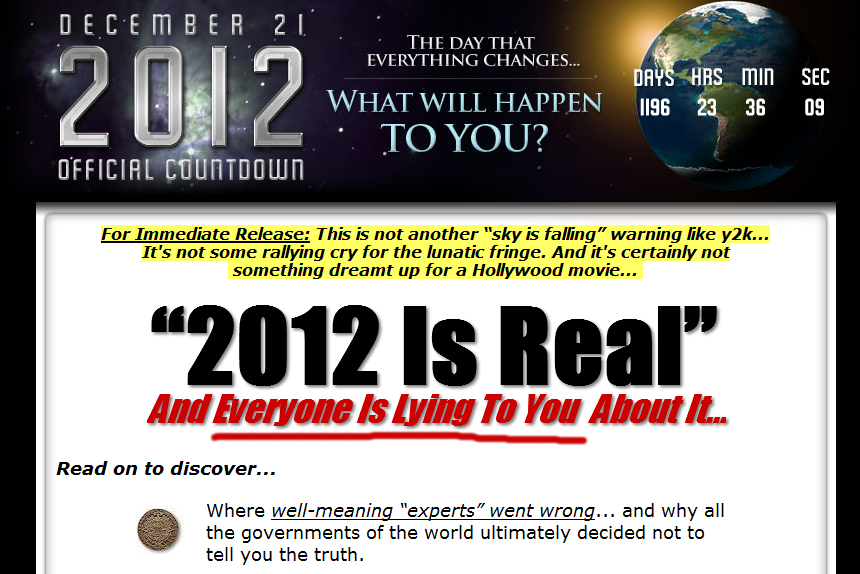
A screenshot of the 2012 Official Countdown website.
It’s one of those classic “I can show you how to earn $5000/hour” set-ups. One long page, filled with text that takes a whole evening to read. This particular site is called the “2012 Official Countdown” and the URL is http://www.2012officialcountdown.com (I won’t link to it). A screenshot of the top of the page can be seen to the right.
So how do I know this is a scam? You mean apart from the transparent desperation to tell you that the government is lying to the world? The insane statements that “well-meaning experts” have got it all wrong (those silly scientists)? Or is it the the complete overuse of bold type, red type, yellow highlights and claims that they are the only ones that know the “truth”?
Actually, I can look past all that crap, and skip to one key detail that suggests to me that the author has an even looser grasp on reality than all the other crackpots I’ve encountered (thank you Greg for pointing this peach out):
Mr. Sayer is a respected Internet scholar with a concentration on the topics of history, spirituality and exposing untruths.
So Mr Sayer is, in fact, a guy that spends all his time on the Internet? You mean he’s a graduate of Google University? Poor guy, he must be a little warped. Oh, no, actually he’s more than a little warped:
There is one thing that remains completely undisputed by anyone who is truly informed…
“Every Major Religion… Minor Religions You’ve Never Heard Of… Non-Religious Spiritualists… And Even Atheists And Agnostics Agree…”
In 2012… something will happen.
What?
Aaaah… that’s the issue in dispute. That’s the issue that is causing all the debate.
And that’s where you’re having the most trouble deciding what is fact… and what is pure Hollywood fiction.
Hi. My name is J. Michael Sayer. And… I have the answer.
Unfortunately, the superiority complex is strong in this one. Mr Sayer is a self-professed “Internet scholar” who “has the answer.” The answer to what? Well, something bad is going to happen in 2012! No, really? Really. What’s more, he presents his material like a true soothsayer on a mission. People are pleading for his help! He has the answer! He helps people by telling them the answer! (After clicking on the PayPal button.)
I’ll be honest, I felt a legion of braincells die as I read through the story that ensues. For some reason “James” decides to chronicle the events of Hurricane Katrina and how we can prepare for a similar catastrophe in 2012 if we read his book. But the book is just a re-hash of all the old theories that have come before (as I outlined in No Doomsday in 2012) — ancient civilizations/prophets predict doomsday in 2012 etc. Even though the Mayans never predicted doom when their Long Count calendar ran out, and Nostradamus never accurately predicted what he was going to have for dinner, let alone the events that would happen hundreds of years after his death. In short, it’s all total rubbish.
The one thing that really ticks me off however, are questions like, “How much is it worth to you to have the peace of mind you need for your family?” Apparently, the package James is offering is “worth” (it seems you can put a price on bullshit these days) $7,850. Why? That’s because he’s put 157 hours of “research” into this package (so it looks like he charges $50/hour for his Internet surfing expertise). But wait! He doesn’t want to sell it for $7,850.
We both agree a mere $1,000.00 to change everything about your life and the future lives of your family members. That’s a bargain.
But he’s not even selling it for $1,000! What a guy. A hero.
You won’t pay $99… $89… or even $79. This price cutting is getting crazy.
Oh James, you’re making me cry. You’re such a crazy, crazy guy!
After some more nonsense about throwing in an mp3, another book, and a little piece of his soul, James is flogging this whole kit for $49.95. Amazing, right?
What is amazing is that I actually read that entire page and I’m not dribbling. This is 100% pure-home-grown bullshit, a scam. And I can call it a scam because absolutely none of what he is promoting is provable, and every theory presented can be debunked with real science. Unfortunately, this is the most brazen attempt yet to screw people out of their money. Although I’m fairly sure most people will see the page and know it’s a con, some will see it as a lifeline, unfortunately.
Another very unfortunate thing is that I found this page via a Google Ad on Astroengine.com. It’s now blocked, but I suspect we’ll be seeing more and more of these websites pop up the closer we get to December 21st, 2012.
The Flying Speghetti Monster. I wonder if this is what Lord May had in mind? (Church of the FSM)
This one comes direct from the UK’s Department for Wacky Ex-Chief Science Advisors, and I’m not too sure which I’m more shocked with; the fact that Lord May actually suggested that religion (i.e. fear of the All Mighty) could save the world from a climate meltdown or that the Telegraph reported May’s views so candidly.
Ex-government officials certainly are not afraid to share their views with the world, and that’s fine, but sometimes they sound a little crazy in doing so. Take last year’s discussion between Prof. Brian Cox and Sir David King.
King, Chief Science Advisor for the UK government from 2000-2007, came out with the astonishing statement that the Large Hadron Collider was “more navel searching than searching for potential future developments for the benefit of mankind.” He made this astounding point during a discussion on the BBC’s Newsnight, on the day the LHC was switched on. Buzz kill. Fortunately, Cox offloaded a round of common sense in the direction of Sir King, proving that it probably should have been a practising scientist, not a guy with a knighthood, advising the Prime Minister about UK science between the years of 2000 and 2007.
Unfortunately, a Lord might not be up to the task either, judging by this most recent statement by the UK Chief Science Advisor who reigned from 1995-2000.
“Given that punishment is a useful mechanism, how much more effective it would be if you invested that power not in an individual you don’t like, but an all-seeing, all powerful deity that controls the world,” he said
“It makes for rigid, doctrinaire societies, but it makes for co-operation.”
And how would this supernatural being help modern society? We’ll all be so scared to avoid getting struck down by “God” that the whole planet will band together, human cultures would stabilize and cooperate to find a quick solution to carbon emissions and climate change.
Yeah, ‘cuz that’s how religion works: scare the crap out of the commoners! Tell them that if they don’t recycle, or use public transportation, they’ll piss off God so much that he’ll fry them with a thunderbolt from heaven. That will solve all our climate woes!
The odd thing is that May is apparently an Atheist, so I’m even more confused as to where his faith in religion comes from. Sure, religion is integrated into society, and yes, it’s provided a structure to people’s lives for thousands of years. But this is not a solution for the international community to suddenly become best of friends. I’m not even sure how May thinks believing in a “supernatural punisher” will change a thing. Who’s going to evangelize this God? How do you drive the fear into the hearts of billions in an effort to save the planet? He does point out that fundamentalism isn’t good either, and that he’s not a big fan of the Pope.
This sounds more like a description of some conspiracy-driven New World Order than an answer to rising carbon emissions.
No, don’t confuse the world’s inability to coordinate an effective plan to slow (or reverse) the effects of greenhouse gases with a world without a “supernatural punisher.” Besides, shouldn’t Lord May be promoting good science rather than thinking religion might save us all? As, let’s face it, religion isn’t the best catalyst for world collaboration (no matter how moderate it is).
My belief is that science is our best bet at finding a solution. Unfortunately it’s international politics that often lets us down, not a world that doesn’t have the fear for a divine being.
As we all know by now, India’s first mission to the Moon (Chandrayaan-1) lost contact with mission control over a week ago. Very quickly, the Indian Space Research Organization (ISRO) declared that the mission was unrecoverable, and after a 10-month stint, it was curtains for India’s début lunar jaunt.
Oh well, these things happen in space.
But not everyone sees it that way. Almost immediately, the media started calling Chandrayaan-1 a “failure.” The ISRO issued press releases saying that 95% of the mission objectives had been completed, so it couldn’t be considered a “failure.”
During the Al Jazeera Inside Story show I was invited to appear on shortly after contact was lost with the satellite, I mentioned that it isn’t easy to put stuff into space. Although the ISRO has been operational for the best part of 40 years, getting a probe to the moon, dropping an impactor onto the surface and surviving for 10 months wasn’t an easy thing to do by any means. How could the mission possibly be a failure? More of a partial success.
Some questions will obviously hover over the reasons for the mishap, but it doesn’t seem to be holding India back as they prepare Chandrayaan-2.
So what did happen? It would appear that some more details are surfacing about the satellite’s demise. The Indian press are pointing to a decision by the ISRO to increase the orbit of Chandrayaan-1 from 100km to 200km in May this year for scientific reasons. In actuality, the radiation shielding installed on the craft was insufficient, forcing mission control to increase the orbit away from the Moon.
And now it looks like the same problem — lack of decent radiation shielding — fried the communication computers on board the satellite, probably the root cause of the blackout. In any case, international specialists will meet in Bangalore today to shed some light on why Chandrayaan-1 disappeared and to evaluate its performance.
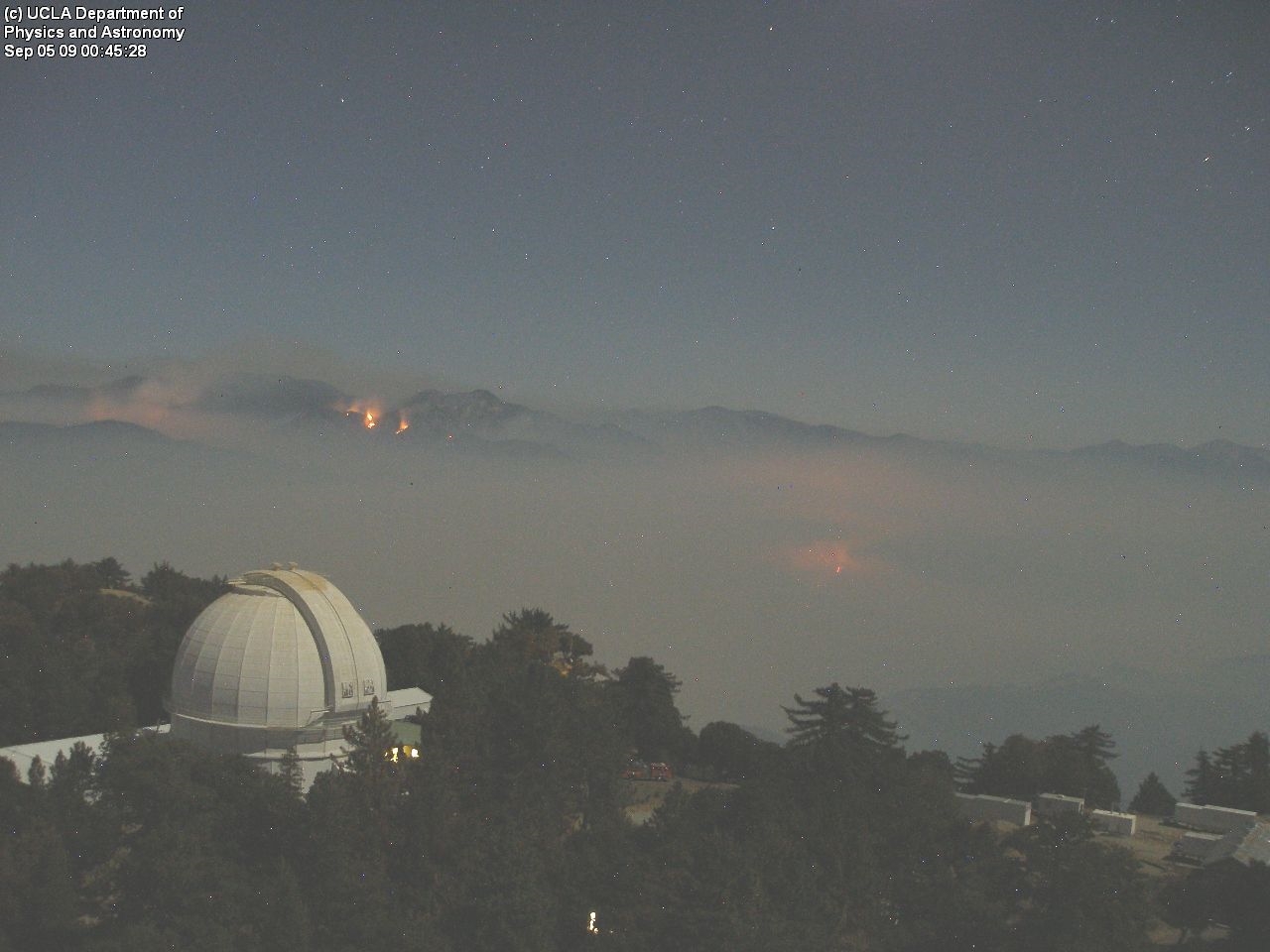
The view from Mt. Wilson Towercam, facing east (UCLA)
So, the observatory Towercam is back online, and the summit of Mount Wilson is looking decidedly un-charred and… peaceful. This means the fire crews did an outstanding job of removing vegetation and the aerial water attack obviously paid off. The Hooker Telescope dome is also looking fine.
But it’s the scene to the east of Mt. Wilson (the Towercam has been turned around), showing fires burning in the valley and in the hills (the nearest fires still burn in the West Fork of the San Gabriel River Canyon near Shortcut Saddle), that reminds us that the fire fight is far from over, and the fire men and women are putting their lives on the line day and night.
Over these last few days, the Internet was abuzz with news about the Station Fire threatening the world-famous Mount Wilson Observatory. In case you don’t know what the observatory is famous for, Edwin Hubble used the 100″ Hooker Telescope to deduce that the Universe is expanding. So, yes, it’s an important site that needed to be defended for as long as was physically possible. Also, an array of telecommunications towers share the Mt. Wilson summit, so there was a lot at stake.
So far so good. The Station Fire is gradually coming under control, even though it still spreads east through the San Gabriel Mountains (and I can still smell smoke through my open office window). We’re not out of the woods, but at least the observatory is safe for now and fire crews are making great headway.
Yes, there’s another observatory at stake. Not as famous as Mt. Wilson, but Stony Ridge is in jeopardy, if not more so. Stony Ridge is currently inside the Station Fire perimeter, five miles north of Mt. Wilson, and nobody knows if it’s been hit by the fires.
Stony Ridge Observatory is a single 30-inch Newtonian-Cassegrain telescope housed inside a dome. It is a site that was built and is maintained by amateur astronomers, and back in 1963, it was the 8th biggest telescope in California. Currently, the observatory is used for outreach activities and follow-up observation campaigns. It’s also accredited with a number of asteroid discoveries.
Unfortunately, Stony Ridge probably won’t see the aerial fire fighting we saw at Mt. Wilson. Ground crews have made attempts to approach the site, but access to the observatory was blocked by mountain debris on the road. In short, there is no word about the status of the observatory and there are no plans to mount a huge fire fighting effort.
When housing, communication masts and larger observatories are threatened by fire, resources are committed, but for an observatory the size of Stony Ridge, it’s the sad case of waiting for the fire to burn its course and then assess the damage after the fact.









 astroengine.com

