A bolt of lightning strikes over Strasbourg, France (Ian O'Neill)
As you may have noticed, things have been rather quiet on Astroengine of late. This is partly due to my pan-European trek and my work on Discovery News, but mainly due to my horrid affliction of procrastination. Hence why I’m late in posting this pretty awesome picture of a lightning bolt blasting across the French skies.
It was an incredible experience and I got to meet some incredible people. Hoping to get a blog post up about the whole thing some time over the coming days, but for now, I’ll leave you with this picture of the storm that hit Strasbourg while I was there. For the full set, check out my Posterous gallery.
Oh yes, and that little dot ahead of the falling debris? That’s the sample return capsule before it was found int he Outback safely. Thank goodness its parachute worked (presumably).
The Moon, Space Shuttle Atlantis, an aurora plus Kibo, all in one breathtaking scene (Soichi Noguchi)
The instant I saw this photograph I realized I was seeing something so beautiful, I’d have a hard job writing something to accompany it.
Coming straight from the Twitter feed of Soichi Noguchi, Japanese astronaut and social-media-in-space-photography-guru, this single photograph has captured the moon, an aurora hanging above the Earth’s limb, a docked space shuttle Atlantis and the International Space Station’s Kibo module (plus a bonus robotic arm and solar panel).
This picture is awesome on so many levels. And to be honest, this should be the photograph of Atlantis’ final mission. It encapsulates so much; a testament to what mankind is capable of and a tribute to the men and women who are currently in space, risking their lives for the advancement of our race.
Astroengine.com is now being syndicated by The Christian Science Monitor! The CSM has been around for ever (well, since 1908) and it’s a publication that’s won seven Pulitzer Prizes. That’s all kinds of awesome. Personally, I’ve been following CSMonitor.com for some time and their coverage of all things science is excellent — I’m very excited to be a part of their new “Cool Astronomy” section.
But I’m not alone! You’ll find many familiar faces in this new superblog, many of which you can see in Astroengine’s blogroll.
What does this mean for Astroengine? Well, nothing is going to change, except I’ll be less lazy and write more. My plan for Astroengine’s global domination is on track!
*I stole this title from a Chipotle ad, but it’s a great ad (and an awesome Mexican take out), so why not? Unfortunately the burritos aren’t free in the Astroengine Universe.
Firstly, apologies that it’s been over a month since last posting to Astroengine.com. Call it slacking off, call it a sabbatical, either way, it’s not good. I’ve actually prepared several half-finished articles, but I just never got around to completing them. However, I have been on writing overdrive over at Discovery News, so if I go quiet over here, you know where to find me.
Although Spitzer has entered a new phase of operations since it depleted the liquid helium coolant used to maintain its instrumentation, that doesn’t mean its stopped producing some awe-inspiring imagery. In a new vista released on Thursday, a bustling star formation region in Orion is detailed, showing some 1,500 young stars the observatory watched for 40 days. This is an unprecedented study, allowing rapid variations in these baby stars to be tracked by Spitzer.
Young stars are generally highly variable in their brightness, a characteristic that is of huge interest to astrophysicists. If we can understand the mechanisms causing this variation, we can gain an insight to stellar evolution, possibly even understanding the history of our own Solar System.
As Spitzer observes in infrared wavelengths, it’s very sensitive to clouds of dust being heated by these young stars. Therefore, the proto-planetary disks surrounding these million year old stars glow brightly. Not only does this give an indication to the conditions surrounding the star, it also provides astronomers with an idea to how these disks of dust clump together, slowly evolving into exoplanets. And now Spitzer has data sets spanning weeks, dynamic changes in the emissions from the stars and their evolving planetary systems can be studied.
But science aside, the Spitzer imagery is a thing of beauty, reminding us how complex our cosmos really is. Don’t believe me? Take a look for yourself (click the pic to dive right in):
The star forming region in Orion as studied by Spitzer, rotated 90 degrees (NASA/JPL/Caltech)
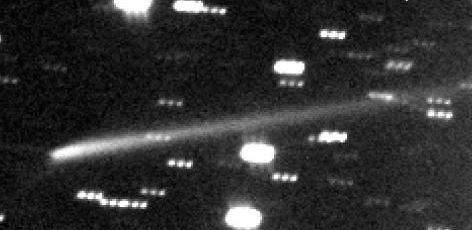
Comets don’t usually do that, they tend to have elliptical and inclined orbits, orbits that carry them close to the Sun (when they start to heat up, creating an attractive cometary tail as volatile ices sublimate into space, producing a dusty vapor). They are then flung back out into the furthest reaches of the Solar System where the heating stops and the comet tail disappears until the next solar approach.
But P/2010 A2 — discovered by the Lincoln Near-Earth Asteroid Research (LINEAR) sky survey — has a circular orbit and it still appears to be venting something into space.
P/2010 A2 (LINEAR): A comet or asteroid debris? (Spacewatch/U of Arizona)
There is the possibility that it is a member of a very exclusive bunch of objects known as main belt comets (MBCs). MBCs are confused asteroid/comet hybrids that appear to spontaneously vent vapor and dust into space and yet stay confined to the asteroid belt. But, if P/2010 A2 is confirmed to be one of these, it will only be the fifth such object to be discovered.
So what else could it be? If the potential discovery of an MBC doesn’t excite you enough, it could be something else entirely: the dust produced by a hyper-velocity impact between two asteroids. If this is the case, it would be the first ever observation of an asteroid impact in the Solar System.
The asteroid belt isn’t the same asteroid belt you might see in science fiction; although there are countless rocky bodies in our asteroid belt, it is rare that these rocky bodies encounter each other. Space is very big, and although the density of asteroids in this region might be considered to be “high”, this is space we’re talking about, you can fly a spaceship through the region without having to worry that you’ll bump into something. The average distance between asteroids is huge, making it a very rare occurrence any two should hit. But given enough asteroids, and enough time, eventually asteroid collisions do happen. And in the case of P/2010 A2, we might have been lucky.
Asteroid collisions: Rare, but possible.
The chatter between comet/asteroid experts is increasing, and on one message board posting, Javier Licandro (Instituto de Astrofísica de Canarias, Spain) reports observing a secondary asteroid traveling with the cloud-like P/2010 A2.
“The asteroid moves in the same direction and at the same rate as the comet,” reports Licandro on The Minor Planet Mailing List. “In addition, the P/2010 A2 (LINEAR) image does not show any central condensation and looks like a ‘dust swarm’.”
“A short lived event, such as a collision, may have produced the observed dust ejecta.”
Therefore, this ‘comet’ may actually be the debris that was ejected after a collision between two asteroids. Although these are preliminary findings and it’s going to take some serious observing time to understand the true nature of P/2010 A2, it’s exciting to think that we may just have observed an incredibly rare event, 250 million miles away.
I do admit, I’m terrible with names, but I never forget a face. In this case, the face I didn’t forget was a little moon orbiting Saturn (it’s the one that looks like the Death Star from Star Wars). However, after seeing this photo, I doubt I’ll ever forget Tethys’ name again.
In a photo snapped by the awesome Cassini Equinox mission back in November, the little moon with characteristic impact crater carved into its crust can be seen to be drifting behind Titan. Tethys only disappears for 18 minutes behind Titan’s thick atmosphere, but it was enough to ignite my interest in the icy world.
It’s strange how a simple photograph and perfect timing can ignite the imagination, as I doubt “just another moon shot” would have the same effect. No, this is a moon drifting in front of another moon as seen by a veteran spaceship orbiting the second largest planet in the solar system millions of miles away. Sometimes words are insufficient to describe the enormity of what we are doing in space.
So, sod the words and look at this, you won’t be disappointed:
Released in December 2009, Kate McAlpine (a.k.a. AlpineKat) put together the rather fun “Black Hole Rap” in an effort to trivialize the disinformation being peddled about the Large Hadron Collider (LHC). You might remember AlpineKat from the hugely popular (and deliciously geeky) “LHC Rap” that has generated over 5 million hits on the YouTube video. Here’s the newest music video filmed in the depths of the French-Swiss border:
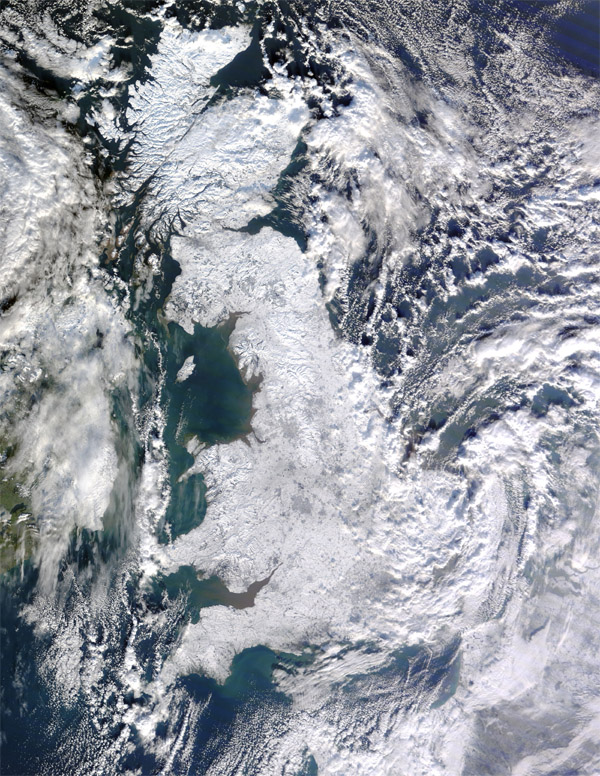
I just saw this stunning image on Phil Plait’s Bad Astronomy and I assumed it was a fancy bit of art… or a computer generated view of glacial Britain… or UK-shaped frosted cake. Nope, it’s the UK as it looks from space, right now.
The UK is experiencing record low temperatures and I just got off the phone to my mum to hear that Bristol (my hometown, somewhere in the south-west of England) hit a bone shattering -15°C low last night. Yikes! And here I am looking out of my office window feeling the heat of the Sun of a 24°C California day. Truth be told, I’m a little jealous, I haven’t felt sub zero cold for years. In fact, the last time I saw negative temperatures in double figures was when I lived in the Arctic in 2002.
For now, I’ll just have to enjoy the view from space and hope this cold spell doesn’t cause too much hassle for my family and friends. My advice: Stay indoors, only go outside if you have a warm local pub within walking distance.
I’ve been pondering a word that could describe today.
I drew a blank.
It’s a very hard day to sum up in one word. In fact, this entire week has been something of a unique one. From a space point of view, it’s been busy, largely due to the endless supply of space science research spewing from the American Astronomical Society’s Division of Planetary Sciences meeting in Puerto Rico.
However, last night (and early this morning) is what topped it all off. The NASA LCROSS mission slammed into the lunar south pole at 4:31am (PDT) and I was there tweeting away, keeping abreast of all the juicy LCROSS news. That was until Time Warner Cable decided to pull the plug on my internet connection 10 minutes before the main event (I’m certain they did it deliberately, it’s the only explanation). Panic-stricken — and really peeved that I’d spent the whole night excited to see the glorious end to this Moon mission, only to be foiled by my ISP — I checked the TV, and it was working, plus a local channel was covering the event. Phew.
Anyway, on waking up this morning, I was shocked to find my inbox was stuffed full of Twitter follow messages and notes of congratulations from my team at Discovery News. CNN had picked me, with four heavy-hitters on Twitter as their #FollowFriday. But it wasn’t an ordinary #FollowFriday, the guys at CNN Technology posted this #FollowFriday on their site!
Editor’s note: In this new weekly feature, we highlight five recommended Twitter feeds about a hot topic in the news. Today’s list focuses on space-related tweets and NASA’s plan to crash two spacecraft on the moon Friday in a search for water in lunar soil. —CNN Tech
So despite my internet woes, CNN had chosen me (@astroengine) with @BadAstronomer, @Astro_Mike, @LCROSS_NASA and @NASA_AMES. So I was in the company of an entire NASA facility (Ames), a NASA mission that had just hours before slammed into the Moon (LCROSS), the first astronaut to tweet from space (Mike Massimino) and the one, and only, Phil “The Bad Astronomer” Plait.
Wow.
They also added this very flattering description of @astroengine:
4. astroengine — Astroengine is the Twitter name of Ian O’Neill, a British-born physicist with a long resume and a healthy sense of humor. It’s also the name of his blog, which gathers articles and posts on such light-reading topics as quantum mechanics, solar physics, relativity, cosmology, space flight science and “some of the more bizarre theories that drive our universe.”
Number of followers: more than 1,700
Sample tweet: “Europa, Jupiter’s Moon, Could Support Complex Life http://bit.ly/3n6iKL (I, for one, welcome our alien Jellyfish Overlords)”
So, I’d like to take this opportunity to say “hello” to my hundreds of new followers!
And did I think of a word that describes today? Actually, I think I just did:





 astroengine.com