Hayabusa re-enters over the Australian Outback, generating a bright fireball (screen grabs from the JAXA video feed)
Staring hard at the live streaming video of the black Australian skies, I was hoping to see a faint streak of light glide across the camera’s field of view.
But no, it wasn’t that subtle.
Shortly after 9:51 am EDT on Sunday morning (or, for me, a far more civilized 2:51 pm GMT), the Japanese space agency’s (JAXA) Hayabusa’s mission officially came to an end, burning up in the atmosphere. However, a few hours before, the spacecraft released a 40 cm-wide capsule, sending it ahead of the main spacecraft. This sample return capsule would have a very different re-entry than its mothership.
As I watched the small dot of light on the horizon of the streaming video getting brighter and brighter — feverishly hitting the PRTSC button and using some rapid cut&paste-fu in Photoshop — suddenly it erupted, shedding light on the distant clouds that had been invisible in the night.
Far from the re-entry being a faint or dull event, it was dazzling (as seen in the screen grabs to the right).
So, after seven dramatic years in space, the Hayabusa mission has come to an end.
For the full story about how Hayabusa got hit by the largest solar flare in history, limped to visit an asteroid called Itokawa and how its sample-collecting kit malfunctioned, have a read of my main article on Discovery News: Hayabusa Generates Re-Entry Fireball Over Australia
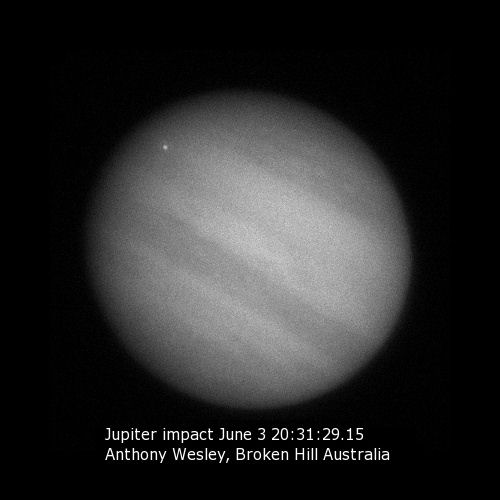
Anthony Wesley’s first event was the famous July 2009 observation of what was thought to have been the immediate aftermath of a comet impact in the Jovian atmosphere. His second happened on Thursday at 20:31 UTC when he was observing Jupiter when something hit the atmosphere, generating a huge fireball.
It is not known whether this event was caused by a comet or asteroid, but in a bizarre case of serendipity, earlier on Thursday Hubble released more information on his original impact event. The July 2009 “bruise” in the gas giant’s atmosphere is now thought to have been caused by an asteroid, and not a comet.
The Hubble press release included details on how researchers deduced that it was actually more likely that a 500 meter-wide asteroid hit Jupiter in 2009. One clue was that newly installed cameras on the space telescope detected little dust in the halo surrounding the impact site — a characteristic that was detected after the impact of the shards of comet Shoemaker-Levy 9 in July 1994. Also, the calculated trajectory of the 2009 event indicated the object didn’t have an orbit commonly associated with comets. If the 2009 event was an asteroid, that means Wesley saw something never seen before: the site of a recent asteroid impact on a celestial body.
And now, less than a year after being the first to see that impact aftermath, Wesley has done it again. Another amateur astronomer, Christopher Go, was quick to confirm Thursday’s fireball with a video of the 2 second flash in Jupiter’s upper atmosphere.
These impact events serve as a reminder about Jupiter’s fortuitous role in our Solar System. As the gas giant is so massive, its gravitational pull has a huge influence over the outer planets, dwarf planets, comets and asteroids. Acting like an interplanetary ‘vacuum cleaner’ Jupiter can block potentially disastrous chunks of stuff from taking a dive into the inner Solar System. It is thought that this distant planet has helped Earth become the thriving world it is today, preventing many asteroids and comets from ruining our evolution.
The interstellar probes are still operational (NASA)
The Voyager 2 spacecraft has been speeding through the Solar System since 1977 and it’s seen a lot. Besides scooting past Jupiter, Saturn, Uranus and Neptune, the probe is now passing through the very limit of the heliosphere (called the heliopause) where it has begun to detect a magnetic field beyond the Solar System. The fact we have man-made objects exiting our star system is something that makes me goosebumpily.
For some perspective, Voyager 2 is so far away from Earth that it takes nearly 13 hours for commands sent from Earth to reach the probe.
After decades of travel, the NASA spacecraft continues to relay data back to us, making it one of the most profound and exciting space missions ever launched. Perhaps unsurprisingly, the aging explorer recently experienced a glitch and the data received by NASA was rather garbled.
Naturally, the conspiracy theorists were out in force quickly pointing their sticky fingers at a possible encounter of the 3rd kind. How these ‘aliens’ found the probe in the first place and reprogrammed the transmission for it to appear corrupt Earth-side is beyond me, but according to an ‘expert’ in Germany, aliens (with an aptitude for reprogramming 30 year old Earth hardware, presumably) were obviously to blame.
One of the alien implication articles came from yet another classic ‘science’ post thrown together by the UK’s Telegraph where they decided to take the word of a UFO expert (obviously a viable source) without any kind of counter-argument from a real expert of real science. (But this is the same publication that brought us other classics such as the skull on Mars and the Doomsday Turkey, so it’s not too surprising.)
As I discussed in a recent CRI English radio debate with Beyond Beijing hosts Chris Gelken and Xu Qinduo, the Voyager-alien implication is beyond funny; an entertaining sideline to poke fun at while NASA worked out what actually went wrong. But the big difference was that Chris and Xu had invited Seth Shostak (from the SETI Institute) and Douglas C. Lin (from the Kavli Institute for Astronomy and Astrophysics at Peking University) to join the fun. No UFO expert in sight, so the discussion was biased toward science and logic, not crazy talk.
So what did happen to Voyager 2? It turns out that aliens are not required to answer this cosmic mystery.
On Tuesday, NASA announced that Voyager 2 had flipped one of its bits of memory the wrong way. “A value in a single memory location was changed from a 0 to a 1,” said JPL’s Veronia McGregor.
This glitch was thought to occur in the flight data system, which formats information for transmission to Earth. Should something go wonky in its memory allocation, the stuff it transmits can be turned into gibberish.
Although it isn’t known how this single bit was flipped (and we may never know, as Voyager 2 is an awful long way from home), it sounds very much like a cosmic ray event interfering with the onboard electronics. As cosmic rays are highly energetic charged particles, they can penetrate deep into computer systems, causing an error in calculations.
And this situation isn’t without precedent either. Recently, NASA’s Mars Reconnaissance Orbiter (MRO) was hit by a cosmic ray event, causing the onboard computer to switch to “safe mode.” Also, Voyager 2 is beginning to exit the Sun’s outermost sphere of influence, where turbulence and confused magnetic fields rule. If I had to guess, I’d say — statistically-speaking — the probe might have a greater chance of being hit by the most energetic cosmic rays from deep space.
Just because something “mysterious” happens in space doesn’t mean aliens, the Illuminati or some half-baked doomsday phenomenon caused it. Before jumping to conclusions it would be nice if certain newspapers and UFO experts alike could look at the most likely explanation before pulling the alien card.
Alas, I suspect that some things will never change.
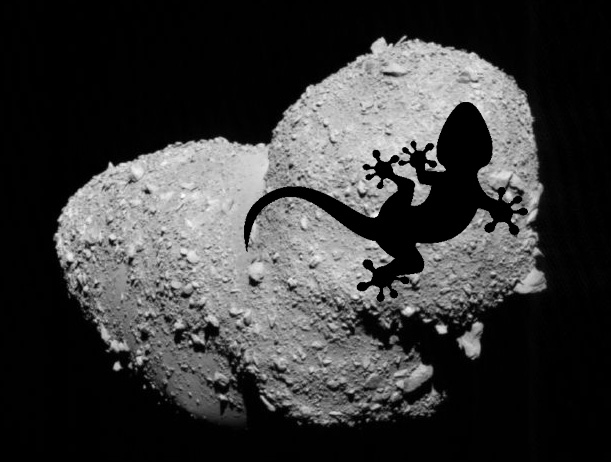
The asteroid Itokawa (as imaged by the Japanese Hayabusa probe) and a gecko tattoo. Bear with me, it'll make sense soon (JAXA)
What do asteroids and geckos have in common? Not a lot, as you’d expect, but they may share a common force.
This rather strange notion comes from research being done by a team of University of Colorado scientists who have been studying the odd nature of the asteroid Itokawa. When the Japanese Hayabusa mission visited the space rock in 2005 (Hayabusa’s sample return capsule is set to return to Earth on June 13th by the way), it noticed the asteroid was composed of smaller bits of rubble, rather than one solid chunk. Although this isn’t a surprise in itself — indeed, many asteroids are believed to be floating “rubble piles” — the rate of spin of the asteroid posed a problem.
Itokawa spins rather fast and if only the force of gravity was keeping the lumps of rock together, they would have been flung out into space long ago. In short, the asteroid shouldn’t exist.
Although plenty of theories have been bandied around, one idea seems to stick.
More commonly found as a force that holds molecules together, the van der Waals force may bind the individual components of the asteroid together, acting against the centripetal force caused by its spin.
But where do the geckos come in?
Geckos are highly skilled in the “climbing up walls” department, and it’s the van der Waals force that makes this happen. Should the body of a gecko be tilted in such a way against a perfectly smooth, “impossible” to climb surface, the gravity acting on the little creature will trigger the force into action. Therefore geckos have evolved to exploit the practical application of van der Waals.
This has some rather interesting ramifications for asteroid evolution too. During early stages of asteroid formation, the larger fragments of rock are flung off; the centripetal force exceeds that of gravity. In the latter stages of development, only the smallest rocks remain behind, their mass small enough to allow van der Waals forces to overcome the spin.
So, there you have it, asteroids do have something in common with geckos. It seems only right to call these space rubble piles “Gecksteroids.”
But it hasn’t been easy, especially after the Ares I-X test launch in October 2009.
The Ares I-X was the first new NASA manned vehicle my generation has seen take to the skies (I was only one year old when the first of the shuttle fleet launched, beginning nearly 30 years of low-Earth orbit operations, so that doesn’t count). Despite criticism that this test flight was nothing more than old tech dressed up as a sleek “new” rocket, I was thrilled to see it launch.
The end product didn’t matter on that day. Sure, we’ve been to the Moon before, but it just seemed like the best plan on the table. I was inspired, I felt excited about our future in space. Seeing how astronauts live and work on the lunar surface, using it as a stepping stone for further planetary exploration (i.e. Mars) seemed… sensible. Expensive, but sensible
But the overriding sentiment behind Obama’s new plans was that we’ve been there before, why waste billions on going back? Continuing with the bloated Constellation Program would have used up funds it didn’t have. Cost overruns and missed deadlines were already compiling.
So, the White House took on the recommendations of experts and decided to go for something far riskier than a “simple” moon hop. Things going to plan and on schedule, in the year 2025 we’ll see a team of astronauts launch for a much smaller and far more distant target than the moon.
The asteroid plan has many benefits, the key being that we need to study these potentially devastating chunks of rock up close. Should one be heading in the direction of Earth, it would be really nice to have the technological ability to deal with it. A manned mission may be necessary to send to a hazardous near-Earth asteroid. Think Armageddon but with less nukes, no Bruce Willis, but more science and planning. Besides, if a rock the size of a city is out there, heading right at us, I’m hopeful we’ll have more than 18 days to deal with the thing.
“A several month-long human round trip to an asteroid will test the sea legs of astronauts for interplanetary journeys. And, asteroids are something we have to take very seriously in coming up with an Earth defense strategy, so that we don’t wind up going extinct like the dinosaurs.”
Possibly even more exciting than the asteroid plan is what — according to Obama — will happen ten years after that: a manned mission to Mars. I can’t overemphasize my enthusiasm for a mission to the Red Planet; that will be a leap for mankind like no other. Granted, there is plenty of criticism flying around that we need to live on the moon first before we attempt to land on Mars, but looking at the new plan, we won’t be actually landing on Mars any time soon. A 2030’s mission to Mars will most likely be a flyby, or if we’re really lucky, an orbital manned mission.
And that’s why going to an asteroid will be a good first step. Spending months cramped inside a spaceship with a handful of crewmates will likely be one of the biggest challenges facing man in space, so popping over to a near-Earth asteroid first is a good idea. A Mars trip could take over a year (depending on the mission). Now, this is where technological development sure would help.
If NASA can plough dedicated funds into new technologies, new life support and propulsion systems can be developed. Those two things will really help astronauts get places quicker (avoiding boredom) and live longer (avoiding… death). For the “living longer” part, there appears to be genuine drive to increase the life of the space station and do more impressive science on it. As it’s our only manned outpost, perhaps we’ll be able to use it for what it’s designed for.
There are a lot of unknowns still, and Obama’s Thursday speech certainly wasn’t NASA’s silver bullet, but it’s a start. Allocating serious funding for space technology development whilst setting the space program’s sights on going where no human has been before will surely boost enthusiasm for space exploration. In fact, I’d argue that this is exactly what NASA should be doing.
Although I was dazzled by the Ares I-X, I can see that continuing with Constellation would have been a flawed decision. Launching a manned mission to explore an interplanetary threat sounds risky, but considering that asteroids are the single biggest cosmic threat to civilization, it sure would be useful to know we have the technology to send astronauts to asteroids, perhaps even dealing with a potential threat in the near future.
What happens when you put a snowball in front of an open fireplace? It melts. What happens when you throw a comet at the Sun? Erm… it doesn’t end well. In fact, as this daredevil comet proves, comets get vapourized very quickly. And the Solar and Heliospheric Observatory (SOHO) captured the whole event, here’s a video.
Sungrazing comets are spotted fairly regularly and this particular comet spotted over the weekend is likely a member of the Kreutz sungrazer family. This group of comets are thought to have been spawned when a giant comet broke up over 2000 years ago. However, the larger Kreutz fragments usually make a close approach to the Sun 3 or 4 times a year, but there have been 3 such events in 2010 so far.
As noted by Spaceweather.com, this could just be a statistical anomaly, but it could be that these fragments are a part of a swarm of comets approaching perihelion (closest approach to the Sun).
Either way, if you’re a comet, don’t venture too close to the Sun, you might get eaten.
What you see here is something mankind has never seen before, the aftermath of an asteroid collision. This conclusion comes after the Hubble Space Telescope was commanded to take a closer look at a strange comet-like object pottering around in the asteroid belt between the orbits of Mars and Jupiter.
“The truth is we’re still struggling to understand what this means,” said David Jewitt, a planetary physicist from UCLA. “It’s most likely the result of a recent collision between two asteroids.”
After P/2010 A2 was discovered in January, Jewitt managed to get observation time on Hubble to get a closer look of what was thought could be a rare asteroid-comet hybrid.
In the image, the object named P/2010 A2 has a very obvious “X” on its surface shaped pattern in its tale, possibly the location where a smaller body slammed into it at high speed. The result of this hyper-velocity impact produced a lot of debris and scientists think the comet-like tail being swept back by the pressure of the solar wind is dust and outgassing volatiles (like subliming water ice).
Although this kind of event has never been observed before, over the lifetime of the evolving solar system, events like this occur on a regular basis, in fact asteroid collisions have shaped the asteroid belt. Interestingly, it is thought this impact was caused by a collision of a “Flora family” asteroid, a type of object that may have wiped out the dinosaurs 65 million years ago. (Don’t worry, this collision won’t affect Earth in any way, the dinosaur thing is simply an interesting connection!)
What an incredible discovery, it’s fortunate that we have Hubble’s excellent eyesight to peer deep into the asteroid belt…
Comets don’t usually do that, they tend to have elliptical and inclined orbits, orbits that carry them close to the Sun (when they start to heat up, creating an attractive cometary tail as volatile ices sublimate into space, producing a dusty vapor). They are then flung back out into the furthest reaches of the Solar System where the heating stops and the comet tail disappears until the next solar approach.
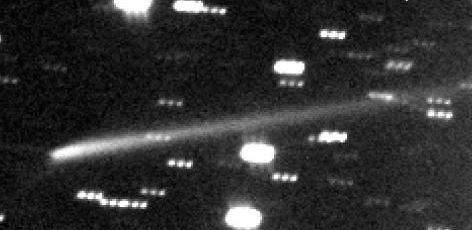
But P/2010 A2 — discovered by the Lincoln Near-Earth Asteroid Research (LINEAR) sky survey — has a circular orbit and it still appears to be venting something into space.
P/2010 A2 (LINEAR): A comet or asteroid debris? (Spacewatch/U of Arizona)
There is the possibility that it is a member of a very exclusive bunch of objects known as main belt comets (MBCs). MBCs are confused asteroid/comet hybrids that appear to spontaneously vent vapor and dust into space and yet stay confined to the asteroid belt. But, if P/2010 A2 is confirmed to be one of these, it will only be the fifth such object to be discovered.
So what else could it be? If the potential discovery of an MBC doesn’t excite you enough, it could be something else entirely: the dust produced by a hyper-velocity impact between two asteroids. If this is the case, it would be the first ever observation of an asteroid impact in the Solar System.
The asteroid belt isn’t the same asteroid belt you might see in science fiction; although there are countless rocky bodies in our asteroid belt, it is rare that these rocky bodies encounter each other. Space is very big, and although the density of asteroids in this region might be considered to be “high”, this is space we’re talking about, you can fly a spaceship through the region without having to worry that you’ll bump into something. The average distance between asteroids is huge, making it a very rare occurrence any two should hit. But given enough asteroids, and enough time, eventually asteroid collisions do happen. And in the case of P/2010 A2, we might have been lucky.
Asteroid collisions: Rare, but possible.
The chatter between comet/asteroid experts is increasing, and on one message board posting, Javier Licandro (Instituto de Astrofísica de Canarias, Spain) reports observing a secondary asteroid traveling with the cloud-like P/2010 A2.
“The asteroid moves in the same direction and at the same rate as the comet,” reports Licandro on The Minor Planet Mailing List. “In addition, the P/2010 A2 (LINEAR) image does not show any central condensation and looks like a ‘dust swarm’.”
“A short lived event, such as a collision, may have produced the observed dust ejecta.”
Therefore, this ‘comet’ may actually be the debris that was ejected after a collision between two asteroids. Although these are preliminary findings and it’s going to take some serious observing time to understand the true nature of P/2010 A2, it’s exciting to think that we may just have observed an incredibly rare event, 250 million miles away.
I do admit, I’m terrible with names, but I never forget a face. In this case, the face I didn’t forget was a little moon orbiting Saturn (it’s the one that looks like the Death Star from Star Wars). However, after seeing this photo, I doubt I’ll ever forget Tethys’ name again.
In a photo snapped by the awesome Cassini Equinox mission back in November, the little moon with characteristic impact crater carved into its crust can be seen to be drifting behind Titan. Tethys only disappears for 18 minutes behind Titan’s thick atmosphere, but it was enough to ignite my interest in the icy world.
It’s strange how a simple photograph and perfect timing can ignite the imagination, as I doubt “just another moon shot” would have the same effect. No, this is a moon drifting in front of another moon as seen by a veteran spaceship orbiting the second largest planet in the solar system millions of miles away. Sometimes words are insufficient to describe the enormity of what we are doing in space.
So, sod the words and look at this, you won’t be disappointed:
Apophis is a 300 meter wide asteroid that caused a stir back in 2004. When NASA discovered the near-Earth asteroid (or NEO), it appeared to be tumbling in our direction Armageddon-style and the initial odds for a 2029 impact were 1-in-37. Understandably, people got scared, the media went nuts and astrophysicists were suddenly very interested in space rock deflection techniques.
It’s important to note that NASA didn’t just pull these numbers out of a hat; the space agency has been tracking Apophis intently since its discovery, plotted its position and projected its location to a very high degree of precision. The more we watch Apophis, the more the world’s scientists are convinced that the asteroid poses a very tiny risk to life on Earth. In fact, giving anything a 1-in-250,000 chance of happening is more of a courtesy than a ‘risk.’ Granted, we’re talking about a global catastrophe should Apophis hit, but would you ever bet on those kinds of odds?
Apparently, the Russian space agency thinks it’s more of a game of Russian Roulette than NASA thinks.
“I don’t remember exactly, but it seems to me it could hit the Earth by 2032,” said Anatoly Perminov, the head of Roscosmos, on December 30, 2009. “People’s lives are at stake. We should pay several hundred million dollars and build a system that would allow to prevent a collision, rather than sit and wait for it to happen and kill hundreds of thousands of people.”
Wait a minute. Does Perminov know something NASA doesn’t? Is he even referring to Apophis? You know, the same asteroid NASA has calculated that has a cat in hell’s chance of causing bother in 2036? And what’s this about the year 2032?
Just for the record, Perminov is indeed referring to Apophis, but he got the date wrong (Apophis does not make a flyby in 2032). Perminov also puts a price on saving hundreds of thousands of people… “several hundred million dollars” should do it, apparently.
On the one hand I’m impressed that Roscosmos is calling for some kind of anti-asteroid shield, but on the other, Perminov’s concern is terribly misplaced (and potentially damaging). His statement sounds as if he’s only just heard about Apophis and then thrown into a press conference unprepared, then asked what he’s going to do about this impending doom. Naturally, in that situation he would have blurted out the first thing that popped into his head: We need to save the world! However, this isn’t the first time he’d heard about Apophis.
Boris Shustov, the director of the Institute of Astronomy under the Russian Academy of Sciences, tried to repair the damage pointing out that Perminov was just using Apophis as a “symbolic example, there are many other dangerous objects we know little about.”
However, saving the world from a theoretical “dangerous object” that may or may not hit us for the next few hundred/thousand/million years is less likely to get funding that an imminent 2032… sorry, 2036 impact.
Although Perminov might sound reasonable in asking for asteroid deflection funding, using sensationalist means to try to leverage funding only serves to make the same funding hard to come by.
In the AGU 2009 meeting in San Fransisco last month, ex-Apollo astronaut Rusty Schweickart outlined his organization’s plans to deflect an asteroid should it pose a threat to Earth. The B612 Foundation points out that there is a ~2% chance of Earth being involved with an “unacceptable” collision in the next century (not by Apophis, but by another undiscovered asteroid), but Schweickart and his colleagues want to emphasize urgency, not panic.
An infrastructure needs to be put in place to deal with asteroid deflection, but this goal will only be hindered by unwarranted alarm by the likes of Perminov. Asteroid detection and deflection will be two critical skills mankind will need to develop for the long-term survival of life on Earth, but the head of Roscosmos is running the risk of making the issue sound more like a crazed rant than anything of substance.
Besides, when Perminov says, “Everything will be done according to the laws of physics,” perhaps he shouldn’t be in charge of messing around with the orbits of NEOs after all…








 astroengine.com
