Sometimes, words are not enough to describe views of the universe when captured through the lens of the Hubble Space Telescope. This is one of those moments.
Kicking off its 20th anniversary (yes, that super-sized telescope has been in space that long — I would say that I remember it being launched, but I don’t, because I was nine, playing with my Star Wars toys), Hubble has published some astonishing images of deep inside the Carina Nebula, some 7,500 light-years from Earth. And, quite frankly, I’m floored.
The pillar of gas and dust looks like a gnarled tree branch, dotted with sparkling lights. The Hubble press release even describes the structure as a “Mystic Mountain,” and it’s not hard to see why. In this age of computer generated everything, this release of images show that the cosmos contains things that defy our tiny imaginations.
We are looking at a star-forming region, deep inside the nebula, where stars are being born inside the bulbous towers of gas and dust, but on the outside, young stars are battering the tower with intense stellar winds and powerful radiation. The pillar is being eroded away. However, this exterior pressure is seeding the birth of new stars inside the nebulous material.
The mindblowing clarity of this Hubble observation even brings out the fine detail in the jets of ionized gas as it is blasted from the point of the tallest finger of material. This is being generated by a young star, gorging itself on gas, forming a superheated accretion disk, blasting the energized gas out from the stellar nursery.
As Hubble’s 20th anniversary celebrations continue, I think we can expect a lot more where this came from. So brace yourself, this gem of a space telescope may be getting old, but it still has a shedload of cosmos to show us.
Now, lets stand back and get a better view of the incredible floating ‘Mystic Mountain’…
The Carina stellar nursary from afar (NASA/ESA/HST)
But it hasn’t been easy, especially after the Ares I-X test launch in October 2009.
The Ares I-X was the first new NASA manned vehicle my generation has seen take to the skies (I was only one year old when the first of the shuttle fleet launched, beginning nearly 30 years of low-Earth orbit operations, so that doesn’t count). Despite criticism that this test flight was nothing more than old tech dressed up as a sleek “new” rocket, I was thrilled to see it launch.
The end product didn’t matter on that day. Sure, we’ve been to the Moon before, but it just seemed like the best plan on the table. I was inspired, I felt excited about our future in space. Seeing how astronauts live and work on the lunar surface, using it as a stepping stone for further planetary exploration (i.e. Mars) seemed… sensible. Expensive, but sensible
But the overriding sentiment behind Obama’s new plans was that we’ve been there before, why waste billions on going back? Continuing with the bloated Constellation Program would have used up funds it didn’t have. Cost overruns and missed deadlines were already compiling.
So, the White House took on the recommendations of experts and decided to go for something far riskier than a “simple” moon hop. Things going to plan and on schedule, in the year 2025 we’ll see a team of astronauts launch for a much smaller and far more distant target than the moon.
The asteroid plan has many benefits, the key being that we need to study these potentially devastating chunks of rock up close. Should one be heading in the direction of Earth, it would be really nice to have the technological ability to deal with it. A manned mission may be necessary to send to a hazardous near-Earth asteroid. Think Armageddon but with less nukes, no Bruce Willis, but more science and planning. Besides, if a rock the size of a city is out there, heading right at us, I’m hopeful we’ll have more than 18 days to deal with the thing.
“A several month-long human round trip to an asteroid will test the sea legs of astronauts for interplanetary journeys. And, asteroids are something we have to take very seriously in coming up with an Earth defense strategy, so that we don’t wind up going extinct like the dinosaurs.”
Possibly even more exciting than the asteroid plan is what — according to Obama — will happen ten years after that: a manned mission to Mars. I can’t overemphasize my enthusiasm for a mission to the Red Planet; that will be a leap for mankind like no other. Granted, there is plenty of criticism flying around that we need to live on the moon first before we attempt to land on Mars, but looking at the new plan, we won’t be actually landing on Mars any time soon. A 2030’s mission to Mars will most likely be a flyby, or if we’re really lucky, an orbital manned mission.
And that’s why going to an asteroid will be a good first step. Spending months cramped inside a spaceship with a handful of crewmates will likely be one of the biggest challenges facing man in space, so popping over to a near-Earth asteroid first is a good idea. A Mars trip could take over a year (depending on the mission). Now, this is where technological development sure would help.
If NASA can plough dedicated funds into new technologies, new life support and propulsion systems can be developed. Those two things will really help astronauts get places quicker (avoiding boredom) and live longer (avoiding… death). For the “living longer” part, there appears to be genuine drive to increase the life of the space station and do more impressive science on it. As it’s our only manned outpost, perhaps we’ll be able to use it for what it’s designed for.
There are a lot of unknowns still, and Obama’s Thursday speech certainly wasn’t NASA’s silver bullet, but it’s a start. Allocating serious funding for space technology development whilst setting the space program’s sights on going where no human has been before will surely boost enthusiasm for space exploration. In fact, I’d argue that this is exactly what NASA should be doing.
Although I was dazzled by the Ares I-X, I can see that continuing with Constellation would have been a flawed decision. Launching a manned mission to explore an interplanetary threat sounds risky, but considering that asteroids are the single biggest cosmic threat to civilization, it sure would be useful to know we have the technology to send astronauts to asteroids, perhaps even dealing with a potential threat in the near future.
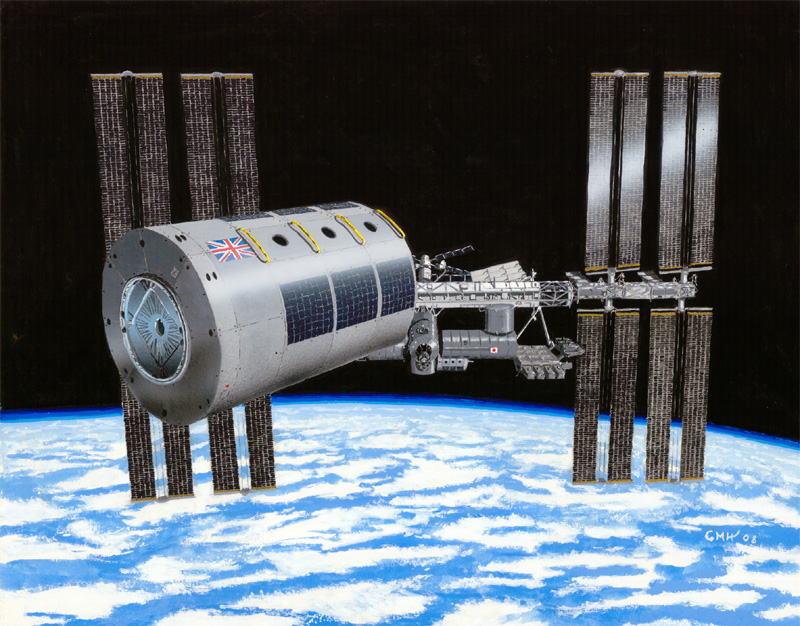
The Habitation Extension Module (HEM) proposed by UK engineers (University of Bristol)
The UK has started its own space agency (at long last) and the agency has a logo. The latter is the big news here.
At a time when motivation for manned spaceflight by NASA is dwindling and yet private industry is forcing its foot in the door of getting stuff into space, it’s nice to hear that the UK government felt the need to keep up with the rest of the world and set up an agency of their own. That’s not to say the UK hasn’t been involved in space programs before now, it’s just that our involvement has always been a piecemeal approach; hitching rides on other nation’s rockets with occasional probes (erm, well, the Mars Beagle 2 lander is the only one that comes to mind). Personally, I blame Maggie Thatcher (I have my reasons).
Awesome, so we now have an agency rather than an office cubicle tagged “Space.” This is a bona fide agency that has lunar aspirations (yep, really, we’re that original) and a funky logo to boot.
However, not everyone is impressed with the logo. In fact, Ken Carbone, a graphic designer who writes for the website Fast Company, thinks it’s dull:
The design recipe is simple, right? Take a square, add a Union Jack, thrust an arrow through it and BAM!
This logo is anything but tasty. The net result looks terribly fractured and unstable. Not the ideal visual for space flight.
To make matters worse, the U.K. Space Agency will have the inevitable and unfortunate acronym “U.K.S.A.” which sounds like something translated into Pig Latin.
But say if “fractured and unstable” is exactly the impression we were trying to give, huh? But, in all fairness, he does point out that all space agency logos are dull.
Let’s have a look the offending logo. Prepare yourself, it’s a disgrace:
Woah! Hold on a second. I thought it was supposed to be crap? As far as logos go, that’s one I can believe in. I mean, it’s a re-worked version of our proud national flag. It also has a gert red arrow, pointing up. What more do you need?
Admittedly, I think the acronym isn’t much cop. U.K.S.A. sucks cheese, “BritSpace” is far superior in my humble opinion (Science Minister Lord Drayson, consider that a suggestion), but as for the logo, I’m proud of that, I think it means business. Look at that arrow. It’s red. Pointing up. Masculine. Grrr.
That’s the logo of an aspiring space faring nation if I ever saw one.
And now for my least favorite space agency logo. Ladies and Gentlemen, please avert your eyes for the Croatian Space Agency:
But hey, what do I know, I’m not a graphic designer.
In all honesty, I like the UKSA logo, but I’m especially happy that the UK actually has an agency now rather than being just a player in the European Space Agency (ESA). But will it motivate a solution to the summering STFC debacle? That remains to be seen.
Sure, NASA is a government agency, but can you think of any other agency with the power to inspire a nation? That’s the gist of Neil deGrasse Tyson’s presentation at the University of New York at Buffalo on March 31st, certainly worth watching.
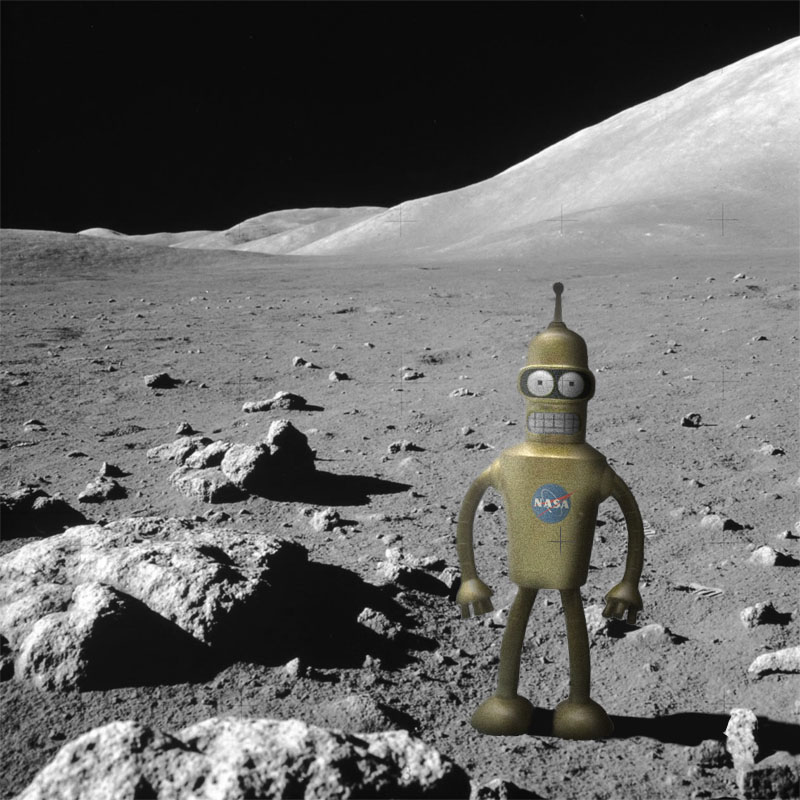
The Project M android... haven't I seen you somewhere before?
As you know, I’m highly dubious about this “Project M” that has just surfaced on the intertoobs (I strongly suspect it’s a hoax). But doubts aside, I kept looking at that android throwing stones on the lunar surface thinking I’d seen that guy somewhere before. At first, I thought C3PO from Star Wars… but no! It’s this guy:
It's uncanny! Bender from Futurama explores the lunar surface (NASA/20th Century Fox/Ian O'Neill).
I think Futurama’s Bender would do a fine job exploring the moon.
Doing for NASA what Star Wars did for sci-fi, send C3PO to the Moon! Huh?
OK, so I have little idea about this project because there’s not much information circulating, but I hope it’s not real.
It looks like NASA’s Johnson Space Center is heading up a robotic mission to the Moon. No big surprises there as that plan is pretty much in alignment with the “Flexible Path” for the future of space exploration for the U.S. space agency. Also, now the Constellation Program has bitten the dust, we’re not going to see man return to the Moon any time soon.
So what’s the answer? Send a robot that looks like a human to the Moon instead!
As I said, there’s little information about “Project M” apart from what’s been posted on AmericaSpace:
Project M is a JSC Engineering Directorate led mission to put a lander on the moon with a robot within a 1,000 days starting Jan 1., 2010. “M” has significance in two ways. First, it is the Roman numeral for 1,000. And “M” is the first letter for “Moon”.
How is Project M different from past NASA projects?
No prime contractors.
No roadblocks.
Just use the best engineers in the world to get the job done on time.
There will be full press on this… including embedded media, full multimedia and social networking. Can you say “The Apprentice goes to Space?”
When will Project M begin? Next month? Next year? No, Project M has been “go” since Monday, November 9th.
But “M” is the first letter of “Missing the Point” too, but that hasn’t been mentioned.
The enthusiasm for a robotic mission to the lunar surface sounds fine and dandy, and it’s to be expected, but if they really intend to send a bipedal robotic man to the Moon within 1000 days, then NASA hasn’t learnt anything from the Constellation debacle. This smells like a publicity stunt with little to no direction and it would be a shame if serious funding is being put into it.
Could the bipedal robot just be a metaphor for the project? Possibly, but I’d have to question the common sense in doing that too.
Also, where’s the incentive (indeed urgency) to create a Manhattan Project-style group of engineers to rush this project to completion within 3 years? If the members of Project M think they can avoid the cumbersome red tape and cost overruns that NASA and its contractors have faced in the past, then great, but I don’t think that’s a reality for such an ambitious project that lacks direction.
Sure, there’s funding being ploughed into humanoid robot technology — such as the “Robonaut” that is being developed by JSC engineers and the car maker GM — but the real-world application of androids (robots designed to look and act like a human) is that they can assist human operators. Bipedal androids such as the one depicted in this promo video would be exploring (read: “picking up stones”) space by themselves. There are no humans working along side them and therefore no real reason to create them in the inefficient form of a human.
The human body isn’t exactly an optimized one for space exploration. The next robotic missions to the Moon and Mars will be rovers, with wheels, because guess what? That makes more sense than revolutionizing android technology, sending it to the Moon within 1000 days, only for it to fall over and not be able to stand back up. (I’m sure Project M would counter this argument and say that the technology would have matured to such an extent that the android would be able to stand up again, but why let it fall over at all?) The center of gravity needs to be low for stability and no matter how big you make a robot’s feet, it’s simply not going to be able to explore as efficiently as a wheeled or multi-legged all-terrain vehicle.
If you know me, you’ll probably know that my passion for communicating space exploration is matched by one thing and one thing only: trance music. Interestingly the crossovers between space and music are many and trance is often the choice backing music of many space-based videos.
So here’s one of my favorite trace groups who were asked by Virgin Galactic to perform their kick-ass tune “Buzz” at the official unveiling of SpaceShipTwo in the Mojave Desert last month. I actually saw Above & Beyond live at Global Gathering in 2006, and I can confirm that they are as awesome as they sound.
When Virgin Galactic were looking for some atmospheric music to herald the launch of their ground-breaking ‘SpaceShipTwo,’ they turned to Above & Beyond. At an event hosted by Richard Branson in the Mojave Desert, the track chosen to accompany the official unveiling of SpaceShipTwo was Above & Beyond’s club anthem ‘Buzz’, which was inspired by the Apollo 11 moon-landing. After the unveiling of the world’s first space tourism spacecraft, Above & Beyond performed an exclusive DJ set in front of an audience of 800 dignitaries, celebrities and soon-to-be astronauts, plus the assembled global media.
A space station in the movie '2001: A Space Odyssey.' It's hard to believe that by 2015 we might not have any manned outpost in orbit (sci-fi writers never saw that coming).
I was only half joking when I tweeted, “Vote for your favorite NASA accomplishment in 2009: http://bit.ly/83xWlJ [x] Still existing.” I was referring to a vote that is being held over on iTWire, where they’ve listed an array of NASA endeavors and then asked their readers to pick their favorite mission/discovery.
To be honest, I wouldn’t have a clue about how to choose between a Mercury flyby, precision-bombing of the Moon or detection Martian methane; all endeavors have enormous merit and each have vastly improved our knowledge of the Universe. Each is as profound as the other. But it’s not the vote of a 3 page list of NASA achievements that I found myself most uneasy with, it’s the fact that none of these achievements can make the future of the world’s premier space agency any more secure, especially when we are talking about orbiting U.S. astronauts.
There’s a strange dichotomy of opinion: NASA is globally renowned and respected for carrying out outstanding science, and yet it is constantly lambasted (often unfairly) for its spaceflight ineptitude.
Shuttle Out. Space Station Out?
The catalyst to NASA’s human spaceflight problems is of course the retirement of the shuttle next year. We’ve seen it coming for a long time and yet the “5-year gap” hasn’t budged, in fact, it’s become a lot bigger. This gap is the number of years between the shuttle being retired and the proposed completion of NASA’s next launch system, Constellation. To fill this gap, the U.S. must use the Russian Soyuz vehicle at a premium rate. One can only imagine the diplomatic fun NASA has in store for the next few years.
And why should NASA maintain its human spaceflight program anyway? You remember the International Space Station (ISS), right? Well, it’s a good idea to have access to the biggest space station ever constructed in Earth-orbit after spending billions to build the thing. Unfortunately, the very foundations of the ISS are looking a little shaky.
Here we are with the world’s most expensive real estate zooming over our heads, and the U.S. Government Accountability Office (GAO) has just told the White House that the U.S. taxpayer is getting a raw deal from International Space Station (ISS) science. This obviously doesn’t sound good for the ISS’ future beyond 2015. (That is, if you can still comprehend that the space station is still slated for decommissioning in five years time.)
Slight-Of-Hand Rocketry
I only have a general idea about what information the GAO has access to, but I know that the ISS is doing continuous science in microgravity to better our understanding about how we operate in space and use instrumentation that have a huge advantage over ground-based techniques. Unfortunately, NASA is a political entity and politicians are eying the space station with more than a little skepticism. As pointed out by Greg Fish over at Weird Things, wasn’t the ISS supposed to the stepping stone to the Moon… or even Mars by now? Not so long ago I remember intense excitement for how the ISS was going to change the world. Shockingly, now I sometimes hear people say: “we have a space station?!”
To make matters worse, the shuttle replacement is underfunded and behind schedule and the shadow of doubt over Constellation is becoming blacker than a moonless night. NASA triumphantly launched the Ares I-X, only for the celebrations to be quenched by critics (including ex-Apollo astronaut Buzz Aldrin calling it “slight-of-hand rocketry“) pointing out that the Ares test launch was a publicity stunt at best. At worst, the space agency was conning the American public into thinking progress was being made.
Whether NASA makes any kind of Constellation progress or continues to perform outstanding science on the ISS, it seems that there is a widening disconnect between NASA science and the perception of what NASA is trying to do. Many argue that NASA is just really bad at communicating science to a public audience, but I would say that the agency is doing more than ever to communicate their stuff. Also, NASA does an awful lot more than just getting astronauts into space — their robotic missions, observatories, space telescopes and research are breaking new ground every day. So why the huge question mark hanging over NASA’s human spaceflight plans?
Myopic Politics
Well, getting man into space is dangerous, it’s expensive and it’s long-term. All of which are not good for the political nature of NASA. In 2004, President Bush made the gargantuan promise that the US would make it back to the Moon by 2020 (and Mars soon after). This sounds great, but there was no money. Bush had made a political decision based on his term in office, he had also made it after the Space Shuttle Columbia tragedy when seven astronauts lost their lives. Back then, NASA needed direction more than ever, especially as the shuttle fleet was grounded.
Although the shuttle missions recommenced and NASA got back to leading space station construction, by 2009 Bush’s “Vision” has become nothing more than a pipe dream. The money that was promised never materialized and it is now up to President Obama to get NASA’s human spaceflight plans back on its feet. But the damage has been done and the U.S. has an ailing economy and lumped with an overpriced Constellation Program. Changes need to be made.
Personally, I don’t see the Constellation Program getting off the starting blocks. But I don’t think this is due to any kind of technical or design issue, it will be purely political. Funds are tight, Constellation is too expensive. Sadly, adding insult to injury, the ISS is also in the firing line.
So now the responsibility for U.S. participation in the ISS falls on the shoulders of the burgeoning private spaceflight sector, which in itself could be a revolution in the making. Wouldn’t it be great if there was a real commercial answer to the human spaceflight problem? Using companies like SpaceX to ferry astronauts to-and-from the ISS makes a lot more sense than NASA doing the same job for way more money.
But again, I have that nagging feeling about a genuine disconnect between the public and the importance of spaceflight. Not only can human spaceflight advance human experience, it can boost our economy, education and technology. Last time I looked, those were very political sectors, it’s just unfortunate that politicians and many voters will never understand the correlation.
The president chose the new direction for the U.S. human space flight program Wednesday at a White House meeting with NASA Administrator Charles Bolden, according to officials familiar with the discussion. NASA would receive an additional $1 billion in 2011 both to get the new launcher on track and to bolster the agency’s fleet of robotic Earth-monitoring spacecraft.
In a nutshell, NASA would get an additional $1 billion in funding and start work on a new (yet undetermined) heavy-lift launch system. Good news for NASA, but not-so-good news for the Ares I (and possibly Ares V, although the larger rocket wasn’t mentioned). Also, this magical silver bullet of a “new” launch vehicle would be ready for blast-off in 2018.
NASA and White House officials claim such reports are mere speculation, but they are providing no information on when a decision could be announced. The administration will file its fiscal year 2011 budget request in February.
Still mulling over the findings from the Augustine Commission report, Obama and Bolden have yet to arrive at an agreement as to how to progress with NASA’s human spaceflight plans. It’s now very clear that ex-President Bush’s bold “Vision for Space Exploration” was lacking a little thing called money, and the commission’s findings indicated that NASA needs an extra $3 billion in funding to keep the agency’s human spaceflight plans alive.
Although these anonymous sources are no doubt credible, it’s wise to wait until the final word from the White House is known before saying “bye-bye” to Ares.
This is hardly surprising if we consider that the lifespan of Spirit should have been 3 months, the fact that it has lasted 69 months (so far) is nothing short of miraculous. In rover-mission-lifetime years, doesn’t that make Spirit and her twin sister Opportunity 1380 years old? (I decided that a “lifetime” is 60 years, in case you were wondering.) Perhaps that’s not how it works, but for NASA to build a robot that has lived 23 times longer than the mission specified is pretty damn impressive. No wonder Spirit is losing her memory. I’m surprised she hasn’t lost the will to live.
Spirit has lost the use of one of her wheels and remains stuck in the sand… so she is showing her age. But still, 23× longer than planned? When I’m 1380 years old, I hope I’m only suffering amnesia every now and again.








 astroengine.com