I know that Star Wars lovers everywhere are currently on their nth replay of the brand new The Force Awakens movie trailer, and for good reason. BECAUSE IT IS JUST PURE AWESOMENESS.
Seriously.
There were tears.
I have nothing else to add, except, for the first time in my adult life I can’t wait til Christmas.
Curiosity’s right-middle and rear wheels, bearing the scars of 488 sols of rough roving. Credit: NASA/JPL-Caltech
If you’re like me, you hang off every news release and new photo from our tenacious Mars rover Curiosity. The awesome one-ton, six-wheeled robot is, after all, exploring a very alien landscape. But if there’s one thing I’ve learned from the mission, Mars is far from being a truly alien place. Sure, we can’t breath the thin frigid air, but we can certainly recognize similar geological processes that we have on Earth, and, most intriguingly, regions that would have once been habitable for life as we know it. This doesn’t mean there was life, just that once upon a time parts of Gale Crater would have been pretty cozy for terrestrial microbes. Personally, I find that notion fascinating.
But, way back in May, I noticed something awry with our beloved rover’s wheels. Curiosity’s beautiful aircraft-grade aluminum wheels were looking rather beaten up. Punctures had appeared. Fearing the worst I reached out to NASA to find out what was going on. After a friendly email exchange with lead rover driver Matt Heverly, I felt a lot more at ease: The damage was predicted; dings, scratches, even holes were expected to appear in the thinnest (0.75 mm thick) aluminum between the treads. On Mars, after all, there is no asphalt. Also, erosion is a slower-paced affair in the thin winds and dry environment — sharp, fractured rocks protrude, embedding themselves into the wheels at every slow turn.
Then, on Friday, in a news update on Curiosity’s progress, JPL scientists mentioned that they would be commanding the rover to drive over a comparatively smooth patch to evaluate the condition of the wheels as their condition is getting worse. But isn’t that to be expected? Apparently not to this degree. “Dents and holes were anticipated, but the amount of wear appears to have accelerated in the past month or so,” said Jim Erickson, project manager for the NASA Mars Science Laboratory at NASA’s Jet Propulsion Laboratory, Pasadena, Calif.
So what are we looking at here?
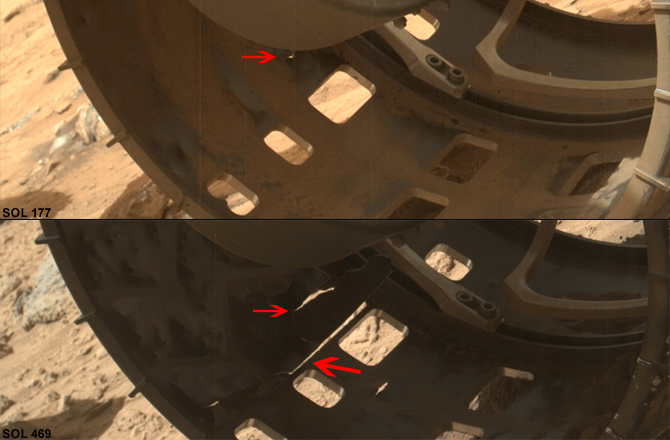
Curiosity’s front-left wheel on Sol 177. Credit: NASA/JPL-Caltech
Curiosity’s front-left wheel on Sol 488. Credit: NASA/JPL-Caltech
All of the wheels are exhibiting wear and tear, but this particular ‘rip’ in aluminum is by far the most dramatic. But what does that mean for Curiosity? We’ll have to wait and see once JPL engineers have assessed their condition. Although this kind of damage has inevitably been worked into the the structural equations for the wheels’ load-bearing capabilities, whichever way you look at it, damage like this is not good — especially as Curiosity hasn’t even roved three miles yet.
But in the spirit of Mars exploration, Curiosity will soldier on regardless of how rough the red planet treats her.
Read more in my coverage on Discovery News, a location you’ll find me during most daylight (and many nighttime) hours:
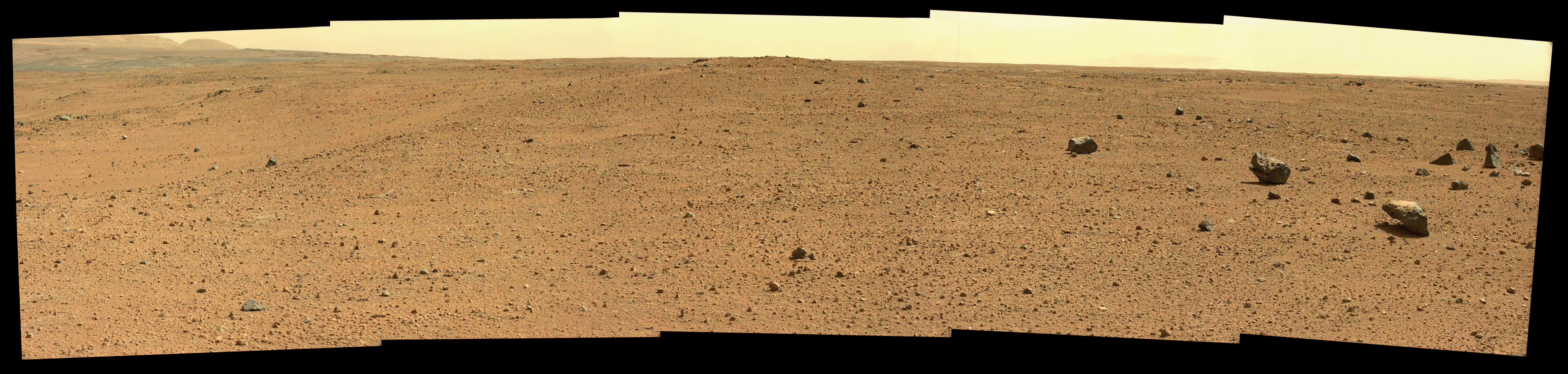
Panorama mosaic taken by Curiosity’s Mastcam on Sol 413 of its mission inside Gale Crater. Credit: NASA/JPL-Caltech/MSSS, edit by Ian O’Neill
As NASA has been shuttered by the insane U.S. government shutdown, there’s been little in the way of news releases from NASA (site offline) or NASA’s Jet Propulsion Laboratory (site still online, but no recent updates posted). In this Mars Science Laboratory science lull, I’ve found myself obsessively trawling the mission’s raw image archive so I can get my fix of high-resolution imagery from Curiosity’s ongoing mission inside Gale Crater.
While getting lost in the Martian landscape once more, I started tinkering with Curiosity’s raw photos; zooming in, adjusting the contrast, brightness and color. One thing led to another and I found myself stitching together various photos from the rover’s Mastcam camera. Being awash with photographs with little professional insight from mission scientists (as, you know, a noisy minority at Capitol Hill has gagged them by starving the agency of funds), I started to tinker in Photoshop, blindly trying to stitch a selection of Mastcam photos together to see an updated Martian panorama once more. This is the result.
Of particular interest, I found myself staring at the precariously-shaped boulder to the far right of the panorama. I can only guess what geological processes shaped it that way — Wind action? Ancient water flow? — or whether it had simply landed that way after getting blasted from an impact crater, but I was curious as to what JPL mission scientists are making of it. Alas, we’ll have to wait a little longer for the awesome Mars science to begin flowing again.
Here’s that rock:
It felt nice to be absorbed in the Mars landscape again. The photo stitching is rough in places (by far the hardest task was getting the brightness and contrast correct in each photo) and I lack any calibration tools to ensure the color is correct or that the orientation is sound, but it satisfied my curiosity as to what Curiosity was up to on the Red Planet. It has, after all, been over a year since the historic landing of the NASA mission and the regular news updates from NASA and JPL have become something of an intellectual opiate.
Going cold turkey, apparently, makes a space blogger itchy.
“It’s kind of like landing on the moon. It’s a milestone in history. Like all science, it’s exploration. It’s new knowledge.” — Donald Gurnett.
After endless speculation, guesswork and data interpretation over the past year, it’s official: Voyager 1 is now an interstellar mission. It’s the first man-made object to leave the heliopause and enter the interstellar medium. This is history.
And now! We have R2-D2 trundling across the lunar surface as the perfect Moon rover design for dodging levitating Moon dust. Don’t ask me, it’s SCIENCE!
(Note: The inspiration for R2-D2 was not my idea, blame Astronomy Now’s Keith Cooper for that stroke of genius. But the ‘shopping is totally my doing. I have a lot of time on my hands, apparently.)
It’s always hard when a person who inspired you in life dies. And for me, there are only a handful of people beyond my circles of family and friends who have, in some way, shaped my thinking.
But through his novels, Scottish writer Iain Banks had such a powerful impact on my teenage years that he, in no small way, gave me a new appreciation for science fiction and in doing so helped me pursue a higher education in astrophysics. Sadly, as he announced with his trademark wit only two months ago, Iain had terminal gall bladder cancer and today has died at the heartbreaking young age of 59. He will be sorely missed by the fiction and science fiction communities — he was a plain-speaking, powerful voice in life and a skillful genius when describing the worlds he created on paper.
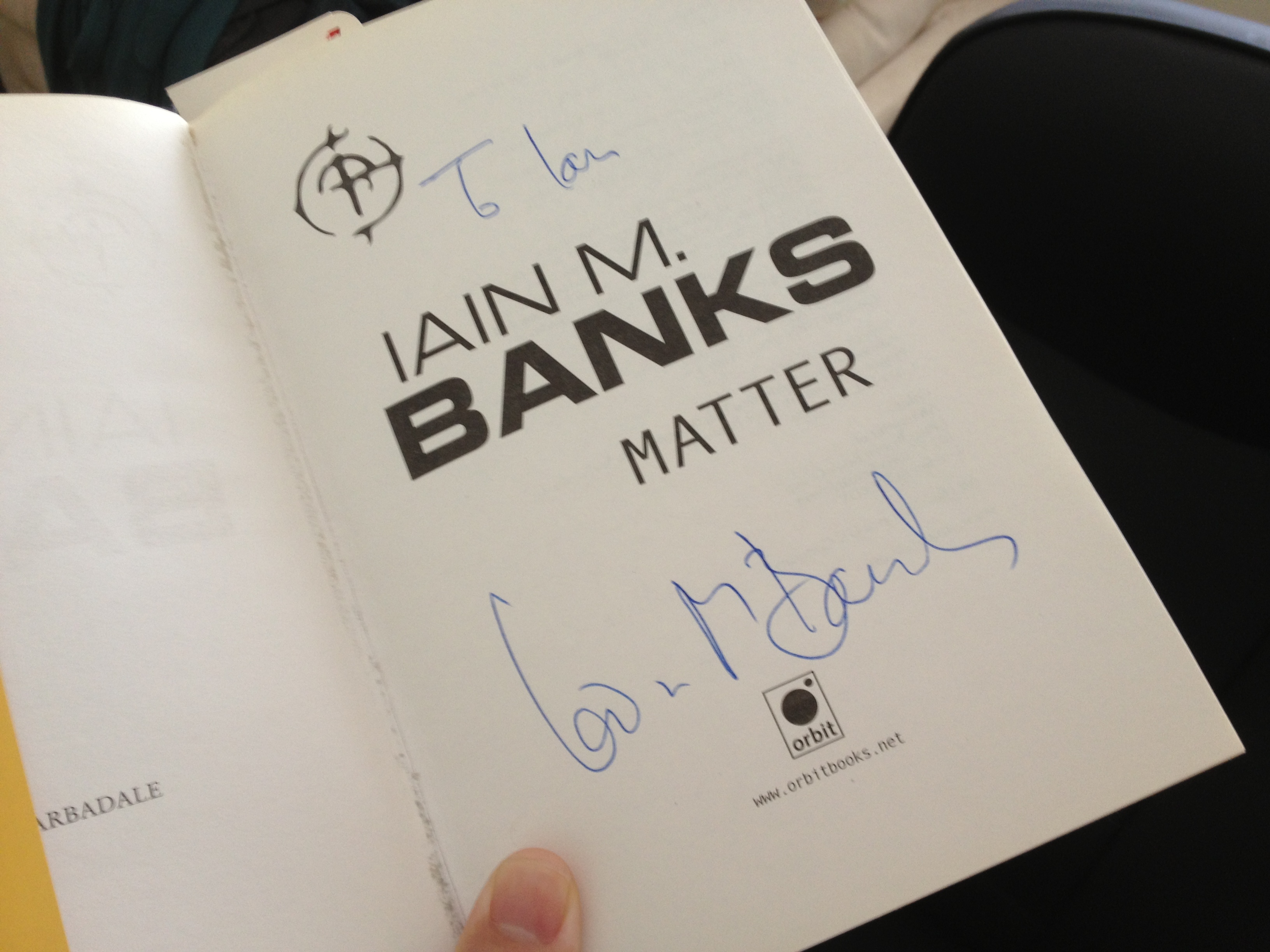
My signed copy of Iain M. Banks’ “Matter” — my mum sat in on one of Iain’s book readings in Bristol that I couldn’t attend and got a signed copy of the novel for me — one of my most precious books.
Now, I’m not the biggest of readers, but when you pick up an Iain Banks (a.k.a. Iain M. Banks for his science fiction novels) book, it’s hard to put down. His first science fiction novel Consider Phlebas introduced us to the epic Culture universe — a vast interstellar multi-species civilization, of which Earth and humanity had been enveloped. The very notion of a post-scarcity, pan-galactic race seemed to hit the sweet spot of my imagination, so I hungrily read all of Iain’s Culture series, feeling the very notion of what science fiction is change in my brain. In a particularly tumultuous period of my life, I took on Iain’s fictional writing too, reading the deeply unsettling The Wasp Factory.
Iain’s writing is a constant source of surprise to me — he has this unique ability to shock, enlighten and entertain while creating such a fine tapestry of plot twists and deep characters that you quickly become lost in his words.
But for me, Iain’s imagination forced the very limits of science fiction, expanding my thoughts on what is possible in our Universe. This is why, while struggling with mathematics in my undergraduate years at the University of Aberystwyth that Iain M. Banks’ work became a welcome escape. When I began questioning some of the fundamental ideas behind physics and developed a thirst for advanced and, quite frankly, unfathomable concepts in astrophysics, Iain’s books became a huge source of inspiration.
Although many facets of my life threw me on a course that would eventually see me tackle a PhD in coronal physics and send me on a life-changing trip to Hawaii and ultimately land me in California, with my beautiful wife Debra, 5 rabbits and a job with the task of communicating awe-inspiring space science to the world, Iain’s fictional universe has always been there, complementing my life in a very real way.
I will always remember Iain and will continue reading his novels so that inspiration endures beyond his death. People who inspire you are few and far between, so when someone changes the way you think through the medium of their writing, you should never let them go.
Goodbye Iain, the Culture will forever be my inspiration.
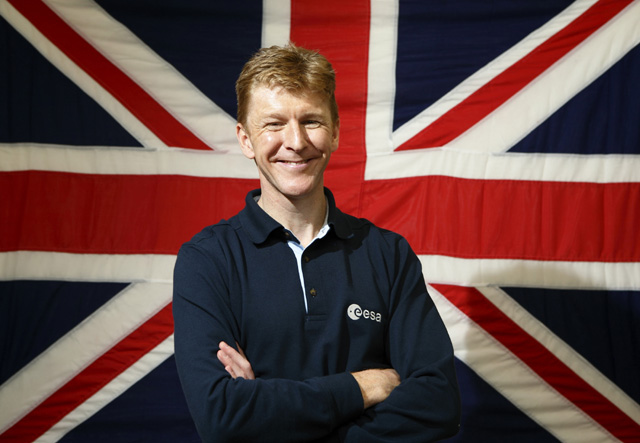
Lucky sod: Major Tim Peake, British astronaut (BNSC)
Really, we are. But for the love of god old chap, make sure the first 2015 space station cargo run is packed to the brim with tea bags!
Ever since I heard the first UK government-funded astronaut was being trained to join the European Space Agency in 2009, I nearly wet myself. You see, when you’re a kid growing up in the UK, you can say: “I want to be a fireman,” “I want to be a policeman,” or “I want to be a doctor,” (I said the latter, which, as it turned out, wasn’t too far off.) You can’t say, for example: “I want to be an astronaut!” — to do that you’d have to emigrate, something my mum would never have endorsed to a starry-eyed 10-year-old.
Ever since Margaret Thatcher’s government deemed human spaceflight too expensive for our little island nation to shoulder in the 1980s, we Brits have been relegated to spectators in the human spaceflight arena (robotic spaceflight, however, is a whole different matter). But now, that’s beginning to change with the announcement that Major Tim Peake has been selected as a 2015 space station crew member.
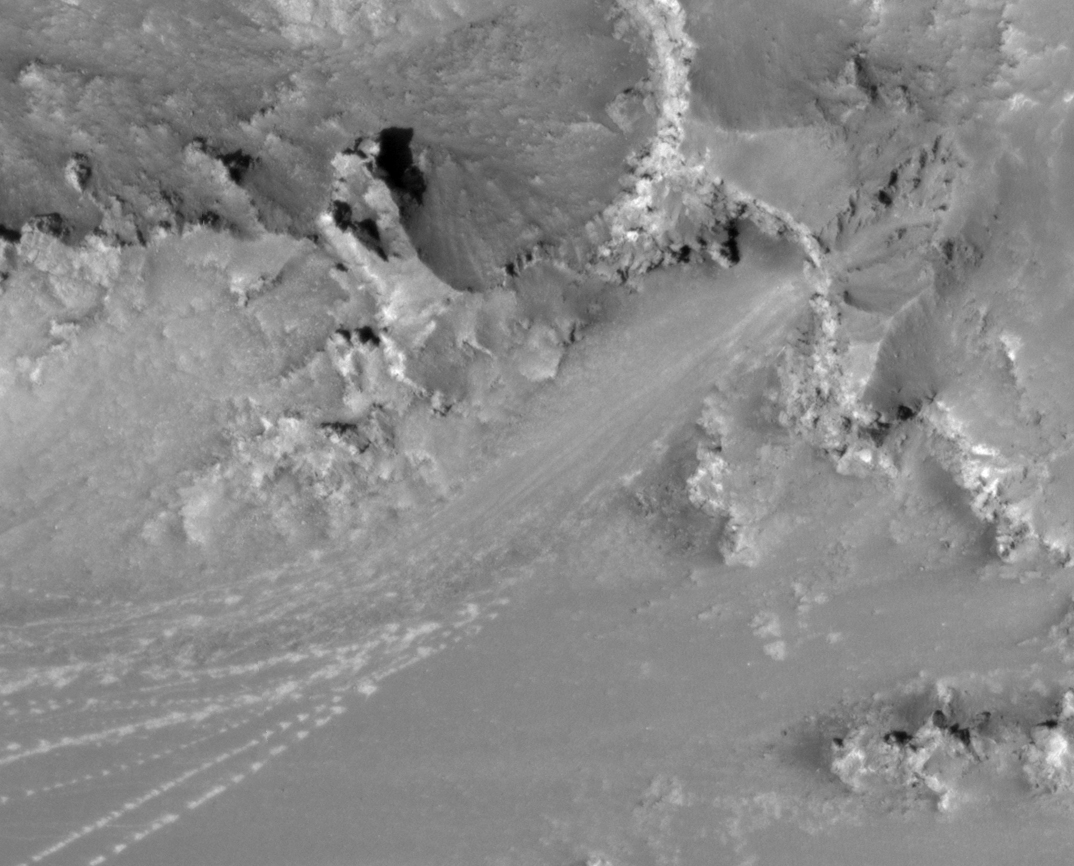
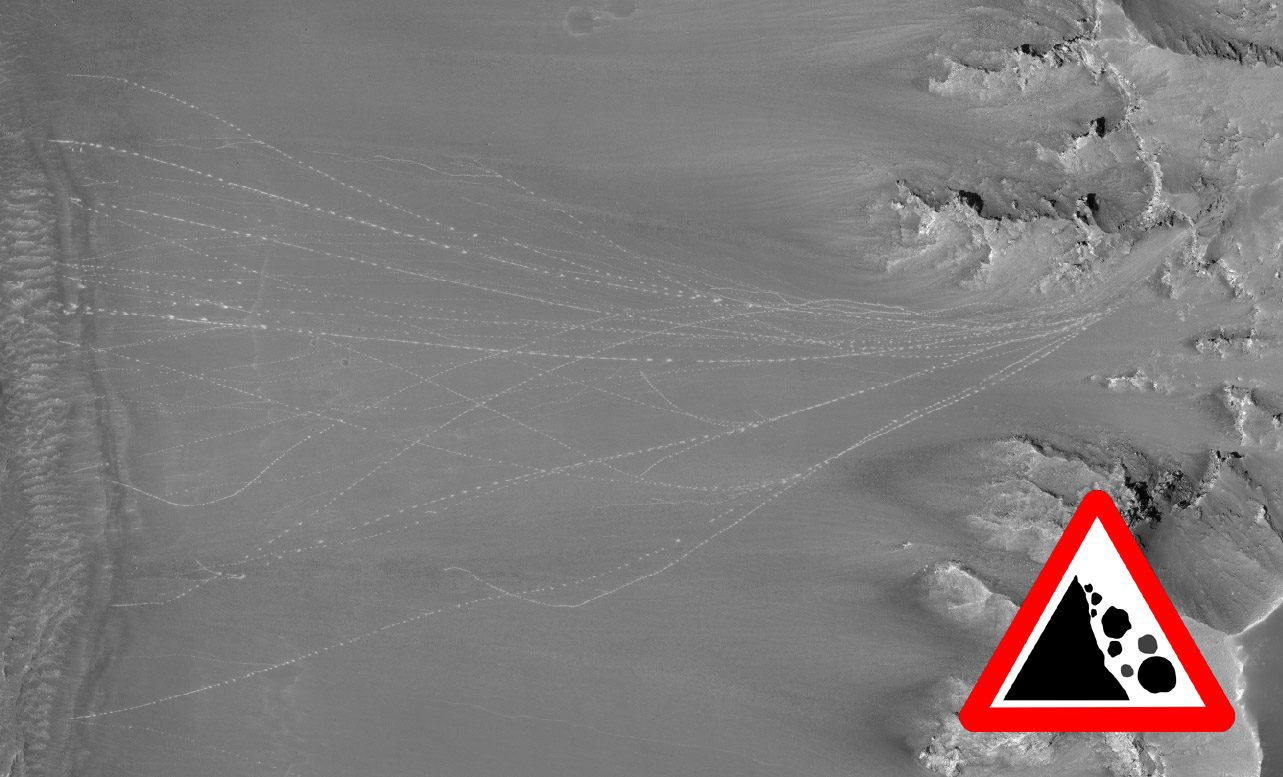
Trails of Mars rocks that have rolled down the slope of a crater rim as imaged by the HiRISE camera. Credit: NASA/JPL/Univ. of Arizona.
It’s always fascinating to see evidence of active geological processes on Mars. And with the help of the armada of robots in orbit and roving the Red Planet, there are plenty of opportunities to see the planet in action.
Take this recent image from the High-Resolution Imaging Science Experiment (HiRISE) camera aboard NASA’s Mars Reconnaissance Orbiter (MRO) for example. In this striking scene — which is a little over one kilometer wide — the bright trails of rocks that have rolled down a sloping crater rim after being dislodged from the top are visible from space. The rocks have obviously bounced on their way, leaving dotted impressions as they rolled. Some have reared in wide arcs, following the topography of the landscape. Others have hit other rocks on their way down, dislodging them, creating secondary cascades of smaller boulders.
“The many boulder tracks in this image all seem to emanate from a small alcove near the rim of the crater,” describes HiRISE Targeting Specialist Nicole Baugh. “They spread out downslope and finally terminate near the crater floor. A high-contrast stretch of the area where the tracks stop shows lots of boulders, some still at the ends of the tracks.”
A rough estimate from the high-resolution imagery suggests some of these Mars boulders are over a meter wide. Future Mars astronauts beware: don’t camp out at the bottom of Martian hills! There’s no vegetation to hold big rocks in place or slow their speed. As previous observations of Mars “avalanches” suggest, weathering through the expansion of water ice (frost action) and/or rapid vaporization of carbon dioxide ice likely trigger pretty extreme downfalls of debris. It would be a bummer to travel all the way to Mars, survive the ravages of solar radiation, a daring descent and landing only to get flattened by a wayward chunk of rock when you set up camp.
I’ve always had a special joy for surveying HiRISE observations; it’s a very privileged window to this alien landscape that, in actuality, has many similar geological processes we find on Earth. And so here we have a collection of boulders that, somehow, became dislodged and stormed down from the rim of a crater. If we saw such an event in person, we might note the unnatural bounce these boulders have in the roughly one-third Earth gravity. But we’d also have to find shelter fast, as just like rolling boulders on Earth, those things will flatten you.
On Monday, I appeared on RT America’s live news broadcast to talk exoplanets — particularly the three small (possibly rocky) worlds that orbit the stars Kepler-62 and Kepler-69. It was a lot of fun discussing ‘Goldilocks Zones’ and the possibilities of extraterrestrials. Enjoy!







 astroengine.com