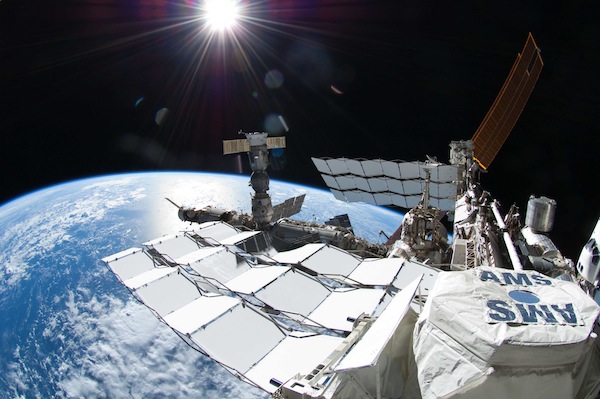
The AMS attached to the space station’s exterior (NASA)
This month is Global Astronomy Month (GAM2013) organized by my friends Astronomers Without Borders (AWB). There is a whole host of events going on right this moment to boost astronomy throughout the international community, and as a part of GAM2013, AWB are hosting daily blogs from guest astronomers, writers, physicists and others with a background in space. Today (April 11) was my turn, so I wrote a blog about the fascinating first results to be announced on the International Space Station instrument the Alpha Magnetic Spectrometer — or AMS for short.
Although the AMS’ most recent findings suggest positrons with a signature energy indicative of the annihilation of dark matter — particularly hypothetical weakly interaction massive particles (WIMPS) — it isn’t final proof of dark matter (despite what the tabloid press might’ve told you). But still, it’s exciting and another component of our enduring search for 95.1% of the mass-energy of the universe that is locked in the mysterious and perplexing dark matter and dark energy.
Screengrab from the NASA “Asteroid Retrieval and Utilization Mission” animation (NASA LaRC/JSC)
It’s been a looooong time since I last updated Astroengine.com, so first off, apologies for that. But today seems as good a time as any to crank up the ‘engine’s servers as the White House has rubber-stamped a manned NASA mission to an asteroid! However, this isn’t what the President originally had in mind in 2009 when he mandated the US space agency with the task of getting astronauts to an asteroid by the mid-2020’s.
In a twist, it turns out that NASA will be basing their manned asteroid jaunt on a 2011 Keck Institute study. To cut a long story short (you can read the long story in my Discovery News article on the topic: “NASA to Hunt Down and Capture an Asteroid“), NASA will launch an unmanned spacecraft to hunt down a small space rock specimen, “lasso” it (although “bagging” it would be more accurate) and drag the wild asteroid to park it at the Earth-moon Lagrangian point, L2. Then we can treat it like a fast food store; we can fly to and from, chipping off pieces of space rock, return samples to Earth and do, well, SCIENCE!
Great? Great.
Overall, this robotic capture/manned exoplration of an asteroid saves cash and “optimizes” the science that can be done. It also lowers the risk associated with a long-duration mission into deep space. By snaring an asteroid in its natural habitat and dragging it back to the Earth-moon system, we avoid astronauts having to spend months in deep space. The EML2 point is only days away.
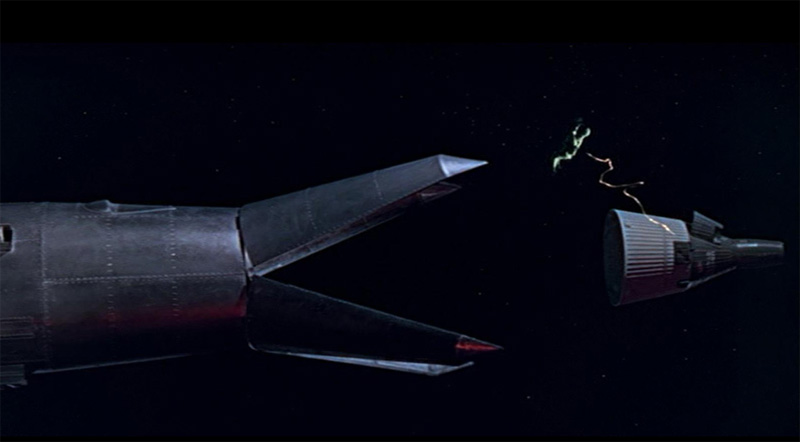
But when watching the exciting NASA video after the news broke today, I kept thinking…
But that wasn’t the only thing I was thinking. I was also thinking: what’s the point? It’s flashy and patriotic, but where’s the meat?
The human component of this asteroid mission has now been demoted to second fiddle. Sure, it will utilize NASA’s brand new Orion spacecraft and be one of the first launches of the Space Launch System (SLS), but what will it achieve? Astronauts will fly beyond Moon orbit, dock with the stationary space rock and retrieve samples as they please, but why bother with astronauts at all?
It is hoped that the robotic asteroid bagging spacecraft could launch by 2017 and, assuming a few years to steer the asteroid to EML2, a human mission would almost certainly be ready by the mid-2020s. But by that time, sufficiently advanced robotics would be available for unmanned sample retrieval. Heck, as telepresence technology matures, the EML2 point will be well within the scope for a live feed — light-time between Earth and the EML2 point will only be a few seconds, perhaps a little more if communications need to be relayed around the Moon. Robotics could be controlled live by a “virtual astronaut” on Earth — we probably have this capability right now.
The most exciting thing for me is the robotic component of asteroid capture. The advances in asteroid rendezvous and trajectory modification techniques will be cool, although scaling the asteroid bagging technique up (for large asteroids that could actually cause damage should they hit Earth) would be a challenge (to put it mildly). At a push, it may even be of use to a theoretical future asteroid mining industry. The rationale is that if we can understand the composition of a small asteroid, we can hope to learn more about its larger cousins.
The human element seems to be an afterthought and purely a political objective. There will undoubtedly be advancements in life support and docking technologies, but it will only be a mild taster for the far grander (original) NASA plan to send a team of astronauts into deep space to study an asteroid far away from the Earth-Moon system. The argument will be “an asteroid is a stepping stone to Mars” — sadly, by watering down the human element in an already questionable asteroid mission, it’s hard to see the next step for a long-duration spaceflight to Mars.
From this logic, we may as well just keep sending robots. But that wasn’t the point, was it?
‘Perfect solstice sunrise’ by @STONEHENGE (Stonehenge UK on Twitter)
Now, call your friends, grab a beer and celebrate the end of the Maya Long Count calendar’s 13th b’ak’tun and the winter solstice. (Sorry doomsayers, I will not be giving you a reference for your post-doomsday interview, you did a crappy job of the Apocalypse.)
Also, send your congratulations to my sister, Colette! IT’S HER 30TH BIRTHDAY! Congrats Sis!!
On a side note, a few of us appeared on the #TWISmageddon 21 hour marathon to talk about the end of the world (or lack thereof), science and the human propensity for believing the Mayan doomsday bunkum. Thanks to Kiki Sanford, Justin Jackson, Scott Lewis, Blair Bazdarich, Nicole Gugliucci and Andy Ihnatko for a terrific Google+ Hangout. Who knew doomsday would be so much fun! (We start at about 1hr 45mins into the Hangout.)
“I’m only a four-dimensional creature. Haven’t got a clue how to visualise infinity. Even Einstein hadn’t. I know because I asked him.” — Sir Patrick Moore
The Sky at Night: Curiosity at Mars (Patrick Moore and Chris Lintott):
Patrick Moore interviews Carl Sagan (h/t @megschwamb):
A view from Curiosity’s front hazcam of the sandy Mars soil the rover scooped samples of for analysis by its SAM instrument (NASA/JPL-Caltech)
UPDATE 2:So it turns out that Curiosity does have data to suggest that organics and perchlorates may be present in the Mars soil. As NASA keeps reminding us, this is not “proof” of organics, it’s “promising data.” Regardless, the media has made up their own mind as to what it means. As for Voyager 1, my speculation that it has left the solar system wasn’t quite correct… close, but she hasn’t left the heliosphere, yet.
UPDATE 1:That whole thing I said in my Al Jazeera English op-ed about being blinkered on the organics explanation for the “big” news on Monday? Well, case in point, as tweeted by @MarsToday on Sunday night, perhaps Curiosity has discovered further evidence for perchlorates on Mars. I have no clue where this information is sourced, and I’m not going to speculate any more, but if perchlorates have been discovered in Gale Crater, it would support the findings of NASA’s 2008 Mars Phoenix lander findings of perchlorate and possible liquid water brine in the arctic regions of the Red Planet. Place your bets…
Over the last bizarre few days, a key NASA scientist (almost) spilled the beans on a “historic” discovery by the Mars Science Laboratory (MSL) rover Curiosity. Then, speculation ran wild. Had NASA’s newest Mars surface mission discovered organics? Feeling the need to stamp out the glowing embers of organic excitement ahead of the Dec. 3 AGU press conference, NASA said that there would be no big announcement on Monday. But then the agency went even further, issuing a terse statement to point out that the speculation is wrong. “At this point in the mission, the instruments on the rover have not detected any definitive evidence of Martian organics,” said NASA.
So now we’re left, understandably, wondering what lead MSL scientist John Grotzinger was referring to. I think it’s safe to assume that he wasn’t misquoted by the NPR journalist who happened to be sitting in his office when the MSL team was receiving data from the mission’s Sample Analysis at Mars (SAM) instrument. And if we take NASA’s damage-controlling statements at face value, Grotzinger was just getting excited for all the data being received from the rover — after all, the entire mission is historic.
As a science media guy with a background in science, I totally ‘get’ what the MSL team are going through. Scientists are only human and whether or not Grotzinger was getting excited for a specific “historic” find or just getting generally excited for all the “historic” data streaming from the rover, is irrelevant. Perhaps he should have been more careful as to the language he used when having an NPR reporter sitting in the same room as him, but that’s academic, I’m pretty sure that if I was leading the most awesome Mars mission in the history of Mars missions I’d be brimming over with excitement too. The scientific process is long and can often seem labored and secretive to the media and public — rumors or a few slipped words from scientists is often all that’s needed to spawn the hype. But for the scientific process to see its course, data needs to be analyzed, re-analyzed and theories need to be formulated. In an announcement as important as “organics on Mars,” the science needs to be watertight.
However, I can’t help but feel that, in NASA’s enthusiasm to “keep the lid” on speculation, that they are setting themselves up for a backlash on Monday.
If the AGU press conference is just “an update about first use of the rover’s full array of analytical instruments to investigate a drift of sandy soil,” as the NASA statement says, won’t there be any mention of organics? Will this be a similar announcement to the sampling of Mars air in the search for methane? The upshot of that Nov. 2 press conference was that the Mars air had been tested by SAM and no methane (within experimental limits) had been discovered… yet. But this was a sideline to the announcement of some incredible science as to the evolution of the Martian atmosphere.
This time, although there may not be “definitive,” absolute, watertight proof of organics, might mission scientists announce the detection of something that appears to be organics… “but more work is needed”? It’s a Catch 22: It’s not the “historic” news as the experiment is ongoing pending a rock-solid conclusion; yet it IS “historic” as the mere hint of a detection would bolster the organics experiments of the Viking landers in the 1970s and could hint at the discovery of another piece of the “Mars life puzzle.” And besides, everything Curiosity does is “historic.”
In NASA’s haste to damper speculation, have they cornered themselves into not making any big announcements on Monday? Or have they only added to the speculation, bolstering the media’s attention? Besides, I get the feeling that the media will see any announcement as a “big” announcement regardless of NASA scientists’ intent. Either way, it’s a shame that the hype may distract from the incredible science the MSL team are carrying out every single day.
Meanwhile, in deep space, a little probe launched 35 years ago is edging into the interstellar medium and NASA’s Voyager Program team are also holding an AGU press conference on Monday. Although there have been no NPR journalists getting the scoop from mission scientists, it’s worth keeping in mind that Voyager 1 really is about to make history. In October, I reported that the particle detectors aboard the aging spacecraft detected something weird in the outermost reaches of the Solar System. As Voyager 1 ventures deep into the heliosheith — the outermost component of the heliosphere (the Sun’s sphere of influence) — it detected inexplicable high-energy particles. The theory is that these particles are being accelerated by the magnetic mess that is the outermost reaches of the Solar System. But there is growing evidence in particle detections and magnetometer readings that the probe may have just left the Solar System, completely escaping the heliosphere.
A big hint is in the following graphs of data streaming from Voyager 1. The first plot shows the increase in high-energy cosmic ray particle counts. These high-energy particles typically originate from beyond the heliosphere. The bottom plot shows lower-energy particles that originate from the solar wind. Note how the lower-energy particle counts fell off a cliff this summer, and how the high-energy particles have seen a marked increase at around the same period:
High-energy cosmic ray count as detected by Voyager 1. Credit: NASALow-energy cosmic ray count as detected by Voyager 1. Credit: NASA
So, in light of the media-centric Curiosity debate over what is “historic” and what’s not “historic” enough to be announced at conferences, I’m getting increasingly excited for what the Voyager team have got to say tomorrow. It’s inevitable that Voyager 1 will leave the Solar System, but will NASA call it at the AGU? Who knows, but that would be historic, just without the hype.
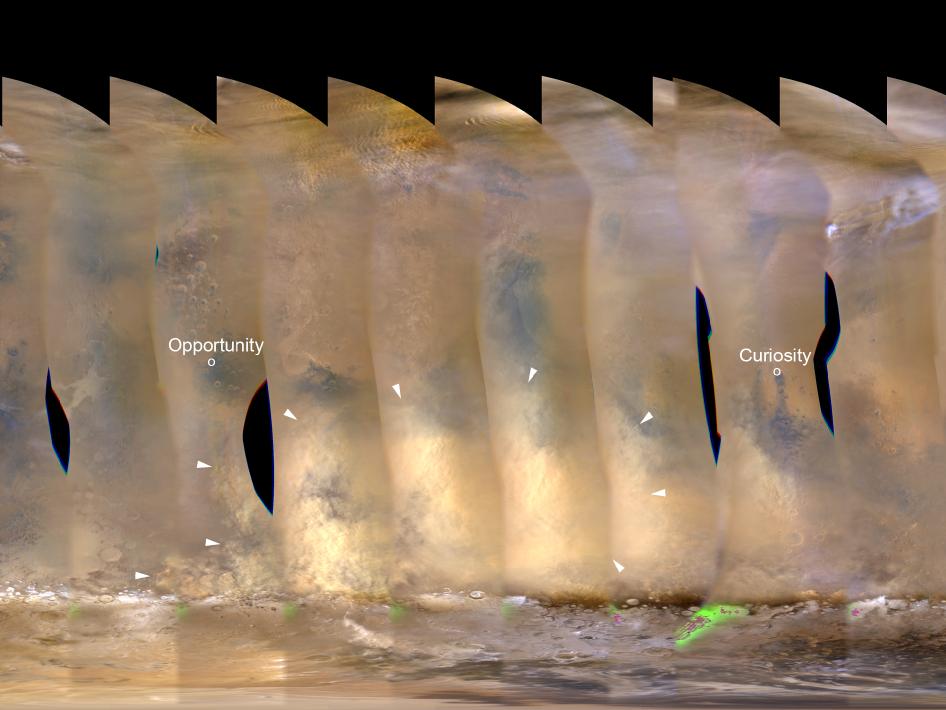
This nearly global mosaic of observations made by the Mars Color Imager on NASA’s Mars Reconnaissance Orbiter on Nov. 18, 2012, shows a dust storm in Mars’ southern hemisphere. Credit: NASA
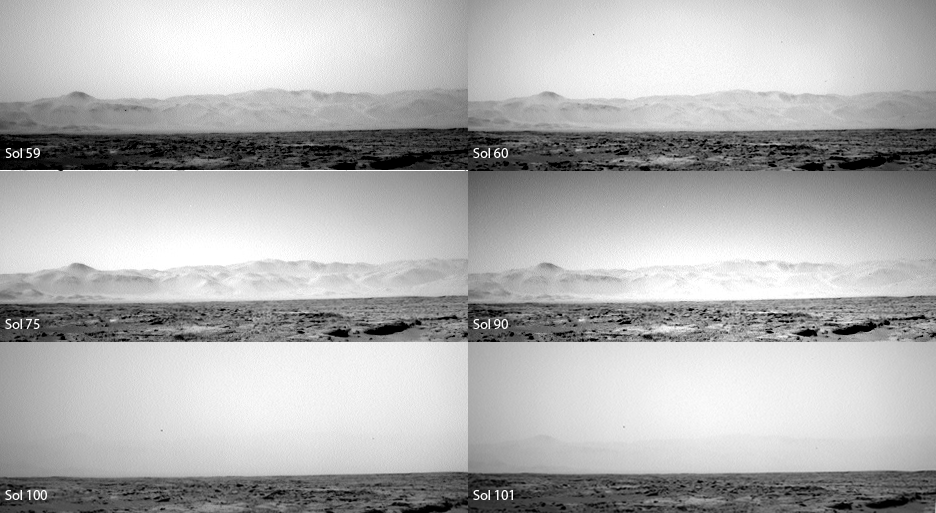
As the sols march on, NASA’s brand new nuclear-powered rover Curiosity has detected a dramatic change in its surrounding atmosphere. A once-clear vista of the distant rim of Gale Crater now looks smoggy — almost like the gray-brown-yellow stuff that hangs above Los Angeles on a hot summer’s day. So what’s causing this change in opacity?
As can be seen in the above global view of Mars, NASA’s Mars Reconnaissance Orbiter took a near-continuous observation of the planet on Nov. 18 with its Mars Color Imager. The mosaic has picked out an assortment of geographical features, but there’s one rather ominous atmospheric feature (white arrows) that grabbed the attention of Malin Space Science Systems’ Bruce Cantor.
A regional dust storm is brewing and Cantor first observed the storm on Nov. 10. He reported the detection to NASA’s Mars Exploration Rover team who manage Opportunity. Although the storm is over 800 miles from the tenacious rover, dust storms are of a concern for any solar powered surface mission, especially for a rover that has outlived its expected mission lifetime by several years. Opportunity’s solar panels are already covered in dust, so should there be an additional dip in sunlight due to a dusty atmosphere there could be an impact on its mission. Additional dust layers on the panels wouldn’t help either.
Opportunity does not have a weather station, but its cameras have detected a slight drop in atmospheric clarity. Curiosity, on the other hand, does have a weather station — called the Rover Environmental Monitoring Station (REMS) — and has been closely monitoring the atmospheric variability over the last few days, detecting a decreased air pressure and a slight rise in overnight low temperature. This is in addition to the dramatic loss in visibility. In short, it sounds like Curiosity can sense a storm in the air.
Six Navcam images pointed toward the horizon taken over the course of Curiosity’s time near Rocknest document changes in the transparency of the atmosphere. NASA/JPL/ Egorov Vitaly (“Zelenyikot”)
“This is now a regional dust storm. It has covered a fairly extensive region with its dust haze, and it is in a part of the planet where some regional storms in the past have grown into global dust hazes,” said Rich Zurek, chief Mars scientist at NASA’s Jet Propulsion Laboratory, Pasadena, Calif. “For the first time since the Viking missions of the 1970s, we are studying a regional dust storm both from orbit and with a weather station on the surface.”
Now this is the cool bit. We currently have an armada of Mars orbiters, plus two generations of Mars rovers doing groundbreaking work on opposite sides of the red planet. We are in an unprecedented age of planetary exploration where a network of robots all work in concert to aid our understanding of how the planet works. In this case, local weather changes are being observed around two surface missions while corroborating data is being gathered hundreds of miles overhead.
Starting on Nov. 16, the Mars Climate Sounder instrument on the Mars Reconnaissance Orbiter detected a warming of the atmosphere at about 16 miles (25 kilometers) above the storm. Since then, the atmosphere in the region has warmed by about 45 degrees Fahrenheit (25 degrees Celsius). This is due to the dust absorbing sunlight at that height, so it indicates the dust is being lofted well above the surface and the winds are starting to create a dust haze over a broad region.
Warmer temperatures are seen not only in the dustier atmosphere in the south, but also in a hot spot near northern polar latitudes due to changes in the atmospheric circulation. Similar changes affect the pressure measured by Curiosity even though the dust haze is still far away.
We’re monitoring weather on another planet people! If that’s not mind-blowing, I don’t know what is.
Note: Apologies for the Astroengine.com hiatus, I’ve been somewhat distracted with writing duties at Discovery News and Al Jazeera English. If you’re ever wondering where I’ve disappeared to, check in on my Twitter feed, I tweet a lot!
(Imagine an island long, long ago, in an ocean far, far away…)
“Intercontinental travel will never happen. The nearest shore is thousands of miles away. This means that even if we had the ability to row five miles per day from our little island, it would take years to get there!
To rub (sea) salt into the wound, the nearest shoreline is probably not a place we’d want to visit anyway. We’ve heard that beasts of unimaginable horror lurk over the horizon. Even worse, what if that undiscovered country is a desert-like place, or a disease-ridden tropic? Perhaps water doesn’t even flow as a liquid! Imagine trying to live in a land covered with ice. What a thought!
To put it bluntly, our little island is quarantined from the rest of the world. But it’s not a quarantine where we are locked inside an impenetrable room, we’re quarantined by a mind-bogglingly vast expanse of ocean. We live here with only a rowing boat for transportation — you can do some laps around the island in that rowing boat, but that’s all.
Forget about it. Don’t look at those distant shores and think that some day we’ll be able to build an engine for that rowing boat. A little outboard motor wouldn’t get you very far — you’d likely run out of gas before the island is out of sight! Heck, you’ll probably starve before then anyway.
Just go home. Why are you still planning on building a big boat — that sci-fi notion of a metal-hulled “ship” no less! — when you should be worrying more about your little island? We have problems here! Our resources are dwindling, people are starving! Your dreams mean nothing in our everyday lives.”
On Sol 34, Curiosity’s Mars Hand Lens Imager (MAHLI) captured images of the rover’s dusty wheels. Credit: NASA/JPL-Caltech
Late on Sunday night, NASA’s Mars Science Laboratory (MSL) website had a surprise in store: Curiosity’s recently un-capped robotic arm-mounted Mars Hand Lens Imager (MAHLI) snapped some incredible photographs of the rover’s undercarriage and its calibration target. Shown above is my favorite pic, detailing dust on two of the rover’s wheels. Shown below is an image of Curiosity’s set of front Hazcams (left and right pairs).
Curiosity’s front Hazcams as imaged by the robotic arm-mounted MARDI camera. Credit: NASA/JPL-Caltech
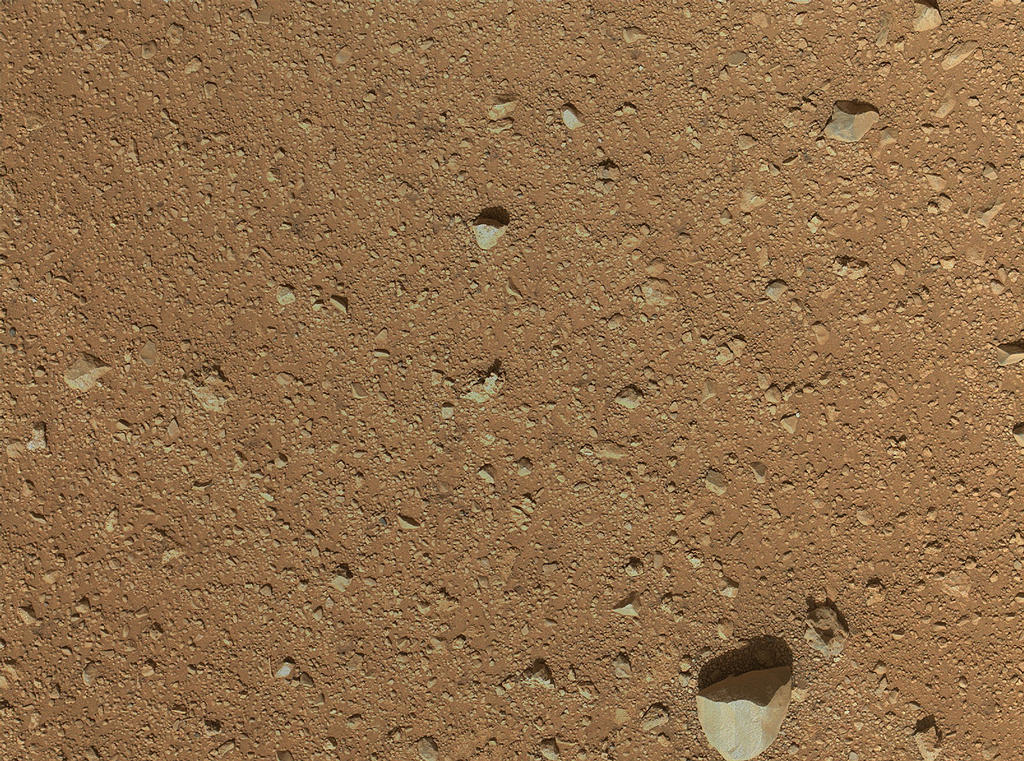
Although the dust cap has been in place up until now, the camera was used to grab Curiosity’s first fuzzy color landscape pic and, only last night, it was used to snap a fuzzy “self portrait” of Curiosity’s “head” — but that was achieved by looking through the semi-transparent dust cap still attached to the lens. Today, the very first crystal-clear “open” MAHLI image has been acquired after mission controllers sent the command for the re-closable dust cap to swing open. The picture shows a patch of Mars dirt next to the rover measuring about 86 centimeters across. The large pebble at the bottom of the frame is about 8 cm wide.
This may be a very preliminary image, but the MSL team are already using it to do science. “Notice that the ground immediately around that pebble has less dust visible (more gravel exposed) than in other parts of the image,” says the image description on the MSL mission site. “The presence of the pebble may have affected the wind in a way that preferentially removes dust from the surface around it.”
The left eye of the Mast Camera (Mastcam) on NASA’s Mars rover Curiosity took this image of the camera on the rover’s arm, the Mars Hand Lens Imager (MAHLI), during the 30th sol of the rover’s mission on Mars (Sept. 5, 2012).
During the Sept. 6 press conference from NASA’s Jet Propulsion Laboratory (JPL) in Pasadena, Calif., Mars Science Laboratory (MSL) mission scientists discussed updates from Curiosity’s progress in Gale Crater. It’s hard to keep up with the incredible deluge of images and scientific data as the six-wheeled rover roves toward its first target — a geologically interesting location called “Glenelg.” Mission managers hope to use Curiosity’s drill for the first time when the rover arrives. Expect mission updates and some pretty cool photos to appear on Discovery News throughout the day.
There was one photograph, however, imaged by the rover’s Mastcam that was showcased in today’s briefing that fascinated me. Shown above, the Mars Hand Lens Imager (MAHLI) can be seen on the rover’s robotic arm (with dust cap still in place). All the instrumentation and wiring has a very cool Steampunk-esque quality to it.
When I “met” Curiosity at the JPL clean room last year, I was also fascinated by its ugly functionality. By “ugly,” I don’t mean repulsive, I actually fell in love with the robot that day. But with any space mission, function succeeds form and Curiosity is no different. Instruments jut out from a central box; cables snake over all surfaces; gold and silver components are scattered across the deck like opulent jewels; and the whole thing is supported by some seriously heavy duty wheels that wouldn’t look out of place attached to a Bentley cruising through Los Angeles.
Back then, I stared at the Mars exploration machine, whose one purpose is to do science in an alien land, and thought how alien the thing looked. But in all the ugliness of an apparently random assortment of instrumentation, Curiosity has an undeniably beautiful character. Also, it has a WALL-E-like “head” in the form of the blocky ChemCam atop its mast. And now I know what its character is after seeing this latest robotic arm photo; it’s a creation that wouldn’t look out of place in a Steampunk museum or imagined in a H. G. Wells novel. However, this isn’t sci-fi, this is real. We have a nuclear-powered rover on Mars. Sometimes it’s too hard to put such awesomeness into words.










 astroengine.com