In agreement with Phil Plait, this video made me smile too. A lot.
President Obama (now a Nobel Peace Prize recipient) hosted an astronomical party on the White House lawn on October 7th for an audience of 150 middle school students from the Washington area and some guests of honour (including Charlie Bolden, NASA Administrator and Buzz Aldrin, Apollo legend). It looked like a really exciting event for all the school kids involved.
This was my favourite bit:
“So, there are a lot of mysteries left, and there are a lot of problems for you students to solve, and I want to be a president who makes sure you have the teachers and the tools that you need to solve them. That’s why we’re working to reinvigorate math and science in your schools and attract new and qualified science teachers in your classrooms, some with lifetimes of experience […] That’s how we’ll move American students to the top of the pack in math and in science over the next decade to guarantee that America will lead the world in discovery in this new century.” –President Barack Obama, Oct. 3rd.
Was there ever an astronomy party on the White House lawn during the previous administration?
One scenario: Exploding star flings binary parter away at high velocity (Max Planck Institute for Astrophysics)
HC 271791 is a star with a problem, it’s moving so fast through our galaxy that it will eventually escape from the Milky Way all together. However, there is a growing question mark hanging over the reasons as to why HD 271791 is travelling faster than the galactic escape velocity.
So-called hyper-velocity stars were first predicted to exist back in 1988 when astrophysicist Jack Hills at Los Alamos National Laboratories pondered what would happen if a binary star system should stray too close to the supermassive black hole lurking in the galactic nucleus. Hills calculated that should one of the stars get swallowed by the black hole, the binary partner would be instantly released from the gravitational bind, flinging it away from the black hole.
This would be analogous to a hammer thrower spinning around, accelerating the ball of the hammer rapidly in a circle around his body. When the thrower releases the hammer at just the right moment, the weight is launched into the air, travelling tens of meters across the stadium. The faster the hammer thrower spins the ball, the greater the rotational velocity; when he releases the hammer, rotational velocity is converted to translational velocity, launching the ball away from him. Gold medals all ’round.
So, considering Hills’ model, when one of the stars are lost through black hole death, the other star is launched, hammer-style, at high velocity away from the galactic core. The fast rotational velocity is converted into a hyper-velocity star blasting through interstellar (and eventually intergalactic) space.
Hills actually took his theory and instructed the astronomical community to keep an eye open for speeding stellar objects, and sure enough they were out there. HD 271791 is one of these stars, travelling at a whopping 2.2 million kilometres per hour, a speed far in excess of the galactic escape velocity.
However, the 11 solar mass star didn’t originate from the Milky Way’s supermassive black hole (inside the radio source Sgr. A*), it was propelled from the outermost edge of the galactic disk. There is absolutely no evidence of a supermassive black hole out there, so what could have accelerated HD 271791 to such a high velocity? After all, stars aren’t exactly easy objects to throw around.
If HD 271791 used to be part of a binary pair, its partner would have had to suddenly disappear, releasing its gravitational grip rapidly. One idea is that HD 271791’s sibling exploded as a supernova. This should have provided the sudden loss in a gravitational field — the rapidly expanding supernova plasma will have dispersed the gravitational influence of the star.
However, according to Vasilii Gvaramadze at Moscow State University, the supernova theory may not be sound either; by his calculations a binary pair simply cannot produce such a large velocity. Gvaramadze thinks that a far more complex interaction between two binary pairs (four stars total) or one binary pair and another single star some 300 solar masses. Somehow, this “strong dynamical encounter” caused HD 271791 to be catapulted out of the system, propelling it at a galactic escape velocity.
Although this complex slingshot theory sounds pretty interesting, the supernova theory still sounds like the most plausible answer. But how could a sufficient rotational velocity be attained? As Gvaramadze points out, even an extreme rapidly orbiting binary pair cannot produce a star speeding at 530-920km/s.
This is in contrast to research carried out by scientists at the Max Planck Institute for Astrophysics and the University of Erlangen-Nuremberg. In a January 2009 press release, Maria Fernanda Nieva points out that this hyper-velocity star possesses the chemical fingerprint of having been in the locality of a supernova explosion. This leads Nieva to conclude that HD 271791 was ejected after its binary partner exploded. What’s more, a Wolf-Rayet may have been the culprit.
Up to now such a scenario has been dismissed for hyper-velocity stars, because the supernova precursor usually is a super-giant star and any companion has to be at large distance in order to orbit the star. Hence the orbital velocities are fairly modest. The most massive stars in the Galaxy, however, end their lives as quite compact so-called Wolf-Rayet stars rather than as super-giants. The compactness of the primary leaves room for a companion to move rapidly on a close orbit of about 1 day-period. When the Wolf-Rayet-star exploded its companion HD 271791 was released at very high speed. In addition, HD 271791 made use of the Milky Way rotation to finally achieve escape velocity. —Maria Fernanda Nieva
Even though Gvaramadze’s stellar pinball theory sounds pretty compelling, the fact that HD 271791 contains a hint of supernova remnant in its atmosphere, the supernova-triggered event sounds more likely. But there is the fact that just because this 11 solar mass star was near a supernova some time in its past, it certainly doesn’t indicate that a supernova was the cause of it’s high speed.
Back in 2006, I remember sitting in my local UK Job Centre finding out how I could claim for unemployment benefits.
I can see it now, the moment I explained to my liaison officer that I had been looking for work but received little interest. She looked at me and said, candidly, “Have you thought about not mentioning you have a PhD? It might help.” She smiled.
What? I now need to hide my qualifications if I want to get a job? Isn’t that a little counter-intuitive? Actually, as it turned out, she was right. Many of the jobs I had applied for didn’t require a postdoc to do them; why would a company hire me when they can hire a younger postgrad with lower salary expectations?
Up until that moment, I was still hopeful that I might be able to land an academic position; possibly back in my coronal physics roots, but funding was tight, and I hadn’t done enough networking during my PhD to find a position (I had been too busy scoping out the parties and free booze at the conference dinners).
So there I was, with all the qualifications in the world with no career prospects and a liaison officer who deemed it necessary to advise me to forget the last four years of my academic career. It was a low point in my life, especially as only a few months earlier I had been enjoying one of the highest points in my life: graduating as a doctor in Solar Physics.
Fortunately for me, I had another option. My girlfriend (now lovely wife) was living in the US, and although searching for a job in the UK was a priority for us (we were planning on living in the UK at the time), I knew I could try my luck in the US as well. So after a few months of searching, I cancelled my Job Centre subscription and moved to the other side of the Atlantic.
I had just become a part of the UK’s “brain drain” statistic. I had qualifications, but I was in a weird grey area where companies thought I was over-qualified and funds were in short supply for me to return to academic research.
A lot has happened since those uncertain postdoc times, and although I tried (and failed) to pick up my academic career in solar physics in the US (it turns out that even the sunny state of California suffers from a lack of solar physics funding), the job climate was different. Suddenly, having a PhD was a good thing and the world was my oyster again.
To cut a long story short, I’m happily married, we own five rabbits (don’t ask), we live just north or Los Angeles and I have a dream job with Discovery Channel, as a space producer for Discovery News.
Although I’d like to think that if I was currently living in the UK, I might have landed an equivalent career, I somehow doubt I would be as happy as I am right now with how my academic qualifications helped me get to where I am today.
Why am I bringing this up now? Having just read about Stephen Hawking stepping down as Lucasian professor of Mathematics at Cambridge University and the Guardian’s report about the risk of losing British thinkers overseas, I wonder if employment opportunities have improved since 2006. What’s most worrying is that there appears to be this emphasis on making money as quickly as possible, rather than pursuing academic subjects. However, in my experience, having a PhD doesn’t mean you can even land a job in industry, you might be over-qualified.
“Giving up on that tradition of deep intellectual discovery in favour of immediate economic benefit is a huge mistake. You lose the gem of creative, insightful, long-term thinking. That is what Britain has done so spectacularly in the past, and to give that up is a tragedy.” —Neil Turok
Triton, Neptune’s largest moon, hasn’t been studied in detail since Voyager 2 did a flyby in 1989. That was until a team headed by Will Grundy, a Lowell Observatory planetary scientist, did a 10-year study into the distribution of the moon’s ices.
Soon to be published in the journal Icarus, the team has found that concentrations of nitrogen and carbon monoxide mix together and form a covering of ice on the Neptune-facing side of Triton. This is in contrast to the methane content of the atmosphere. For some reason, methane is concentrated on the non-facing Neptune hemisphere of the moon. It appears that methane doesn’t like to mix with the other volatile ices.
This is in stark contrast to the non-volatile ices, such as water and carbon dioxide. Both appear to have a homogeneous distribution, regardless of phase or geographical location.
These are incredible observations of a moon that was once a Kuiper Belt Object. However, the infrared analysis carried out on Triton could be a test-run before observations are carried out on other, more exotic, targets.
“This type of long-term, detailed analysis would be equally valuable for small icy planets like Pluto, Eris, and Makemake, all of which are similar to Triton in having volatile ices like methane and nitrogen on their surfaces,” said Grundy. “We have been monitoring Pluto’s spectrum in parallel with that of Triton, but Eris and Makemake are quite a bit fainter. It is hard to get time on large telescopes to monitor them year after year. We expect that Lowell Observatory’s Discovery Channel Telescope will play a valuable role in this type of research when it comes on line.”
As scheduled, the extra-special 2012 teaser trailer appeared on the TV. Mildly excited, I flicked between the channels in the hope of catching a glimpse of what lies in store for November cinema screens. I tried to keep up the typing in real time… alas, it was too hard, the doom was moving too fast for my fingers, but this is what I remember…
We start off with John Cusack’s panic-stricken face warning his family on the phone while driving a stretch limo (stretch limo?) through LA streets, “When they tell you not to panic, that’s when you RUN!!!” Poetry.
Then a scene that can only be described as hilarioussillygratuitousinsane the most over-powering CGI I have ever had the pleasure of seeing.
It was basically the Planes, Trains and Automobiles version of doomsday. Just without the trains. Add a crying child.
High-speed car sequences, palm trees snapping, ground cracking, houses folding… ooh look out for the obligatory exploding petrol tanker!!!! [extra !!! for effect] Then, buildings fall to the ground, people dying everywhere… but Cusack, plus brood, fly through the surprisingly uncongested LA streets at hyperspeed! Oh crap! Look out for the– PHEW! The car jumped through (jumped through!!) a disintegrating building (disintegrating building!!!), popping out the other end unscathed.
There’s more!
The Huge Massive CrackTM advances through California, with Cusack and co.’s car always in front of the impending doom that’s unfolding behind them.
Oh! There’s a plane! We’re now on an airfield… it’s okay, the family have an escape route! They fly off, Huge Massive CrackTM ripping through the asphalt as the pilot accelerates into the air. Buildings crashing down, toppling sideways (sideways!!!), crying child looks out the window, people are being squashed by cars down there!! That’s not for young eyes goddammit! They keep flying– NOOO!! More collapsing buildings!! Fly under them!!! YESSS!!! That pilot just flew UNDER a sideways collapsing building. Los Angeles is toast, looks more like the Grand Canyon than a city.
I’m tired… that was intense. Totally silly, too. Did it make me want to see the movie more? Not really, looks like it’s going to be very basic disaster pr0n, as predicted, with a very loose plot. Ah well.
Disclaimer: This in no way, shape or form indicates that I now think something is going to happen in 2012. All of the above is based on a trailer for a movie. A movie people! The theories about doomsday in 2012 are still nonsense. If you don’t believe me, have a read.
No, Jon & Kate aren’t going to be screaming at each other (why do people find that pair interesting anyway?), the 2012 movie teaser campaign will go up a notch after Sony decided it would be awesome if they throw even more money at this over-hyped End Of The World advertising campaign. 2012 will, quite literally, be spewing its CGI glory across the majority of TV stations.
Although it’s probably pretty obvious by now that 2012 is a marketing opportunity rather than anything that might really happen, even after 18 months since my original No Doomsday in 2012 article, I still receive countless emails about the subject. Some emails are angry (how dare I give scientific reasons why Planet X is bunk!), others are weird, but the majority are from people who have a genuine concern that they (and their family) might not live past Dec. 21st, 2012.
So for those of you who think there might be an ounce of truth in the doomsday claims you see on the ‘net, or the ones depicted in tonight’s 2012 trailer, to borrow the advice from Alan Boyle at Cosmic Log:
DON’T PANIC!
And why shouldn’t you panic? The simplest reason not to panic is that ancient civilizations (like the Maya) have never, ever predicted anything with any degree of accuracy (and no, just because they apparently had good astronomy skills does not mean they did a good Nostradamus impression). Quite simply, time is a one-way street, you can never foretell anything before it happens. It is a physical impossibility.
If you still don’t believe me and think that the cosmos has marked us for death on Dec. 21st 2012, check out my other articles on the subject: Could Planet X make an appearance?No, nope, no way, nah. What about a solar-fried Earth?Balls, bullshit… grapefruit? Geomagnetic shift?Don’t even go there!
Still in doubt? Please, just read through EVERYTHING listed on Astroengine.com and the Universe Today about the topic.
So, in short, ignore the 2012 viral campaign, but enjoy the movie for what it is, a disaster movie (and nothing more sinister). Will I be watching the movie? Hell yes, I want to be one of the first to review it!
In a discussion I seem to keep having these days when I mention that human spaceflight is actually a valuable endeavour for a nation, I’m usually met with a look of incongruity. Then the question: What has space exploration ever done for us?
I used to get a little angry about this question (of course space exploration is important!) but in actuality, I have to explain the answer because it isn’t necessarily obvious. By pushing into space, a nation can enrich its technology, improve education, boost employment in skilled areas, thereby improving the economy and generally improving a nation’s standing in the world. That’s the eco-friendly version. There are other applications such as military prowess, strategic advantage and business potential. Unfortunately, doing bold things in space requires money, and to get money you need to convince the government that it’s worth spending money on. Last time I looked, there’s no Space Race 2 going on, so we can’t rely on politics to see the necessity of space flight.
However, the US has invested billions of dollars in the exploration of space, and although NASA is a money-hungry entity, it produces results and has shaped the world as we know it. Granted, the US space agency was built on Cold War ideals and was hinged around the sole purpose of beating the Soviets to the Moon, but modern NASA is still relevant, if not more so.
Rockets and healthcare
From space, and back to Earth with a bump.
I watched a series of fascinating videos of the protests that went on in Washington D.C. on September 12th concerning President Obama’s healthcare reform plans. The Tea Party (not Twinnings, or Boston… some other tea party that didn’t have a lot of tea) exploded to life to the sound of tens of thousands of voices protesting “socialist” healthcare. Apparently, a nationalized healthcare system is a bad thing. The arguments against Obama’s plan seem rather outlandish to me, and a hardcore group of protesters (not all the protesters, just a few apparently missing a sanity gene) accused the US President of being a “communist,” “socialist,” “Marxist” and (most shockingly) a “Nazi.”
So, here we are, with a field-full of rabid protesters that have been whipped up into a frenzy by the media, special interest groups and political antagonizers. These geniuses see a nationalized healthcare system as a socialist agenda. Of course, this means communism is just down the garden path. Last time I looked, the UK wasn’t a communist state, and although the British National Health Service (NHS) isn’t perfect, it’s a damn sight better than the US health insurance insanity.
The point I’m trying to make is that tens of thousands of people descended on the US capital to protest a healthcare bill that actually seems quite sensible. Unfortunately, this huge group believe this bill is actually a government conspiracy intended to dupe the public, bankrupt the country and control the nation.
NASA losses
Now let’s wind back the clock to last year, when it was announced NASA would be shedding thousands of jobs when the space shuttle is retired. More recently, a task group was formed to discuss NASA’s options considering its budget isn’t going to grow any time soon — unfortunately, Bush’s “Vision for Space Exploration” can’t be done because the Constellation Program will cost too much. Now the Augustine Commission has set out some plans that may curtail NASA’s big projects, possibly even cancelling Constellation.
To top all this off, there is a 5-year gap (minimum) between the shuttle being retired and Constellation taking over (if that even happens), that means there will be at least 5 years the US will have without a manned launch vehicle. Yes, the US has gone through this before (between the end of the Apollo Program in 1970 and the Shuttle Program in 1982), but this time we could lose access to the space station, a $100 billion project the US is heavily invested in.
Fortunately, US companies are seeing business opportunities in space, so given enough funding, start-ups like SpaceX could start ferrying NASA astronauts into LEO sooner rather than later. There are also other nations involved in the space station and they can give us a lift into space. Unfortunately, apart from the Shuttle, there’s only one other spacecraft that’s human-rated in the world. That’s Soyuz.
Russian Roulette
Soyuz is great, it’s a sturdy vehicle and it’s received little complaint from the astronauts and cosmonauts that have been ferried around in it (well, most of the time). The Russian space agency will basically be offering NASA taxi rides into space so the US can still use the International Space Station.
The cost? $50 million per seat.
Wow, what a bargain. The space shuttle costs the best part of a billion dollars to launch every time. Compare that with $50 million, it almost seems as if this 5-year gap is a good thing. It might save NASA some money!
However, in the process of retiring the shuttle, skilled US jobs will be lost. Even the transition from the shuttle program to Constellation will cause a re-shuffle of NASA employees. Last year, Senator Bill Nelson pointed out that shedding jobs from the US space agency, only to rely on a Russian launch vehicle, will have the effect of generating jobs in Russia. This might seem like an over-exaggeration, but it may indirectly be the case.
The added concern is that the $50 million value per Soyuz seat could increase. After all, US-Russia relations aren’t exactly toasty, the Russian space agency could set its own price for taxi rides to the space station. NASA money will be spent, not on advancing US spaceflight capabilities, but on another nation’s spaceflight capabilities. Sure, NASA and Roscosmos are co-operating now, but both are government-backed entities and that co-operation could turn south during the next East-West political upset.
Conclusion
In summary, until US spaceflight companies develop human-rated space vehicles, or until the Constellation Project (or equivalent) is finished, the US will be wholly dependent on Russia for human spaceflight. NASA will be paying a premium rate for that privilege.
So when I see thousands of individuals crowding on Capitol Hill, angrily protesting about the idiotic belief that the President of the USA is on the verge of creating a communist state, I think about NASA and the fact that the US space agency has been forced to pay for seats on board a spaceship maintained by an ex-communist state the US government is having problems with.
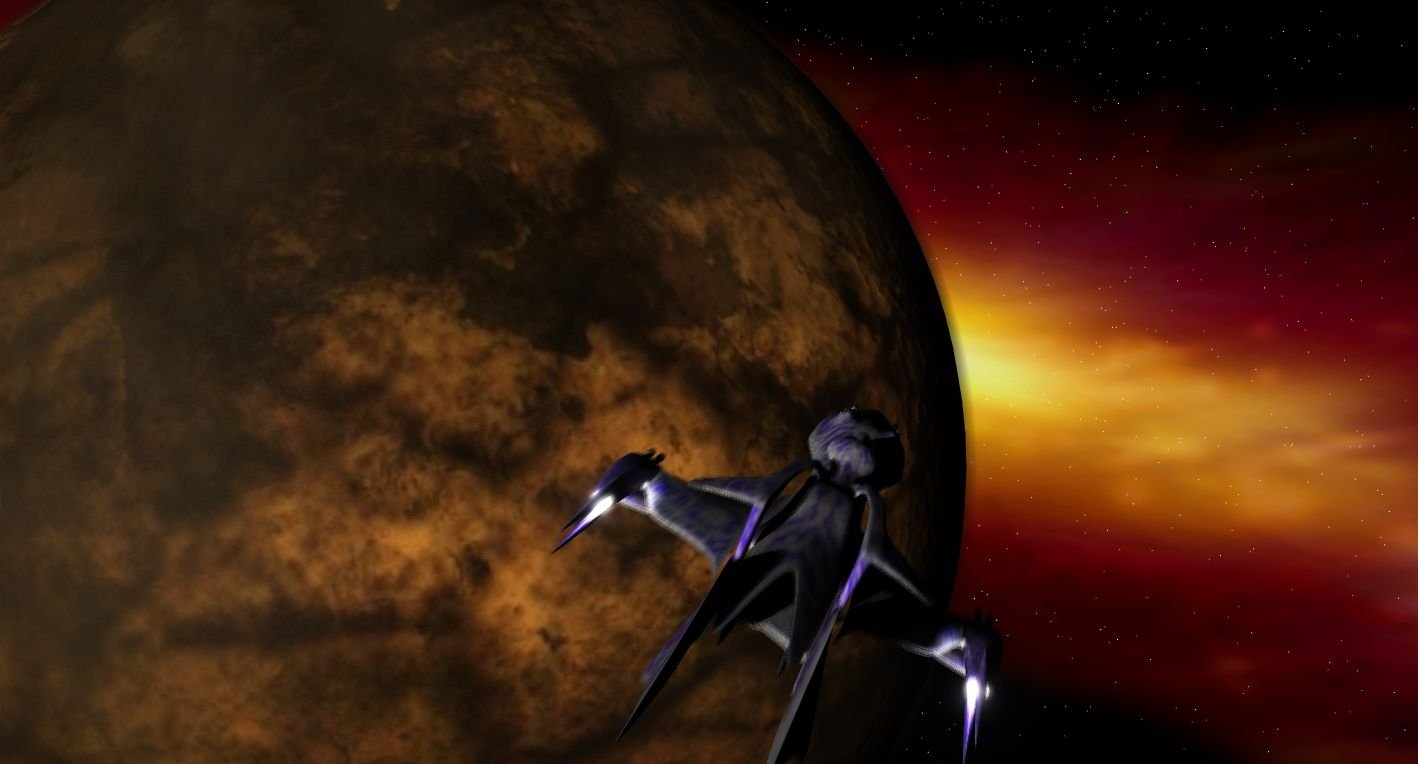
The White Star approaches the Shadow’s homeworld of Z’ha’dum on the Galactic Rim.
It would appear that scientists have confirmed that the outer edge of the Milky Way is a bad location for life to even think about existing.
This research reminded me of the “Galactic Rim” in the 90’s sci-fi TV series Babylon 5. The Rim is the mysterious region of space right at the edge of our galaxy where only the hardiest of explorers dared to venture. As explained in the season 2 episode of B5, “In the Shadow of Z’ha’dum,” Captain Sheridan (Bruce Boxleitner) discovers that his wife (when exploring The Rim) went missing on a planet called Z’ha’dum. It turns out that an angry ancient alien race — called the Shadows — lived on this mysterious world and their discovery led to them being used in all kinds of plots during the latter four seasons of this awesome sci-fi show.
However, the existence of any kind of life (let alone life as complex as the evil Shadows) in the badlands of the Milky Way is looking very unlikely.
Located some 62,000 light years from the core of our galaxy (over twice the distance of the Earth from the galactic centre), two very young star clusters in the constellation of Cassiopeia have been studied. Chikako Yasui, Naoto Kobayashi and colleagues at the University of Tokyo, Japan, found these clusters in a vast cloud of gas and dust called Digel Cloud 2. The stars inside these clusters are only half a million years old, and the majority of them should possess proto-planetary disks (which is characteristic of local star-forming regions). However, it would appear that these stars contain very little oxygen, silicon or iron (i.e. they have very low metallicity) and only 1 in 5 of the 111 baby stars analysed in both clusters have disks.
If proto-planetary disks are rare, this means there will be a rarity of planets. This is an obvious bummer for life to form. After all, Life As We Know It™ is quite attached to evolving on Earth-like planets.
So why are these young stars lacking proto-planetary disks, when local star forming regions don’t seem to have this affliction? The authors of the paper, soon to be published in the Astrophysical Journal, suggest that these stars did have disks, but some mechanism is rapidly eroding them.
The most likely scenario is that low metalicity proto-planetary disks are more susceptible to photoevaporation. Simply put, these disks evaporate when exposed to EUV and X-ray radiation from their parent stars far more rapidly than disks that are metal-rich.
Therefore, if an alien race was able to form, they’d be very rare or they’d be very different from what we’d expect “life” to be like (i.e. they thrive in low metalicity star systems). Sounds like the mysterious Shadow homeworld of Z’ha’dum would be a very rare sight on The Rim of our Milky Way after all.
Oh dear. Just when I was actually beginning to care about the cast of Defying Gravity, it was cancelled half-way through the first season. I was a little annoyed about this as #DefyingGravity on Twitter was fast becoming a weekly ritual; a group of us die-hard sci-fi viewers scoffing at the science atrocities the ABC show was inflicting on us. In fact, the bad science, when coupled with a spaceship full of horny crew mates (a.k.a. friends with benefits… why not?) almost made it compelling viewing (almost).
Apart from hammering home the inevitability of astronauts having sex in space, I almost stood up and cheered when, in the last episode (called “Love, Honor, Obey“), the cast did a great job at explaining the quantum physics thought experiment, Schrödinger’s cat. As the crew was stuck inside a shielded compartment to protect themselves against an impending solar flare (it turned out to be a false alarm), mission control had no way to communicate with the crew. Steve Wassenfelder, the out-of-shape physicist, likened the crew to Schrödinger’s cat; to mission control, as they had no way of knowing whether they were alive or dead, the crew were in fact alive and dead. Clever.
The show also handled the solar flare event pretty well, although they avoided a lot of the details (but kept it within the realms of possibility, as opposed to some movies I won’t mention).
Then, after some fractal tomato plants (I didn’t say all the science was kosher), the crew opened mysterious Pod 4 to see…
…I don’t know what they saw as that was the cliff-hanger of the last episode. I’m sure I’ll end up watching it on Hulu.com, but I don’t think it will be the same without mocking it live on Twitter with the #DefyingGravity contributors (you know who you are).
Then, as quickly as Defying Gravity dropped off our screens, another compelling sci-fi series appears on ABC featuring a competent-looking cast (led by Joseph Fiennes and John Cho). It’s called FlashForward, and after only the first episode, I’m hooked. It’s actually the same feeling I had when I watched the very first episode of Heroes.
In FlashForward, we start off in Los Angeles, looking into several people’s lives, when suddenly the entire planet blacks out for 2mins 17seconds. During that time, everyone has a vision of 6 months into the future.
The series is based on the 1999 novel Flashforward by Canadian science fiction writer Robert J. Sawyer, and the premise is pure sci-fi joy. In fact, I was lucky enough to be sent a behind the scenes video by Times.com science comedian Brian Malow (be warned, there’s a fairly huge spoiler, but it’s an awesome spoiler that will get you nodding with joy… but you’ve been warned):
Robert J. Sawyer calls himself a “hard science fiction writer,” so it will be very interesting to see how the show deals with the speculative quantum-conciousness link. Still, it has to be better than that silly mag grav idea in Defying Gravity.
In other news: The lovely Eliza Dushku will live-tweet during the season 2 premier of Dollhouse (on FOX) if she gathers 100,000 Twitter followers before it airs… in 20 minutes on the West Coast. She’s only on about 92,000 at the moment, so it’s not looking likely. Still, I’ll be watching!
I first came across Ralf Vandebergh’s outstanding astrophotography when I was inquiring about a “mystery” object that appeared to be stalking the International Space Station (ISS) in July. As it turned out, it wasn’t a UFO, it was in fact a Russian Progress re-supply space vehicle testing out a new automated docking procedure with the orbiting outpost. Vandebergh managed to image the ISS and Progress vehicle with amazing clarity from his home in Wittem, the Netherlands.
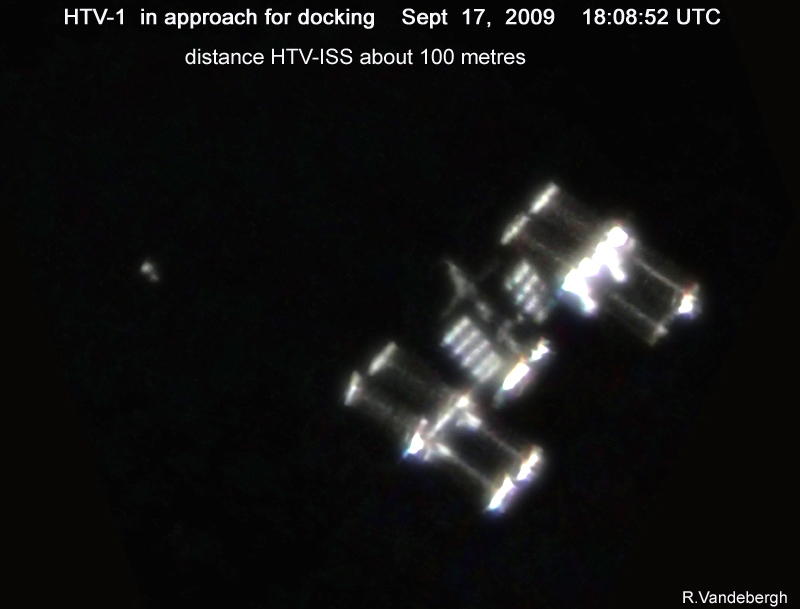
Today, he’s done it again, only this time his target was the first flight of the robotic Japanese H-II Transfer Vehicle, HTV-1.
On day 3 of the mission (Sept. 13th) to supply the ISS with over 4 tonnes of food, water, fuel and equipment, Vandebergh captured this incredibly detailed picture of the vehicle, speeding overhead at an altitude of just under 300km (pictured top). He also took a shot of the HTV-1 as it was approaching the ISS on Sept. 17th (right).
I’m totally in awe of these shots, and there’s a lot more where this came from. In Vandebergh’s gallery there are pictures of spacewalking astronauts, shuttle cockpits and amazingly detailed portraits of the ISS… all taken with a camera, through a telescope, on terra firma. Enjoy.
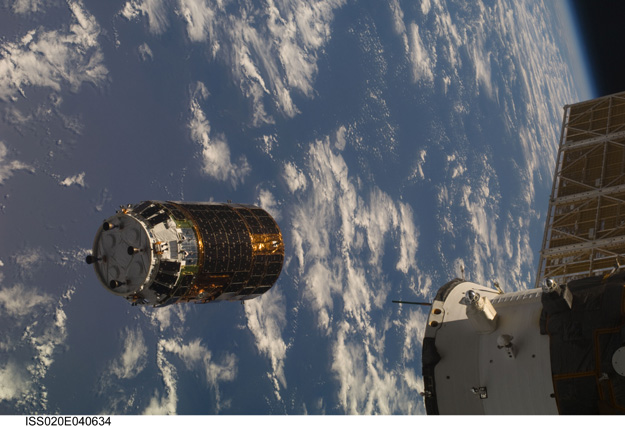
For reference, here’s a shot of the HTV-1 from the ISS shortly before docking:
The HTV-1 approaches the space station on Sept. 17th (NASA)




 astroengine.com