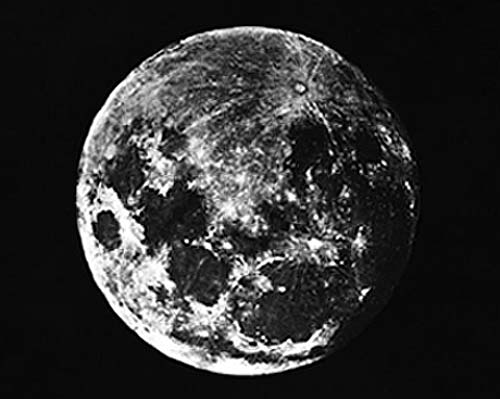
This is the first ever photograph taken of the Moon. The first. 170 years ago!
I was directed to the image by Twitter friend LouisS and I felt compelled to post it on Astroengine.com. Much like the 1911 Martian canal post last month, this serves as a reminder about the heritage of modern astronomy that dates back not decades, but centuries.
The 1839 photograph was taken by British ex-pat John William, a chemistry professor in the New York University, using a silver platinum plate.
Here’s a problem we didn’t see coming. Actually, we might have guessed it could be an issue, but thought, “no way, this is space travel we’re talking about!” But yes, red tape might get in the way of space tourism interests in the USA. In particularly, if you’re not an American citizen.
US export controls could potentially throw a problem or two into the space tourism mix, preventing non-US fee-paying customers from taking a ride on Virgin Galactic’s SpaceShipTwo, or doing microgravity cartwheels inside Bigelow’s Sundancer space hotel.
Although Richard Branson is building the world’s first spaceport in New Mexico and XCOR has signed up its first Danish space tourist, the International Traffic in Arms Regulation (ITAR) rules might prevent non-US citizens from seeing the insides of space vehicles containing technology or equipment under the jurisdiction of ITAR.
It’s a national security “thing”.
It’s funny how rules and regulations get in the way of things, but this is possibly the worst time for the issue to crop up. US companies are already promoting and selling their tickets for sub-orbital joyrides to international consumers, what if a British $200,000 ticket-holder turns up at their spaceplane, only for space border control to tell you to go home? Not so good for business is it? In fact, that’s the kind of thing that prevents you from doing business with international clients. To make it worse, potential European space tourism companies are marketing “ITAR-free” components and technologies, thereby creating untouchable competition.
However, despite the concern, I’m thinking there will be a few work-arounds for the ITAR. Key to the regulations is that ITAR covers tech and passengers. How about cutting out the “passengers” bit?
One of my favourite spaceflight companies, Bigelow Aerospace, has asked the same question and has been forward-thinking enough to lobby the government to change ITAR rules. “We think hardware should be [covered] under ITAR,” said Michael Gold, director of Bigelow Aerospace’s Washington office, “but passengers should be exempted.”
It would appear Congress needs some convincing that this particular ribbon of red tape needs to be cut.
“Congress created a bigger problem than already existed,” said Rep. C.A. Ruppersberger (D-Md.), who oversees these regulations on the House Select Committee on Intelligence. Unless ITAR is reformed, space commercialization could shift toward China or Russia. However, a lot of committees are being consulted and paperwork is being re-shuffled to find a solution to this issue before real damage is done to a (potentially) revolutionary burgeoning industry in the US.
A balance between space commerce and national security needs to be found, without compromising either to international entities.
I don’t usually post two identical stories within a few days of one another, but when I saw this image on SpaceWeather.com I had to comment on it. On Friday, I was captivated by the astounding astrophotography by Nicolas Biver as he tracked the space station with video camera and telescope, to capture some great detail of the manned outpost as it passed over France. With a bit of luck and a whole world of skill, Biver observed a bright space station flare.
Next up, it’s the turn of Martin Gembec. On May 2nd, he grabbed this superb trail as the station passed through the distinctive edge-on disk of our galaxy over the Czech Republic. What’s more, the station flared as its huge solar arrays reflected sunlight through Gembec’s ‘scope… right at the moment when the station travelled through the hazy starlit disk of the Milky Way.
“We were watching a bright flyby of the space station when the ISS surprised us with a big flare in the Milky Way,” said Gembec. “At maximum, the ISS reached magnitude -8.”
A magnitude of -8 makes this flare a beast; that’s 25× brighter than Venus and 400× brighter than the star Sirius.
In the photo above, there is a rather ominous piece of kit attached to a boom reaching into the centre of the image. This is a reflection of Gembec’s Canon 30D camera (that took the picture as the ISS passed overhead) in an all-sky mirror. The mirror is in a concave shape to collect the starlight from the sky, bouncing the light into the camera lens. It acts much like a satellite dish; except it doesn’t bounce and focus radio waves into an antenna, the all-sky mirror reflects visible light and focuses it into the open camera shutter. As you can see, the results are visually stunning.
It’s one of those occasions when you’re not sure whether you should laugh… or hold back your giggling because you realise you’re witnessing some very well produced train-wreck TV.
Oh yes, it can mean only one thing, Walter Wagner is back! But this time, the media came prepared.
Yes, it was the Jon Stewart Show, and yes it was satire, but this time the joke was on the crackpot notion that the Large Hadron Collider (LHC) could actually cause harm to the world.
Now, Wagner has been caught out and been made a fool of. Although I hate to see anyone in this situation, in this case, I think it is needed. Wagner only has himself to blame. He started these doomsday theories, now it’s up to mainstream comedy shows to debunk his authority on the subject.
Hold on, did he ever have an authority over physics? Oh yes, that’s right. No, he didn’t. He used the media as a tool to gain attention.
The Mayans built a calendar so they could better organize their time, document historical events and enable them to make plans for the future (like any good calendar does). So, out of necessity, the Mayans put together an amazingly complex system of embedded calendars of various lengths. They came up with an innovative idea so they didn’t have to rely on short-term cyclical calendars (the longest was only 52 years), they created one of the first number-based calendars devised:
“The Mayans had a solution. Using an innovative method, they were able to expand on the 52 year Calendar Round. Up to this point, the Mayan Calendar may have sounded a little archaic – after all, it was possibly based on religious belief, the menstrual cycle, mathematical calculations using the numbers 13 and 20 as the base units and a heavy mix of astrological myth. The only principal correlation with the modern calendar is the Haab’ that recognised there were 365 days in one solar year (it’s not clear whether the Mayans accounted for leap years). The answer to a longer calendar could be found in the “Long Count”, a calendar lasting 5126 years.” — Me, “No Doomsday in 2012“, Universe Today, May 19th, 2008 (there’s nothing quite like pimping your own megahit articles!)
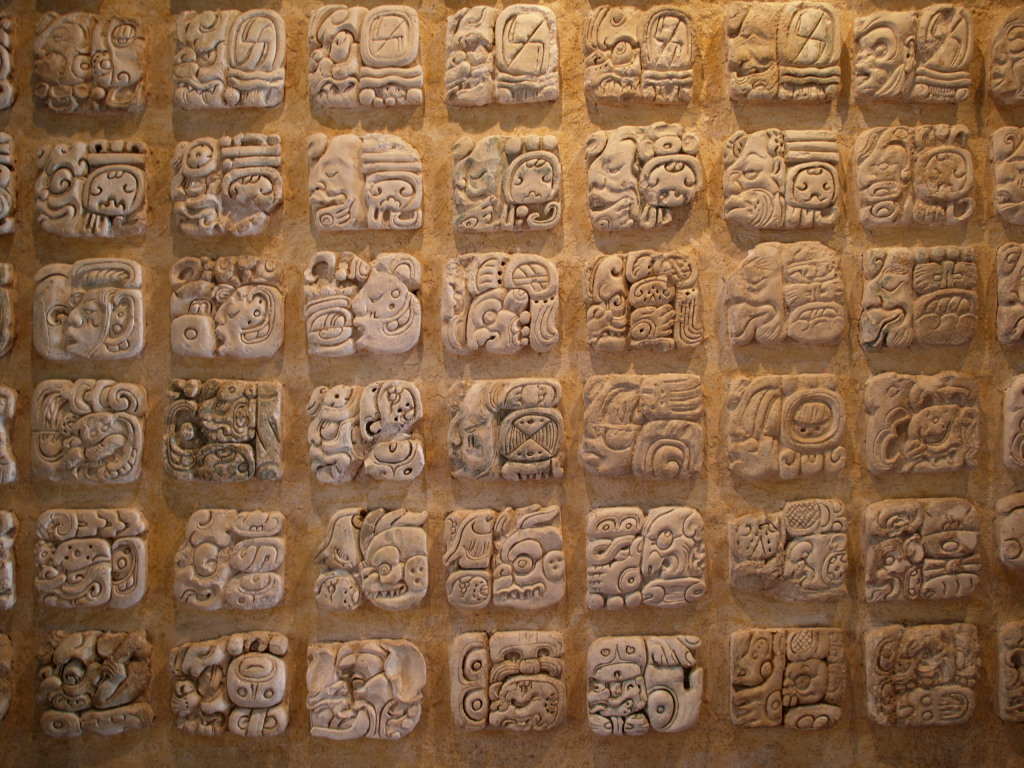
Palenque Museum Mayan glyphs (wyattsailing.com)
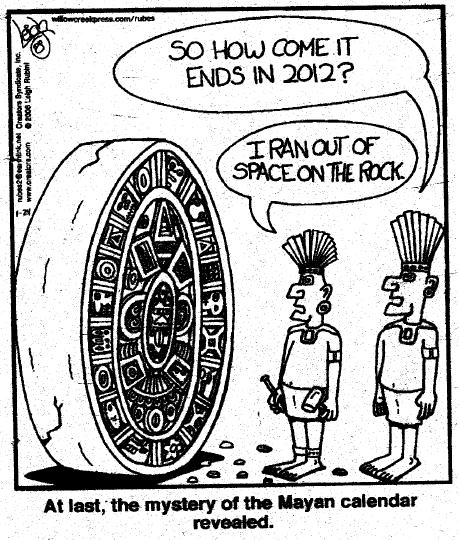
So, the Mayans created a number system that lasted 5126 years. Judging by their love of cycling calendars that reset after 260 days (Tzolk’in calendar), 365 days (Haab’) and 52 years (Calendar Round), isn’t it logical to assume the Long Count calendar was designed to do the same thing? And why didn’t the Mayans explicitly say: “the Long Count will cycle again after 5126 years“? That’s because they were still in their first cycle. And within this first cycle, their entire civilization rose and and crashed back down again. They never got the chance to experience one whole cycle, resetting the Long Count or, indeed, simply extending it.
In short, the world isn’t going to end in 2012 (the coincidental end-date of the Mayan Long Count calendar), it’s the last stand of an ancient culture.
It’s actually rather sad; assuming the historians are correct, and the Long Count does end on December 21st, 2012, that is the final end date for an entire civilization. Although their cities may have crumbled and civilization faded into the history books, at least the Mayans had a calendar that endured hundreds of years after their downfall. The Mayan Long Count calendar outlived a civilization, perhaps December 21st, 2012, should be a celebration of a lost mesoamerican race, as this date will truly be the end of ancient Maya.
Playing on our love for WALL-E, our amazement for the Pixar Lamp and some great animation, Chris Smith, an employee at NASA Goddard Flight Center, has given the upcoming Solar Dynamics Observatory a personality.
Apart from obviously having too much time on his hands, Smith is a very talented guy (as all NASA employees are) and is showing that, once again, the space agency is doing a fantastic job of reaching out to the public.
As proven by the efforts of the Phoenix Mars Lander team in 2008, communication goes a long way and by harnessing social media, NASA can make its missions household names. Phoenix was tweeting, blogging and podcasting to its hearts content for five months, from touchdown to frozen death; it was Big Brother for robots living on Mars.
Now most NASA missions have Twitter feeds and devoted blogs, ensuring everyone’s interest is piqued. It also helps to have a Twitter feed talking in first-person, giving these brave rovers, landers, orbiters and probes a much needed personality.
So now, Chris Smith has done something very cool with the SDO; he’s given it an animated personality in a short animation reminiscent of a movie teaser for an upcoming Disney-Pixar feature film. Behold, the Little SDO:
“It’s a really fun little piece,” says Wade Sisler, a television producer for NASA. “And we’re hoping to use it as a way of waking some kids and folks up to solar science.”
And so NASA should, I like it! It’s going to get people interested in a comparatively small mission, and let’s face it, the satellite lacks character (the boxy 4-eyed robot doesn’t do much for me). However, now that Smith has added squeaky solar panel wings, and blinking “eyes” (without changing the design of the craft at all), he’s boosted the SDO’s likeability. Suddenly I care for the little guy. I hope he doesn’t get hit by a solar flare.
Due for launch in October, the SDO will be inserted into a geosynchronous orbit above New Mexico, gathering data from the Sun, so solar physicists can better understand space weather. The cool thing is that with those four eyes, the SDO will capture high-definition images of the Sun continuously.
It might not have the dazzle of the Phoenix Mars Lander, but it has a personality and people will love him (I await the Twitter feed).
I’ve been watching this short video clip over and over. It may only be two seconds long, but it is such a unique view of the space station that I find it mesmerizing. Each time the animated GIF loops, another detail seems to reveal itself.
It’s also kinda hypnotizing in a rhythmic way; the space station appears to turn and boost away into the black of space, but just before its massive solar arrays capture the sunlight, dazzling the observer with a flash.
Is it me, or are those solar panels reminiscent of the sails hoisted up the masts of canon-touting battleships before the age of iron-hulled vessels and steam-powered engines? These slightly fuzzy images could even be from the turn of the 20th Century, when one of the first movie cameras filmed a ship steering out of port.
Of course, this isn’t a wooden ocean-going ship, it’s the space station, in orbit. And the video was taken with a modern digital camera through a 16-inch Dobsonian telescope by a highly skilled amateur astronomer called Nicolas Biver from Versailles, France. The reason why the station appears to “turn” is because the perspective of the observer changes as the station flies overhead, he did a great job of tracking it.
On April 28th, Biver tracked the space station through his ‘scope. Whether it was intentional or not, he was fortunate to capture an intense flare as the space station’s solar panels reflected sunlight at his location. The resulting flare was much brighter than Venus (after the Moon, the station is the second brightest object in the night sky). Usually when I hear about observations of flares made by stuff in orbit, I usually think of Iridium flares that occur at predictable times and locations, providing a target for observers on the ground to capture a meteor-like streak across the sky. The Iridium satellite network provides a great chance for astronomers to see the reflected light when the angle between them, the satellite’s solar panels and Sun is just right.
However, on the 28th, it was the space station’s turn to reflect some light for Nicolas Biver.
In March, Space Shuttle Discovery completed the construction of the ISS solar arrays during the STS-119 mission. Over a series of space walks, the solar array had its area boosted to 16,000 square feet. With this extra surface area, comes the potential for very bright flaring events.
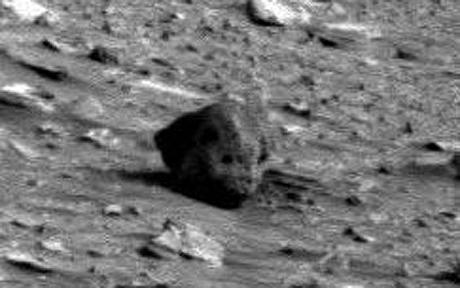
This just came in from the Telegraph, apparently Mars Exploration Rover Spirit has spotted a random skull on the Martian surface. This is obviously the only interpretation… as we know what an alien looks like, don’t we? Big head, big eyes, pasty grey skin. Something like this? Or, more likely, like this? Or this? Wow, it could be any one of them.
However, it’s not quite that exciting.
It’s a rock, as you may have already guessed. And no, the Telegraph isn’t taking it seriously either. (Although The Sun’s microreport could be taken either way.)
Although the newspaper’s article resembles a badly conditioned April Fools gag, there is one glaring error, well two actually. No, three.
Firstly, Spirit is not a camera – it’s a whole robot with a camera attached (called the Panoramic Camera, or Pancam for short). If it was just a camera, could you imagine the movie location costs?
Second, I’m not sure why this was filed in “Science News”. It obviously needs to be filed under “It’s a Slow News Day, We’ll Report Anything”.
And thirdly, I seriously doubt this image got “space-gazers talking”. When I last looked at one of Opportunity’s panoramic shots, I could see all kinds of strange things in the Mars dirt. If I was a conspiracy theorist, I’d love poking around the shapes and shadows, thinking I could see skulls, flying hubcaps and mysterious plant-like features. But I’m not a conspiracy theorist, I’m a “space-gazer”, but I’m not “talking”.
As it’s late, I’ve given up trying to find the source of the article (no links – come on Telegraph, if you’re gonna play blogging for the day, at least reference your lead!). Apparently some “UFO hunters” were being serious, but then joking, about this rock that looks like a skull. So, what the Telegraph is really trying to tell us is:
A stone. On Mars. Might look like a skull. Doesn’t really. Even ufologists don’t take it seriously. So it’s not really news. Move along.
I’m not suggesting the Telegraph isn’t a good newspaper, on the contrary, but really, what’s the point?
Why did I even bother to report on this? Oh yeah: It’s a stone that looks like a bunny skull. Now try explaining how a rabbit got up there…
This is awesome as one of my main effort on Astroengine is to not only promote space news, opinion, skepticism and logical thinking, I also hope the site serves as an educational medium, so readers can understand the science that hides beneath the headlines. “Outreach” is a lot more than a group of scientists trying to work out how best to promote their work to the world; it’s a way of communicating advanced scientific theories to an audience who don’t necessarily have a specialized knowledge of the subject matter. Even though I have an education in a small aspect of astrophysics, it is often hard to understand the next big discovery in cosmology (don’t get me started on quantum dynamics, that stuff is insane!), so the more explaining the better in my books.
Also, to add to the coolness, by virtue of alphabetical luck, Astroengine.com takes the #2 slot in the top 18 space websites. And to top the whole thing off, Don Reisinger’s article hit the front page of Digg.com this morning. Needless to say, Astroengine was busier than Grand Central Station on a Friday evening this afternoon (thank goodness I have a brand new server to deal with demand)!
Thank you Don, I really appreciate the mention and the really cool review!
It is an established theory that comets may have, in some way, seeded life on Earth. Some extreme ideas support the panspermia concept (where bacterial organisms hitched a ride on comets, asteroids or some other planetary debris, spreading life throughout the Solar System), while others suggest comets may have contributed the chemical building blocks essential for life to form 4 billion years ago. We know these icy bodies are also awash with organic compounds, so it’s not a huge leap of the imagination to think comets may have donated life-making material to the early Earth.
In an effort to study cometary material and its possible influence for nurturing early life on Earth, Prof. Akiva Bar-Nun of the Department of Geophysics and Planetary Sciences at Tel Aviv University has been creating his own comets in the laboratory. By doing this, Bar-Nun is hoping to gain a better perspective on how comets acquired their composition of the noble gases Argon, Krypton and Xenon.
The proportion of these elements are found in the Earth’s atmosphere, but are not thought to have originated from the rocky material our planet consists of. By understanding the proportions of these elements that formed in the icy laboratory environment, if the proportions match that of what we’ve measured on Earth, it goes to some way in explaining how comets formed in space and how they delivered organic compounds to the surface.
“Now if we look at these elements in the atmosphere of the Earth and in meteorites, we see that neither is identical to the ratio in the sun’s composition,” said Bar-Nun. “Moreover, the ratios in the atmosphere are vastly different than the ratios in meteorites which make up the bulk of the Earth.”
“So we need another source of noble gases which, when added to these meteorites or asteroid influx, could change the ratio. And this came from comets.”
Prof. Bar-Nun and his team carried out the research using a comet-making machine unique to Tel Aviv University, and although the original press release is light on the details, it is assumed the chemical composition of the early Solar System was recreated and then deep-frozen.
Comets bombarded the Earth 4 billion years ago. Organic chemicals were therefore deposited, possibly kick-starting life (NASA)
Comets formed some distance from the Sun (and a vast number of them populate the Oort Cloud), water vapour would have condensed and frozen, in temperatures as low as -250°C, trapping a primordial collection of chemicals inside their dusty, icy interiors. Some time after, these comets may have fallen into the inner Solar System, many impacting the Earth. Amino acids may have been introduced to the surface and oceans, or vital chemical components from the comets combined with chemicals already on Earth and life was sparked. When this happened, these comets would have left a chemical fingerprint.
Bar-Nun’s team were successful in creating their own synthetic comet, freezing water vapour, creating a natural ratio between the three elements. Then a link could be made, from the laboratory comet, with the very definite noble gas proportions, and the proportions of these gases found in the atmosphere.
“The pattern of trapping of noble gases in the ice gives a certain ratio of Argon to Krypton to Xenon, and this ratio — together with the ratio of gases that come from rocky bodies — gives us the ratio that we observe in the atmosphere of the Earth,” added Bar-Nun.
Judging by the information available (the paper is published in the journal Icarus), Bar-Nun’s research has provided evidence that comets left a unique ratio of stable noble gases in the atmosphere, a ratio of necessary materials for life to eventually form.







 astroengine.com


