Teegarden Party: Don’t Pack Your Interstellar Travel Bags … Yet

While it’s an exciting discovery, the nearby star system is a very alien place with its own unique array of challenges.

The universe is stranger than we can imagine, so when a star system is discovered with some familiar traits to ours, it can be hard not to imagine extraterrestrial lifeforms and interstellar getaways. But before you dream of bathing on the exotic shores of Teegarden b, breathing in the moist and salty air, while sipping on a Teegarden Tequila Sunrise, keep in mind that the reality will likely be, well, much stranger than we can imagine.
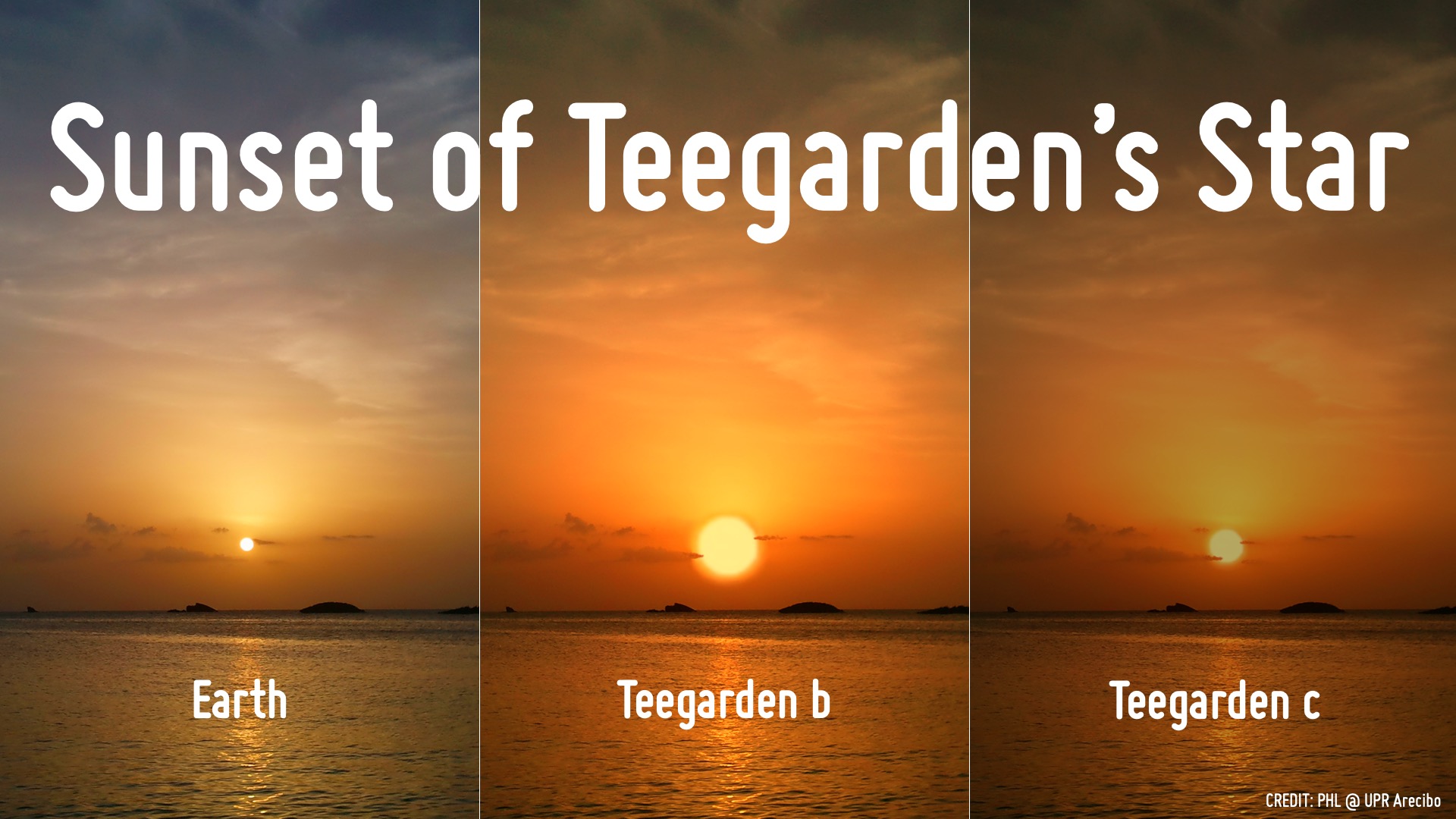
This is how the star Teegarden might look at sunset on its two “habitable” exoplanets, Teegarden b and c [PHL @ UPR Arecibo]

So, what is all the fuss about Teegarden’s Star?

This week, astronomers announced the discovery of two “habitable zone” exoplanets orbiting the tiny red dwarf star, which is located a mere interstellar stone’s throw away. While 12.5 light-years may sound like quite the trek, in galactic distances, that’s no distance at all. The two exoplanets, Teegarden b and c, are now in a very exclusive club, being the joint fourth-nearest habitable zone exoplanets to Earth (after Proxima Centauri b, Tau Ceti b and GJ 273 b). On the Earth Similarity Index (ESI), however, we have a new champion: Teegarden b—after considering its mass and derived surface temperature—this fascinating world is 95% “Earth-similar,” according to Abel Mendez’s analysis at the Planetary Habitability Laboratory (PHL). And like TRAPPIST-1, there’s some optimism that there should be more small exoplanets, some that may also be habitable, that have yet to be discovered around Teegarden.

All of these facts are cause for celebration, no? They are, but a heavy dose of reality needs to be applied when it comes to any world that has been discovered beyond our solar system.

More Exoplanets, More Possibilities

As alien planet-hunting missions continue to add more worlds to the vast menagerie of known exoplanets that exist in our galaxy, an increasing number of them are falling inside the “habitable zone” category.

Top 19 potentially habitable exoplanets, sorted by similar size and insolation to Earth [PHL @ UPR Arecibo]

The habitable zone around any star is the distance at which a rocky planet can orbit where it’s neither too hot or too cold for liquid water to exist on its surface (if it has water, that is). Liquid water is the stuff that Earth-like biology has an affinity to; without it, life on Earth wouldn’t have evolved. So, even before we have any clue about its H2O-ness, if an exoplanet is seen to have an orbit around its star that is deemed habitable, that’s +1 point for habitability.

Now, the next point can only be won if that world is also of approximate Earth-like size and/or mass. There would be little reason in getting too excited for a Jupiter-sized exoplanet sitting in the habitable zone possessing liquid water on its “surface” (because it won’t have a surface). That’s not to say there can’t be some gas giant-dwelling balloon-like alien living in there, but we’re looking for Earth-like qualities, not awesome alien qualities we read in science fiction. (I’d also argue that these kinds of exoplanets might have habitable Earth-sized moons—like Avatar‘s Pandora—but that’s for another article…)

The two key methods for exoplanet detection is the “radial velocity” method and the “transit” method. The former—which precisely measures a star’s light to detect tiny stellar wobbles as an exoplanet gravitationally “tugs” at it as it orbits—can deduce the exoplanet’s mass, thereby revealing whether or not it has an Earth-like mass (Teegarden’s two worlds were discovered using this method). The latter—which was employed by NASA’s Kepler space telescope (and now NASA’s Transiting Exoplanet Survey Explorer, among others) to look for the slight dips in brightness as an exoplanet passes in front of its star—can deduce the exoplanet’s physical size, thereby revealing whether or not it has an Earth-like size. Should a habitable zone exoplanet possess either one of these Earth-like qualities, or both (if both methods are used on a target star), that’s another +1 point for its habitability.
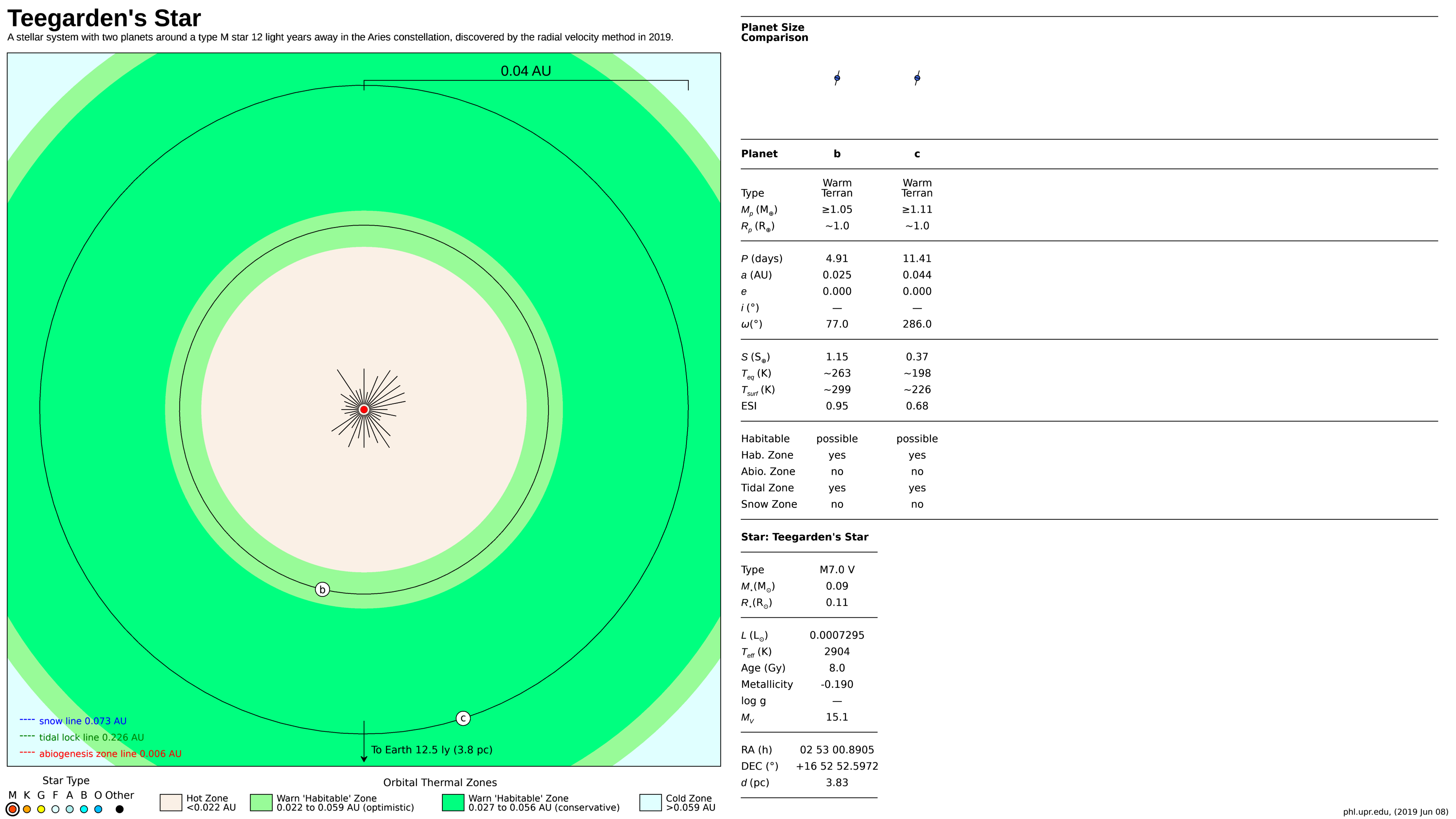
The orbital characteristics of Teegarden b and c, both falling well within the star’s habitable zone [PHL @ UPR Arecibo]

There’s a few other measurements that astronomers can make that may add to a hypothetical world’s habitability (such as observations of the host star’s flaring activity, age, or some other derived measurement), but until we develop more powerful observatories on Earth and in space, there are several factors that quickly cause our hypothetical exoplanet to diminish in habitable potential.

The Unhabitability of “Habitable” Worlds

So far in our burgeoning age of exoplanetary studies, we’ve only been able to measure (and derive) a handful of characteristics—such as mass, orbital period, physical size, density—but we have very little idea about these habitable zone exoplanets’ atmospheres. Apart from measurements of a few massive and extreme exoplanets—such as “hot-Jupiters” and exoplanets getting blow-torched by their star when they venture too close—astronomers haven’t been able to directly measure the existence of any of these “habitable” exoplanet’s hypothetical atmospheres. Do they even possess atmospheres? Or are they the opposite, with hellish Venus-like pressure-cooker atmospheres? Who knows. Even if they do have atmospheres that are more Earth-like, are the gases they contain toxic to life as we know it?

Recently, theoretical models of exoplanetary atmospheres brought carbon dioxide and carbon monoxide into the discussion. CO2 is a powerful greenhouse gas that helps maintain a balance in our atmosphere, regulating a temperate world (until industrialized humans came along, that is). But too much can be a very bad thing. For exoplanets existing on the outer edge of their habitable zone to remain habitable, they’d need massive concentrations of CO2 to remain temperate—concentrations that would render the atmosphere toxic (to complex lifeforms, at least). In the case of carbon monoxide (the terrible gas that asphyxiates anything with a cardiovascular system), as our star is so hot and bright, its ultraviolet radiation destroys large accumulations of CO in Earth’s atmosphere. But for habitable zone exoplanets that orbit cool red dwarf stars (like Teegarden), huge concentrations of CO may accumulate and snuff-out life before it has the opportunity to evolve beyond a germ. These two factors are a big negative against life as we know it, shrinking the effective habitable zone around certain stars and certain exoplanetary orbits.
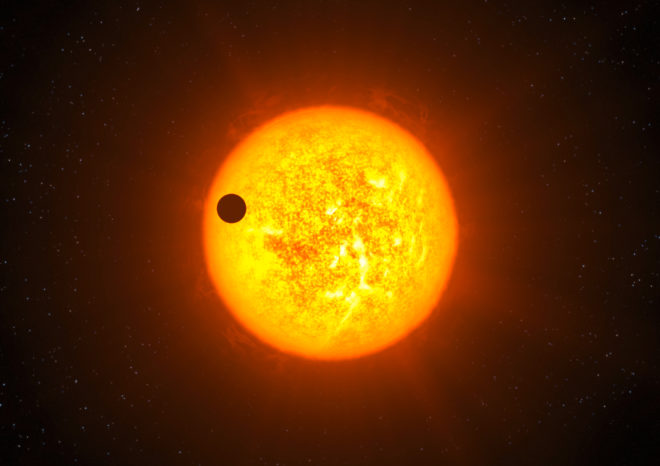
Artist impression of a transiting exoplanet [ESO]

Most habitable zone exoplanets have been found orbiting red dwarfs, primarily because our observations have been biased in favor of these little stars—they’re small and cool, meaning that any planet orbiting within their habitable zones need to get up-close and personal, so it’s an easier task to detect the periodic star wobbles or exoplanetary transits to confirm their existence.

While this may sound cute, orbiting so close to a red dwarf is a blessing (for astronomers) and a curse (for any unfortunate aliens). Many red dwarf stars generate powerful stellar flares that would regularly bombard nearby worlds with radiation that terrestrial biology would not be able to tolerate. Unless those planets have incredibly powerful global magnetic fields to, a) protect their inhabitants from being irradiated and, b) prevent the savage stellar winds from stripping away their protective atmospheres, there’s limited hope for the evolution of life.

Interestingly, however, according to the Teegarden study published in the journal Astronomy & Astrophysics, this particular red dwarf is relatively quiet on the life-killing flare front, so that’s something. Another tentative +1 for Teegarden’s actual habitability! (Pass the tequila.)

Known habitable zone exoplanets plotted against the type of star they orbit and distance from star. Note: all temperate worlds discovered so far orbit stars far cooler (and smaller) than the Sun [C. Harman]

As you can tell, there’s lots of exciting implications balanced by plenty of sobering reality checks. There is, however, one factor that is often missed from big announcements about worlds orbiting small stars that, whether they are habitable or not, is truly beyond our experience.

Eyeballing Temperate Red Dwarf Systems

Teegarden is an eight-billion-year-old star system, approximately twice the age of our solar system. If life has found a way, it will have come and gone, or be in an evolved state (though this is anyone’s guess, we have little idea about the hows and whys of the emergence of life on Earth, let alone on a different planet). But the worlds themselves, if either possess liquid water (Teegarden b, being the one that should be the most temperate of the pair, so will have the higher odds), they certainly wouldn’t look like Earth, even if they have Earth-like qualities.

Having settled billions of years ago, any orbital instabilities would have ebbed, and the planetary orbits would be clearly defined and likely in some kind of resonance with the other bodies in the star system. In addition, both Teegarden b and c will, in all likelihood, be tidally locked with their star.

To understand what this means, we need only look up. When we see our moon, we only see one hemisphere—the “near side”; the lunar “far side” is never in view. Except for the Apollo astronauts, no human has ever seen the moon’s far side with their own eyes. That’s because the moon’s rotation period (28 days) exactly matches its orbital period (28 days) around the Earth. Other examples of tidally-locked systems in the solar system are Pluto and its largest moon Charon, Mars and both its moons Phobos and Diemos, plus a whole host of moons orbiting Jupiter, Saturn, Uranus and Neptune.

The same tidal physics applies to red dwarf stars and their closely-orbiting worlds. And Teegarden b and c have very close orbits, zipping around the star once every five and eleven days, respectively, so they are very likely tidally locked, too.

So what does a habitable zone exoplanet orbiting a red dwarf star look like? Enter the “Eyeball Earth” exoplanet:
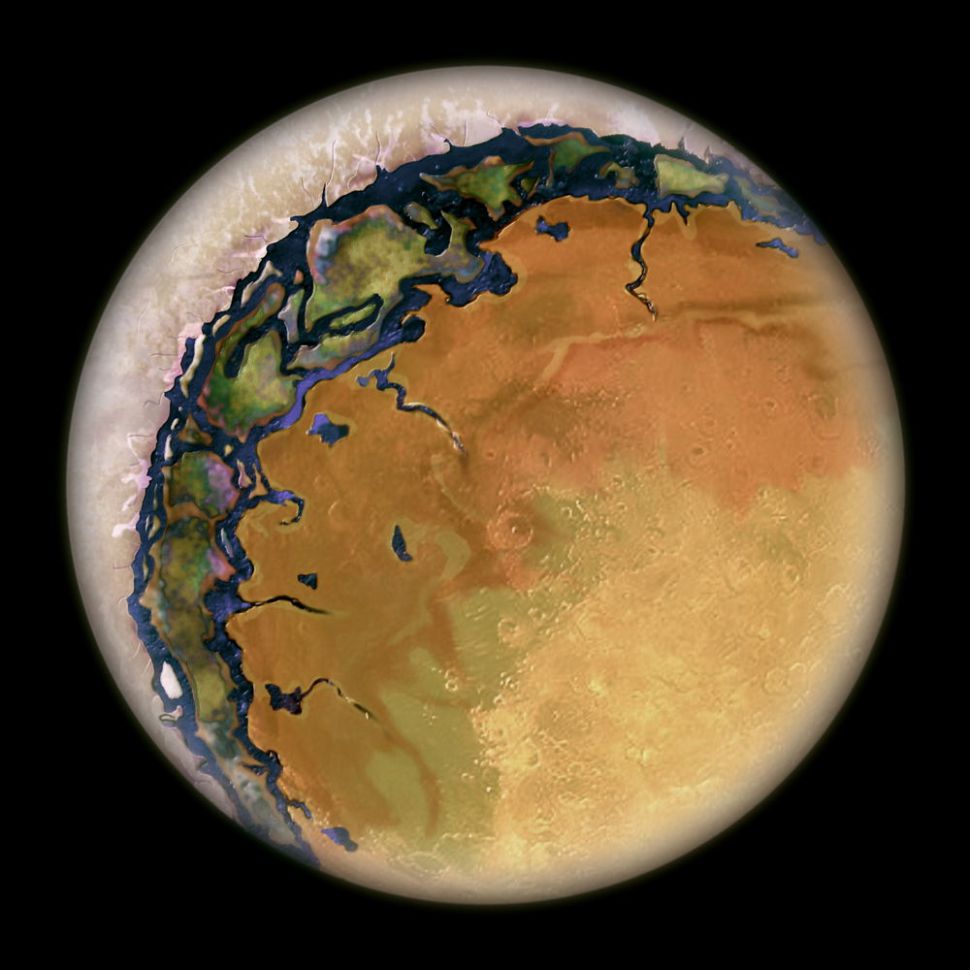
Earth-like, right? [source: Rare Earth Wiki]

I’ve written about this hypothetical world before and it fascinates me. As temperate exoplanets orbit red dwarfs so snugly, and if they have an atmosphere, they may too look like the above artistic rendering.

Looking like an eyeball, the star-facing hemisphere of the planet will be perpetually in daylight, whereas the opposite side will be in perpetual night. The near-side will likely be an arid desert, but the far side will be frozen. Computer simulations of the atmospheric dynamics of such a world are fascinating and well worth the read. The upshot, however, is that these worlds may have dynamic atmospheres where habitability is regulated by powerful winds that blast from the star-facing hemisphere to the night-side, transporting water vapor in a surprisingly complex manner. These worlds will never be fully-habitable, but they may host in interesting array of biological opportunities nonetheless.

For example, there may be a “ring ocean” that separates the desert from the ice, where, on one side, tributaries flow into the hot hemisphere only to be evaporated by the incessant solar heating. The vapor is then transported anti-star-ward, only to be deposited as it freezes on the night-side. One could imagine this massive buildup of ice on the planets night-side as an hemisphere-wide glacier that slowly creeps sun-ward, where it melts and pools into a temperate ring ocean where the process starts all over again.

Like Earth, the atmospheric dynamics would need to be balanced perfectly and if an alien ecosystem manages to get a foothold, perhaps such a planet-wide “water cycle” could be sustained while maintaining the life that thrives within.

“Hypothetically Habitable”

So, whenever we hear about the latest exoplanetary discovery, and take note that these strange new worlds are “Earth-like” or “habitable,” it’s worth remembering that neither may be accurate. Sure, finding an Earth-sized world in orbit around their star in the habitable zone is a great place to start, but it’s just that, a start. What about its atmosphere? Does it have the right blend of atmospheric gases? Is it toxic? Does it even have an atmosphere? Whether or not an alien world has a global magnetic field could make or break its habitable potential. Does its star have sporadic temper tantrums, dousing any local planets with a terrible radiation storm?

These challenges are no stranger to the astronomers who find these worlds and speculate on their astrobiological potential, but in the excitement that proceeds the discovery of “Earth-like” and “habitable” exoplanets, the headlines are often blind to the mechanics of what really makes a world habitable. The next step will be to directly observe the atmospheres of habitable exoplanets, a feat that may be within reach when NASA’s James Webb Space Telescope (JWST) and the ESO’s Extremely Large Telescope (ELT) go online.

The fact is, we know of only ONE habitable world, all the others are hypothetically habitable—so let’s look after this one while it can still sustain the rich and diverse ecosystem we all too often take for granted.
There’s Something Massive Buried Under the Moon’s Far Side

And it’s likely the massive metallic corpse of an ancient asteroid

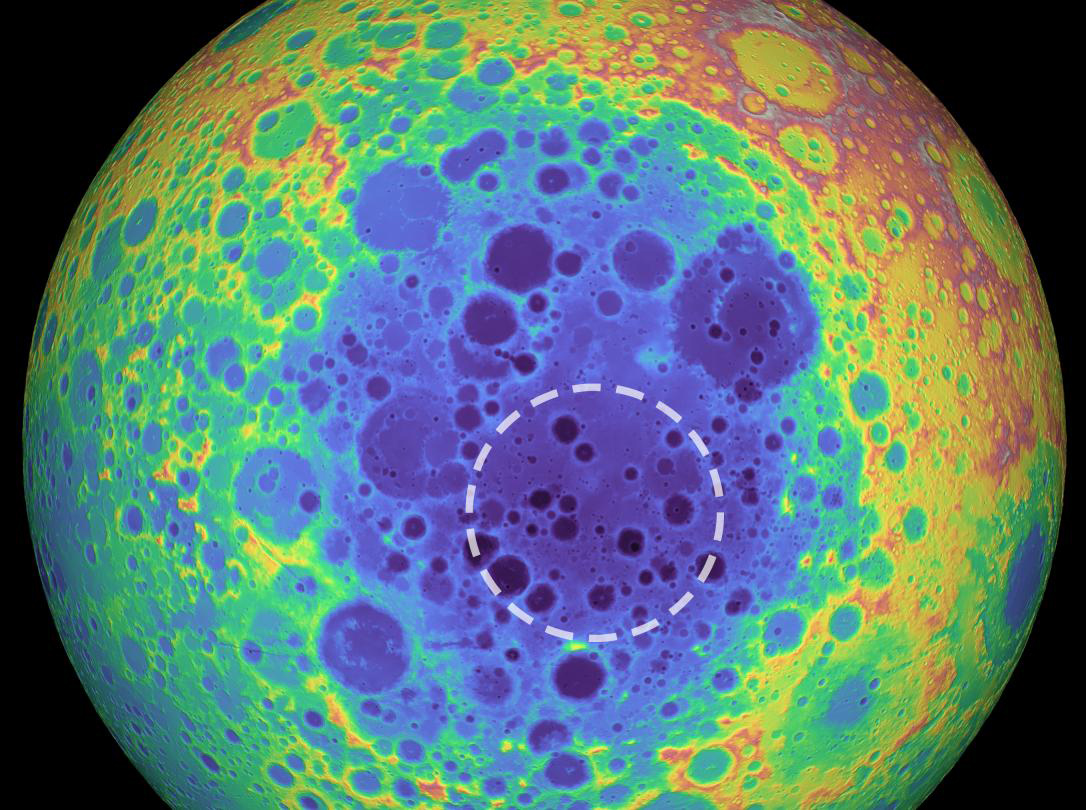
This false-color graphic shows the topography of the far side of the Moon. The warmer colors indicate high topography and the bluer colors indicate low topography. The South Pole-Aitken (SPA) basin is shown by the shades of blue. The dashed circle shows the location of the mass anomaly under the basin. [NASA/Goddard Space Flight Center/University of Arizona]

It may be Earth’s only natural satellite and our closest alien world, but the Moon still hides a multitude of mysteries under its surface—including something massive embedded in its far side.

As detailed in a new study published in the journal Geophysical Research Letters, researchers led by Baylor University analyzed data from NASA’s Gravity Recovery and Interior Laboratory (GRAIL) mission that orbited above the lunar surface for a little under a year in 2012.

The two GRAIL spacecraft flew one in front of the other, precisely measuring the distance of their separation in order to detect very small fluctuations in the Moon’s gravitational field. When the spacecraft passed over a region of higher density, the local gravitational field would become enhanced, slightly accelerating the leading spacecraft (called “Ebb”) before the trailing spacecraft (“Flow”) experienced that acceleration. By mapping these acceleration fluctuations, scientist have gained an invaluable understanding of density fluctuations deep below the Moon’s surface that would have otherwise remained invisible.

During this recent analysis, the researchers discovered a gravitational “anomaly” beneath the South Pole-Aitken basin—a vast depression on the lunar far side spanning 2,000 miles wide and several miles deep. This anomaly represents a huge accumulation of mass hundreds of miles below the basin.

“Imagine taking a pile of metal five times larger than the Big Island of Hawaii and burying it underground. That’s roughly how much unexpected mass we detected,” said Peter B. James, of Baylor University and lead author of the study, in a statement.

How did all that material end up buried inside the Moon’s mantle? The South Pole-Aitken basin was created four billion years ago in the wake of a massive asteroid impact. In fact, the basin is known to be one of the biggest impact craters in the solar system. If this crater was formed by an impact, it stands to reason that the gravitational anomaly is being caused by the dense metallic remains of the massive asteroid that met its demise when the Earth-Moon system was in the throes of formation.

“When we combined [the GRAIL data] with lunar topography data from the Lunar Reconnaissance Orbiter, we discovered the unexpectedly large amount of mass hundreds of miles underneath the South Pole-Aitken basin,” added James. “One of the explanations of this extra mass is that the metal from the asteroid that formed this crater is still embedded in the Moon’s mantle.”

There may be other explanations, one of which focuses on the formation of the Moon itself. As the lunar interior cooled after formation, the large subsurface mass could be an accumulation of “dense oxides associated with the last stage of lunar magma ocean solidification,” the researchers note.

The metallic corpse of an ancient asteroid is the leading candidate, however, and computer simulations carried out by the team indicated that if the conditions are right, the dense iron-nickel core of an asteroid can be dispersed inside the Moon’s mantle where it remains embedded today without sinking into the lunar core.

Although there were certainly larger asteroid impacts throughout the history of our solar system, the Moon’s South Pole-Aitkin basin is the largest preserved impact crater known, making it a prime candidate to study ancient impact sites

“[It’s] one of the best natural laboratories for studying catastrophic impact events, an ancient process that shaped all of the rocky planets and moons we see today,” said James.

It just so happens that we currently have a mission at the basin, exploring this strange and unexplored place. On Jan. 3, the Chinese Chang’e 3 mission achieved the first soft touchdown on the lunar far side, landing inside Von Kármán crater and releasing a robotic rover, Yutu-2, to explore the landscape. At time of writing, the mission is ongoing.

Toxic “Habitable” Worlds Could Be Havens for Alien Microbes

Don’t forget your spacesuit: Complex lifeforms, such as humans, would not survive on many of the worlds we thought would be interstellar tropical getaways

[Pixabay]

Worlds like Earth may be even rarer than we thought.

We live on a planet that provides the perfect balance of ingredients to support a vast ecosystem. This amazing world orbits the Sun at just the right distance where water can exist in a liquid state—a substance that, as we all know, is an essential component for our biology to function. Earth is also an oddball in our solar system, being the only planet where these vast oceans of liquid water persist on its surface, all enshrouded in a thick atmosphere that provides the stage for a complex global interplay of chemical and biological cycles that, before we industrialized humans came along, has supported billions of years of uninterrupted evolution and biological diversity.

Humans, being the proud intelligent beings that we profess to be, are stress-testing this delicate balance by pumping an unending supply of carbon dioxide into the atmosphere. Being a potent greenhouse gas, we’re currently living through a new epoch in our planet’s biological history where an exponential increase in CO2 is being closely followed by an increase in global average temperatures. We are, in effect, altering Earth’s habitability. Well done, humans!

While this trend is a clear threat to the sustainability of our biosphere, spare a thought for other “habitable” worlds that may appear to have all the right stuff for complex lifeforms to evolve, but toxic levels of the very chemicals that keep these worlds habitable has curtailed the possibility of complex life from gaining a foothold.

Welcome to the Not-So-Habitable Zone

Habitable zone exoplanets are the Gold Standard for exoplanet-hunters and astrobiologists alike. Finding a distant alien world within this zone—a region surrounding any star where it’s not too hot and not too cold for water to exist on its surface, a region also known as the “Goldilocks Zone” for obvious reasons—spawns a host of questions that our most advanced telescopes in space and on the ground try to answer: Is that exoplanet Earth-sized? Does it have an atmosphere? What kind of star is it orbiting? Does its system possess a Jupiter-like gas giant? These questions are all trying to help us understand whether that world has the Earthly qualities that could support hypothetical extraterrestrial life.

(Of course, there’s the debate as to whether all life in the universe is Earth-life-like, but as we’re the only biological examples that we know of in the entire galaxy, it’s the best place to start when pondering what biological similarities extraterrestrial life may have to us.)

The habitable zone for exoplanets is a little more complicated than simply the distance at which they orbit their host stars, however. Greenhouse gases, such as carbon dioxide, can extend the area of a star’s habitable zone. For example: If an atmosphere-less planet orbits beyond the outermost edge of its habitable zone, the water it has on its surface will remain in a solid, frozen state. Now, give that planet an atmosphere laced with greenhouse gases and its surface may become warm enough to maintain the water in a liquid state, thereby boosting its habitable potential.

But how much is too much of a good thing? And how might this determination impact our hunt for truly habitable worlds beyond our own?

In a new study published in the Astrophysical Journal, researchers have taken another look at the much-coveted habitable zone exoplanets to find that, while some of the atmospheric gases are essential to maintain a temperature balance, should there be too much of the stuff keeping some of those worlds at a habitable temperature, their toxicity could curtail any lifeforms more complex than a single-celled microbe from evolving.

“This is the first time the physiological limits of life on Earth have been considered to predict the distribution of complex life elsewhere in the universe,” said Timothy Lyons, of the University of California, Riverside, and director of the Alternative Earths Astrobiology Center.

“Imagine a ‘habitable zone for complex life’ defined as a safe zone where it would be plausible to support rich ecosystems like we find on Earth today,” he said in a statement. “Our results indicate that complex ecosystems like ours cannot exist in most regions of the habitable zone as traditionally defined.”

Toxic Limits

Carbon dioxide is an essential component of our ecosystem, particularly as it’s a greenhouse gas. Acting like an insulator, CO2 absorbs energy from the Sun and heats our atmosphere. When in balance, it stops too much energy from being radiated back out into space, thereby preventing our planet from being turned into a snowball. Levels of CO2 have ebbed and flowed throughout the biological history of our planet and it has always been a minor component of atmospheric gases, but its greenhouse effect (i.e. the atmospheric heating effect) is extremely potent and the human-driven 400+ppm levels are causing dramatic climate changes that modern biological systems haven’t experienced for millions of years. That said, the CO2 levels required to keep some “habitable” exoplanets in a warm enough state would need to be a lot more concentrated than the current terrestrial levels, potentially making their atmospheres toxic.

“To sustain liquid water at the outer edge of the conventional habitable zone, a planet would need tens of thousands of times more carbon dioxide than Earth has today,” said lead author Edward Schwieterman, of the NASA Astrobiology Institute. “That’s far beyond the levels known to be toxic to human and animal life on Earth.”

In the blue zone: some of the known exoplanets that fall within the habitable zones of their stars may have an overabundance of CO (yellow/brown), at a level that is toxic to human life. Likewise, the more CO2 (from blue to white) will become toxic at a certain point. The sweet-spot is where Earth sits, with Kepler 442b (if it has a habitable atmosphere) coming in second [Schwieterman et al., 2019. Link to paper]

From their computer simulations, to keep CO2 at acceptable non-toxic levels, while maintaining planetary habitability, the researchers realized that for simple animal life to survive, the habitable zone will shrink to no more than half of the traditional habitable zone. For more complex lifeforms—like humans—to survive, that zone will shrink even more, to less than one third. In other words, to strike the right balance between keeping a hypothetical planet warm enough, but not succumbing to CO2 toxicity, the more complex the lifeform, the more compact the habitable zone.

This issue doesn’t stop with CO2. Carbon monoxide (CO) doesn’t exist at toxic levels in Earth’s atmosphere as our hot and bright Sun drives chemical reactions that remove dangerous levels of the molecule. But for exoplanets orbiting cooler stars that emit lower levels of ultraviolet radiation, such as those that orbit red dwarf stars (re: Proxima Centauri and TRAPPIST-1), dangerous levels of this gas can accumulate. Interestingly, though CO is a very well-known toxic gas that prevents animal blood from carrying oxygen around the body, it is harmless to microbes on Earth. So it may be that habitable zone exoplanets orbiting red dwarfs could be a microbial heaven, but an asphyxiation hell for more complex lifeforms that have cardiovascular systems.

While it could be argued that life finds a way—extraterrestrial organisms may have evolved into more complex states after adapting to their environments, thereby circumventing the problems complex terrestrial life has with CO2 and CO—if we are to find a truly “Earth-like” habitable world that could support human biology, these factors need to be considered before declaring an exoplanet habitable. And, besides, we might want to make the interstellar journey to one of these alien destinations in the distant future; it would be nice to chill on an extraterrestrial beach without having to wear a spacesuit.

“Our discoveries provide one way to decide which of these myriad planets we should observe in more detail,” said Christopher Reinhard, of the Georgia Institute of Technology and co-leader of the Alternative Earths team. “We could identify otherwise habitable planets with carbon dioxide or carbon monoxide levels that are likely too high to support complex life.”

Earth: Unique, Precious

Like many astronomical and astrobiological studies, our ongoing quest to explore strange, new (and habitable) worlds has inevitably led back to our home and the relationship we have with our delicate ecosystem.

“I think showing how rare and special our planet is only enhances the case for protecting it,” Schwieterman said. “As far as we know, Earth is the only planet in the universe that can sustain human life.”

So, before we test the breaking point of our atmosphere’s sustainability, perhaps we should consider our own existential habitability before its too late to repair the damage of carbon dioxide emissions. That’s the only way that we, as complex (and allegedly intelligent) lifeforms, can continue to ask the biggest questions of our rich and mysterious universe.

Our Supermassive Black Hole Is Slurping Down a Cool Hydrogen Smoothie

The world’s most powerful radio telescope is getting intimate with Sagittarius A*, revealing a never-before-seen component of its accretion flow

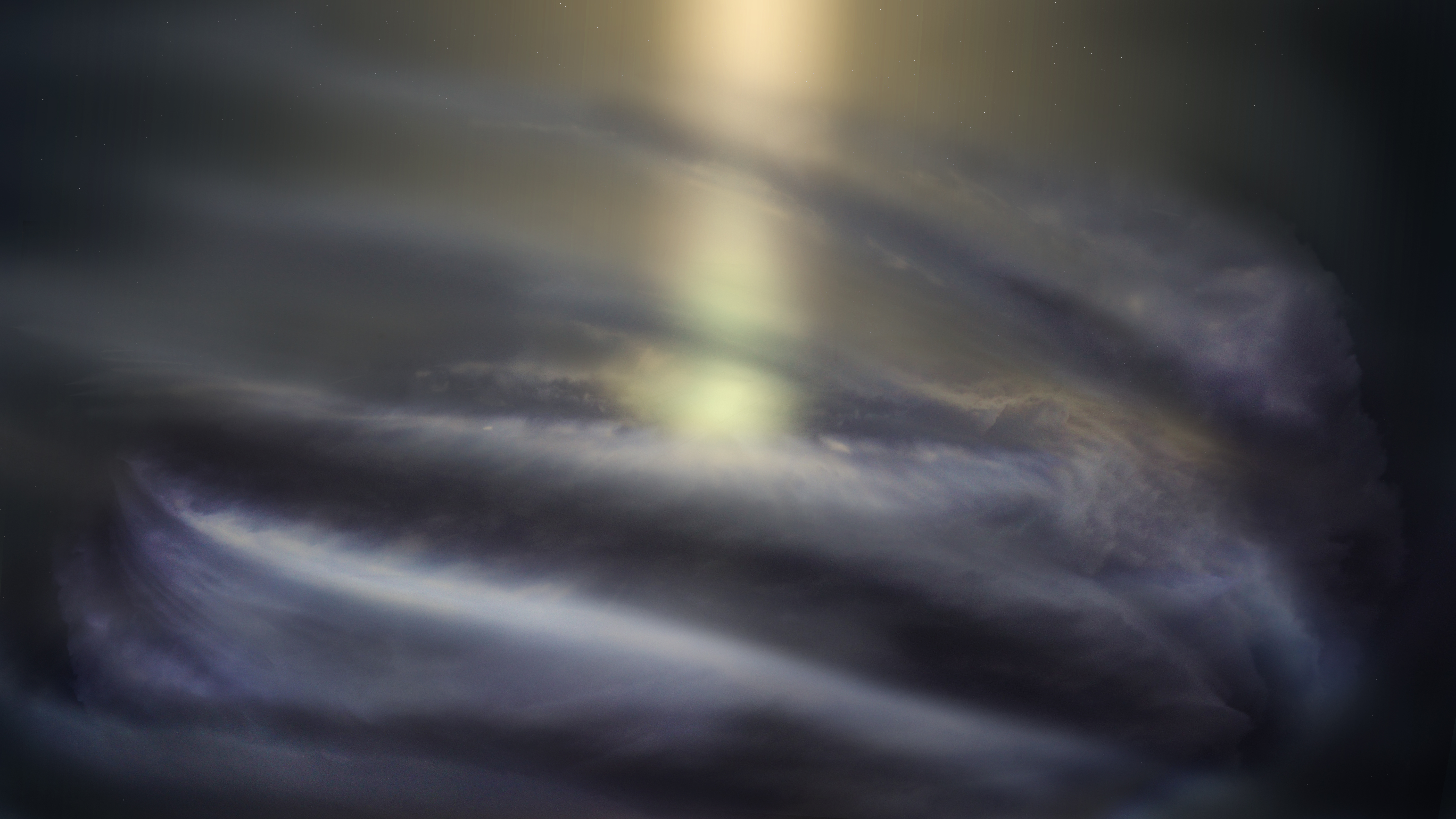
Artist impression of ring of cool, interstellar gas surrounding the supermassive black hole at the center of the Milky Way [NRAO/AUI/NSF; S. Dagnello]

As we patiently wait for the first direct image of the event horizon surrounding the supermassive black hole living in the core of our galaxy some 25,000 light-years away, the Atacama Millimeter/submillimeter Array (ALMA) has been busy checking out a previously unseen component of Sagittarius A*’s accretion flow.

Whereas the Event Horizon Telescope (EHT) will soon deliver the first image of our supermassive black hole’s event horizon, ALMA’s attention has recently been on a cool flow of gas that is orbiting just outside the event horizon, before being consumed. (The EHT delivered its first historic image on April 10, not of the supermassive black hole in our galaxy, but of the gargantuan six-billion solar mass monster in the heart of the giant elliptical galaxy, Messier 87, 50 million light-years away.)

While this may not grab the headlines like the EHT’s first image (of which ALMA played a key role), it remains a huge mystery as to how supermassive black holes pile on so much mass and how they consume the matter surrounding them. So, by zooming in on the reservoir of material that accumulates near Sagittarius A* (or Sgr A*), astronomers can glean new insights as to how supermassive black holes get so, well, massive, and how their growth relates to galactic evolution.

While Sgr A* isn’t the most active of black holes, it is feeding off limited rations of interstellar matter. It gets its sustenance from a disk of plasma, called an accretion disk, starting immediately outside its event horizon—the point at which nothing, not even light, can escape a black hole’s gravitational grasp—and ending a few tenths of a light-year beyond. The tenuous, yet extremely hot plasma (with searing temperatures of up to 10 million degrees Kelvin) close to the black hole has been well studied by astronomers as these gases generate powerful X-ray radiation that can be studied by space-based X-ray observatories, like NASA’s Chandra. However, the flow of this plasma is roughly spherical and doesn’t appear to be rotating around the black hole as an accretion disk should.

Cue a cloud of “cool” hydrogen gas: at a temperature of around 10,000K, this cloud surrounds the black hole at a distance of a few light-years. Until now, it’s been unknown how this hydrogen reservoir interacts with the black hole’s hypothetical accretion disk and accretion flow, if at all.

ALMA is sensitive to the radio wave emissions that are generated by this cooler hydrogen gas, and has now been able to see how Sgr. A* is slurping matter from this vast hydrogen reservoir and pulling the cooler gas into its accretion disk—a feature that has, until now, been elusive to our telescopes. ALMA has basically used these faint radio emissions to act as a tracer as the cool gas mingles with the accretion disk, revealing its rotation and the location of the disk itself.

“We were the first to image this elusive disk and study its rotation,” said Elena Murchikova, a member in astrophysics at the Institute for Advanced Study in Princeton, New Jersey, in a statement. “We are also probing accretion onto the black hole. This is important because this is our closest supermassive black hole. Even so, we still have no good understanding of how its accretion works. We hope these new ALMA observations will help the black hole give up some of its secrets.” Murchikova is the lead author of the study published in Nature on June 6.

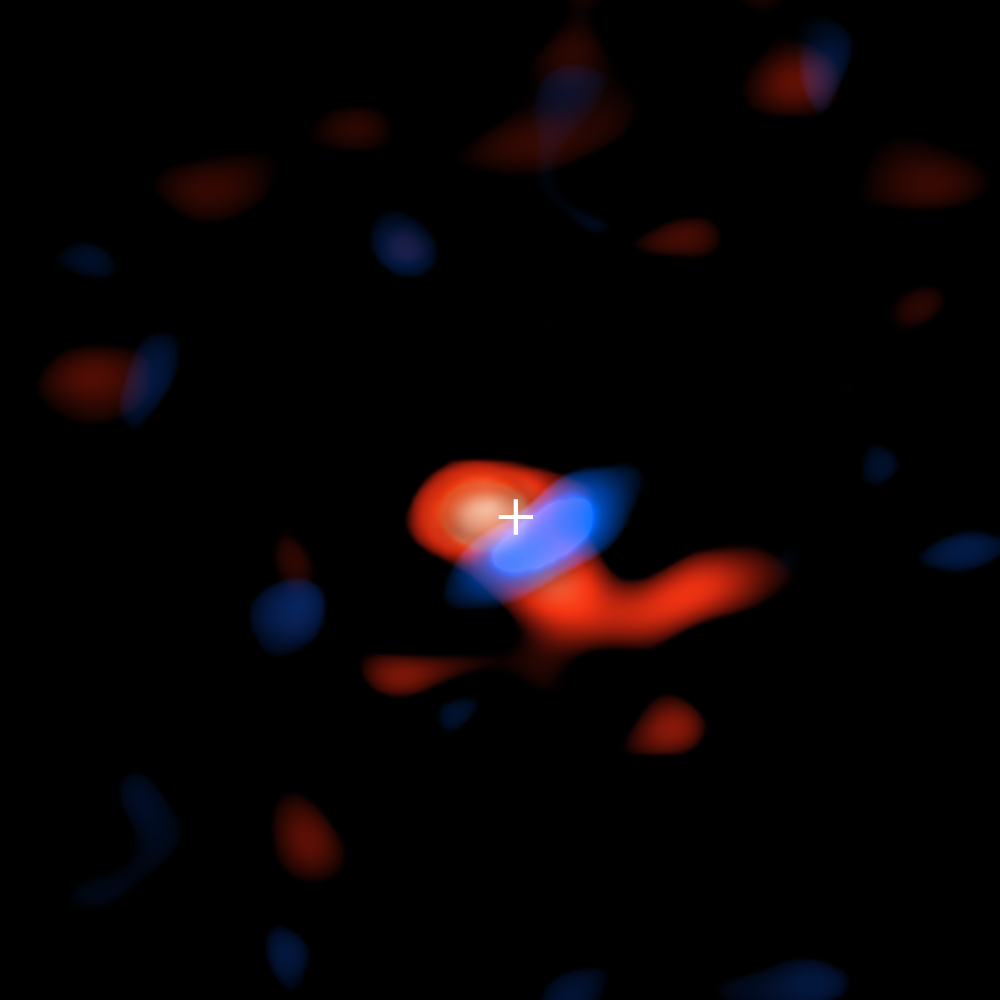
ALMA image of the disk of cool hydrogen gas flowing around the supermassive black hole at the center of our galaxy. The colors represent the motion of the gas relative to Earth: the red portion is moving away, so the radio waves detected by ALMA are slightly stretched, or shifted, to the “redder” portion of the spectrum; the blue color represents gas moving toward Earth, so the radio waves are slightly scrunched, or shifted, to the “bluer” portion of the spectrum. Crosshairs indicate location of black hole [ALMA (ESO/NAOJ/NRAO), E.M. Murchikova; NRAO/AUI/NSF, S. Dagnello]

Located in the Chilean Atacama Desert, ALMA is comprised of 66 individual antennae that work as one interferometer to deliver observations of incredible precision. This is a bonus for these kinds of accretion studies, as ALMA has now probed right up to the edge of Sgr A*’s event horizon, only a hundredth of a light-year (or a few light-days) from the point of no return, providing incredible detail to the rotation of this cool disk of accreting matter. What’s more, the researchers estimate that ALMA is tracking only a minute quantity of cool gas, coming in at a total only a tenth of the mass of Jupiter.

A small quantity this may be (on galactic scales, at least), but it’s enough to allow the researchers to measure the Doppler shift of this dynamic flow, where some is blue-shifted (and therefore moving toward us) and some is red-shifted (as it moves away), allowing them to clock its orbital speed around the relentless maw of Sgr A*.

“We were able to shed new light on the accretion process around Sagittarius A*, which is a typical example of a class of black holes that have little to eat,” added Murchikova in a second statement. “The accretion behavior of these black holes is quite complex and, so far, not well understood.

“Our result is potentially important not only for our galaxy, but to any galaxy which has this type of underfed black hole in its heart. We hope that this cool disk will help us uncover more secrets of black holes and their behavior.”