You may have noticed I’ve been a little quiet on the airwaves these last couple of weeks. This doesn’t mean all the space news of the world has slowed, or I’ve been any less active article writing, it’s just that life seems to happen during my regular Wednesday slot and I have to keep cancelling!
But not today, I’ll be on the air at 4pm PST/7pm EST for an extra special show, just before Captain Jack hits the mic in his brand new and shiny Badlands Radio (formally known as Paranormal Radio).
Black holes are as extreme as anything can get. When a massive structure can no longer sustain its own gravity, it will collapse to a point known as a singularity. For example, a massive star after it has gone supernova may leave one of these singularities behind, a remnant of massive star death, sucking any local matter into a one-way trip to the guts of space-time.
At a certain point, when light itself succumbs to the black hole’s gravity, an event horizon forms, beyond which universal physics breaks down; we have very little idea about what lies inside the event horizon. All we do know is that you don’t want to fall into one, you’d be stretched and spaghettified. Spaghettification is due to extreme (and when I say extreme, I mean as-extreme-as-it-can-get) tidal forces between your head to your toes.
So, the message is: Don’t play with black holes, it can only end in tears.
Now the Black Hole Health & Safety lecture is over, it’s time to talk about “black rings”. Under certain conditions, black holes may not be the mathematical singularities we once knew and (thought we) understood.
In a recent publication by Masashi Kimura at Osaka City University in Japan, the black ring idea is explored in 5-dimensional space. In the space-time we know and love, there are three spatial dimensions and one temporal dimension. We are four-dimensional creatures. When string theory came along in the 1980’s we really began to appreciate that there could be more than the four dimensions we live in.
Previously, cosmologists have entertained the thought that black rings may exist in our 4D space-time. However, the big problem comes when trying to understand how these structures maintain their shapes; surely they should simply collapse and form your regular black holes? Actually, it depends on how big they are and how the competing forces balance out.
As the Universe is expanding, it is thought black rings could exist if they are of scales similar to the cosmological constant (this constant was derived by Einstein to explain a “flat” Universe, but later it was found the constant was required to characterize the universal expansion as observed by Edwin Hubble in 1929). If a black ring exists in 4D space-time, its gravitational collapse would be countered by the expansion of space-time (as characterized by the cosmological constant).
The only analogy I can relate this to in the terrestrial world is bubble rings (or, indeed, smoke rings). When under water, a bubble will rise to the surface. However, under the constriction of surface tension, the bubble will form the smallest possible shape. When a bubble ring is produced, there needs to be a balance between surface tension and a vortex. The surface tension pulls in, while the vortex maintains the bubble ring shape, pushing out.
In the case of the black ring, gravity is pulling inward, while the expansion of space-time is countering it, pushing out. In this situation, in an expanding Universe, there could be enduring examples of black rings out there.
In Kimura’s research, not only are black rings a possibility, there could be a number of different complex shapes that could form when considering these extra dimensions. When the Universe was young, multiple interacting black rings may have been possible, eventually coalescing to form black holes.
Although this research is very interesting, it is hard to imagine how we could observe these higher-dimensional black rings. Would we see them as a singularity (i.e. a black hole) in our 4D space-time? Or would they even be unobservable for lower-dimensional beings such as ourselves?
I’ve always found asteroids to be fascinating. They are often surprisingly big, they contain a wealth of information about the history of the Solar System… and, let’s be honest, they’re frightening.
There are thousands of asteroids out there, often collecting in clearly defined belts or gravitationally stable regions known as Lagrangian points. However, many are not so well behaved; they seem to have their own agenda, flying around the Solar System in their own orbits, sometimes buzzing the Earth.
Fortunately, the vast majority of these rocks are harmless; if they hit our atmosphere they might create a dazzling light show, burning up, possibly even exploding as a fireball. Sometimes though, a big asteroid might be observed and astronomers become a little concerned. The next known threat that might hit us is the famous asteroid named Apophis that is expected to make an uncomfortably close encounter with Earth on April 13th, 2036. The odds of Apophis hitting us in 2036 (not 2029 as quoted in the above video) are 45,000:1, which may sound fairly unlikely, but if you start comparing those odds with dying in a plane crash, or being hit by a car, you’ll see that actually, a one in 45,000 chance are the kind of odds you’d happily quote when placing a bet in a Vegas casino. I have a chance!
Yes, and there’s also a chance of a 350 metre-wide asteroid hitting us in 2036, so perhaps we should start planning for the worst?
Fortunately, we have some lead time on Apophis, and we’ll learn more about the chunk of rock when it flies past the Earth in 2029. And that’s what it’s all about: lead time. If mankind spots a potentially deadly asteroid approaching us, we’ll need as much time as possible to nudge it off course.
In a video I just stumbled across on Discovery.com, Joseph A. Nuth III from NASA Goddard Spaceflight Center shares his views on what we could do to prevent a potential asteroid catastrophe. By developing asteroid deflection techniques, we’ll also be presented with an opportunity. As pointed out by Nuth, if we have the ability to deflect an asteroid, perhaps we can steer it into lunar orbit, so we can carry out mining operations…
From Pluto, looking at its icy moons in the Kuiper belt (NASA)
The Pioneer Effect is a mysterious observation of a number of man-made probes that venture through and beyond the Solar System. Originally noticed in the slight drift of the Pioneer 10 and Pioneer 11 spacecraft (launched in 1972 and 1973) from their calculated trajectories, scientists have been at a loss to explain the tiny, yet constant, extra-sunward acceleration.
However, there are other, more mundane ideas. Perhaps there is a tiny fuel leak in the probes’ mechanics, or the distribution of heat through the spacecraft is causing a preferential release of infrared photons from one side, nudging them off course.
Finding an answer to the Pioneer effect probably won’t surface any time soon, but it is an enduring mystery that could have a comparatively simple explanation, within the realms of known science, but there’s also the possibility that we could also be looking at some entirely new physics.
In an attempt to single out whether the Pioneer anomaly is an artefact with the spaceships themselves, or unknown in the physics of the Universe, astronomers decided to analyse the orbits of the planets in the outer Solar System. The rationale being that if this is a large-scale influence, some observable periodic effects should be evident in the orbit of Pluto.
So far, no effect, periodic or otherwise, has been observed in the orbit of Pluto. If the effect isn’t big enough to influence Pluto, does this mean we can narrow the search down to spaceship-specific artefacts?
Not so fast.
Gary Page and John Wallin from George Mason University in Virginia and David Dixon from Jornada Observatory in New Mexico, have published a paper pointing out that the suggestion that the Pioneer effect doesn’t influence Pluto is flawed. Pluto’s orbit is far less understood than the orbits of the inner Solar System planets, as, let’s face it, Pluto is far away.
We simply don’t possess the data required to cancel out the Pioneer effect on planetary bodies in the outer-Solar System to reach the conclusion the anomaly doesn’t influence Pluto.
“Of course, this does not mean that the Pioneer effect exists. It does mean that we cannot deny the existence of the Pioneer effect on the basis of motions of the Pluto as currently known.” — Page et al., 2009
So, back to the drawing board. This is a fascinating study into a true Solar System mystery; bets are on as to the real reason why our interplanetary probes are being knocked off course…
You remember last month’s fuss over a certain component of the International Space Station, don’t you? You know, the NASA node-naming competition that a certain US comedian managed to dominate, ultimately winning the popular vote to name the node after himself? Come on, you must remember? The vote that NASA ultimately decided wasn’t very suitable and went with “Tranquillity” instead? Ah yes, that competition!
Although space scientists are not so keen on naming components of the space station after Colbert, zoologists don’t have the same concerns about naming something after a living person. Two entomologists, Quentin Wheeler at Arizona State University and Kelly Miller at the University of New Mexico, have named a Venezuelan diving beetle after him, the mighty Agaporomorphus colberti. This is in honour of Colbert’s 45th birthday on May 13th.
Although it is great to be named after a small creature that enjoys paddling in the depths of South American ponds, I wonder if it’s any match for being named after an orbiting running machine for astronauts? After reading the honours list in the beetle world, I think I’d still prefer to have the unique privilage of astronauts saying, “I’m off to the COLBERT to stave off any muscle wastage…”
The pair have named beetles to honor the late rock ‘n’ roll legend Roy Orbison and his widow Barbara (Orectochilus orbisonorum); for fictional “Star Wars” character Darth Vader (Agathidium vaderi); and for former President George W. Bush, former Vice President Dick Cheney, and former Secretary of Defense Donald Rumsfeld (Agathidium bushi, A. cheneyi and A. rumsfeldi).
Agathidium vaderi? No way! Can I get one as a pet?
Still, good for Wheeler and Kelly. They’ve drummed up some interest in diving beetles and created some popular media attention for their area of science.
What does this have to do with space? Not a lot, just thought Agaporomorphus colberti sounded cool.
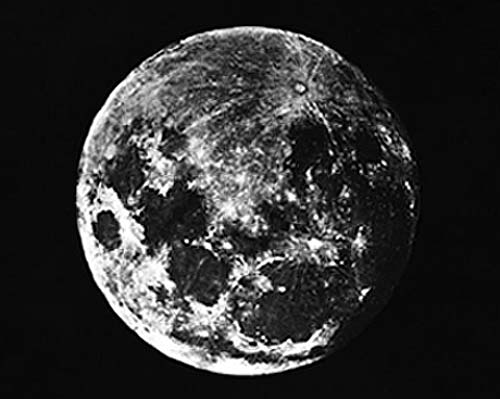
This is the first ever photograph taken of the Moon. The first. 170 years ago!
I was directed to the image by Twitter friend LouisS and I felt compelled to post it on Astroengine.com. Much like the 1911 Martian canal post last month, this serves as a reminder about the heritage of modern astronomy that dates back not decades, but centuries.
The 1839 photograph was taken by British ex-pat John William, a chemistry professor in the New York University, using a silver platinum plate.
Here’s a problem we didn’t see coming. Actually, we might have guessed it could be an issue, but thought, “no way, this is space travel we’re talking about!” But yes, red tape might get in the way of space tourism interests in the USA. In particularly, if you’re not an American citizen.
US export controls could potentially throw a problem or two into the space tourism mix, preventing non-US fee-paying customers from taking a ride on Virgin Galactic’s SpaceShipTwo, or doing microgravity cartwheels inside Bigelow’s Sundancer space hotel.
Although Richard Branson is building the world’s first spaceport in New Mexico and XCOR has signed up its first Danish space tourist, the International Traffic in Arms Regulation (ITAR) rules might prevent non-US citizens from seeing the insides of space vehicles containing technology or equipment under the jurisdiction of ITAR.
It’s a national security “thing”.
It’s funny how rules and regulations get in the way of things, but this is possibly the worst time for the issue to crop up. US companies are already promoting and selling their tickets for sub-orbital joyrides to international consumers, what if a British $200,000 ticket-holder turns up at their spaceplane, only for space border control to tell you to go home? Not so good for business is it? In fact, that’s the kind of thing that prevents you from doing business with international clients. To make it worse, potential European space tourism companies are marketing “ITAR-free” components and technologies, thereby creating untouchable competition.
However, despite the concern, I’m thinking there will be a few work-arounds for the ITAR. Key to the regulations is that ITAR covers tech and passengers. How about cutting out the “passengers” bit?
One of my favourite spaceflight companies, Bigelow Aerospace, has asked the same question and has been forward-thinking enough to lobby the government to change ITAR rules. “We think hardware should be [covered] under ITAR,” said Michael Gold, director of Bigelow Aerospace’s Washington office, “but passengers should be exempted.”
It would appear Congress needs some convincing that this particular ribbon of red tape needs to be cut.
“Congress created a bigger problem than already existed,” said Rep. C.A. Ruppersberger (D-Md.), who oversees these regulations on the House Select Committee on Intelligence. Unless ITAR is reformed, space commercialization could shift toward China or Russia. However, a lot of committees are being consulted and paperwork is being re-shuffled to find a solution to this issue before real damage is done to a (potentially) revolutionary burgeoning industry in the US.
A balance between space commerce and national security needs to be found, without compromising either to international entities.
I don’t usually post two identical stories within a few days of one another, but when I saw this image on SpaceWeather.com I had to comment on it. On Friday, I was captivated by the astounding astrophotography by Nicolas Biver as he tracked the space station with video camera and telescope, to capture some great detail of the manned outpost as it passed over France. With a bit of luck and a whole world of skill, Biver observed a bright space station flare.
Next up, it’s the turn of Martin Gembec. On May 2nd, he grabbed this superb trail as the station passed through the distinctive edge-on disk of our galaxy over the Czech Republic. What’s more, the station flared as its huge solar arrays reflected sunlight through Gembec’s ‘scope… right at the moment when the station travelled through the hazy starlit disk of the Milky Way.
“We were watching a bright flyby of the space station when the ISS surprised us with a big flare in the Milky Way,” said Gembec. “At maximum, the ISS reached magnitude -8.”
A magnitude of -8 makes this flare a beast; that’s 25× brighter than Venus and 400× brighter than the star Sirius.
In the photo above, there is a rather ominous piece of kit attached to a boom reaching into the centre of the image. This is a reflection of Gembec’s Canon 30D camera (that took the picture as the ISS passed overhead) in an all-sky mirror. The mirror is in a concave shape to collect the starlight from the sky, bouncing the light into the camera lens. It acts much like a satellite dish; except it doesn’t bounce and focus radio waves into an antenna, the all-sky mirror reflects visible light and focuses it into the open camera shutter. As you can see, the results are visually stunning.
It’s one of those occasions when you’re not sure whether you should laugh… or hold back your giggling because you realise you’re witnessing some very well produced train-wreck TV.
Oh yes, it can mean only one thing, Walter Wagner is back! But this time, the media came prepared.
Yes, it was the Jon Stewart Show, and yes it was satire, but this time the joke was on the crackpot notion that the Large Hadron Collider (LHC) could actually cause harm to the world.
Now, Wagner has been caught out and been made a fool of. Although I hate to see anyone in this situation, in this case, I think it is needed. Wagner only has himself to blame. He started these doomsday theories, now it’s up to mainstream comedy shows to debunk his authority on the subject.
Hold on, did he ever have an authority over physics? Oh yes, that’s right. No, he didn’t. He used the media as a tool to gain attention.
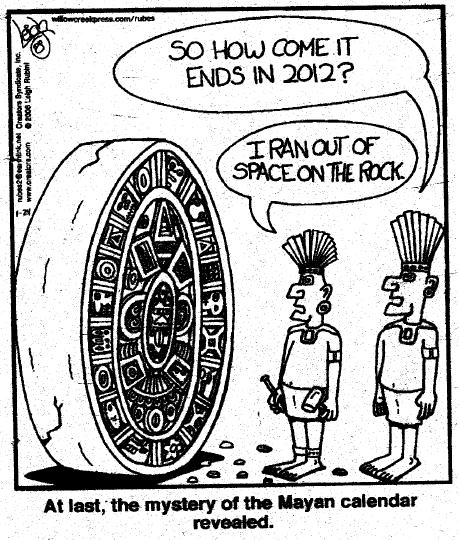
The Mayans built a calendar so they could better organize their time, document historical events and enable them to make plans for the future (like any good calendar does). So, out of necessity, the Mayans put together an amazingly complex system of embedded calendars of various lengths. They came up with an innovative idea so they didn’t have to rely on short-term cyclical calendars (the longest was only 52 years), they created one of the first number-based calendars devised:
“The Mayans had a solution. Using an innovative method, they were able to expand on the 52 year Calendar Round. Up to this point, the Mayan Calendar may have sounded a little archaic – after all, it was possibly based on religious belief, the menstrual cycle, mathematical calculations using the numbers 13 and 20 as the base units and a heavy mix of astrological myth. The only principal correlation with the modern calendar is the Haab’ that recognised there were 365 days in one solar year (it’s not clear whether the Mayans accounted for leap years). The answer to a longer calendar could be found in the “Long Count”, a calendar lasting 5126 years.” — Me, “No Doomsday in 2012“, Universe Today, May 19th, 2008 (there’s nothing quite like pimping your own megahit articles!)
Palenque Museum Mayan glyphs (wyattsailing.com)
So, the Mayans created a number system that lasted 5126 years. Judging by their love of cycling calendars that reset after 260 days (Tzolk’in calendar), 365 days (Haab’) and 52 years (Calendar Round), isn’t it logical to assume the Long Count calendar was designed to do the same thing? And why didn’t the Mayans explicitly say: “the Long Count will cycle again after 5126 years“? That’s because they were still in their first cycle. And within this first cycle, their entire civilization rose and and crashed back down again. They never got the chance to experience one whole cycle, resetting the Long Count or, indeed, simply extending it.
In short, the world isn’t going to end in 2012 (the coincidental end-date of the Mayan Long Count calendar), it’s the last stand of an ancient culture.
It’s actually rather sad; assuming the historians are correct, and the Long Count does end on December 21st, 2012, that is the final end date for an entire civilization. Although their cities may have crumbled and civilization faded into the history books, at least the Mayans had a calendar that endured hundreds of years after their downfall. The Mayan Long Count calendar outlived a civilization, perhaps December 21st, 2012, should be a celebration of a lost mesoamerican race, as this date will truly be the end of ancient Maya.





 astroengine.com