Astroengine Roundup: Time Machines, Stealth Solar Eruptions, Comet Oxygen

As I freelance for other websites, I thought I’d begin posting links and summaries here on a quasi-regular basis so you can keep up with the other space stuff I write about. So, to kick off the Astroengine Roundup, here you go:

Using TARDIS to Mathematically Travel Through Time (HowStuffWorks.com)

time-travel
HowStuffWorks

Ever since H. G. Wells wrote “The Time Machine” in 1895, we’ve been fascinated with the possibility of magically bouncing around through history. But it wasn’t until Einstein published his historic theory of general relativity that scientists (and science fiction writers) realized that time wasn’t necessarily as ridged as classical theories predicted. After a thought-provoking chat with general relativity expert Ben Tippett, of the University of British Columbia, I was able to get the lowdown on his mathematical model of a time machine called… TARDIS.

Comets Are Oxygen Factories (HowStuffWorks.com)

comet
ESA

When Europe’s Rosetta mission discovered molecular oxygen venting from comet 67P/Churyumov-Gerasimenko in 2015, scientists were weirded out. In space, molecular oxygen (O2, i.e. the stuff we breathe) is highly reactive and will break down very quickly. The working theory was that the O2 had been locked in the comet’s ices for billions of years since the solar system’s earliest moments, but new research suggests that 67P is actually producing its own O2 right this moment from a complex interplay between the venting water molecules and chemicals on the comet’s surface. Yes, comets are therefore molecular oxygen factories.

Not So Fast: Magnetic Mystery of Sun’s ‘Stealth’ Eruptions Uncovered (SPACE.com)

stealthcme2a
NASA’s Goddard Space Flight Center/ARMS/Joy Ng

Coronal mass ejections, or CMEs, are the most dramatic eruptions that our sun can produce. If they are Earth-directed, these magnetized bubbles of superheated plasma can cause all kinds of issues for our high-technology civilization. Usually, space weather forecasters do a great job of at least predicting when these eruptions might be triggered in the sun’s lower corona, but there’s a different type of CME — the so-called “stealth” CME — that appears to come out of nowhere, created by the complex interplay of magnetic fields high in the sun’s atmosphere.

NASA Competitions (SPACE.com: 1, 2)

level1cylinder_plastic_and_dust

There’s been a couple of updates from NASA challenges and competitions these last few days. The first was the announcement of the High Performance Fast Computing Challenge (HPFCC), which challenges coders with some time on their hands to better optimize supercomputer software for NASA’s simulations of aeronautics models. The second was the announcement of the first winners of Phase 2 of NASA’s 3D-Printed Habitat Challenge — a competition that hopes to pull in talent from a range of backgrounds to ultimately develop the technology to 3D print habitats on Mars and beyond.

~Ad astra
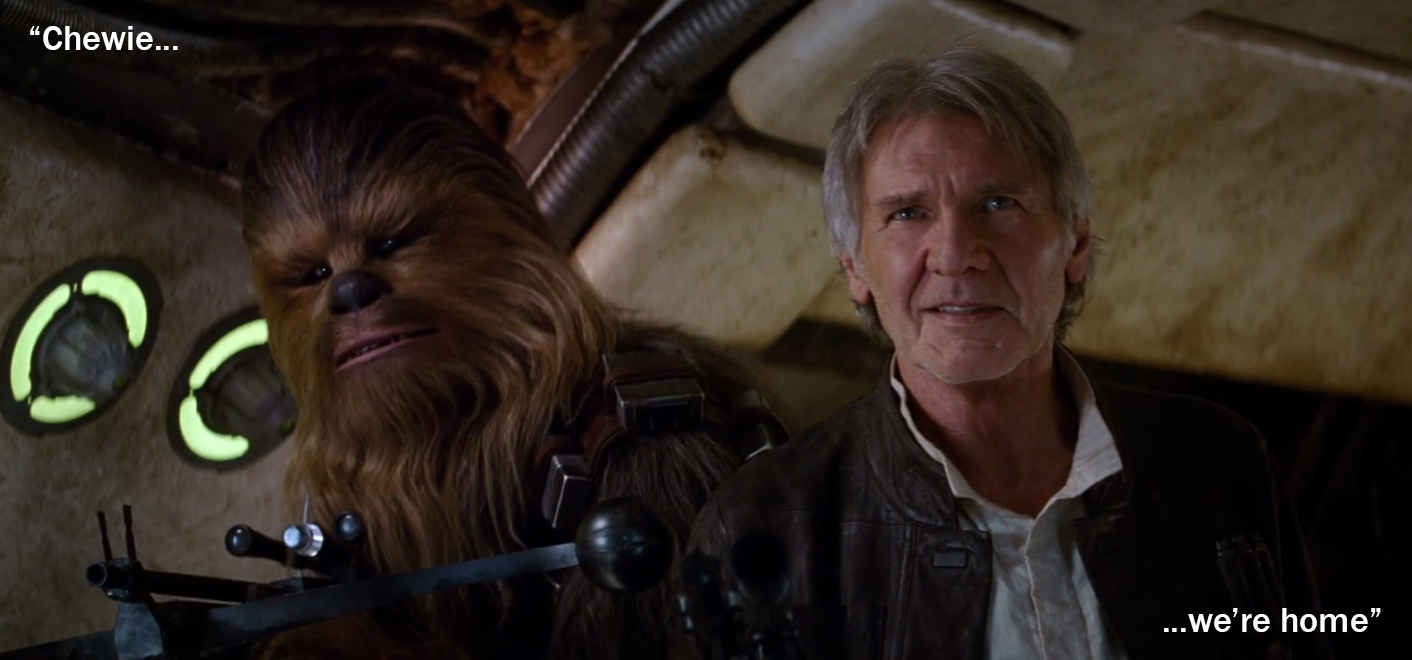
“Chewie, We’re Home.”

Credit: Lucasfilm/Disney

I know that Star Wars lovers everywhere are currently on their nth replay of the brand new The Force Awakens movie trailer, and for good reason. BECAUSE IT IS JUST PURE AWESOMENESS.

Seriously.

There were tears.

I have nothing else to add, except, for the first time in my adult life I can’t wait til Christmas.

Keep hitting repeat. And again:

Battlestar Galactica’s “Twelve Colonies of Kobol” Star System Found?

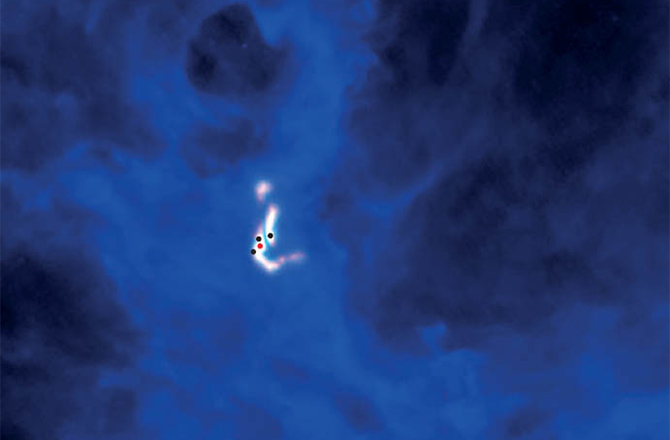
An image at radio wavelengths of a young stellar quadruplet. Credit: CfA/Nature/Pineda

825 light-years away, in the constellation of Perseus, hides one protostar and three previously unseen gas concentrations that are undergoing gravitational collapse — basically embryos of soon-to-be baby stars. Found through the analysis of data from radio telescopes by astronomers at the Harvard-Smithsonian Center for Astrophysics (CfA), this tiny cluster of baby stars occupy a small volume only 10,000 AU across — meaning that they’d all easily fit within the confines of the boundaries of our solar system (yes, the Oort Cloud is the solar system’s outermost boundary).

This is exciting for a couple of reasons. Firstly, this little ‘stellar womb’ has given astronomers an opportunity to study the genesis of a multi-star system. Indeed, most stars in our galaxy belong to multi-star systems, whether that be binary or greater, and astronomers are currently trying to figure out whether they were born this way or whether, over time, stars jostled around and eventually became gravitationally bound. After analysis of the velocities of the protostar and stellar embryos, it appears that the masses are gravitationally interacting. In other words, it has the potential to mature into a quadruple star system in around 40,000 years, a minute amount of time in cosmic timescales. Although it is likely that the system will become unstable, possibly ejecting one or two of the stars in the process, it does provide observational evidence that multi-star systems can be born in a gravitational embrace.

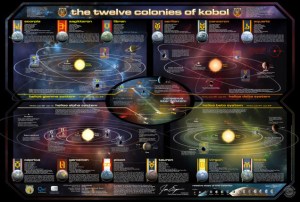
A map of the Twelve Colonies via io9.com

But as I have a habit of linking astrophysical studies with science fiction imaginings, when I first saw this research, I immediately thought of the awesome re-imagined series’ Battlestar Galactica and Caprica.

Battlestar Galactica is set in the years following the Cylon attack on the Twelve Colonies of Kobol, which almost wiped out humanity in this far-flung part of the galaxy. The remaining survivors, headed by William Adama (Edward James Olmos), take to the stars in a fleet of ragtag spaceships in search of the fabled Earth. One of my favorite scifi storylines and favorite scfi TV shows. But I digress.

The Twelve Colonies consist of four stars — Helios Alpha, Helios Beta, Helios Delta and Helios Gamma — each with their own systems of planets, 12 in total, including capital world Caprica.

So that poses a question: Just because Battlestar Galactica imagines a quadruple star system (well, two binary systems in a mutual orbit), is it possible to have such a stable system of planets evolve in a multi-star system? Or are the gravitational interactions too complex for anything to coalesce and slot into stable orbits? Well, by understanding how multi-star systems evolve by finding examples like this embedded inside star forming molecular clouds, we may start to appreciate how common and how stable they are and whether accompanying planetary systems are a reality or something that will forever be confined to the Twelve Colonies.

READ MORE: Star Quadruplets Spied Growing Inside Stellar Womb (Discovery News)

On Mars, There’s No Asphalt

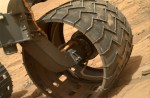
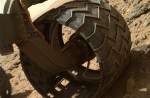
Curiosity's right-middle and rear wheels, bearing the scars of 488 sols of rough roving. Credit: NASA/JPL-Caltech
Curiosity’s right-middle and rear wheels, bearing the scars of 488 sols of rough roving. Credit: NASA/JPL-Caltech

If you’re like me, you hang off every news release and new photo from our tenacious Mars rover Curiosity. The awesome one-ton, six-wheeled robot is, after all, exploring a very alien landscape. But if there’s one thing I’ve learned from the mission, Mars is far from being a truly alien place. Sure, we can’t breath the thin frigid air, but we can certainly recognize similar geological processes that we have on Earth, and, most intriguingly, regions that would have once been habitable for life as we know it. This doesn’t mean there was life, just that once upon a time parts of Gale Crater would have been pretty cozy for terrestrial microbes. Personally, I find that notion fascinating.

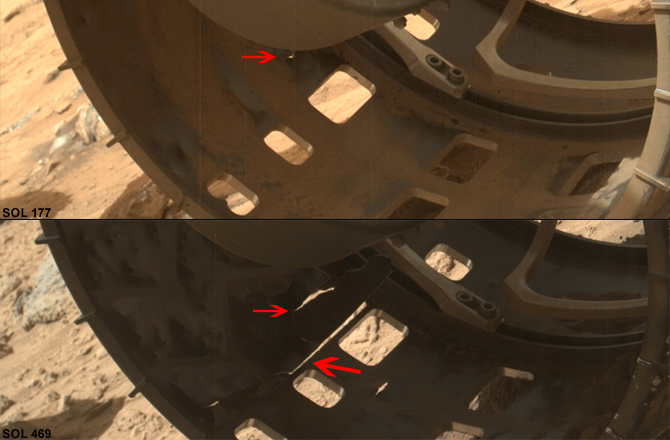
But, way back in May, I noticed something awry with our beloved rover’s wheels. Curiosity’s beautiful aircraft-grade aluminum wheels were looking rather beaten up. Punctures had appeared. Fearing the worst I reached out to NASA to find out what was going on. After a friendly email exchange with lead rover driver Matt Heverly, I felt a lot more at ease: The damage was predicted; dings, scratches, even holes were expected to appear in the thinnest (0.75 mm thick) aluminum between the treads. On Mars, after all, there is no asphalt. Also, erosion is a slower-paced affair in the thin winds and dry environment — sharp, fractured rocks protrude, embedding themselves into the wheels at every slow turn.

Then, on Friday, in a news update on Curiosity’s progress, JPL scientists mentioned that they would be commanding the rover to drive over a comparatively smooth patch to evaluate the condition of the wheels as their condition is getting worse. But isn’t that to be expected? Apparently not to this degree. “Dents and holes were anticipated, but the amount of wear appears to have accelerated in the past month or so,” said Jim Erickson, project manager for the NASA Mars Science Laboratory at NASA’s Jet Propulsion Laboratory, Pasadena, Calif.

So what are we looking at here?

curiosity-wheels-08-670x440-131220

All of the wheels are exhibiting wear and tear, but this particular ‘rip’ in aluminum is by far the most dramatic. But what does that mean for Curiosity? We’ll have to wait and see once JPL engineers have assessed their condition. Although this kind of damage has inevitably been worked into the the structural equations for the wheels’ load-bearing capabilities, whichever way you look at it, damage like this is not good — especially as Curiosity hasn’t even roved three miles yet.

But in the spirit of Mars exploration, Curiosity will soldier on regardless of how rough the red planet treats her.

Read more in my coverage on Discovery News, a location you’ll find me during most daylight (and many nighttime) hours:

R2-D2 On The Moon? Why Not!

"R2, where are you?" On the moon... Credit: NASA/Corbis/Ian O'Neill/Discovery News
“R2, where are you?” On the moon… Credit: NASA/Corbis/Ian O’Neill/Discovery News

Sometimes, all it takes is the slightest of hints before I start Photoshopping stuff on the Moon that shouldn’t be there.

We’ve seen the Banff crasher squirrel steal Buzz Aldrin’s thunder.

We’ve seen the Sarlacc monster gobble up the LCROSS booster.

(Meanwhile, on Mars, something odd happened to rover Spirit.)

And now! We have R2-D2 trundling across the lunar surface as the perfect Moon rover design for dodging levitating Moon dust. Don’t ask me, it’s SCIENCE!

(Note: The inspiration for R2-D2 was not my idea, blame Astronomy Now’s Keith Cooper for that stroke of genius. But the ‘shopping is totally my doing. I have a lot of time on my hands, apparently.)

Read more: Why R2-D2 Would be the PERFECT Moon Rover

Iain M. Banks, Science Fiction Genius, Dies at 59

Iain M. Banks
Iain M. Banks

It’s always hard when a person who inspired you in life dies. And for me, there are only a handful of people beyond my circles of family and friends who have, in some way, shaped my thinking.

But through his novels, Scottish writer Iain Banks had such a powerful impact on my teenage years that he, in no small way, gave me a new appreciation for science fiction and in doing so helped me pursue a higher education in astrophysics. Sadly, as he announced with his trademark wit only two months ago, Iain had terminal gall bladder cancer and today has died at the heartbreaking young age of 59. He will be sorely missed by the fiction and science fiction communities — he was a plain-speaking, powerful voice in life and a skillful genius when describing the worlds he created on paper.

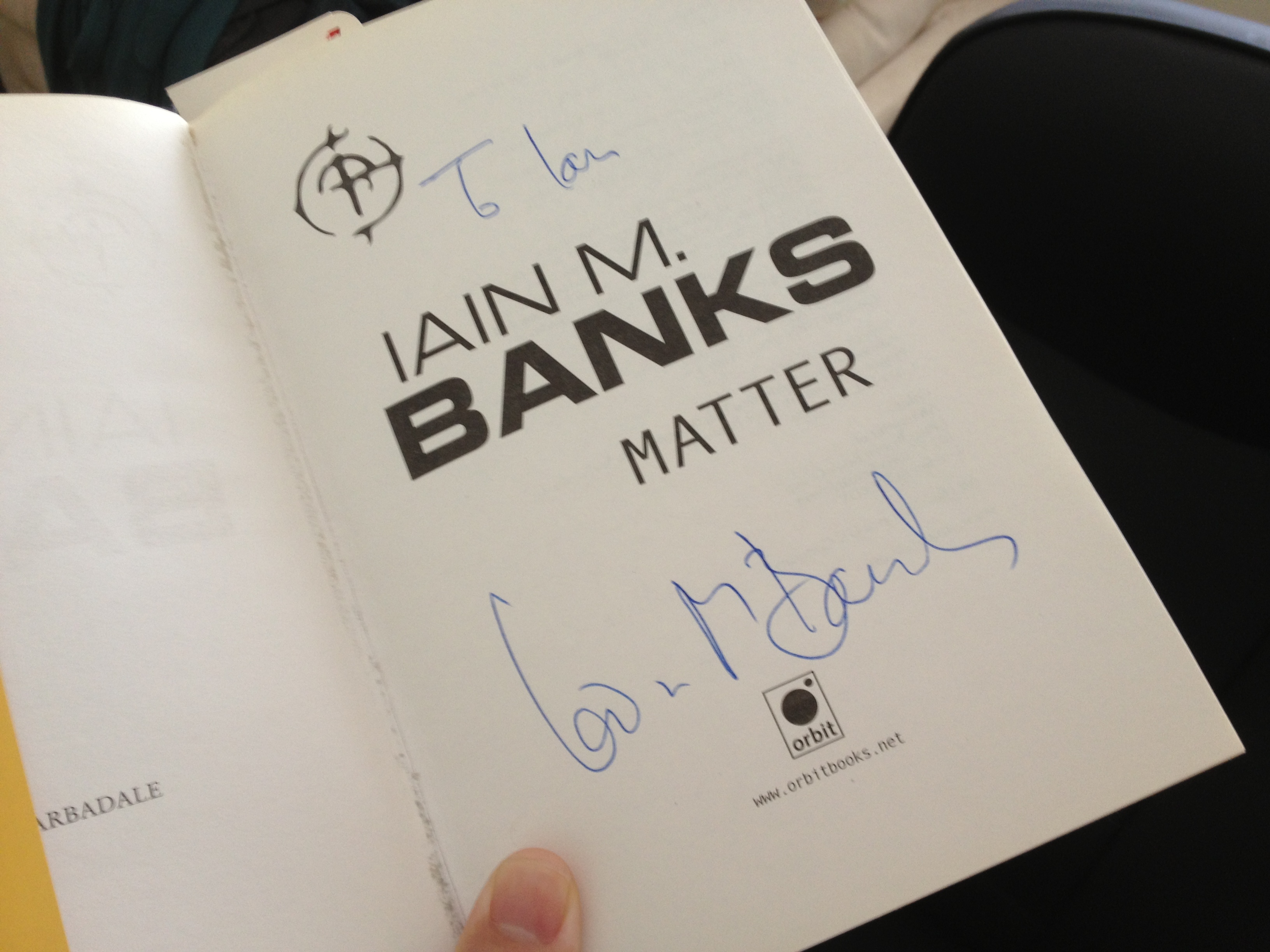
My signed copy of Iain M. Banks' "Matter" -- my mum sat in on one of Iain's book readings in Bristol that I couldn't attend and got a signed copy of the novel for me -- one of my most precious books.
My signed copy of Iain M. Banks’ “Matter” — my mum sat in on one of Iain’s book readings in Bristol that I couldn’t attend and got a signed copy of the novel for me — one of my most precious books.

Now, I’m not the biggest of readers, but when you pick up an Iain Banks (a.k.a. Iain M. Banks for his science fiction novels) book, it’s hard to put down. His first science fiction novel Consider Phlebas introduced us to the epic Culture universe — a vast interstellar multi-species civilization, of which Earth and humanity had been enveloped. The very notion of a post-scarcity, pan-galactic race seemed to hit the sweet spot of my imagination, so I hungrily read all of Iain’s Culture series, feeling the very notion of what science fiction is change in my brain. In a particularly tumultuous period of my life, I took on Iain’s fictional writing too, reading the deeply unsettling The Wasp Factory.

Iain’s writing is a constant source of surprise to me — he has this unique ability to shock, enlighten and entertain while creating such a fine tapestry of plot twists and deep characters that you quickly become lost in his words.

But for me, Iain’s imagination forced the very limits of science fiction, expanding my thoughts on what is possible in our Universe. This is why, while struggling with mathematics in my undergraduate years at the University of Aberystwyth that Iain M. Banks’ work became a welcome escape. When I began questioning some of the fundamental ideas behind physics and developed a thirst for advanced and, quite frankly, unfathomable concepts in astrophysics, Iain’s books became a huge source of inspiration.

Although many facets of my life threw me on a course that would eventually see me tackle a PhD in coronal physics and send me on a life-changing trip to Hawaii and ultimately land me in California, with my beautiful wife Debra, 5 rabbits and a job with the task of communicating awe-inspiring space science to the world, Iain’s fictional universe has always been there, complementing my life in a very real way.

I will always remember Iain and will continue reading his novels so that inspiration endures beyond his death. People who inspire you are few and far between, so when someone changes the way you think through the medium of their writing, you should never let them go.

Goodbye Iain, the Culture will forever be my inspiration.

About Those ‘Habitable’ Exoplanets (RT America Interview)

On Monday, I appeared on RT America’s live news broadcast to talk exoplanets — particularly the three small (possibly rocky) worlds that orbit the stars Kepler-62 and Kepler-69. It was a lot of fun discussing ‘Goldilocks Zones’ and the possibilities of extraterrestrials. Enjoy!

Discovery News coverage of Kepler-62:

The White House Approves NASA’s ‘James Bond’ Asteroid Bagging Mission

Screengrab from the NASA "Asteroid Retrieval and Utilization Mission" animation (NASA LaRC/JSC)
Screengrab from the NASA “Asteroid Retrieval and Utilization Mission” animation (NASA LaRC/JSC)

It’s been a looooong time since I last updated Astroengine.com, so first off, apologies for that. But today seems as good a time as any to crank up the ‘engine’s servers as the White House has rubber-stamped a manned NASA mission to an asteroid! However, this isn’t what the President originally had in mind in 2009 when he mandated the US space agency with the task of getting astronauts to an asteroid by the mid-2020’s.

In a twist, it turns out that NASA will be basing their manned asteroid jaunt on a 2011 Keck Institute study. To cut a long story short (you can read the long story in my Discovery News article on the topic: “NASA to Hunt Down and Capture an Asteroid“), NASA will launch an unmanned spacecraft to hunt down a small space rock specimen, “lasso” it (although “bagging” it would be more accurate) and drag the wild asteroid to park it at the Earth-moon Lagrangian point, L2. Then we can treat it like a fast food store; we can fly to and from, chipping off pieces of space rock, return samples to Earth and do, well, SCIENCE!

Great? Great.

Overall, this robotic capture/manned exoplration of an asteroid saves cash and “optimizes” the science that can be done. It also lowers the risk associated with a long-duration mission into deep space. By snaring an asteroid in its natural habitat and dragging it back to the Earth-moon system, we avoid astronauts having to spend months in deep space. The EML2 point is only days away.

But when watching the exciting NASA video after the news broke today, I kept thinking…

asteroid-grab2

But that wasn’t the only thing I was thinking. I was also thinking: what’s the point? It’s flashy and patriotic, but where’s the meat?

The human component of this asteroid mission has now been demoted to second fiddle. Sure, it will utilize NASA’s brand new Orion spacecraft and be one of the first launches of the Space Launch System (SLS), but what will it achieve? Astronauts will fly beyond Moon orbit, dock with the stationary space rock and retrieve samples as they please, but why bother with astronauts at all?

It is hoped that the robotic asteroid bagging spacecraft could launch by 2017 and, assuming a few years to steer the asteroid to EML2, a human mission would almost certainly be ready by the mid-2020s. But by that time, sufficiently advanced robotics would be available for unmanned sample retrieval. Heck, as telepresence technology matures, the EML2 point will be well within the scope for a live feed — light-time between Earth and the EML2 point will only be a few seconds, perhaps a little more if communications need to be relayed around the Moon. Robotics could be controlled live by a “virtual astronaut” on Earth — we probably have this capability right now.

The most exciting thing for me is the robotic component of asteroid capture. The advances in asteroid rendezvous and trajectory modification techniques will be cool, although scaling the asteroid bagging technique up (for large asteroids that could actually cause damage should they hit Earth) would be a challenge (to put it mildly). At a push, it may even be of use to a theoretical future asteroid mining industry. The rationale is that if we can understand the composition of a small asteroid, we can hope to learn more about its larger cousins.

The human element seems to be an afterthought and purely a political objective. There will undoubtedly be advancements in life support and docking technologies, but it will only be a mild taster for the far grander (original) NASA plan to send a team of astronauts into deep space to study an asteroid far away from the Earth-Moon system. The argument will be “an asteroid is a stepping stone to Mars” — sadly, by watering down the human element in an already questionable asteroid mission, it’s hard to see the next step for a long-duration spaceflight to Mars.

From this logic, we may as well just keep sending robots. But that wasn’t the point, was it?

Take a look at the video and decide for yourself:

Shhhhh… Do You Hear That? That’s The Sound Of The World Not Ending

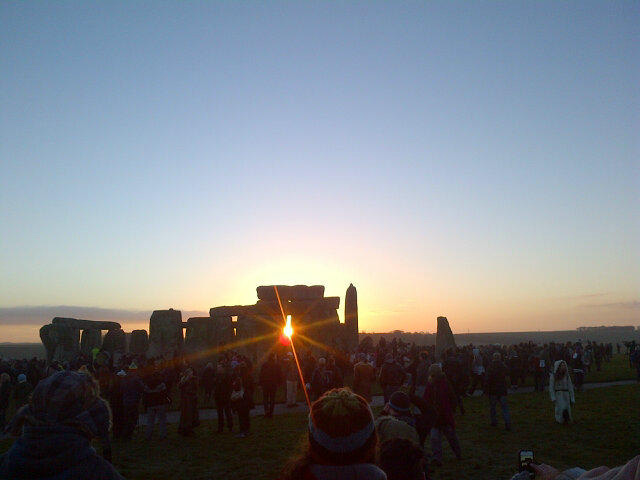
Perfect solstice sunrise by @STONEHENGE (Stonehenge UK)
‘Perfect solstice sunrise’ by @STONEHENGE (Stonehenge UK on Twitter)

Now, call your friends, grab a beer and celebrate the end of the Maya Long Count calendar’s 13th b’ak’tun and the winter solstice. (Sorry doomsayers, I will not be giving you a reference for your post-doomsday interview, you did a crappy job of the Apocalypse.)

Also, send your congratulations to my sister, Colette! IT’S HER 30TH BIRTHDAY! Congrats Sis!!

On a side note, a few of us appeared on the #TWISmageddon 21 hour marathon to talk about the end of the world (or lack thereof), science and the human propensity for believing the Mayan doomsday bunkum. Thanks to Kiki Sanford, Justin Jackson, Scott Lewis, Blair Bazdarich, Nicole Gugliucci and Andy Ihnatko for a terrific Google+ Hangout. Who knew doomsday would be so much fun! (We start at about 1hr 45mins into the Hangout.)

EDIT: Is John Cusack skiing? He’d better be — that’s what he told me during the premier of “2012” in 2009! More: “What Will John Cusack be Doing on Dec. 21, 2012? Skiing.

“Skiing” he told me. Skiing.

Read more: No Doomsday! The Quick Reference Guide (Discovery News)