Astrology Shakeup: What’s Your New Sign? (FOX News Interview)

I join FOX News host Megyn Kelly (center) and astrologer Constance Stella (right) on America Live.

Today’s horoscope says: Expect some angry emails.

Early this morning I get the call from Lori, my Director at Discovery News, saying, “You’re appearing on FOX this morning!”

My morning-addled brain started wondering why. Was it because of the tech article I wrote about dousing superconductors in wine? Or was it about the Playboy Playmate picture that flew to the moon in 1969? Or had some massive piece of space news broken while I was asleep? Perhaps FOX News needed a space expert to explain some uber-cool cosmic discovery!

Alas, no.

They wanted me to explain an article I nearly didn’t bother writing: “Your Star Sign Just Got Rumbled.”

I nearly didn’t bother writing about this as I didn’t consider it “news.” I just saw a lot of fuss on Twitter about a change in the Zodiac and did some investigating. I won’t go over this non-news event again (you can read my article for the details), but for some reason the fact that astrology is bunk seemed to surprise people.

“I’m so depressed. How do I tell my wife that I’m now a Taurus?” — too funny.

The FOX News chat was fun, but there wasn’t nearly enough time to go into all the gory details. Have a watch, I thought it was quite entertaining. (I’ve heard that this YouTube video might not be available beyond the U.S. — let me know if you have problems.)

The upshot is that astrology isn’t a science. Astronomy is. So when scientists try to find some astronomical link between how the stars can influence our everyday lives — even shape our personalities — we will ultimately be disappointed. This frustration is evident in my article.

Astrologers acknowledge that there is a zodiacal shift — they’d be silly not to, there’s an obvious precession in the Earth’s rotation, or 26,000 year “wobble” — but this shift is in the “sidereal zodiac.” Astrologers have side-stepped this out-of-sync problem by pointing out that they use the “tropical zodiac” which is based on the seasons and not the positions of the constellations — Constance Stella touches on this in the FOX News interview. Hence why everyone getting worked up about a change in their star sign is erroneous. Sure, this fixes the problem, ensuring they keep 12 signs of the zodiac (avoiding the “extra” 13th constellation, the now famous Ophiuchus), but it begs the question: What’s the point in astrology if astrologers don’t care if there’s a drift between the traditional zodiac (written up by Babylonian astrologers 3000 years ago) and today’s corrected zodiac?

(Also, isn’t there another way of predicting future events through the seasons, split into 12 sections? Oh yes, it’s a… calendar.)

I think all this confusion only adds doubt in people’s minds about the validity of modern horoscopes. They are nothing more than fairy tales.

Before I get flamed in the comment boxes about me “trampling” on people’s beliefs and that astrologers have done nothing wrong, consider this. Astrology will always be here so long as people want to hear positive things about their future, regardless of the fact that it’s complete and utter nonsense. Most will call it “entertainment,” while others will spend a fortune getting “detailed forecasts” of junk from the likes of Jonathan Cainer. Where there’s belief in some supernatural “force” (not a real force by the way), there’s money and plenty of modern astrologers who will be able to make a living.

So there you go. A non-news event that culminated in an appearance on national television. While fun, I think I’ll be getting back to the science now…

M87’s Obese Black Hole: A Step Closer to the Event Horizon Telescope

The M87 black hole blasts relativistic plumes of gas 5000 ly from the centre of the galaxy (NASA)

Fresh from the Department Of I Really Shouldn’t Have Eaten That Last Binary, astronomers attending the American Astronomical Society meeting in Seattle, Wash., have announced a supermassive black hole residing inside the nearby galaxy M87 has a weight problem.

In fact, this galactic behemoth is obese.

With a mass of 6.6 billion suns, it is the biggest black hole in our cosmic neighborhood. “It’s almost on top of us, relatively speaking. Fifty million light-years — that’s our backyard effectively. To have one so large, that’s kind of extreme,” astronomer Karl Gebhardt, with the University of Texas at Austin, told Discovery News. The black hole’s mass was arrived at after Gebhardt’s team tracked the motions of the stars near the black hole using the Gemini North telescope in Hawaii. By analyzing the stars’ orbits, the mass of the black hole could be calculated.

Although it’s been known for some time that M87’s black hole might be slightly on the heavy side, 6.6 billion solar masses exceeds previous estimates.

Previously on Astroengine, I’ve discussed the exciting possibility of imaging a black hole’s event horizon. Radio astronomers have even modeled what they might see should a collection of telescopes participate in event horizon astronomy. Naturally, to see the shadow of an event horizon, the black hole a) needs to be massive, and b) relatively close. The first nearby supermassive black hole that comes to mind is our very own Sagittarius A* (Sag. A*) that camps out in the middle of the Milky Way. That would be a good place to point our first event horizon telescope, right?

Think again. Even before astronomers were able to pinpoint M87’s black hole mass, in 2009, researchers from the Max Planck Institute and University of Texas had estimated M87’s mass to be 6.4 billion suns. Although M87 is a whopping 2,000 times further away from Earth than Sag. A*, due to its mass, the M87 supermassive black hole event horizon shadow should appear bigger in the sky than Sag. A*’s. Today’s announcement is bound to stimulate efforts in the quest to directly image a black hole’s event horizon for the first time.

“Right now we have no evidence that an object is a black hole. Within a few years, we might be able to image the shadow of the event horizon,” Gebhardt added.

For more on today’s news, read Irene Klotz’s report on Discovery News: “Obese Black Hole Lurks in Our Cosmic Backyard

Can Spicules Explain the Mysteries of Coronal Heating?

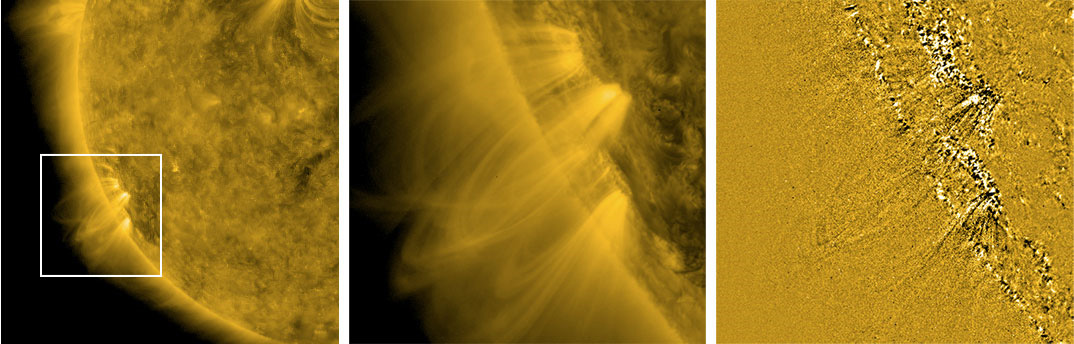
Solar spicules as imaged by NASA's Solar Dynamics Observatory (NASA)

There’s one recurring question I’ve been asking for nearly a decade: Why is the Sun’s corona (its atmosphere) so hot?

When asking this out loud I inevitably get the sarcastic “um, because the Sun is… hot?” reply. Yes, the Sun is hot, really hot, but solar physicists have spent the last half-century trying to understand why the corona is millions of degrees hotter than the solar surface.

After all, if the air surrounding a light bulb was a couple of magnitudes hotter than the bulb’s surface, you’d want to know why that’s the case, right? At first glance, the solar atmosphere is breaking all kinds of thermodynamic laws.

The Sun is a strange beast and because of its magnetic dominance, energy travels through the solar body in rather unfamiliar ways. And today, a group of solar physicists have put forward a new theory as to where the coronal energy is coming from. But they’ve only been able to do this with help from NASA’s newest and most advanced solar telescope: the Solar Dynamics Observatory, or SDO.

Using the SDO’s high-definition cameras and imagery from the awesome Japanese Hinode solar observatory, features previously invisible to solar astronomers have been resolved. The features in question are known as “spicules.” These small-scale jets inject solar plasma from the solar surface into the lower corona, but until now they’ve been considered too cool to have any appreciable heating effect.

That was until a new type of hot, high-speed spicule was discovered.

“It’s a little jet, then it takes off,” solar physicist Scott McIntosh, of the National Center for Atmospheric Research’s High Altitude Observatory, told Discovery News’ Larry O’Hanlon. “What we basically find is that the connection is the heated blobs of plasma. It’s kind of a missing link that we’ve been looking for since the 1960s.”

These Type II spicules blast hot multi-million degree Kelvin plasma at speeds of 100 to 150 kilometers per second (62 to 93 miles per second) into the corona and then dissipate. What’s more, these aren’t isolated events, they’ve been observed all over the Sun. “This phenomenon is truly ubiquitous and populates the solar wind,” said McIntosh.

While this research provides more clarity on coronal dynamics, McIntosh is keen to point out that Type II spicules probably don’t tell the whole coronal heating story.

NASA’s coronal physics heavyweight James Klimchuk agrees. “It is very nice work, but it is absolutely not the final story on the origin of hot coronal plasma,” he said.

“Based on some simple calculations I have done, spicules account for only a small fraction of the hot plasma.”

Klimchuk favors coronal heating through magnetic stresses in the lower atmosphere generating small reconnection events. Right at the base of the corona, loops of magnetic flux channeling multi-million degree plasma high above the Sun’s chromosphere become stressed and eventually snap. These reconnection processes produce sub-resolution nanoflare events — akin to small explosions releasing energy into the solar plasma, heating it up.

Another heating mechanism — a mechanism I studied during my solar research days (.pdf) — is that of wave heating, when magnetohydrodynamic waves (I studied high-frequency Alfven waves, or ion cyclotron waves) interact with the lower corona, heating it up.

But which heating mechanism injects the most energy into the corona? For now, although there’s plenty of theorized processes (including these new transient Type II spicules), we don’t really know. We can only observe the solar corona from afar, so getting a true grasp on coronal dynamics is very hard. We really need a probe to dive deep into the solar atmosphere and take a measurement in-situ. Although the planned Solar Probe Plus will provide some answers, it may still be some time before we know why the corona is so hot.

But it is most likely that it’s not one coronal heating mechanism, but a combination of the above and, perhaps, a mechanism we haven’t uncovered yet.

For more on this fascinating research, check out Larry O’Hanlon’s Discovery News article “New Clue May Solve Solar Mystery.”

It’s Official: “2012” Sucked

Just in case you didn’t know, Roland Emmerich’s 2012 wasn’t the best of movies.

Actually, from a science perspective, it sucked.

It sucked in so many ways that I can’t be bothered to list why it sucked (so have a read of my Discovery News review instead).

Now, I’m happy to announce that NASA agrees with me. They think 2012 sucked so much, they’ve branded it the most “scientifically flawed of its genre.”

Donald Yeomans, head of NASA’s Near-Earth Asteroid Rendezvous mission, agrees with what I’ve been saying all along (especially since all that “Institute for Human Continuity” bullshit hit the internet). He said at the Pasadena Jet Propulsion Laboratory meeting:

“The film makers took advantage of public worries about the so-called end of the world as apparently predicted by the Mayans of Central America, whose calendar ends on December 21, 2012. [NASA] is getting so many questions from people terrified that the world is going to end in 2012 that we have had to put up a special website to challenge the myths. We have never had to do this before.”

Even though NASA agreed that Bruce Willis’ Armageddon was bad, it couldn’t compete with the scientific atrocities 2012 inflicted on its audience. The killer neutrinos, planetary alignment, crustal shift, geomagnetic reversal and super-duper-massive tsunamis proved too much. 2012 has even toppled The Core as worst sci-fi science movie. Now that is impressive.

But what does it all mean? Apart from us science snobs having a chuckle on our blogs, I doubt it will make the blind bit of difference. Why? This is why:

“On the opening weekend of 2012, the movie pulled in 65 million in U.S. ticket sales and an additional $160 million internationally, easily covering the $200+ million budget.

Movies aren’t about scientific accuracy, and it would seem that the hype behind 2012 can stand alone as the biggest moneymaker of all.

Fear sells, science doesn’t. The subject of doomsday will always be a blockbuster. Unfortunately, through the miscommunication of science, fear is usually the end-product.”

— “2012” Sells Tickets, Sells-Out Science

Oh well, you can’t win ’em all. Now, have a laugh:

Thanks to @mars_stu and @RogerHighfield for the inspiration.

EDIT: An earlier version of this blog post stated that the Science and Entertainment Exchange was involved with NASA’s decision to make 2012 “most scientifically flawed” movie in its list. I have received an email from the Exchange’s director that this is not the case. I have therefore edited any mention of the Exchange from the blog (even though my source, the Adelaide Now, still references the Exchange).

Who Cares if Ashton Kutcher is Preparing for Armageddon?

So, it’s 2011. A brand new year. Who knows what it holds? Actually, I know what it holds. Trolls. In fact, 2011 will henceforth be the Year of the Troll. (Not the Year of the Rabbit, sorry Bun-bun.)

I’ve noticed a rather crazy uptick in the number of anti-science diatribes and wet doomsday theories in recent months. Most are due to questionable reports written on quasi-news websites (as debunked in “2012 Alien Invasion? Um, No.”), and others are down to the trolls who surf the web dropping comments under otherwise benign science articles. Could it be that Fakemageddon is a year away? Or has the use of computers been granted in kindergarten? Could be both.

Although I joke about the misguided individuals inventing tales of doom to sell books, there is a rather serious undercurrent to my 2012 ramblings. People genuinely worry about this stuff. Sure, I’m totally numb to all this 2012 tomfoolery — it’s all crap, honest — but I’m still receiving messages from readers who are convinced something bad is going to happen on Dec. 21, 2012.

(The only person I know who’ll have a bad time is my little sister, who’ll be turning 30 on that day — don’t worry sis, I’ll be there administering the vodka, it numbs the chronological pain, trust me.)

So where does that leave us? What can we do to divert the nonsense and bring some real science to the table?

For one thing, I’m going to keep writing about the crackpots perpetrating these silly myths through 2011 and beyond. Although fellow debunkers and myself have been under attack recently for even mentioning the 2012 thing — something about a dead horse and a good beating — it’s important to inject common sense into the Internet whenever nonsense appears. If these doomsday theories go unchecked, for some, science and pseudoscience may become confused.

This is where the “Truth Squad” (as MSNBC science editor and Cosmic Log space maestro Alan Boyle has dubbed us) comes in, and I’m pretty sure all space science bloggers will be on the lookout for the doomsayers’ tall stories.

So, in conclusion, if you read something with an eerie 2012 flavor on the internet, be sure to check out my handy dandy “How Do You Spot Science Abuse in the Social Media Soup?” cheat sheet.

Also, don’t pay attention to celebrities who are obviously getting a little hyped up on the doomsday juice. No, I don’t think Ashton Kutcher really has anything to worry about in the near future, but if Armageddon works as a workout motivator… well, good for him (besides, I think he might have been taken out of context, so also look out for Huffington Post articles that try to make mountains out of molehills).

That is all.

Happy New Year!

PS. I hope to make Astroengine.com a little more productive through 2011. But in case you’re wondering what I’m up to, be sure to pop over to Discovery News, I’m always there.

National Geographic Feature: “Star Struck” by Ken Croswell

An all-sky image of the Milky Way (Serge Brunier/NASA)

As promised, here’s an excerpt from astronomer Ken Croswell’s “Star Struck,” a National Geographic featured article from the December 2010 edition that takes us on a fascinating tour of the Milky Way.

Croswell discusses recent discoveries of hypervelocity stars, why planets are rare in the outermost reaches of our galaxy and the black hole hiding inside the galactic core. The Astroengine article “Life is Grim on the Galactic Rim” gets a mention as Croswell describes metal-poor stars and why life might be unlikely in those systems.

From “Star Struck”:

It’s hard to be modest when you live in the Milky Way. Our galaxy is far larger, brighter, and more massive than most other galaxies. From end to end, the Milky Way’s starry disk, observable with the naked eye and through optical telescopes, spans 120,000 light-years. Encircling it is another disk, composed mostly of hydrogen gas, detectable by radio telescopes. And engulfing all that our telescopes can see is an enormous halo of dark matter that they can’t. While it emits no light, this dark matter far outweighs the Milky Way’s hundreds of billions of stars, giving the galaxy a total mass one to two trillion times that of the sun. Indeed, our galaxy is so huge that dozens of lesser galaxies scamper about it, like moons orbiting a giant planet.

Read the rest of “Star Struck” by Ken Croswell in the December edition of National Geographic.

In addition to the article, National Geographic has a beautiful extended Milky Way gallery that’s well worth a look.

Astroengine Gets Quoted in National Geographic

The December 2010 edition of National Geographic

A couple of months ago I was contacted by National Geographic magazine notifying me that one of their writers had quoted me in an article for their December issue. Pretty cool, I thought. But then I forgot all about it.

Then, I received a note from the ever watchful Bill Hudson (@2012hoax) telling me Astroengine had been printed on page 99. I quickly scurried over to the National Geographic website to find, sure enough, I was there too: on page 3 of the online article “Star Struck.”

The following morning, I received a complementary copy of the December edition so I could see Astroengine in print for the first time.

National Geographic’s special feature takes a fascinating tour of the Milky Way and when discussing metal-poor stars in the outermost reaches of our galaxy, the article quotes the title of the Astroengine post “Life is Grim on the Galactic Rim.” Obviously they like my rhyming skills.

Thank you National Geographic!

I’ve been told I can write a blog with an excerpt from the superb article written by Ken Croswell, so that’ll be coming right up!

I think I need to blog more…

Dead On Arrival: Necropanspermia Spawned Life on Earth?

Are those Martian fossils in meteorite ALH84001? (NASA)

Panspermia” is a hypothesis that life is transferred from planet-to-planet and star system-to-star system through some interplanetary or interstellar means.

But for panspermia to work, this life needs to be sufficiently protected — and, um, kept alive — from the worst the universe can throw at it (such as radiation, cold and vacuum). Alas, when considering interstellar hops, the timescales are likely too long (i.e. millions of years) and said life will be dead on arrival.

We know that Earth Brand™ life is a pretty hardy thing. After all, we’ve tortured terrestrial microbes and mosquito larvae in the vacuum of space to see if they’d pop. Sure enough, when brought back to terra firma the various creatures wriggled and squirmed as if nothing had happened. But these experiments in orbit were carried out over the course of months or years. While this might be suitable for interplanetary transfers, it would take millions of years for an extraterrestrial interloper to traverse even a modest interstellar gap.

Any hitchhikers that were alive on a stellar wind-blown particle will be toast (or, more accurately: freeze-dried, pulverized, mashed-up, DNA-shredded mess) on reaching their exotic destination eons later.

What good are tiny alien fossils when the panspermia model is supposed to seed other worlds with life… that’s actually alive?

Enter a new incarnation of pansermia: “Necropanspermia.”

Conceived by Paul Wesson, of Herzberg Institute of Astrophysics in Canada, necropanspermia is the transfer of the information of life to new worlds, wriggling extraterrestrial bacterium not required.

Assuming alien microbial life has made the trip across interstellar space, died and then fossilized, Wesson reckons the information contained within the long-dead microbe could be used as some kind of template by a hospitable world to use and grow new life. (It’s not quite zombie science, but it’s hard not to say “reanimated alien corpse.”)

Wesson even goes so far to suggest ET’s microbial remains can be “resurrected.”

“Resurrection may, however, be possible.” Wesson concludes in his Space Science Reviews paper. “Certain micro-organisms possess remarkably effective enzyme systems that can repair a multitude of strand breaks.”

Hypothesizing about various forms of panspermia may seem more like a philosophical argument, but Wesson suggests that we might be able to find evidence for necropanspermia if we collect some dust samples from the outermost reaches of the solar system, far enough away from Earth’s biological pollution.

Alas, as the Hayabusa asteroid mission has proven, capturing dust from anywhere in space isn’t easy.

Read more about necropanspermia in my Discovery News article “Life on Earth Spawned by Dead Alien Microbes?

Holographic Universe: Fermilab to Probe Smallest Space-Time Scales

Conceptual design of the Fermilab holometer (Fermilab)

During the hunt for the predicted ripples in space-time — known as gravitational waves — physicists stumbled across a rather puzzling phenomenon. Last year, I reported about the findings of scientists using the GEO600 experiment in Germany. Although the hi-tech piece of kit hadn’t turned up evidence for the gravitational waves it was seeking, it did turn up a lot of noise.

Before we can understand what this “noise” is, we need to understand how equipment designed to look for the space-time ripples caused by collisions between black holes and supernova explosions.

Gravitational wave detectors are incredibly sensitive to the tiniest change in distance. For example, the GEO600 experiment can detect a fluctuation of an atomic radius over a distance from the Earth to the Sun. This is achieved by firing a laser down a 600 meter long tube where it is split, reflected and directed into an interferometer. The interferometer can detect the tiny phase shifts in the two beams of light predicted to occur should a gravitational wave pass through our local volume of space. This wave is theorized to slightly change the distance between physical objects. Should GEO600 detect a phase change, it could be indicative of a slight change in distance, thus the passage of a gravitational wave.

While looking out for a gravitational wave signal, scientists at GEO600 noticed something bizarre. There was inexplicable static in the results they were gathering. After canceling out all artificial sources of the noise, they called in the help of Fermilab’s Craig Hogan to see if his expertise of the quantum world help shed light on this anomalous noise. His response was as baffling as it was mind-blowing. “It looks like GEO600 is being buffeted by the microscopic quantum convulsions of space-time,” Hogan said.

Come again?

The signal being detected by GEO600 isn’t a noise source that’s been overlooked, Hogan believes GEO600 is seeing quantum fluctuations in the fabric of space-time itself. This is where things start to get a little freaky.

According to Einstein’s view on the universe, space-time should be smooth and continuous. However, this view may need to be modified as space-time may be composed of quantum “points” if Hogan’s theory is correct. At its finest scale, we should be able to probe down the “Planck length” which measures 10-35 meters. But the GEO600 experiment detected noise at scales of less than 10-15 meters.

As it turns out, Hogan thinks that noise at these scales are caused by a holographic projection from the horizon of our universe. A good analogy is to think about how an image becomes more and more blurry or pixelated the more you zoom in on it. The projection starts off at Planck scale lengths at the Universe’s event horizon, but its projection becomes blurry in our local space-time. This hypothesis comes out of black hole research where the information that falls into a black hole is “encoded” in the black hole’s event horizon. For the holographic universe to hold true, information must be encoded in the outermost reaches of the Universe and it is projected into our 3 dimensional world.

But how can this hypothesis be tested? We need to boost the resolution of a gravitational wave detector-type of kit. Enter the “Holometer.”

Currently under construction in Fermilab, the Holometer (meaning holographic interferometer) will delve deep into this quantum realm at smaller scales than the GEO600 experiment. If Hogan’s idea is correct, the Holometer should detect this quantum noise in the fabric of space-time, throwing our whole perception of the Universe into a spin.

For more on this intriguing experiment, read the Symmety Magazine article “Hogan’s holometer: Testing the hypothesis of a holographic universe.”

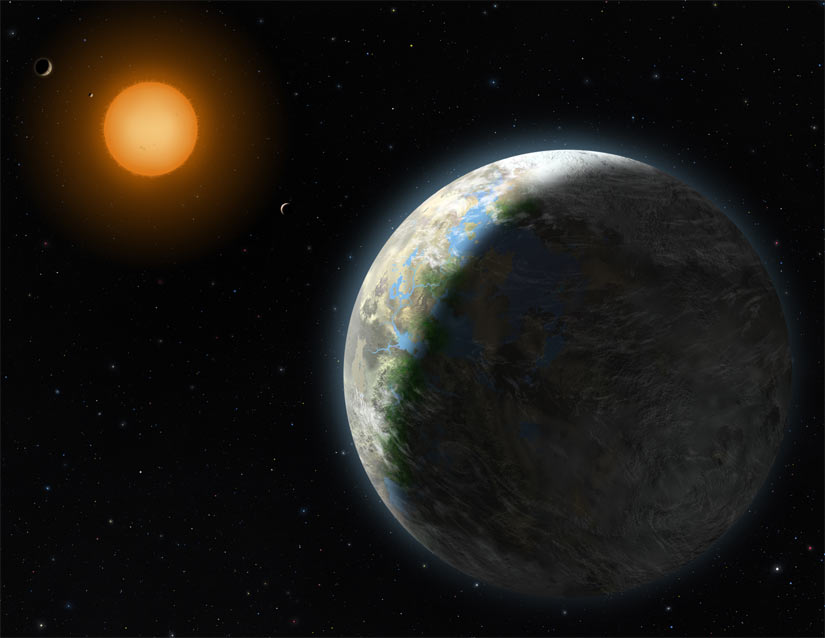
Ingredients for Life on Gliese 581g?

Credit: Lynette Cook

Just in case you haven’t heard, astronomers have released news about an “Earth-like” exoplanet orbiting within the “Goldilocks zone” of a star some 20 light-years away. This is awesome, but does it mean Gliese 581g is habitable? Does it mean life is already slithering across its surface?

Judging by an exuberant claim by Steven Vogt, professor of astronomy and astrophysics at University of California Santa Cruz, one would think we now know there’s life on this strangely familiar world.

“Personally, given the ubiquity and propensity of life to flourish wherever it can, I would say that the chances for life on this planet are 100 percent. I have almost no doubt about it,” Vogt told Discovery News when the announcement broke on Wednesday.

100%?

Why did he say that his personal view was that the chances for life on Gliese 581g are 100%? At first glance, it is easy to see where he’s coming from.

Goldilocks Zone

Firstly, the exoplanet orbits close to a small red dwarf star (called Gliese 581), with a fast-paced orbit of 37 days. This is important as the energy output of a red dwarf is tiny when compared to our Sun (which is a yellow dwarf star, in case you were wondering) — to receive an equivalent amount of heating as the Earth, Gliese 581g needs to be much closer to its star.

Also, it isn’t orbiting too close. It is within the habitable zone (or the “Goldilocks zone,” i.e., a zone that’s not too hot or too cold) of the system. Therefore there’s a high probability that if water is present on its surface, it’s likely to be in liquid form. The presence of liquid water would be exciting as Earth Brand™ life likes liquid water.

Secondly, Gliese 581g is small for an exoplanet discovered thus far. Weighing in at a minimum mass of 3x that of the Earth, it could certainly have some Earth-like qualities. This has another implication; the world has enough gravitational oomph to hold onto an atmosphere — another ingredient that life seems to like (assuming it’s not of the bone-crushing, lead-boiling, Venus-type atmosphere).

It’s Complicated

But there’s a few complications. To be within the habitable zone of its parent star, Gliese 581g will be “tidally locked.” This means that one side of the exoplanet will always be facing the star. On the far side (or, indeed, the “dark side”) it will be cold whilst the near side will always be hot. Having one perpetual day doesn’t sound very Earth-like to me. But there is an upside to this strange orbit.

“This planet doesn’t have days and nights. Wherever you are on this planet, the sun is in the same position all the time. You have very stable zones where the ecosystem stays the same temperature… basically forever,” Vogt said. “If life can evolve, it’s going to have billions and billions of years to adapt to the surface.”

So a tidally-locked planet could have a stable atmosphere and perhaps life could evolve as a result. What could be considered to be a negative has just become a positive.

With all this good news, why wouldn’t life be thriving on this world?

Unknowns and Assumptions

There’s still a lot of unknowns and assumptions being made. For a start, the presence of Gliese 581g was detected by measuring the “wobble” of the star as the exoplanet orbits (its gravity tugs on the star as it circles). Therefore its mass and orbital radius can be derived. But we have no information about its atmosphere; the world doesn’t pass in front (or “transit”) the star from our perspective, so we can’t get a peek into its atmosphere.

Therefore we have zero clue as to whether it even has an atmosphere. It might not have an atmosphere, but then again it could have a very thick atmosphere — two extremes that would would put a stop to any Earth Brand™ life evolving. Also, we have zero clue if there’s any water there, it’s just guesswork that suggests there might be. There’s also the huge unknown as to whether life is ubiquitous in the cosmos or not.

Bread in the Oven

It’s a bit like baking a loaf of bread when you have all the necessary ingredients to make bread, but you have no clue about what quantities to use. Gliese 581g appears to have most of the ingredients for life (and with a few assumptions, it has all the ingredients for life), but we only have a general idea as to what quantities these ingredients come in.

If you threw flour, water and yeast straight into the breadmaker in random quantities, would you get a loaf of bread? What if you forgot to add the yeast?

Gliese 581g is that breadmaker. Unfortunately we have no clue if it can make bread.

For more on this incredible discovery, read Irene Klotz’s Discovery News article: “Earth-Like Planet Can Sustain Life