Warp Drives and… Black Holes?

black-hole-aurora

Why do all roads seem to lead to black holes? Man made black holes are supposedly going to be produced by the Large Hadron Collider, swallowing Earth (or, at least, a large fraction of Europe), so it seems only logical that something like a warp drive — a technology of the uber-future requiring uber-energies — would also generate a black hole, right?

Yes, we are talking about a vastly theoretical technology, but according to Italian researchers, the spaceship propulsion device popularized by Star Trek could have grave consequences for Planet Earth.

Over the past week, I’ve been deep inside the science behind faster-than-light-speed propulsion and time travel as a part of the Discovery Space Wide Angle: Surfing Spacetime, and I feel well versed in the astounding physics that could make warp speed a possibility in the future. All this started when interviewing one of the leading authorities on warp drive propulsion, Dr Richard Obousy, who is not only upbeat about the possibilities of the futuristic warpship, he’s done the math to prove that a sufficiently advanced civilization could “surf” on a spacetime wave.

However, there’s a catch. Well, two.

Firstly, we need to develop an understanding for dark energy. And second, we need a gargantuan energy source.

Dark energy is a cosmological theory that explains the continued expansion of the universe. This energy pervades all of the cosmos, explaining everything from the grouping of galactic clusters to the faster-than-light-speed inflationary period immediately after the Big Bang. There’s a lot of indirect observation of dark energy and its effects on spacetime. It’s out there, but it’s a tough proposition to think we might be able to harness it someday. But then again, we said that about electricity once, who knows what technological revolutions await us in the decades and centuries ahead.

Assuming we find a way of harnessing dark energy, how can we use it? This is where visionary physicists like Dr Obousy come in. Skipping over the superstring small-print of extra-dimensional theory, we basically need a huge amount of energy to manipulate the universal dark energy, thereby shrinking and expanding vanishingly small dimensions beyond our three dimensional universe.

So how much energy is needed warp spacetime, allowing a futuristic spaceship to zip through space? “Some back of the envelope calculations I performed last year indicated approximately the mass energy contained within the planet Jupiter,” Richard told me.

This sounds like a lot of energy! However, there’s a trend, the rest mass energy of Jupiter is actually an improvement on previous warp drive calculations. “The very early warp drive calculations indicated that one would need more mass energy than was available within the entire universe… that’s TRILLIONS of Jupiters!

This improvement is down to recent developments in superstring theory and quantum dynamics. It would appear that the energy requirements for a warp drive improves with developments in physics. If this trend continues, we may find other energy saving ways to make a warpship a reality.

However, there are some practical issues putting the breaks on travelling at warp speed. Only recently, I reported on a study focusing on quantum fluctuations as the warp “bubble” (containing our warpship) blasts through the light speed barrier: the occupants could get roasted by Hawking Radiation.

Today, another problem has surfaced from the extreme warp equations: black holes (who would have guessed?). Italian physicist Stefano Finazzi of Italy’s International School for Advanced Studies has crunched the numbers and wondered about what would happen when the energy runs out. It’s all very well generating a Jupiter’s rest mass-worth of energy, but how will it be sustained by the warp drive? What will happen when all the energy is depleted?

Eventually the energy would run out. The [warp] bubble would rupture, with catastrophic effects. Inside the bubble the temperature would rise to about 1032 degrees Kelvin, destroying almost anything on the bubble.Eric Bland, Discovery News

It gets better, Finazzi also predicts a fair amount of doom outside the warp bubble, too. “We know that the warp drive will be destabilized,” he added. “But we do not know if it will in the end explode or collapse to a black hole.”

Don’t go running out of gas any where near Earth is all I say

Although these implications of doom and gloom should have given Jean Luc Picard a panic attack whenever he said “engage!” or “make it so Number One…”, we have to remind ourselves warp drive propulsion isn’t even close to being a reality. Dr Obousy and warp scientists before him are only just beginning to assemble a theoretical framework around the sci-fi notion of warping spacetime, so to already be predicting warp speed fail seems a little premature in my opinion.

In response to the Hawking Radiation problem, Dr Obousy pointed out that if we get to the point of generating vast quantities of energy, harnessing the spacetime warping power of dark energy, we should be able to at least have a stab at finding solutions to these potential warp drive problems.

Objections are good, but usually we find smart ways of circumventing problems. Humans are good at that,” he said.

I agree.

Thunder Cloud vs. Volcanic Plume; Light Show Ensues

stephen-omeara1

I know I only recently posted a lightning picture, but when I saw this shot, I had to post it. During an eruption of Rabaul volcano in Papua, New Guinea, Stephen O’Meara saw a stunning display in the angry skies.

“A storm cloud approached the volcano’s 2 km plume, and lightning began to arc between the two,” O’Meara said in the SpaceWeather.com article.

These events aren’t uncommon in the air surrounding hot, rising plumes of gas and ash, but some of the recent photography of such events are astounding.

Discovery Space Quiz: Dalek Mothership?

space_quiz

For my first Discovery Space Quiz, I was sent a selection of images from the Lowell Observatory StarTales Archive. On looking through the selection this week, one image grabbed my attention and I decided to use it in the monthly “What Is That?” quiz.

So what is it? The insides of a Dalek spaceship? A new hi-tech observatory? A washing machine drum?

Check out my space photo quiz on Discovery Space… you might be surprised by the answer…

A Lightning Bolt Hits Water, So Close You Can See Its Streamers

A bolt of lightning, 40 metres away (©Francis Schaefers and Daniel Burger)

It’s pictures like these that make me a) want to do more photography, b) feel more in awe of nature than I already am, and c) wonder how the photographer didn’t pack up his gear and run away screaming. But thank goodness the talented storm chasers didn’t run away, they actually witnessed a very rare event, up close.

This astounding image was shot by photographers Francis Schaefers and Daniel Burger when they were chasing a thunderstorm along a beach in Vlissingen, the Netherlands. Chasing a storm along a beach. The best bit of the SpaceWeather.com article comes right at the end, where it says that Schaefers and Burger took a series of shots from “underneath a balcony where they figured the lightning wouldn’t reach.”

Let me emphasise that last bit: underneath a balcony.

Balls of steel comes to mind. For me, nothing less than a reinforced bunker surrounded by lightning rods will do.

Related Lightning Articles:

Anyway, back to why this image is so fantastic. When lightning strikes the ground, if you are able to get the timing perfect, you might be able to capture ‘upward streamers’ rising from the ground to meet the leading edge of the bolt, as NASA lightning expert Richard Blakeslee explains:

Streamers reach upward from the water.

In a typical cloud-to-ground lightning strike, as the leader approaches the ground, the large electric field at the leader tip induces these upward propagating streamers. The first one that connects to the downward propagating leader initiates the bright return stroke that we see with our eye. Upward streamers are often observed on photographs of lightning hitting the ground.”

It’s hard to imagine if this streamer phenomenon has been observed to reach out from water before, but this Dutch example must be very rare. It’s hard enough to photograph lightning streamers on solid ground, let alone on the surface of a body of water.

In case you weren’t already amazed, check out this shot. It’s called The Cruise You Don’t Want to Take for very obvious reasons:

The storm, plus cruise, ship off the coast of Vlissingen, the Netherlands (©Francis Schaefers and Daniel Burger)

Source: SpaceWeather.com

New NASA Funding Proposal: Blow Up Mars

mars_boom

Here’s an idea to get more funding for NASA: destroy Mars before the China gets there first. What an epic feat of human ingenuity!

If you think about it, the proposal makes perfect sense. Build a vast militarized space agency network throughout the US; get the government to heavily invest in R&D; task scientists with a decade-long Mars Manhattan Project to come up with a plan of how to dissect the Red Planet gram-by-gram and then build the most awesome weapon the worl– the Universe has ever seen! Forget the playful Death Star, this thing will eat planets for breakfast!

I’m thinking either a massive laser or a huge burrowing fusion bomb… or trillions of regolith-munching nanobots. (I like the idea of nanobots.) Once this planet killer is built, it will be sent to Mars by 2020. This time, the deadline will be met, if NASA has infinite funds available for this audacious plan, they will build the Mars Marauder in a decade. This is how it works; flood the project with stupid amounts of cash and we will succeed. NASA will stimulate an entire industry, the US will be industrialized once more! Everyone will have a job, private contractors will be in a frenzy and Elon Musk won’t be able to sign SpaceX-NASA contracts fast enough!

Best of all, that worrisome Chinese space agency will give up their plans for space domination, we can relish in the joy that we’d won Space Race 2.0 before it even started! Why the hell haven’t we thought of this before?!

*STOP*

It’s OK, I haven’t gone all megalomaniac on you, I was just inspired by a comic on Saturday Morning Breakfast Cereal. The premise is that NASA science proposals bore congressmen. However, throw in a bit of pizazz and they start to listen, hence my mini rampage just now. Actually, reading the Mars Marauder proposal, it kinda makes sense. Just swap out the planet-killing bit, and we’ll have a means to actually land scientists on Mars… the reason behind this excellent comic:

Check out the full comic at SMBC...

Inspiration: Bad Astronomy

Solar Cycle Prediction: “None of Our Models Were Totally Correct”

nov4flare

Predicting space weather is not for the faint-hearted. Although the Sun appears to have a predictable and regular cycle of activity, the details are a lot more complex. So complex in fact, that the world’s greatest research institutions have to use the most powerful supercomputers on the planet to simulate the most basic of solar dynamics. Once we have a handle on how the Sun’s interior is driven, we can start making predictions about how the solar surface may look and act in the future. Space weather prediction requires a sophisticated understanding of the Sun, but even the best models are flawed.

Today, another solar cycle prediction has been released by the guys that brought us the “$2 trillion-worth of global damage if a solar storm hits us” valuation earlier this month. According to NOAA scientists sponsored by NASA, Solar Cycle 24 will peak in May 2013 with a below-average number of sunspots.

If our prediction is correct, Solar Cycle 24 will have a peak sunspot number of 90, the lowest of any cycle since 1928 when Solar Cycle 16 peaked at 78,” says Doug Biesecker of the NOAA Space Weather Prediction Center.

Although this may be considered to be a “weak” solar maximum, the Sun still has the potential to generate some impressive flares and coronal mass ejections (CMEs). Although I doubt we’ll see the record-breaking flares we saw in 2003 (pictured top), we might be hit by some impressive solar storms and auroral activity will certainly increase in Polar Regions. But just because the Sun will be more active, it doesn’t mean we will be struck by any big CMEs; space is a big place, we’d be (un)lucky to be staring directly down the solar flare barrel.

So, we have a new prediction and the solar models have been modified accordingly, but it is hard to understand why such tight constraints are being put on the time of solar maximum peak (one month in 2013) and the number of sunspots expected (90, or thereabouts). Yes, sunspot activity is increasing, but we are still seeing high-latitude sunspots from the previous cycle (Solar Cycle 23) pop up every now and again. This is normal, an overlap in cycles do occur, yet it surprises me that any definitive figures are being placed on a solar maximum that may or may not peak four years from now.

Ah, I see, it's obvious Solar Cycle 24 will look like that... is it really? (NOAA/NASA)
Tenuous link: Are you really happy with that prediction? (NOAA/NASA)

We are able to look at the history of sunspot number and we can see the cycles wax and wane, and we can pick out a cycle that most resembles the one we are going through now, but that doesn’t mean that particular cycle will happen this time around. Statistically-speaking, there’s a higher chance of a similar-looking cycle from the past happening in this 24th cycle, but predictions based on this premise are iffy to say the least.

Also, solar models are far from being complete, and many aspects of the physics behind the Sun’s internal dynamics are a mystery. The Sun really is acting strange, which is fascinating for solar physicists.

It turns out that none of our models were totally correct,” says Dean Pesnell of the Goddard Space Flight Center, NASA’s lead representative on the panel. “The sun is behaving in an unexpected and very interesting way.”

Personally, I think we should concentrate less on predicting when or how the next solar maximum presents itself. Solar models are not going to suddenly predict the nature of the solar cycle any more than we can predict terrestrial weather systems more than a few days in advance.

Using the atmospheric weather analogy, we know the seasons cycle as the year goes on, but there is no way we can say with any degree of certainty when the hottest day of the year is going to be, or which week will yield the most rain.

The same goes for our Sun. It is vastly complex and chaotic, a system we are only just beginning to understand. We need more observatories and more solar missions with advanced optics and spectrometers (and therefore a huge injection of funding, something solar physicists have always struggled without). Even then, I strongly doubt we’ll be able to predict exactly when the peak of the solar cycle is going to occur.

That said, space weather prediction is a very important science, but long-term forecasts don’t seem to be working, why keep on releasing new forecasts when the old one was based on the same physics anyway? Predicting an inactive, active or mediocre solar maximum only seems to cause alarm (although it is a great means to keep solar physics in the headlines, which is no bad thing in my books).

I suppose if you make enough predictions, eventually one will be correct in four years time. Perhaps there will be a peak of 90 sunspots by May 2013, who knows?

If you’re blindfolded, spun around and armed with an infinite supply of darts, you’ll eventually hit the board. Hell, you’ll probably even hit the bullseye

Source: NASA, special thanks to Jamie Rich for bringing this subject to my attention!

SpaceX Falcon 9 Launch Stalled Until Fall

The Falcon 9 after it was hoisted vertical at Cape Canaveral (SpaceX)

In some ways, this was inevitable, but in others, it’s just plain frustrating.

In January, the powerful Falcon 9 launch vehicle was hoisted vertically at the new SpaceX launch pad at Cape Canaveral. However, that was only temporary. As the first test launch wasn’t expected until late summer, SpaceX was deep in technical work and systems testing.

Now, due to a combination of delayed paperwork and overruns, SpaceX is now looking at a fall launch, several months later than hoped.

It’s basically dealing with the complexities associated with lifting a new rocket off from a new launch site,” said SpaceX President Gwynne Shotwell.

According to Shotwell, the huge quantities of safety documentation required by space operations veteran Brig. Gen. Edward Bolton of the Air Force’s 45th Space Wing, are unfinished. “There is a huge amount of documentation that gets passed to the range and lots of meetings, and that process just takes a long time,” she added.

Although the rocket remained vertical at the Cape for several days at the start of 2009, SpaceX has since been working on the nine Merlin 1C engines that will need to be integrated into the waiting first stage at Launch Complex 40.

Launching rockets is no easy task, as not only do you need to worry about making the launch a success you have to satisfy a lot of red tape, proving the safety of the vehicle. But this will still be a huge disappointment for SpaceX as the longer the Falcon 9 is grounded, the longer Elon Musk’s company will have to wait for payday.

We don’t get paid to sit on the ground.” –Shotwell

Fortunately, SpaceX doesn’t give exact launch times until a day or so in advance of lift-off, so hopefully there will be minimal disruption to the projected dates of commercial launches.

Here’s to hoping for a late-2009 launch!

Source: The Flame Trench

Solar Email Rage, I Got Some

burning_envelope

I’m no stranger to abusive emails, but I thought I’d share a run-in I had with a particularly angry reader during the week.

Now, why would I be receiving hate mail? You might think it has something to do with my campaign of 2012 smack-downs last year… perhaps it’s an angry author of a doomsday book? Or a prominent religious figure with an axe to grind? Perhaps it’s the guys who think the LHC is going to put a continental-sized divot into Europe?

No, no and nope (although the last one would have been fun, I haven’t heard from them for ages; it’s as if I’ve lost touch with an old friend).

Actually, this particular example of email rage came from a very rare subset of Internet critic, the determined-and-possibly-half-way-intelligent-troll. Not content with flinging abuse around in blog comment boxes, this type of individual will read something, and then come hell or high water, they will hunt the author down to give them a piece of their mind.

The reason why I think this guy is possibly-half-way-intelligent is because he can spell. And he doesn’t spout his alternative theory or type in all-caps. Plus, he uses few exclamation marks. His message was short, sweet and left me in no doubt of what he thought about me:

Subject: The sun is BORING!?

Next time you write about the sun, can you try not to sound like a 15 year old? And thanks for educating me on global warming, I’m sure the sun has a negligible effect on the Earth’s climate…

Actually, next time you write about the sun, DON’T.

–Aaron

Now Aaron, tell me how you really feel.

I hold my hands up in defence. Yes, I did say the Sun was being boring, but that’s not quite the same as me saying, “the Sun is boring!” now is it. I’m not going to throw down the ‘but I’m a solar physicist and I actually have a clue card’… oh, I think I just did.

Although I usually assign these kinds of messages to the trash (when I was in my 2012 prime, I was getting up to 10 of these types of email a day, only with f-bombs, and “!!!!!!1“s), I found this one curious.

It was obviously relating to the op-ed article I did for the Discovery Space Wide Angle this week, but this guy had to do his research to find Astroengine.com and consequently use my email form. Is this a new mainstream breed of critic that I haven’t been exposed to before? Do people really have this much time on their hands?

So my conclusion is, I don’t think he liked my opinion about global warming, or he really does think I write like a 15 year old. Well, it takes one to know one. When you grow up to be a 16 year old Aaron, read my articles again will you? And yes, I do forgive you, it’s okay, consider this strike one.

A Wide Angle View of Our Nearest Star

A comparison of solar minimum and solar maximum in EUV wavelengths (SOHO/NASA)

In case you were wondering why Astroengine has been a little quiet of late, this is why. I’ve been working with my Discovery Space colleagues to produce a “Wide Angle” all about the current solar minimum, space weather and the influence of the Sun on our planet.

It’s been fun to do, but it’s also been a steep learning curve to get up to speed with my new duties as producer for Discovery. Currently getting through a tonne of training, but I’ll get there. When organized, Astroengine will be back to full capacity, pumping out the best space news and opinion.

But for now, have an explore of Discovery Space and enjoy the current Wide Angle: Solar Minimum.

Artificial Quake: North Korea Tests Another Nuke

Not a meteorite crater, this was caused by an underground test in Nevada (NDEP).

At 09:54 local time this morning, a magnitude 4.7 earthquake hit a region of North Korea 200 miles north-east of Pyongyang.

So what? I’ve experienced a 5.0 sitting in my back garden, and it was a curious experience. All I remember thinking was “oooh my first quake!” and “I’ll have to tweet about this!“. Then I quickly forgot about it. Apart from the possibility of making that crack in my bedroom ceiling a bit wider, a 5.0 is memorable, but not particularly damaging. I’m sure that if an unsafe structure is hit by a quake of that size, there might be a little more damage than a few cracks in plaster, but in LA, it was fairly unremarkable. But it is entertaining.

North Korea: Zero natural quakes since 1990 (USGS)

So why is there all this fuss about a 4.7 quake deep within the secret nation of North Korea? Well, this is the interesting bit.

The location where the earthquake struck doesn’t get earthquakes. As in, seismic activity has been pretty much non-existent for the last 30 years. Compare that with the California shimmies: we have a stonking huge fault (the San Andreas) running right through the middle of our state. That’s not including all the smaller faults that zig-zag the West Coast of the US. I live atop one of the most seismically active regions on the planet (earthquakes and wildfires? Good move Ian!); we get small quakes all the time. North Korea, not so much.

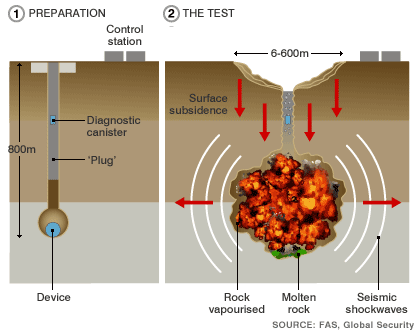
So, when the USGS saw this 4.7 blip on their seismographs, coffee might have been spilled on some keyboards. It was caused by an underground nuclear test. North Korea has detonated a bomb 6.2 miles under the crust of their country which kick-started this artificial earthquake. Sure enough, a state-run North Korean news agency confirmed how insane their government is by releasing this statement:

“[North Korea] successfully conducted another underground nuclear test on May 25 as part of its measures aimed at strengthening its self-defense nuclear deterrent in every way.” —Korean Central News Agency

Deterrent? Are you sure? What are they deterring?

Judging by the frakked-up satellite-submarine launch in April, the nation’s nuclear missile fleet probably isn’t the best in the world, and there’s not many warheads in the armory. So globally, North Korea isn’t fooling anyone.

However, this new test will cause grave concern for the region if the NK dictatorship starts sipping too much of the Kool-Aid. The nightmare scenario would be a nuclear-tipped ICBM dropping into South Korea or Japan. Unfortunately, when you have a crazy person living in a military state, cut off from the rest of the world, all bets are off when they are in charge of the Red Button.

Needless to say, the political fallout will be huge, which is kinda the point. They like propaganda. Especially when a nuclear test’s effects are more than just seismic, it looks as if the economic markets are shaking too. Also, big changes are afoot in Pyongyang, Kim Jong Il appears to be in the process of handing over power to his brother-in-law, so who knows what’s going to happen next… expect a few more artificial quakes in the future

The anatomy of an underground nuclear test (BBC)