
There’s a new hypothesis about what happened on August 15, 1977, and, sadly, it doesn’t involve aliens — just a photobombing comet. I was surprised about the controversy surrounding Antonio Paris’ research into the possibility of comets generating radio signals at 1420MHz and mimicking the famous “Wow!” signal nearly 40 years ago, so I decided to record Astroengine’s second YouTube video on the topic. Enjoy! And remember to subscribe and like, there’s a lot more to come!
Month: June 2017
Newborn Star Found Growing Inside Magnetic Nest of Chaos
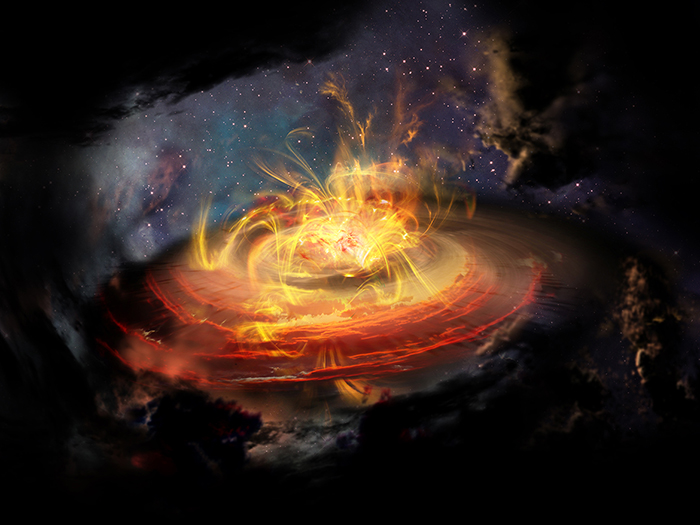
Conventional wisdom would have us believe that stars form in extremely powerful and ordered magnetic fields. But “conventional,” our universe is not (as Yoda might say).
In a new and fascinating study published in Astrophysical Journal Letters and carried out by astronomers using the Atacama Large Millimeter/submillimeter Array (ALMA) in Chile, a star some 1,400 light-years away in the Serpens star-forming region had its magnetic field gauged.
The star, called Ser-emb 8, is embedded inside the magnetic field passing through the molecular cloud it was born in. As the surrounding dust aligns itself with the direction of these magnetic field lines, ALMA is able to make precise measurements of the polarization of the emissions produced by this dust. From these incredibly sensitive measurements, a map of the polarization of light could be created, providing a view of the magnetic nest the star was born in.

And this nest is an unexpected one; it’s a turbulent region lacking the strong and ordered magnetism that would normally be predicted to be in the immediate vicinity of Ser-emb 8. Previous studies have shown newborn stars to possess powerful magnetic fields that take on an “hourglass” shape, extending from the protostar and reaching light-years into space. Ser-emb 8, however, is different.
“Before now, we didn’t know if all stars formed in regions that were controlled by strong magnetic fields. Using ALMA, we found our answer,” said astronomer Charles L. H. “Chat” Hull, at the Harvard-Smithsonian Center for Astrophysics (CfA) in Cambridge, Mass. “We can now study magnetic fields in star-forming clouds from the broadest of scales all the way down to the forming star itself. This is exciting because it may mean stars can emerge from a wider range of conditions than we once thought.”
By comparing these observations with computer simulations, an insightful view of the earliest magnetic environment surrounding a young star has been created.
“Our observations show that the importance of the magnetic field in star formation can vary widely from star to star,” added Hull in a statement. “This protostar seems to have formed in a weakly magnetized environment dominated by turbulence, while previous observations show sources that clearly formed in strongly magnetized environments. Future studies will reveal how common each scenario is.”
Hull and his team think that ALMA has witnessed a phase of star formation before powerful magnetic fields are generated by the young star, wiping out any trace of this pristine magnetic environment passing through the star forming region.
When Black Holes Collide… Astroengine Is Now On YouTube!
So… it begins!
Astroengine has finally been launched on YouTube, kicking off with a summary of the recent gravitational wave discovery by LIGO. I’m aiming to produce at least one video a week and I’d really like to make it as viewer-driven as possible. So if you have any burning space science questions or any critique about the videos I’m posting, please reach out!
But for now, you know what to do: like, subscribe and enjoy!
‘Failed’ Star Rapidly Orbits ‘Dead’ Star in Weird Stellar Pairing

The galaxy may be filled with weird stellar wonders, but you’d be hard-pressed to find a binary system stranger than WD1202-024.
First thought to be an isolated white dwarf star approximately 40% the mass of our sun, astronomers studying observational data from NASA’s Kepler space telescope realized the stellar husk has company. In an extremely fast 71-minute orbit, the star has a brown dwarf, 67 times the mass of Jupiter, in tow — an unprecedented find.
White dwarfs are formed after sun-like stars run out of fuel and die. This will be the fate of our sun in about five billion years time, after it becomes depleted of hydrogen in its core and puffs-up into a red giant. Shedding its outer layers after a period of violent stellar turmoil, a planetary nebula will form with a tiny mass of degenerate matter — a white dwarf — in its center. Earth would be toast long before the sun turns into a red giant, however.
But in the case of WD1202-024, it seems that when it was a young star (before it passed through its final red giant phase), it had a brown dwarf in orbit.
Commonly known as “failed stars,” brown dwarfs are not massive enough to sustain sufficient fusion in their cores to spark the formation of a star. But they’re too massive to be called planets as they possess the internal circulation of material that is more familiar to stars (so with that in mind, I like to refer to brown dwarfs as “overachieving planets”). They are the bridge between stars and planets and fascinating objects in their own right.
But the brown dwarf in the WD1202 binary couldn’t have formed with only a 71-minute orbit around the white dwarf; it would have evolved further away. So what happened? After carrying out computer simulations of the system, the international team of researchers found a possible answer.
“It is similar to an egg-beater effect,” said astronomer Lorne Nelson, of Bishop’s University, Canada, during the American Astronomical Society meeting in Austin, Texas on June 6th. “The brown dwarf spirals in towards the center of the red giant and causes most of the mass of the red giant to be lifted off of the core and to be expelled. The result is a brown dwarf in an extraordinarily tight, short-period orbit with the hot helium core of the giant. That core then cools and becomes the white dwarf that we observe today.”
In the future, the researchers hypothesize, the brown dwarf will continue to orbit the white dwarf until energy is depleted from the system via gravitational waves. In less than 250 million years, the orbital distance will be so small that the extreme tidal forces exerted by the white dwarf will start to drag brown dwarf material into the star, cannibalizing it.
This will turn WD1202 into a cataclysmic variable (CV), causing its brightness to flicker as the brown dwarf material is extruded into an accretion disk orbiting the white dwarf.
What a way to go.
SETI “Wow!” Signal Wasn’t Chatty Aliens After All — It Was a Fizzing Comet

On Aug. 15, 1977 at 10:16 p.m. ET Ohio State University’s Big Ear radio telescope detected a curious signal from deep space. Nearly 40 years later, we finally know what caused it and, sadly, it’s not aliens.
For decades, the signal has been the strongest piece of “go-to” evidence that intelligent extraterrestrials are out there in our galaxy. When found by astronomer Jerry Ehman on that fateful night, the 72-second signal — that had been recorded on a computer printout — certainly stood out.
While pointing at three star systems called Chi Sagittarii in the constellation of Sagittarius, Big Ear had picked up a powerful burst of radio waves. To the untrained eye, the assortment of printed digits might not mean much, but as I wrote in 2016, those letters and numbers could hold the answer to the biggest question we’re currently asking of the universe: Are we alone?
The Big Ear printout contains a bunch of apparently random numbers and letters, but Ehman’s red pen circles a cluster of digits “6EQUJ5” with other circles around a “6” and “7” on separate columns. This particular code first uses the numbers 1-9 and then the alphabet A-Z to denote signal strength. As the burst suggests, the signal strength hit “6” and then blasted through the letters reaching a peak of “U” before subsiding back into the numerical scale at “5.” There was then a slight wave trailing the main signal (hence the circled “6″ and “7″). The wave profile of the “Wow!” signal is graphically envisaged here. (Discovery News, April 18, 2016)

The maddening thing about the Wow! signal has always been a lack of replication. To science, one random signal in the dark proves nothing. It would be like trying to plot a trend line on a graph with one data point. More data is obviously needed and yet, since 1977, there’s been no other radio signal quite like it.
Curious, yes. Definite proof of chatty aliens? A solid nope.
So, when researching other possible causes of the Wow! signal that were also rare occurrences (but not aliens), Antonio Paris of St Petersburg College, Fla. (and an ex-analyst of the US Department of Defense), suggested that the signal might have been generated by one of two comets that serendipitously drifted into the line of sight of the Big Ear radio telescope.
In 1977, neither 266P/Christensen and 335P/Gibbs were known of (they were discovered in 2006 and 2008 respectively) and Paris calculated that both comets would have been in the right place in the sky when the Wow! signal was recorded.
What’s more, the Wow! signal has a frequency of 1420MHz — the same frequency that neutral hydrogen radiates at. Hydrogen is abundant in our universe, so this frequency is commonly observed in astronomy.
At first blush, observing in this frequency to look for alien transmissions might seem like a fool’s errand; if the universe is humming in hydrogen noise, why would aliens bother using that frequency to ping their extraterrestrial neighbors?
Through SETI logic, the frequency of neutral hydrogen might be used by advanced civilizations as a kind of interstellar water cooler. It is the most abundant signal in the universe, every intelligent life-form would know this. So why not use 1420MHz as THE frequency to communicate across the light-years in hopes that other civilizations might already be tuned in?
But a SETI signal would need to stand out from the crowd — it would need to be powerful and possess other qualities that hint at its artificial nature. But should a comet quickly pass through the observing window of a radio telescope, Paris predicted that the received 1420MHz signal might mimic that of an artificial source.
And this year, an opportunity presented itself. Comet 266P/Christensen would pass through the sky in a similar orbital position as it did in 1977. During an observing campaign from November 2016 to February 2017, Paris studied the radio frequencies coming from the region and from the comet itself. He also compared these observations with other known comets.
The upshot: 266P is indeed producing a strong 1420MHz signal, as are other comets.
“The results of this investigation, therefore, conclude that cometary spectra are detectable at 1420 MHz and, more importantly, that the 1977 “Wow!” Signal was a natural phenomenon from a solar system body,” he writes in a study published in the Journal of the Washington Academy of Sciences
It appears that, in this case, the signal wasn’t aliens trying to make contact with us; it was a chance comet that just happened to be in the right place at the right time.
So, back to that alien megastructure…

 astroengine.com