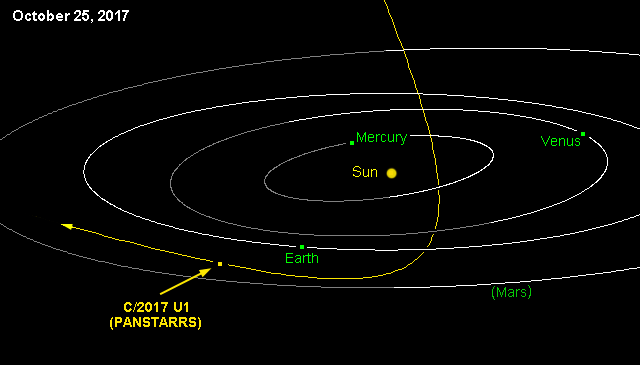
Hello, goodbye interstellar comet. The hyperbolic orbit of Comet C/2017 C1 as plotted by JPL’s Small-Body Database Browser (NASA/JPL-Caltech)
Update: At original time of writing, C/2017 U1 was assumed to be a comet. But Followup observations by the Very Large Telescope in Chile on Oct. 25 found no trace of cometary activity. The object’s name has now been officially changed to A/2017 U1 as it is more likely an interstellar asteroid, not a comet.
Comets and asteroids usually originate from the outermost reaches of the solar system — they’re the ancient rocky, icy debris left over from the formation of the planets 4.6 billion years ago.
However, astronomers have long speculated that comets and asteroids originating from other stars might escape their stars, traverse interstellar distances and occasionally pay our solar system a visit. And looking at C/2017 U1’s extreme hyperbolic trajectory, it looks very likely it’s not from around these parts.
“If further observations confirm the unusual nature of this orbit this object may be the first clear case of an interstellar comet,” said Gareth Williams, associate director of the International Astronomical Union’s Minor Planet Center (MPC). A preliminary study of C/2017 U1 was published earlier today. (Since this statement, followup observations have indicated that the object might be an asteroid and not a comet.)
According to Sky & Telescope, the object entered the solar system at the extreme speed of 16 miles (26 kilometers) per second, meaning that it is capable of traveling a distance of 850 light-years over 10 million years, a comparatively short period in cosmic timescales.
Spotted on Oct. 18 as a very dim 20th magnitude object, astronomers calculated its trajectory and realized that it was departing the solar system after surviving a close encounter with the sun on Sept. 9, coming within 23.4 million miles (0.25 AU). Comets would vaporize at that distance from the sun, but as C/2017 U1’s speed is so extreme, it didn’t have time to heat up.
“It went past the sun really fast and may not have had time to heat up enough to break apart,” said dynamicist Bill Gray. Gray estimates that the comet is approximately 160 meters wide with a surface reflectivity of 10 percent.
But probably the coolest factor about this discovery is the possible origin of C/2017 U1. After calculating the direction at which the comet entered the solar system, it appears to have come from the constellation of Lyra and not so far from the star Vega. For science fiction fans this holds special meaning — that’s the star system where the SETI transmission originated in the Jodie Foster movie Contact.
But the fact that I’m typing this article and you’re reading it, however, suggests that we are here, so something must be awry with our understanding of the physics the universe is governed by.
The universe is the embodiment of an epic battle between matter and antimatter that occurred immediately after the Big Bang, 13.82 billion years ago. Evidently, matter won — because there are galaxies, stars, planets, you, me, hamsters, long walks on sandy beaches and beer — but how matter won is one of the biggest mysteries hanging over physics.
It is predicted that equal amounts of matter and antimatter were produced in the primordial universe (a basic prediction by the Standard Model of physics), but if that’s the case, all matter in the universe should have been annihilated when it came into contact with its antimatter counterpart — a Big Bang followed by a big disappointment.
This physics conundrum focuses on the idea that all particles have their antimatter twin with the same quantum numbers, only the exact opposite. Protons have anti-protons, electrons have positrons, neutrinos have anti-neutrinos etc.; a beautiful example of symmetry in the quantum world. But should one of these quantum numbers be very slightly different between matter and antimatter particles, it might explain why matter became the dominant “stuff” of the universe.
So, in an attempt to measure one of the quantum states of particles, physicists of CERN’s Baryon–Antibaryon Symmetry Experiment (BASE), located near Geneva, Switzerland, have made the most precise measurement of the anti-proton’s magnetic moment. BASE is a complex piece of hardware that can precisely measure the magnetic moments of protons and anti-protons in an attempt to detect an extremely small difference between the two. Should there be a difference, this might explain why matter is more dominant than antimatter.
However, this latest measurement of the magnetic moment of anti-protons has revealed that the magnetic moments of both protons and anti-protons are exactly the same to a record-breaking level of precision. In fact, the anti-proton measurement is even more precise than our measurements of the magnetic moment of a proton — a stunning feat considering how difficult anti-protons are to study.
“It is probably the first time that physicists get a more precise measurement for antimatter than for matter, which demonstrates the extraordinary progress accomplished at CERN’s Antiproton Decelerator,” said physicist Christian Smorra in a CERN statement. The Antiproton Decelerator is a machine that can capture antiparticles (created from particle collisions that occur at CERN’s Proton Synchrotron) and funnel them to other experiments, like BASE.
Antimatter is very tricky to observe and measure. Should these antiparticles come into contact with particles, they annihilate — you can’t simply shove a bunch of anti-protons into a flask and expect them to play nice. So, to prevent antimatter from making contact with matter, physicists have to create magnetic vacuum “traps” that can quarantine anti-protons from touching matter, thereby allowing further study.
A major area of research has been to develop ever more sophisticated magnetic traps; the slightest imperfections in a trap’s magnetic field containing the antimatter can allow particles to leak. The more perfect the magnetic field, the less chance there is of leakage and the longer antimatter remains levitating away from matter. Over the years, physicists have achieved longer and longer antimatter containment records.
In this new study, published in the journal Nature on Oct. 18, researchers used a combination of two cryogenically-cooled Penning traps that held anti-protons in place for a record-breaking 405 days. In that time they were able to apply another magnetic field to the antimatter, forcing quantum jumps in the particles’ spin. By doing this, they could measure their magnetic moments to astonishing accuracy.
According to their study, anti-protons have a magnetic moment of −2.792847344142 μN (where μN is the nuclear magneton, a physical constant). The proton’s magnetic moment is 2.7928473509 μN, almost exactly the same — the slight difference is well within the experiment’s error margin. As a consequence, if there’s a difference between the magnetic moment of protons and anti-protons, it must be much smaller than the experiment can currently detect.
These tiny measurements have huge — you could say: universal — implications.
“All of our observations find a complete symmetry between matter and antimatter, which is why the universe should not actually exist,” added Smorra. “An asymmetry must exist here somewhere but we simply do not understand where the difference is.”
Now the plan is to improve methods of capturing antimatter particles, pushing BASE to even higher precision, to see if there really is an asymmetry in magnetic moment between protons and anti-protons. If there’s not, well, physicists will need to find their asymmetry elsewhere.
Images of Comet 41P/Tuttle-Giacobini-Kresak’s jets as observed by the Discovery Channel Telescope on March 19, 2017 (Schleicher/Lowell Observatory)
Although comets are static lumps of ancient ice for most of their lives, their personalities can rapidly change with a little heat from the sun. Now, astronomers have witnessed just how dynamic comets can be, seeing one dramatically slow its rate of rotation to the point where it may even reverse its spin.
Comets are the leftover detritus of planetary formation that were sprinkled around our sun 4.6 billion years ago. These primordial icy remains collected in the outermost reaches of the solar system and that’s where they stay until they get knocked off their gravitational perches to begin an interplanetary roller coaster ride. Some are unlucky and end up diving straight to a fiery, solar death. But others set up in stable orbits, making regular passes through the inner solar system, dazzling observers with their beautiful tails formed through heating by the sun.
One mile-wide short-period comet is called 41P/Tuttle-Giacobini-Kresak and it’s a slippery celestial object. First discovered in 1858 by U.S. astronomer Horace Parnell Tuttle, it disappeared soon after. But in 1907, French astronomer Michael Giacobini “rediscovered” the comet, only for it to disappear once again. Then, in 1951, Slovak astronomer Ľubor Kresák made the final “discovery” and now astronomers know exactly where to find it and when it will turn up in our night skies.
Its name, Tuttle-Giacobini-Kresak, reflects the wonderful 100-year discovery and rediscovery history of astronomy’s quest to keep tabs on the comet’s whereabouts.
Comet 41P/Tuttle-Giacobini-Kresak as observed on March 22, 2017 (Kees Scherer/Knight Observatory, Tomar)
Now, 41P is the focus of an interesting cometary discovery. Taking 5.4 years to complete an orbit around the sun, 41P came within 13-million miles to Earth earlier this year, the closest it has come to our planet since it was first discovered by Tuttle. So, astronomers at Lowell Observatory, near Flagstaff, Ariz., used the 4.3-meter Discovery Channel Telescope near Happy Jack, the 1.1-meter Hall telescope and the 0.9-meter Robotic telescope on Anderson Mesa, to zoom-in on the interplanetary vagabond to measure its rotational speed.
Comets can be unpredictable beasts. Composed of rock and icy volatiles, when they are slowly heated by the sun as they approach perihelion (the closest point in their orbit to the sun), these ices sublimate (i.e. turn from ice to vapor without melting into a liquid), blasting gas and dust into space.
Over time, these jets are known to have a gradual effect the comet’s trajectory and rotation, but, over an astonishing observation run, Lowell astronomers saw a dramatic change in this comet’s spin. Over a short six-week period, the comet’s rate of rotation slowed from one rotation every 24 hours to once every 48 hours — its rate of rotation had halved. This is the most dramatic change in comet rotation speed ever recorded — and erupting jets from the comet’s surface are what slammed on the brakes.
This was confirmed by observing cyanogen gas, a common molecule found on comets that is composed of one carbon atom and one nitrogen atom, being ejected into space as the comet was being heated by sunlight.
“While we expected to observe cyanogen jets and be able to determine the rotation period, we did not anticipate detecting a change in the rotation period in such a short time interval,” said Lowell astronomer David Schleicher, who led the project, in a statement. “It turned out to be the largest change in the rotational period ever measured, more than a factor of ten greater than found in any other comet.”
For this rapid slowdown to occur, the researchers think that 41P must have a very elongated shape and be of very low density. In this scenario, if the jets are located near the end of its length, enough torque could be applied to cause the slowdown. If this continues, the researchers predict that the direction of rotation may even reverse.
“If future observations can accurately measure the dimensions of the nucleus, then the observed rotation period change would set limits on the comet’s density and internal strength,” added collaborator Matthew Knight. “Such detailed knowledge of a comet is usually only obtained by a dedicated spacecraft mission like the recently completed Rosetta mission to comet 67P/Churyumov-Gerasimenko.”
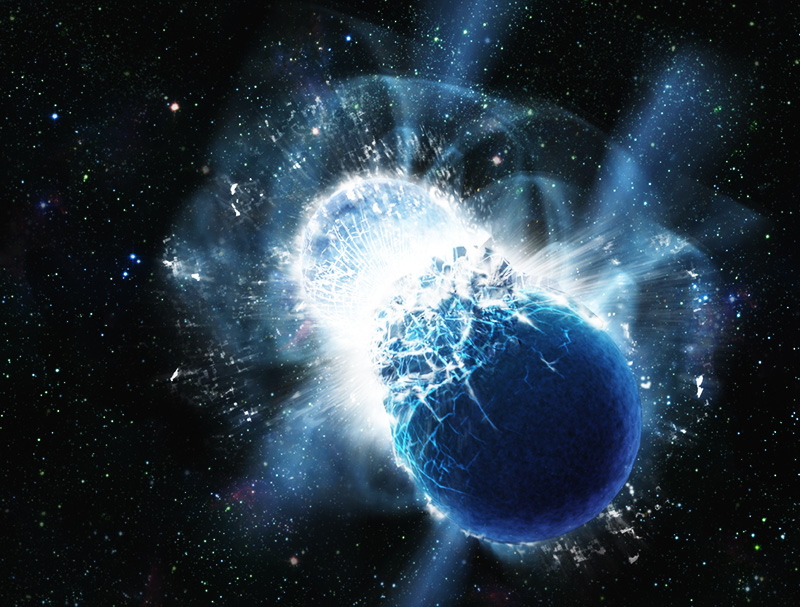
Artist impression of a violent neutron star collision (Dana Berry, SkyWorks Digital, Inc.)
One hundred and thirty million years ago in a galaxy 130 million light-years away, two neutron stars met their fate, merging as one. Trapped in a gravitational embrace, these two stellar husks spiraled closer and closer until they violently ripped into one another, causing a detonation that reverberated throughout the cosmos.
On August 17, the U.S.-based Laser Interferometer Gravitational-Wave Observatory (LIGO) and Italian Virgo gravitational wave detector felt the faint ripples in spacetime from that ancient neutron star collision washing through our planet. Until now, LIGO and Virgo have only confirmed the collisions and mergers of black holes, so the fact that a nearby (a relative term in this case) neutron star merger had been detected was already historic.
But the implications for this particular neutron star signal, which is comparatively weak in comparison with the black hole mergers that have come before it, are so profound that I’ve been finding it hard to put this grand discovery into words (though I have tried).
Why It Matters
With regards to gravitational waves, I feel I’ve described each gravitational wave discovery as “historic” and “a new era for astronomy” since their first detection on Sept. 15, 2015, but the detection of GW170817 may well trump all that have come before it, even though the signal was generated by neutron stars and not black hole heavyweights.
The thing with black holes is that when they collide and merge, they don’t necessarily produce electromagnetic radiation (i.e. visible light, X-rays or infrared radiation). They can go “bump” in the cosmic night and no intelligent being with a conventional telescope would see it happen. But in the the gravitational domain, black hole mergers echo throughout the universe; their gravitational waves travel at the speed of light, warping spacetime as they propagate. To detect these “invisible” waves, we must build instruments that can “see” the infinitesimal wobbles in the fabric of spacetime itself, and this is where laser interferometry comes in.
Very precise lasers are fired down miles-long tunnels in “L” shaped buildings in the two LIGO detectors (in Washington and Louisiana) and the Virgo detector near Pisa. When gravitational waves travel through us, these laser interferometers can measure the tiny spacetime warps. The more detectors measuring the same signal means a more precise observation and scientists can then work out where (and when) the black hole merger occurred.
There are many more details that can be gleaned from the gravitational wave signal from black hole mergers, of course — including the progenitor black holes’ masses, the merged mass, black hole spin etc. — but for the most part, black hole mergers are purely a gravitational affair.
Neutron stars, however, are a different beast and, on Aug. 17, it wasn’t only gravitational wave detectors that measured a signal from 130 million light-years away; space telescopes on the lookout for gamma-ray bursts (GRBs) also detected a powerful burst of electromagnetic radiation in the galaxy of NGC 4993, thereby pinpointing the single event that generated the gravitational waves and the GRB.
And this is the “holy shit” moment.
As Caltech’s David H. Reitze puts it: “This detection opens the window of a long-awaited ‘multi-messenger’ astronomy.”
What Reitze is referring to is that, for the first time, both gravitational waves and electromagnetic waves (across the EM spectrum) have been observed coming from the same astrophysical event. The gravitational waves arrived at Earth slightly before the GRB was detected by NASA’s Fermi and ESA’s INTEGRAL space telescopes. Both space observatories recorded a short gamma-ray burst, a type of high-energy burst that was theorized (before Aug. 17) to be produced by colliding neutron stars.
The growing family of merging black holes and neutron stars observed with gravitational waves (LIGO-Virgo/Frank Elavsky/Northwestern University)
Now scientists have observational evidence that these types of GRBs are produced by colliding neutron stars as the gravitational wave fingerprint unquestionably demonstrates the in-spiraling and merger of two neutron stars. This is a perfect demonstration of multi-messenger astronomy; where an energetic event can be observed simultaneously in EM and gravitational waves to reveal untold mysteries of the universe’s most energetic events.
Another Nod to Einstein
The fact that the gravitational waves and gamma-rays arrived at approximately the same time is yet another nod to Einstein’s general relativity. The century-old theory predicts that gravitational waves should travel at the speed of light and, via this brand spanking new way of doing multi-messenger astronomy, physicists and astronomers have again bolstered relativity with observational evidence.
But why did the gravitational waves arrive slightly before the GRB? Well, NASA’s Fermi team explains: “Fermi’s [Gamma-ray Burst Monitor instrument] saw the gamma-ray burst after the [gravitational wave] detection because the merger happened before the explosion,” they said in a tweet.
In other words, when the two neutron stars collided and merged, the event immediately dissipated energy as gravitational waves that were launched through spacetime at the speed of light — that’s the source of GW170817 — but the GRB was generated shortly after.
Enter the Kilonova
As the neutron stars smashed together, huge quantities of neutron star matter were inevitably blasted into space, creating a superheated, dense volume of free neutrons. Neutrons are subatomic particles that form the building blocks of atoms and if the conditions are right, the neutron star debris will undergo rapid neutron capture process (known as “r-process”) where neutrons combine with one another faster than the newly-formed radioactive particles can decay. This mechanism is responsible for synthesizing elements heavier than iron (elements lighter than iron are formed through stellar nucleosynthesis in the cores of stars).
Artist impression of colliding neutron stars generating gravitational waves and a “kilonova” (NSF/LIGO/Sonoma State University/A. Simonnet)
For decades astronomers have been searching for observational evidence of the r-process in action and now they have it. Soon after the merger, massive amounts of debris erupted in a frenzy of heavy element creation, triggering an energetic eruption known as a “kilonova” that was seen as a short GRB. The GRB was cataloged as “SSS17a.”
The Golden Ticket
Follow-up observations by the Hubble Space Telescope, Gemini Observatory and the ESO’s Very Large Telescope have all detected spectroscopic signatures in the afterglow consistent with the r-process taking place at the site of the kilonova, meaning heavy elements are being formed and, yes, it’s a goldmine. As in: there’s newly-synthesized gold there. And platinum. And all the other elements heavier than iron that aren’t quite so sexy.
And there’s lots of it. Researchers estimate that that single neutron star collision produced hundreds of Earth-masses of gold and platinum and they think that neutron star mergers could be the energetic process that seed the galaxies with heavy elements (with supernovas coming second).
So, yeah, it’s a big, big, BIG discovery that will reverberate for the decades to come.
The best thing is that we now know that our current generation of advanced gravitational wave detectors are sensitive enough to not only detect black holes merging billions of light-years away, but also detect the nearby neutron stars that are busy merging and producing gold. As more detectors are added and as the technology and techniques mature, we’ll be inundated with merging events big and small, each one teaching us something new about our universe.
Streaming LIVE here, today, at 4 p.m. PDT/7 p.m. EDT/11 p.m. GMT
The Perimeter Institute’s public lecture series is back! At 7 p.m. EDT (4 p.m. PDT) today, Erik Verlinde of the University of Amsterdam will ask: Are we standing on the brink of a new scientific revolution that will radically change our views on space, time, and gravity? Specifically, Verlinde will discuss the possibility that gravity may be an emergent phenomena and not a fundamental force of nature. Ohh, interesting.





 astroengine.com