Tonight’s “Black Moon” Isn’t Actually a Thing

The media strikes again.

Ahhh the glorious Black Moon. Seriously, it’s there. [via NASA-SVS]

Who doesn’t love the moon? You just have to look up when the skies are clear and there it is, our lunar friend, doing its thing, changing phases, yanking at our oceans, inspiring the world to look “up.”

It’s little wonder, then, that humanity has created many different names for our planet’s tidal partner in crime. There are useful astronomical names that describe its different phases (new/full, first/third quarter, waxing/waning crescent/gibbous), but there’s also other names that have popped up throughout human history that relate to other subtleties in the lunar dance around our world. A quasi-rare second full moon of the month? Blue moon! When the full moon coincides with perigee (lunar close approach with Earth)? Supermoon! When you get a bonus lunar combo that includes a full moon, a supermoon… and the Earth is blocking the sun so we have a lunar eclipse… and it all happens to occur in January?? That’s a SUPER BLOOD WOLF MOON ECLIPSE! Because of course it is.

As you may or may not have realized, humans—particularly humans in marketing departments, the media, and astrologers with too much time on their hands—like to label things. Some of these labels can be useful, others not so much. Many are, frankly, just plain silly. Which brings me to today’s lunar branding non-event: The Black Moon. Ohh sounds… eerie.

Over to Joe Rao at SPACE.com:

As one who has been involved in the broadcasting field for nearly 40 years, I’d like to point out that we live in a time when the news media is seemingly obsessed with “branding.” This marketing strategy involves creating a differentiated name and image — often using a tagline — in order to establish a presence in people’s mind. In recent years in the field of astronomy, for example, we’ve seen annular eclipses — those cases when the moon is too small to completely cover the disk of the sun — become branded as “Ring of Fire” eclipses. A total eclipse of the moon — when the moon’s plunge through the Earth’s shadow causes the satellite to turn a coppery red color — is now referred to as a “Blood Moon.” 

When a full moon is also passing through that part of its orbit that brings it closest to Earth — perigee — we now brand that circumstance as a supermoon. That term was actually conjured up by an astrologer back in 1979 but quite suddenly became a very popular media brand after an exceptionally close approach of a full moon to Earth in March 2011. It surprises me that even NASA now endorses the term, although it seems to me the astronomical community in general shies away from designating any perigee full moon as “super.”

Then there is Blue Moon. This moniker came about because a writer for Sky & Telescope Magazine misinterpreted an arcane definition given by a now-defunct New England Almanac for when a full moon is branded “blue,” and instead incorrectly reasoned that in a month with two full moons, the second is called a Blue Moon. That was a brand that quietly went unnoticed for some 40 years, until a syndicated radio show promoted the term in the 1980s and it then went viral. So now, even though the second full moon in a month is not the original definition for a Blue Moon, in popular culture we now automatically associate the second full moon in a calendar month with a Blue Moon.

So are you ready for yet another lunar brand? The newest one is Black Moon.

Joe Rao, “Black Moon 2019: What It Is (and Why You Can’t See It)“, SPACE.com

That’s a very polite way of saying, “it’s all bullshit, really.”

So, what IS a Black Moon? Well, it’s the opposite of a Blue Moon, as in it’s the second New Moon in the month of July and a New Moon is when the sun, moon and Earth are in almost exact alignment; the entire Earth-facing side of the moon is in complete shadow. The upshot is you can’t see it. It’s a naked-eye astronomical non-event.

Having said that, should the moon exactly line up with the sun, you get a solar eclipse—arguably the most mind-blowing astronomical event we can see on Earth. A plain ol’ Black Moon? Not so much.

UPDATE: As this post turned into the seed for a fun little online discussion, I added some thoughts in the following Twitter thread. Feel free to @ me:

When a Climate Emergency Turns Into a Human Catastrophe

There’s nothing subtle about this deadly consequence of global warming.

[Pexels]

While the recent record-breaking temperatures in Europe have grabbed the headlines, it’s worth remembering that such record-shattering heatwaves are nothing new to other regions of the planet. And many of those regions are fast approaching a grim reality: heat events that will overwhelm the body’s ability to function.

From “Heatwave: think it’s hot in Europe? The human body is already close to thermal limits elsewhere“:

Once this wetbulb temperature threshold is crossed, the air is so full of water vapour that sweat no longer evaporates. Without the means to dissipate heat, our core temperature rises, irrespective of how much water we drink, how much shade we seek, or how much rest we take. Without respite, death follows – soonest for the very young, elderly or those with pre-existing medical conditions.

Wetbulb temperatures of 35°C have not yet been widely reported, but there is some evidence that they are starting to occur in Southwest Asia. Climate change then offers the prospect that some of the most densely populated regions on Earth could pass this threshold by the end of the century, with the Persian GulfSouth Asia, and most recently the North China Plain on the front line. These regions are, together, home to billions of people.

Tom Matthews, Climate Scientist, Loughborough University, The Conversation.

Matthews goes on to warn of “grey swan” events (read his research here, via Nature Climate Change), where overwhelming heat and moisture is coupled with mass power outages triggered by anthropomorphic global warming-boosted extreme weather events to leave vast populated regions physically unable to keep cool.

While many effects of climate change may seem subtle or “something for future generations to worry about,” this extreme situation will happen sooner rather than later, and as Matthews discusses, it has probably already been experienced.

Any debate about the realities of climate change is a distant dot in the rear-view mirror, and, according to a recent study, the scientific consensus that humans are driving global warming has passed 99 percent. (In reality, the consensus that humans are causing the planet to heat up has been an overwhelming majority for years, likely decades.)

Sadly, scientific consensus isn’t enough to stymie the emissions of greenhouse gasses—if it was, the oil rigs and coal mines would have been shut down years ago. It’s the human disposition for greed and myopic politics that will turn this once ecologically-diverse planet into an increasingly inhospitable place for humans to thrive.

The pushback has been political rather than scientific. In the US, the rightwing thinktank the Competitive Enterprise Institute (CEI) is reportedly putting pressure on Nasa to remove a reference to the 97% study from its webpage. The CEI has received event funding from the American Fuel and Petrochemical Manufacturers and Charles Koch Institute, which have much to lose from a transition to a low-carbon economy.

Johnathan Watts, The Guardian

Policy makers who claim to be “skeptical” about the overwhelming scientific consensus that humans are causing global warming aren’t necessarily uneducated fools. They simply do not care. Democracy has long been hijacked by special interest groups and corporations that care little about the future health of the environment and society. In the long run, their belligerent self-interest will undercut their bottom line. It won’t be long until our carbon-driven economy will collapse under the weight of relentless impacts caused by the continued burning of fossil fuels.

It’s the ultimate self-own, and it’s a shame they’ll take us with them.

Two Stellar Zombie Spinners Are Ripping Up Spacetime

The pair of white dwarf stars are orbiting one another every seven minutes—and future gravitational wave observatories will be able to detect them whirl.

White dwarf binaries are among some of the most fascinating star systems known, and a newly discovered compact binary, located some 8,000 light-years away in the constellation Boötes, has taken the exotic nature of these systems to new spacetime-warping extremes.

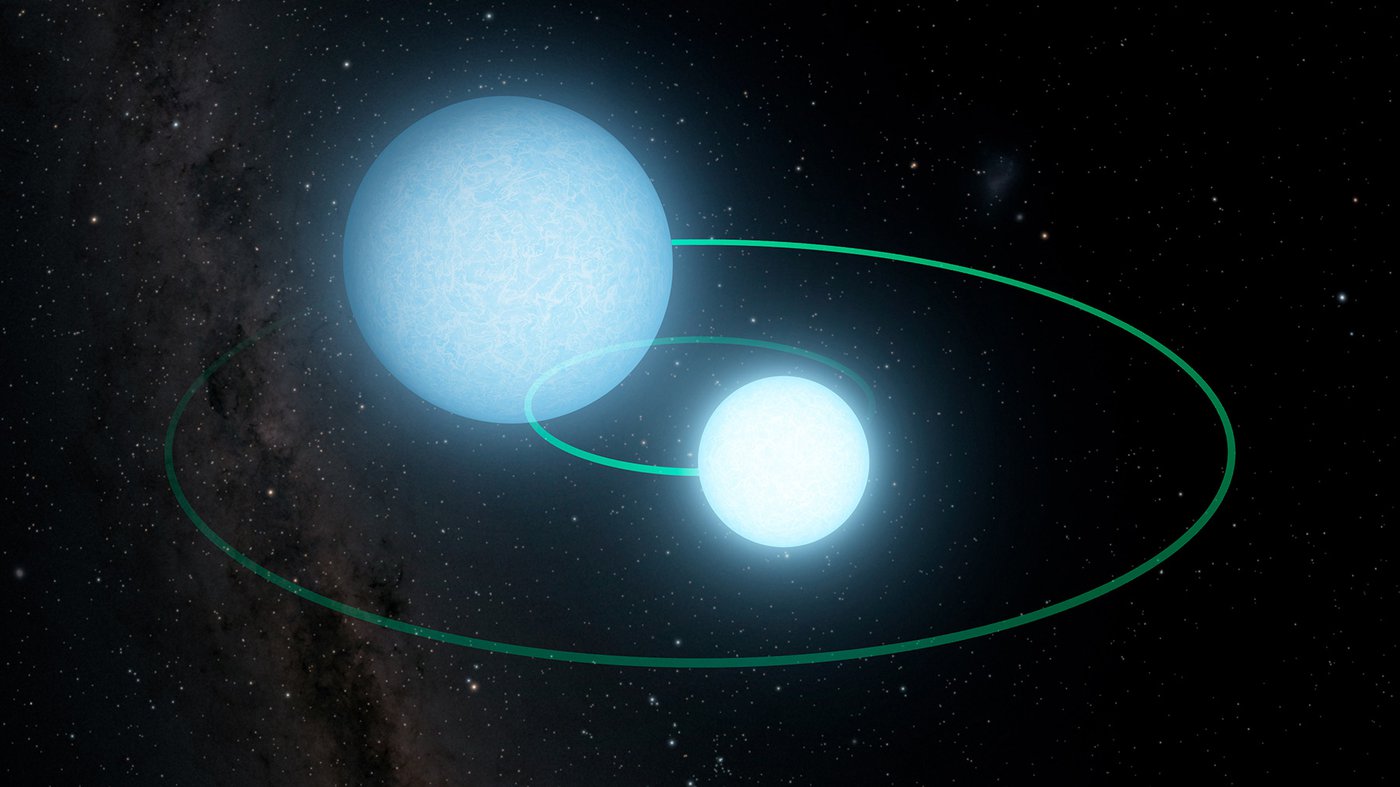
The extremely compact eclipsing binary, called ZTF J1530+5027, is one of the most extreme white dwarf systems known to exist [Caltech/IPAC]

Astronomers using Caltech’s Zwicky Transient Facility (ZTF), a precision sky survey at Palomar Observatory near San Diego in Southern California, made the discovery of ZTF J1530+5027 by detecting the dimming effect caused by one of the stars passing in front of the other. Known as an “eclipsing binary,” the cooler (and therefor dimmer) white dwarf blocks the starlight of the hotter (and brighter) star, causing the ZTF to register a periodic dimming event. This dimming occurs once every seven minutes, meaning they are zipping around each other at speeds of hundreds of miles per second! It is the second fastest white dwarf binary known and the most rapid eclipsing binary discovered in our galaxy. The fortunate alignment allows astronomers to not only precisely measure their orbital speed, they can also gauge the stars’ sizes and masses.

White dwarfs are the stellar corpses of sun-like stars that ran out of fuel long ago. Our sun will become a white dwarf in around five billion years, after it has exhausted its hydrogen fuel that maintains fusion in its core. A short period after, it will swell into a red giant (possibly expanding out as far as Earth, incinerating it) and then lose its plasma to space via powerful solar winds. All that will be left of our once glorious star will be a planetary nebula and a tiny and dense white dwarf, approximately the size of our planet, spinning in the middle. The two white dwarfs in ZTF J1530+5027 likely passed through their red giant phase at different times, but now they’re stuck, in a perpetual death spiral that spells doom for one of the objects.

To fully realize just how crazy-extreme this white dwarf binary is, they are only separated by one-fifth of the distance that the moon orbits Earth, meaning both stars would fully fit inside Saturn. They have a combined mass of our entire sun. As they orbit so snugly, it’s likely that the more massive star will start to tidally drag material from the other, cannibalizing it.

“Matter is getting ready to spill off of the bigger and lighter white dwarf onto the smaller and heavier one, which will eventually completely subsume its lighter companion,” said Kevin Burdge, Caltech graduate student and lead author of a study published in the journal Nature. “We’ve seen many examples of a type of system where one white dwarf has been mostly cannibalized by its companion, but we rarely catch these systems as they are still merging like this one.”

While impressive, the real fireworks are invisible—the stars are ripping up spacetime, generating gravitational waves that are sapping energy from the system, hastening the binary’s ultimate demise. What’s more, astronomers are anticipating that the future Laser Interferometer Space Antenna (LISA), which is scheduled for launch by the European Space Agency in 2034, will be able to detect its gravitational pulse.

“These two white dwarfs are merging because they are emitting gravitational waves,” added collaborator Tom Prince, a senior research scientist at Caltech and NASA’s Jet Propulsion Laboratory (JPL, in Pasadena, Calif. “Within a week of LISA turning on, it should pick up the gravitational waves from this system. LISA will find tens of thousands of binary systems in our galaxy like this one, but so far we only know of a few. And this binary-star system is one of the best characterized yet due to its eclipsing nature.”

This system is expected to keep blinking from our perspective for another hundred thousand years, but how will the system ultimately go kaput? Well, the researchers aren’t entirely certain. On the one hand, the more massive white dwarf may suck the other dry like a vampiric parasite, consuming all of its matter until only one, well-fed star remains. Alternatively, the act of cannibalization may cause the reverse; as mass is transferred to one star, the other may be flung outward to a wider orbit, increasing their orbital period.

“Sometimes these binary white dwarfs merge into one star, and other times the orbit widens as the lighter white dwarf is gradually shredded by the heavier one,” said co-author Jim Fuller, an assistant professor at Caltech. “We’re not sure what will happen in this case, but finding more such systems will tell us how often these stars survive their close encounters.”

One early mystery about this extreme binary is the question of X-rays, or lack thereof. The more massive star is really hot, with a temperature nine times that of the sun (50,000 Kelvin). The researchers believe that this is because it has already begun pulling material from its partner, an act that accelerates and heats the plasma that is being stolen, starting to create an accretion disk. But the accreting gas should be so hot that the system would be humming in X-rays, but it isn’t. “It’s strange that we aren’t seeing X-rays in this system. One possibility is that the accretion spots on the white dwarf—the areas the material is falling on—are bigger than what is typical, and this could result in the emission of ultraviolet light and optical light instead of X-rays,” added Burdge.

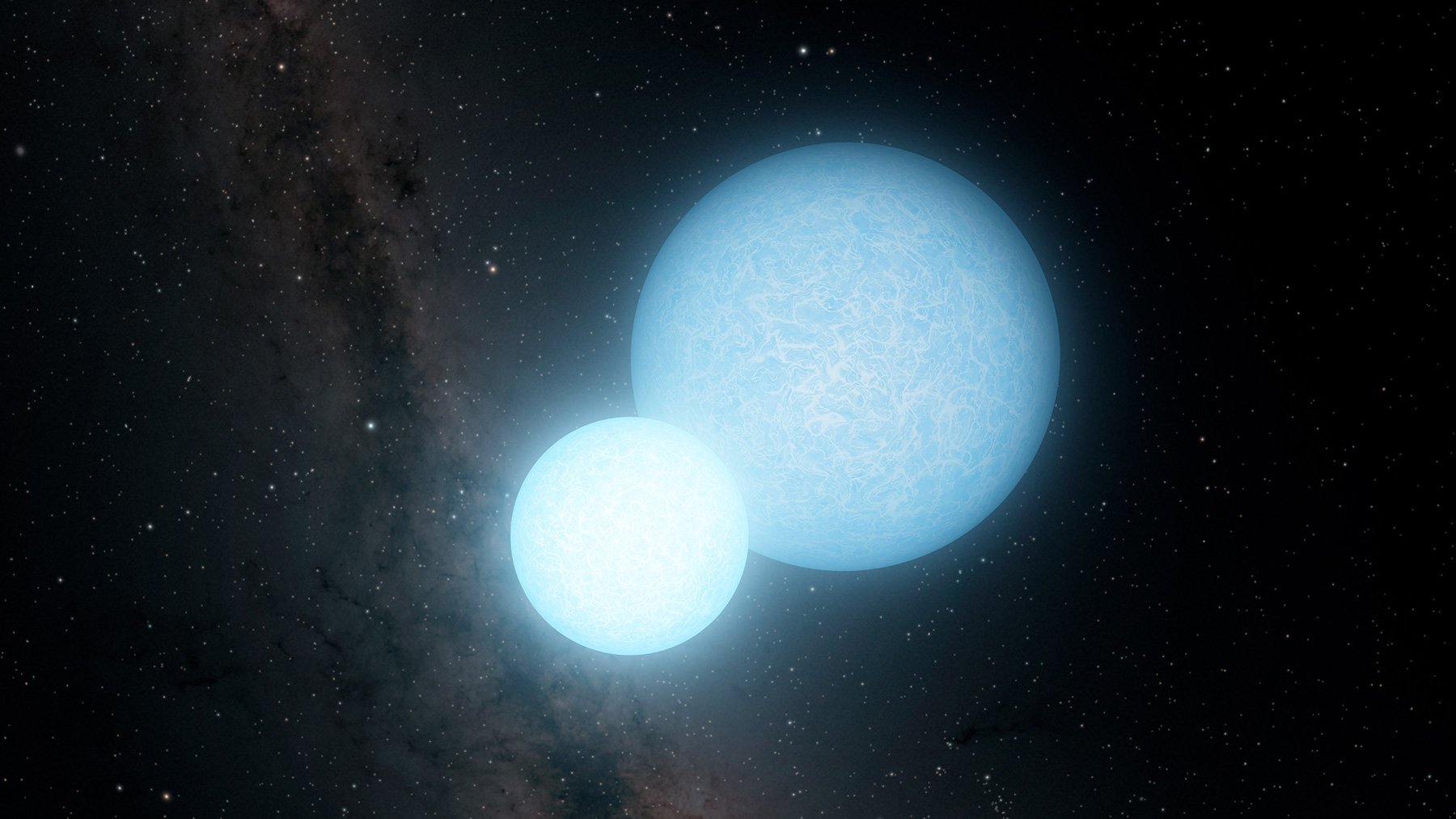
[Caltech/IPAC]

It’s exciting to think what the next generation of gravitational wave observatories (particularly LISA that will be sensitive to extremely weak spacetime ripples from systems such as these) combined with traditional (re: electromagnetic) observatories will herald for the future of astronomy. Like the emerging “multi-messenger” era for astronomy that combines observations of the electromagnetic spectrum and gravitational wave signals to confirm short gamma-ray bursts are triggered by neutron star collisions, it’s going to blow our minds when we can access more subtle gravitational wave sources such as these and directly see the gravitational energy leaking from compact binaries.

Sadly, ‘Oumuamua Isn’t Piloted by Joyriding Aliens

An international team of experts have teamed up to conclude that the interstellar visitor isn’t what we hoped it was.

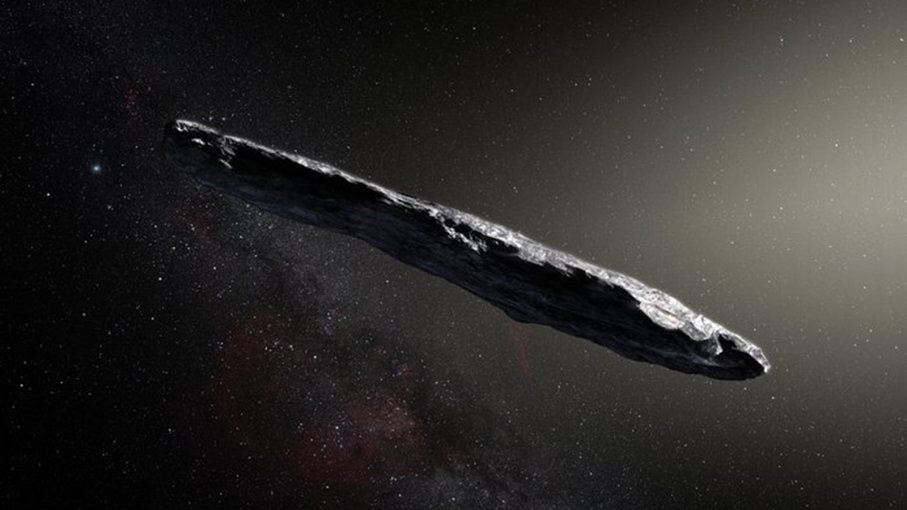
An artist’s impression of the strangely-elongated interstellar object ‘Oumuamua that zoomed through our solar system in 2017 [ESO/M. Kornmesser]

It probably comes as no surprise that the scientific consensus of ‘Oumuamua’s origins have concluded that it is a natural object, despite how funky and alien spaceship-looking the interstellar visitor at first appeared. According to a new study published today in the journal Nature Astronomy, the findings of 14 international experts have been pooled to categorically say that ‘Oumuamua isn’t an artificial object piloted by an intelligent extraterrestrial species, but instead “has a purely natural origin.”

“The alien spacecraft hypothesis is a fun idea, but our analysis suggests there is a whole host of natural phenomena that could explain it,” said the team’s leader Matthew Knight, from the University of Maryland, in a statement.

This most recent study comes hot on the heels of a fair amount of speculation that the spinning cigar-shaped object, which was detected by the Pan-STARRS1 telescope in Hawaii on Oct. 19, 2017, could be artificial. One of the more vocal advocates of this possibility, Avi Loeb of Harvard University, investigated the idea that ‘Oumuamua may be an interstellar probe that used our sun’s radiation pressure for a boost in velocity as it flew through the inner solar system. While the world’s media loved this concept (as did I), many scientists balked and emphasized the need to take the Occam’s razor approach and instead focus on natural explanations, not aliens. But, as pointed out by Loeb, while more likely explanations existed, considering the most extreme ones is still a part of the scientific process.

“This is how science works,” said Loeb in an interview for The Harvard Gazette late last year. “We make a conjecture … and if someone else advances another explanation, we will compare notes and the next time we see an object of this type we will hopefully be able to tell the difference. That’s the process by which science makes progress.”

Deep down, we all had the sense that the interstellar visitor likely wasn’t aliens (though it did spawn some wonderful debates about mind-boggling interstellar distances, the challenges of visiting other star systems, and why ET would bother popping by for a whistle-stop tour without saying “hi”), but this new study convincingly sounds the death knell for the possibility of aliens taking a joyride through our galactic neighborhood.

The new study is clear, in which the researchers write: “Here we review our knowledge and find that in all cases, the observations are consistent with a purely natural origin for ‘Oumuamua.”

So, what does the study conclude?

The object is most likely an ancient interstellar comet that randomly encountered our solar system after drifting through interstellar space for millions of years. The mechanisms by which ‘Oumuamua was ejected from its star system of birth remains up for debate, but the study’s authors point to the likelihood of a Jupiter-like world that may have gravitationally ejected the object when it strayed too close, helping it achieve escape velocity and a future lost deep in the interstellar expanse—until it encountered our solar system.

Even the behavior of the ancient comet as it traveled through the inner solar system agrees with theoretical predictions. The small boost in velocity as it made close approach to our sun was caused by ices (entombed under ‘Oumuamua’s surface) being heated and vented into space as a vapor (and not aliens hitting the gas). This behavior in comets is well-known, but the problem with ‘Oumuamua is that it exhibited few signs of being a comet—it didn’t develop a tail nor did it develop a coma, two clues of its cometary nature. But this object is different from the comets we know; it has been drifting through the galaxy for eons, perhaps it lost the majority of its ice in previous stellar encounters, or perhaps it contained little in the way of volatiles during its formation. Comets and asteroids also have a lot more in common that the textbooks may tell us, so perhaps it did vent small quantities of vapor to give it a boost, but not enough for astronomers to observe a tail and coma. In short, ‘Oumuamua shares similar traits to other objects that exist in our solar system

“While ‘Oumuamua’s interstellar origin makes it unique, many of its other properties are perfectly consistent with objects in our own solar system,” added Robert Jedicke of the University of Hawai’i’s Institute for Astronomy (IfA) and collaborator in the Nature Astronomy study.

The key thing that makes ‘Oumuamua so captivating, however, is not how it behaved when it entered the solar system and used the sun to change its course, it’s that we know it came from interstellar space, the first of its kind that we’ve ever encountered. Undoubtedly, the solar system has been visited countless times by junk that has been shed by other stars in our galaxy—there’s a lot of stars carrying around a lot of comets and asteroids, after all, they’re probably scattered around the Milky Way like baby’s toys being thrown out of strollers—but this is the first, special interstellar visitor that we’ve only just had the ability to detect.

The best news? There will be more.

Humanity is rapidly advancing through a “golden age” for astronomy and, if these interstellar vagabonds are as common as we now believe, we’re on the verge of detecting many more of them. For example, the Large Synoptic Survey Telescope (LSST), which is being constructed in Chile, is expected to become operational in 2022 and it will be so powerful that astronomers predict at least one ‘Oumuamua-like object will be spotted per year. Once we grasp how often these things turn up, perhaps we’ll be prepared enough to have a robotic spacecraft intercept one to see what these visitors from other stars really look like instead of depending on distant observations.

Of course, this whole episode could be a cautionary tale. Perhaps our advanced alien neighbors disguise their spacecraft to look like passing comets to get a closer look of primitive intelligences such as ourselves.* ‘Oumuamua being identified as an interstellar comet is exactly what they want us to believe…

*This was inspired by a tweet I read this morning, but I forgot who tweeted it and it appears I didn’t “like” it, so it’s since been lost to the twitterverse. Thank you to whomever tweeted it, it formed the seed to this blog!

To Explore Space, Earth’s Environment Will Take One for the Team

The space exploration industry is booming, which is an encouraging sign for our future. But some pundits are arguing that rocket launches will exacerbate global warming.

A time-lapse photograph of a SpaceX launch at night [SpaceX]

When so many people, especially those in charge, seem so cavalier about the impact of global warming and climate change on our planet, it’s refreshing to see a perspective that worries about what we’re doing to our environment. Unfortunately, when that perspective focuses on a tiny contributor and seems to lack the understanding of what it criticizes, it needs to be called out. A number of pundits looked at the exploding private space industry and have grown concerned that rocket launches we will inject too much greenhouse gas into the atmosphere, exacerbating global warming and the attendant problems that come with it. And while it’s true that rocket fuel is far from clean, releasing plenty of unwanted chemicals into the atmosphere as it burns, we have to keep the big picture in mind.

When it comes to launching things into space, there aren’t that many alternatives to rockets and their toxic fuel. You can’t use an ion drive or any of the other seemingly sci-fi but realistic propulsion methods for traveling to other worlds and solar systems. Earth’s gravity and atmospheric pressure at sea level are very different from the vacuum of the cosmos where the tiniest push can really add up in the long term. The only way to get tons of supplies and machinery into orbit and beyond is through controlled explosions harnessed by rockets. There is simply no other way currently feasible, and there won’t be until we figure out how to build giant electromagnetic railguns, or how to harness antimatter, although that would come with a high risk of exposure to gamma radiation.

We could conceivably launch human crews in single stage to orbit planes, but their spacecraft are going to have to rely on good old-fashioned rocketry. That said, however, the plan is not to simply keep launching things from earth with no regard to the pollution thousands of rockets launched every year would cause. Launching payloads from Earth is expensive, both financially and energetically, so ideally, we would want to launch them from somewhere else. We would want to take off from the Moon or asteroids, somewhere where the gravity is in a fraction of what it is on our world, and we could use the same engines to propel anywhere between six and a hundred times the cargo. This is what we mean by infrastructure for space exploration. Forget about turning Earth into a giant launchpad. The ideal gateway to the rest of the solar system is the Moon.

Lacking an atmosphere, the Moon doesn’t particularly care how toxic the fuel is or how much greenhouse gas each launch produces. For all intents and purposes, the moon is a harsh and the radioactive wilderness with no environment to conserve. The same goes for asteroids we want to use as refueling stations, which are simply chunks of radiation-battered rock and metal floating through space we could harvest for fuel and building materials by using, of all things, steam powered asteroid-hopping robots. So, while it’s understandable to worry about the carbon footprint of everything that we do, considering the current inaction by so many on pressing climate issues, it’s important to keep things in perspective when doing so. If global warming continues apace, it won’t be thanks to rockets. It will be thanks to stubborn clinging to fossil fuels across the world and pollution from heavy industry and manufacturing.

If we were to push for serious investments in green energy, which is thankfully something that’s already happening, rocket launchers wouldn’t even be a blip on our carbon radar. Before we start asking ourselves how much carbon dioxide a SpaceX Falcon Heavy releases, and how many greenhouse gases it saves by reusing its booster cores, we need to ask ourselves how many coal plants are still powering cities and why, and what it will take to switch them over to clean, renewable sources. Otherwise, we’re doing the equivalent of trying to pay off the national debt by scrimping and saving on how many pencils public school teachers are allowed to get from their school districts. Which would be a funny analogy if it wasn’t true.

[This article originally appeared on World of Weird Things]