Solar Cycle Prediction: “None of Our Models Were Totally Correct”

nov4flare

Predicting space weather is not for the faint-hearted. Although the Sun appears to have a predictable and regular cycle of activity, the details are a lot more complex. So complex in fact, that the world’s greatest research institutions have to use the most powerful supercomputers on the planet to simulate the most basic of solar dynamics. Once we have a handle on how the Sun’s interior is driven, we can start making predictions about how the solar surface may look and act in the future. Space weather prediction requires a sophisticated understanding of the Sun, but even the best models are flawed.

Today, another solar cycle prediction has been released by the guys that brought us the “$2 trillion-worth of global damage if a solar storm hits us” valuation earlier this month. According to NOAA scientists sponsored by NASA, Solar Cycle 24 will peak in May 2013 with a below-average number of sunspots.

If our prediction is correct, Solar Cycle 24 will have a peak sunspot number of 90, the lowest of any cycle since 1928 when Solar Cycle 16 peaked at 78,” says Doug Biesecker of the NOAA Space Weather Prediction Center.

Although this may be considered to be a “weak” solar maximum, the Sun still has the potential to generate some impressive flares and coronal mass ejections (CMEs). Although I doubt we’ll see the record-breaking flares we saw in 2003 (pictured top), we might be hit by some impressive solar storms and auroral activity will certainly increase in Polar Regions. But just because the Sun will be more active, it doesn’t mean we will be struck by any big CMEs; space is a big place, we’d be (un)lucky to be staring directly down the solar flare barrel.

So, we have a new prediction and the solar models have been modified accordingly, but it is hard to understand why such tight constraints are being put on the time of solar maximum peak (one month in 2013) and the number of sunspots expected (90, or thereabouts). Yes, sunspot activity is increasing, but we are still seeing high-latitude sunspots from the previous cycle (Solar Cycle 23) pop up every now and again. This is normal, an overlap in cycles do occur, yet it surprises me that any definitive figures are being placed on a solar maximum that may or may not peak four years from now.

Ah, I see, it's obvious Solar Cycle 24 will look like that... is it really? (NOAA/NASA)
Tenuous link: Are you really happy with that prediction? (NOAA/NASA)

We are able to look at the history of sunspot number and we can see the cycles wax and wane, and we can pick out a cycle that most resembles the one we are going through now, but that doesn’t mean that particular cycle will happen this time around. Statistically-speaking, there’s a higher chance of a similar-looking cycle from the past happening in this 24th cycle, but predictions based on this premise are iffy to say the least.

Also, solar models are far from being complete, and many aspects of the physics behind the Sun’s internal dynamics are a mystery. The Sun really is acting strange, which is fascinating for solar physicists.

It turns out that none of our models were totally correct,” says Dean Pesnell of the Goddard Space Flight Center, NASA’s lead representative on the panel. “The sun is behaving in an unexpected and very interesting way.”

Personally, I think we should concentrate less on predicting when or how the next solar maximum presents itself. Solar models are not going to suddenly predict the nature of the solar cycle any more than we can predict terrestrial weather systems more than a few days in advance.

Using the atmospheric weather analogy, we know the seasons cycle as the year goes on, but there is no way we can say with any degree of certainty when the hottest day of the year is going to be, or which week will yield the most rain.

The same goes for our Sun. It is vastly complex and chaotic, a system we are only just beginning to understand. We need more observatories and more solar missions with advanced optics and spectrometers (and therefore a huge injection of funding, something solar physicists have always struggled without). Even then, I strongly doubt we’ll be able to predict exactly when the peak of the solar cycle is going to occur.

That said, space weather prediction is a very important science, but long-term forecasts don’t seem to be working, why keep on releasing new forecasts when the old one was based on the same physics anyway? Predicting an inactive, active or mediocre solar maximum only seems to cause alarm (although it is a great means to keep solar physics in the headlines, which is no bad thing in my books).

I suppose if you make enough predictions, eventually one will be correct in four years time. Perhaps there will be a peak of 90 sunspots by May 2013, who knows?

If you’re blindfolded, spun around and armed with an infinite supply of darts, you’ll eventually hit the board. Hell, you’ll probably even hit the bullseye

Source: NASA, special thanks to Jamie Rich for bringing this subject to my attention!

SpaceX Falcon 9 Launch Stalled Until Fall

The Falcon 9 after it was hoisted vertical at Cape Canaveral (SpaceX)

In some ways, this was inevitable, but in others, it’s just plain frustrating.

In January, the powerful Falcon 9 launch vehicle was hoisted vertically at the new SpaceX launch pad at Cape Canaveral. However, that was only temporary. As the first test launch wasn’t expected until late summer, SpaceX was deep in technical work and systems testing.

Now, due to a combination of delayed paperwork and overruns, SpaceX is now looking at a fall launch, several months later than hoped.

It’s basically dealing with the complexities associated with lifting a new rocket off from a new launch site,” said SpaceX President Gwynne Shotwell.

According to Shotwell, the huge quantities of safety documentation required by space operations veteran Brig. Gen. Edward Bolton of the Air Force’s 45th Space Wing, are unfinished. “There is a huge amount of documentation that gets passed to the range and lots of meetings, and that process just takes a long time,” she added.

Although the rocket remained vertical at the Cape for several days at the start of 2009, SpaceX has since been working on the nine Merlin 1C engines that will need to be integrated into the waiting first stage at Launch Complex 40.

Launching rockets is no easy task, as not only do you need to worry about making the launch a success you have to satisfy a lot of red tape, proving the safety of the vehicle. But this will still be a huge disappointment for SpaceX as the longer the Falcon 9 is grounded, the longer Elon Musk’s company will have to wait for payday.

We don’t get paid to sit on the ground.” –Shotwell

Fortunately, SpaceX doesn’t give exact launch times until a day or so in advance of lift-off, so hopefully there will be minimal disruption to the projected dates of commercial launches.

Here’s to hoping for a late-2009 launch!

Source: The Flame Trench

Solar Email Rage, I Got Some

burning_envelope

I’m no stranger to abusive emails, but I thought I’d share a run-in I had with a particularly angry reader during the week.

Now, why would I be receiving hate mail? You might think it has something to do with my campaign of 2012 smack-downs last year… perhaps it’s an angry author of a doomsday book? Or a prominent religious figure with an axe to grind? Perhaps it’s the guys who think the LHC is going to put a continental-sized divot into Europe?

No, no and nope (although the last one would have been fun, I haven’t heard from them for ages; it’s as if I’ve lost touch with an old friend).

Actually, this particular example of email rage came from a very rare subset of Internet critic, the determined-and-possibly-half-way-intelligent-troll. Not content with flinging abuse around in blog comment boxes, this type of individual will read something, and then come hell or high water, they will hunt the author down to give them a piece of their mind.

The reason why I think this guy is possibly-half-way-intelligent is because he can spell. And he doesn’t spout his alternative theory or type in all-caps. Plus, he uses few exclamation marks. His message was short, sweet and left me in no doubt of what he thought about me:

Subject: The sun is BORING!?

Next time you write about the sun, can you try not to sound like a 15 year old? And thanks for educating me on global warming, I’m sure the sun has a negligible effect on the Earth’s climate…

Actually, next time you write about the sun, DON’T.

–Aaron

Now Aaron, tell me how you really feel.

I hold my hands up in defence. Yes, I did say the Sun was being boring, but that’s not quite the same as me saying, “the Sun is boring!” now is it. I’m not going to throw down the ‘but I’m a solar physicist and I actually have a clue card’… oh, I think I just did.

Although I usually assign these kinds of messages to the trash (when I was in my 2012 prime, I was getting up to 10 of these types of email a day, only with f-bombs, and “!!!!!!1“s), I found this one curious.

It was obviously relating to the op-ed article I did for the Discovery Space Wide Angle this week, but this guy had to do his research to find Astroengine.com and consequently use my email form. Is this a new mainstream breed of critic that I haven’t been exposed to before? Do people really have this much time on their hands?

So my conclusion is, I don’t think he liked my opinion about global warming, or he really does think I write like a 15 year old. Well, it takes one to know one. When you grow up to be a 16 year old Aaron, read my articles again will you? And yes, I do forgive you, it’s okay, consider this strike one.

A Wide Angle View of Our Nearest Star

A comparison of solar minimum and solar maximum in EUV wavelengths (SOHO/NASA)

In case you were wondering why Astroengine has been a little quiet of late, this is why. I’ve been working with my Discovery Space colleagues to produce a “Wide Angle” all about the current solar minimum, space weather and the influence of the Sun on our planet.

It’s been fun to do, but it’s also been a steep learning curve to get up to speed with my new duties as producer for Discovery. Currently getting through a tonne of training, but I’ll get there. When organized, Astroengine will be back to full capacity, pumping out the best space news and opinion.

But for now, have an explore of Discovery Space and enjoy the current Wide Angle: Solar Minimum.

Artificial Quake: North Korea Tests Another Nuke

Not a meteorite crater, this was caused by an underground test in Nevada (NDEP).

At 09:54 local time this morning, a magnitude 4.7 earthquake hit a region of North Korea 200 miles north-east of Pyongyang.

So what? I’ve experienced a 5.0 sitting in my back garden, and it was a curious experience. All I remember thinking was “oooh my first quake!” and “I’ll have to tweet about this!“. Then I quickly forgot about it. Apart from the possibility of making that crack in my bedroom ceiling a bit wider, a 5.0 is memorable, but not particularly damaging. I’m sure that if an unsafe structure is hit by a quake of that size, there might be a little more damage than a few cracks in plaster, but in LA, it was fairly unremarkable. But it is entertaining.

North Korea: Zero natural quakes since 1990 (USGS)

So why is there all this fuss about a 4.7 quake deep within the secret nation of North Korea? Well, this is the interesting bit.

The location where the earthquake struck doesn’t get earthquakes. As in, seismic activity has been pretty much non-existent for the last 30 years. Compare that with the California shimmies: we have a stonking huge fault (the San Andreas) running right through the middle of our state. That’s not including all the smaller faults that zig-zag the West Coast of the US. I live atop one of the most seismically active regions on the planet (earthquakes and wildfires? Good move Ian!); we get small quakes all the time. North Korea, not so much.

So, when the USGS saw this 4.7 blip on their seismographs, coffee might have been spilled on some keyboards. It was caused by an underground nuclear test. North Korea has detonated a bomb 6.2 miles under the crust of their country which kick-started this artificial earthquake. Sure enough, a state-run North Korean news agency confirmed how insane their government is by releasing this statement:

“[North Korea] successfully conducted another underground nuclear test on May 25 as part of its measures aimed at strengthening its self-defense nuclear deterrent in every way.” —Korean Central News Agency

Deterrent? Are you sure? What are they deterring?

Judging by the frakked-up satellite-submarine launch in April, the nation’s nuclear missile fleet probably isn’t the best in the world, and there’s not many warheads in the armory. So globally, North Korea isn’t fooling anyone.

However, this new test will cause grave concern for the region if the NK dictatorship starts sipping too much of the Kool-Aid. The nightmare scenario would be a nuclear-tipped ICBM dropping into South Korea or Japan. Unfortunately, when you have a crazy person living in a military state, cut off from the rest of the world, all bets are off when they are in charge of the Red Button.

Needless to say, the political fallout will be huge, which is kinda the point. They like propaganda. Especially when a nuclear test’s effects are more than just seismic, it looks as if the economic markets are shaking too. Also, big changes are afoot in Pyongyang, Kim Jong Il appears to be in the process of handing over power to his brother-in-law, so who knows what’s going to happen next… expect a few more artificial quakes in the future

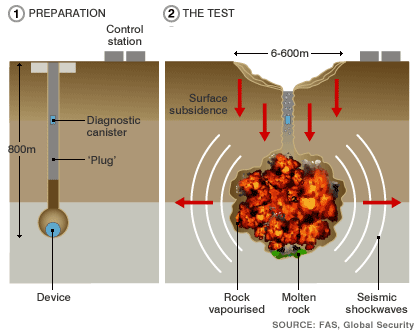
The anatomy of an underground nuclear test (BBC)

Space or Pizza?

This is an unlikely comparison if I ever saw one. According to ex-NASA Administer Mike Griffin, the US spends more money on pizza in a year than it does on the US space agency. If you thought that was funny, the best has yet to come…

pizza_nasa

…polls have concluded that most US citizens believe NASA receives 24% of the annual $3 trillion federal budget. In actuality, NASA receives… wait for it… less than 1% ($18 billion).

Now stand up, and stop rolling around on the floor laughing hysterically. No wonder people get so pissed with NASA when they think 24% of the national annual budget is invested into the exploration of space! No guys, 1%. Is that really too much to pay for the advancement of science, exploration, technology and human ingenuity? Fancy donating few percent of your annual pizza budget to NASA?

What we do is huge, and we do it for chump change – less than the annual market for pizza,” Griffin said earlier in the week during a New York presentation to aerospace businessmen. The annual US market for pizza is $27 billion.

$27 billion? Wow.

I’ve always liked Griffin. He was a pretty strong leader of NASA and he’s a tireless manned space exploration advocate. He was also instrumental in the creation of the Commercial Orbital Transportation Services (COTS), thus stimulating the private sector to start pushing into space, carrying out NASA contracts to the International Space Station.

When the NASA budget is being dwarfed by the annual sales of a product consisting of a doughy base and three toppings, I can’t help but think commercial space options are the way forward…

Source: AL.com

The Sadness of Hubble’s Repair Job

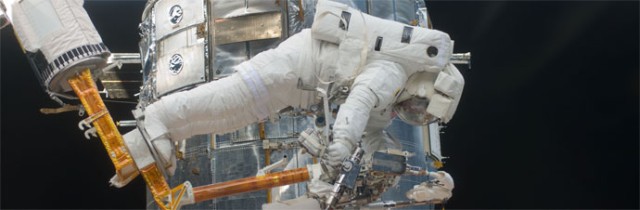
The cargo bay of the shuttle, a valuable in-orbit repair station (NASA)

On the flight back from Washington D.C. last night, United Airlines had the wonderful sense to play the fourth episode of the documentary When We Left Earth: The NASA Missions. It couldn’t have come at a better time, having just watched Mall Cop, The Office, Big Bang Theory and then How I Met Your Mother, I was in dire need for a good documentary.

I was actually returning from a visit to the Discovery Channel HQ after meeting my amazing Discovery.com team for the first time, so I was in the mood to watch something about space. The best thing about When We Left Earth is that when watching it you can’t help but feel inspired and moved (coincidentally, it was produced by the Discovery Channel). In part 4, the Apollo missions (from 12-17) and Skylab are documented, and I must admit, I was a little vague on a lot of the facts that were presented.

Probably the best bit for me was watching the converted Saturn V, resembling a high caliber bullet, blast into the sky in May 1973, taking Skylab into orbit. However, the story that ensued came as a surprise to me, I’d forgotten just how revolutionary Skylab really was. During launch, the space station sustained serious damage, causing loss of the sunshield and damage to the solar panels. If astronauts weren’t launched to repair Skylab, the mission would be lost, cooked from the inside-out, and losing energy fast.

The first crew of Skylab became a space station rescue mission. A small Saturn IB rocket carried Charles Conrad, Jr, Paul J. Weitz and Joseph P. Kerwin to rendezvous with Skylab. In space, the trio overcame all the odds and carried out a risky in-orbit repair on the crippled station, ultimately saving it and allowing two more Skylab missions to be carried out (SL-3 and SL-4) until February 1974.

Skylab launches atop a converted Saturn V in May 1973 (NASA)

It was a story of space adventure and discovery to the highest degree; Skylab changed our understanding of the Sun and gave us an incredible opportunity to study the human physiology for long periods in space.

Then I started to think about what we are capable of today. We can routinely send a team of seven astronauts, to a 19 year old space telescope, to carry out a servicing mission to prolong the observatory’s life for another five years. If I think about that too hard, I start to feel a little dizzy. From sending three heroic individuals on one of the first emergency in-orbit repairs to save a space station in 1973 to sending a sophisticated space shuttle (with a space workshop in its cargo bay) to carry out a carefully choreographed engineering task in microgravity, our technology has come a long way, but one thing has remained the same. The heroism of our men and women in space has not changed; space travel may seem to be routine, but being an astronaut is still a highly dangerous profession.

So when I read Irene Klotz’s Discovery News article Need Satellite Repairs? Don’t Call NASA, I feel sad. Although the Space Shuttle has its faults and its endless supply of critics, it has enabled us to do unprecedented science and engineering tasks in space. When the shuttle is retired, NASA will no longer have the capability of capturing or docking with a satellite to carry out complex repairs and then send it on its way. Even when the Constellation Program launches, we wont have this facility. For me, that feels like one huge step backwards for our ability as a space-faring race; NASA will be prevented from carrying out complicated repairs in orbit.

That’s just a shame to abandon one of the most impressive, refined, sophisticated capabilities that this agency as a whole, human side and robotics side, has achieved. I’m not talking about re-servicing Hubble, I’m talking about the hard-won loss of capability — and costly capability.” —David Leckrone, Hubble senior scientist at NASA’s Goddard Space Flight Center in Greenbelt, Maryland.

This wasn’t only the final Hubble servicing mission, it was also the final NASA satellite repair mission. That is a huge shame.

Social Media Aggregates Space News For Breakfast

Getting the full experience: Twitter provided a ring-side seat during today's Hubble servicing spacewalk (NASA).

Earlier today, 500 people meandered through Astroengine.com, and I was a little confused as to where they came from. I checked the social bookmarking sites, but this particular page wasn’t listed. Normally, an excess collection of visitors will appear from the aether after quasi-randomly plopping onto my server from StumbleUpon, or blasting my bandwidth during a Digg surge, but this traffic was different. The visitors found my website after clicking a link on a new website called A Portal To The Universe. I knew the site existed, but I hadn’t had the time to check it out. But it is awesome.

Astroengine’s regular readers will know that I have a fascination with the movers and shakers in the world of social media, and I have found various ways to use it for my evil intelligence gathering methods. Also, I’ve met some fantastic people along the way and made very good friends. This time last year, if someone said, “Ian, you will make real friendships online in 12 months,” I would have thought, a) OMG, I’ll be more of a geek than I am now! or b) that is the saddest thing I’ve heard in my life, I never want to see this laptop again.

But then, the web mist cleared, and I saw the light (with a little help from my good friend Avi). Social media isn’t about connecting with a bunch of strangers who have little care for who you are or what you do, it’s about forming social links with like-minded people who have a genuine interest in what you have to say. It’s not quantity (@aplusk-style; why would you want the responsibility of entertaining over a million followers on Twitter anyway?), it’s quality that counts.

Before I realized it, I was collaborating, communicating and collecting space news from real people with real science to distribute. I was tweeting, digging, stumbling, reddit-ting, mixxing and generally socializing my heart out. Along the way, certain platforms fell by the wayside, and now I’m currently enjoying Twitter (more than I should), StumbleUpon and pretty much all the Google applications. Facebook has been steady and so has Digg (for better or worse).

Information reloaded

Building a community is the mainstay of social media, but what do you do if you have too much information flooding your bookmarks? You might use an RSS feed aggrigator, or you might filter your Twitter messages, but wouldn’t it be great if you had a website that helped you find the specific information you are looking for, and helped you find other like-minded people in an ocean of chatter?

But now it would appear space news is welcoming social media with open arms. Two exciting projects have appeared online, using the best information gathering techniques on Web 2.0. Finally, it would appear space science is getting the attention it deserves.

Portal to the Universe

port_uni

In celebration of the International Year of Astronomy 2009 (IYA 2009), the Portal to the Universe was launched at the European Week of Astronomy and Space Science (JENAM 2009), that took place at the University of Hertfordshire, UK, in April.

It is a fantastic news platform with featured news from a range of blogs and news sources. Real-time data is also available from many missions with a wealth of socially generated topics. In the spirit of social media, the Portal grabs community-based space news, displaying all the relevant news to the astronomy and space community. An amazing resource I have been using since it was launched.

Keeping up-to-date with cutting-edge astronomy and space science breakthroughs has just become that much easier, thanks to the Portal To The Universe, the latest Cornerstone project of the International Year of Astronomy 2009 (IYA2009). As a high-tech website embracing Web 2.0 technologies, the Portal To The Universe aims to become a one-stop-shop for astronomy news.Portal to the Universe

AstroSpaceNow

astrospace

This website actually came as a surprise to me. Ricardo J. Tohmé, founder of AstroSpaceNow, contacted me on Twitter and mentioned they were starting up a social astronomy blog. Fortunately, I went to the site to check it out and was impressed with the design of the “coming soon” page. Feeling I’d be left out if I didn’t, I signed myself up for the newsletter and forgot about it.

Then, as promised, a week later, the site went live.

Looking at the pages of AstroSpaceNow, there is a very real Twitter/microblogging feel, and at first, I was a little cautious. There has been a massive surge of the bold-colour/bold-type websites over the last few months, so I didn’t want this to be just another Twitter aggregator with a space twist.

As it turns out, AstroSpaceNow is tremendously powerful. It uses the power and speed of Twitter to keep up to date with key space-related Twitter accounts. Each account is tagged and colour-coded so you can quickly scan through the lists. Each Twitter stream is categorized and the site refreshes every five minutes.

So, if you want to find out what the space news buzz is all about right now, and find the interesting people who are buzzing, this is the site for you. It’s another fantastic resource for space bloggers, as one glance at the pages of AstroSpaceNow and you know exactly what is going on.

A Calculated Love Story: Me and My Casio fx-82D

I call her Casio, Casio fx-82D.

Sitting here at my laptop, like I do most of the time, I see the same stuff on my desk day and night. Occasionally I clean it, but most of the time it’s a mess of the highest order.

If I walked away from my desk, I probably wouldn’t remember what I have on it. I suppose it’s one of those “I remember it like the back of my hand” moments, when you really have no clue what the back of your hand actually looks like. It’s familiar, why would your brain need to remember it anyway?

So, the other day I gave this some serious thought: What item do I have in my life that I, a) can’t live without, b) I take totally for granted and c) I’ve had for a long time.

First thought was my Swiss Army knife. I’ve had that for many years, I take it for granted, but I could live without it. Second thought was my wallet; I take it for granted, but I’ve only had it for a couple of years and, to be honest, I leave it at home most of the time, stashing cash and credit cards into my back pocket. What about my laptop? Nope, I never take it for granted (after seeing the death of many a good computer). My cellphone? Nope, I get through so many phones it’s not funny.

So what else is there? Could I really coast around life without that vital item? Is there anything that fulfils a), b) and c)?

She's been a patient friend

Then I saw it.

The one thing that has sat on my desk for nearly two decades, ready for action, always reliable, necessary, but woefully taken for granted. My Casio fx-82D (FRACTION no less), my first, and only, scientific calculator…

I’m going to start this story with an interesting fact. To my recollection, I’ve only replaced the battery twice. I received my fx-82D some time between 1989 and 1992 for a birthday from my parents, and being a budding scientist I was overwhelmed (it is a scientific calculator after all). So nearly two decades later, to remember replacing the battery twice is astounding.

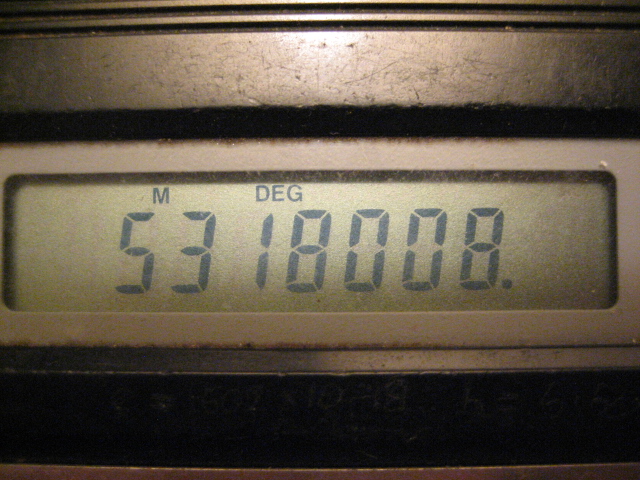
The first thing I ever typed into my Casio. Probably the last thing I typed in too.

It’s not as if I haven’t used it very much either. Not only do I have a problem with numbers, mental arithmetic comes hard, so I have to use trusty old Casio for pretty much everything.

I remember calculating my shopping budget in 1998 during my first week at university; I remember using it to calculate the number of holes there were in the ceiling tile above my head during a particularly boring religious education class in school (I remember being amazed that there were 40×64 = 2560 holes); then there’s the countless exams, thousands of hours sitting in the library studying for finals (instinctively I just used Casio to quickly calculate how many hours there were in a year, just in case the “thousands” of hours in the library didn’t sound reasonable) and huge amounts of time debugging calculations in thousands of lines of code during my PhD.

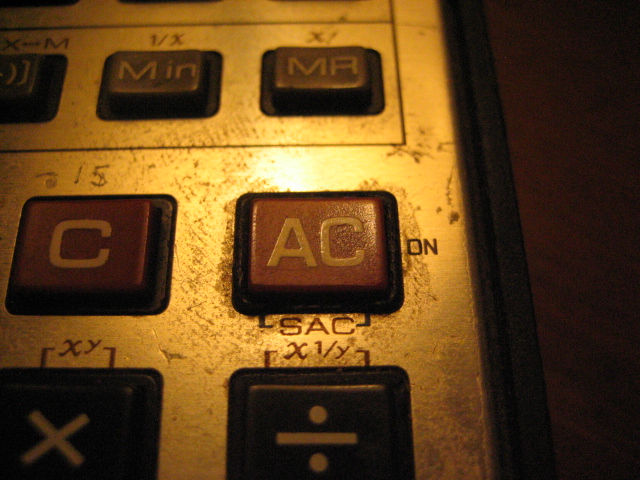
The fingerprints of ancient calculations

I may have achieved a lot in my academic life, but a huge portion of my success is down to the countless key strokes on my fx-82D.

She’s also been my partner in crime on a few occasions.

Did I really just say “she”?

There’s a funny story from my days in college when I was studying for my A Level in physics. For some strange reason, I couldn’t remember unit prefixes (such as the value of nano, micro and pico)…

In my defence, the bulky “graphical” calculators that were popping up in school pencil cases that my classmates were using had functions that could automatically abbreviate the exponential number into a unit. So I didn’t feel so bad scoring a mini conversion chart into the aluminium casing with my compass in the front of the calculator. To this day, you can read:

m-3 μ-6 η-9 ρ-12 f-15

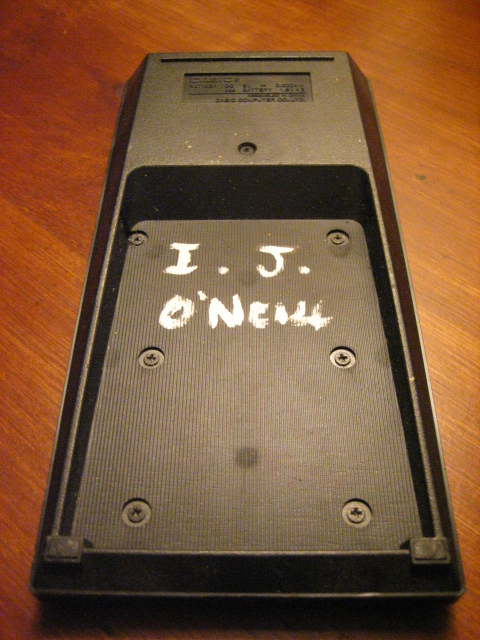
She even has her rear tattooed with my name. Dedicated.

It almost looks like mini hieroglyphics. In truth, I don’t think I ever had to use it in an exam situation, but at least I know it’s there, just in case.

All in all my Casio fx-82D FRACTION has been my constant, reassuring mass of two-decade-old microchips, printed circuit boards and basic liquid crystal display. She’s developed with my in my personal mathematical development and calculated everything from shopping lists to complex partial differential equations. She’s shared my voyage of calculating the density of pubs per person in my university town, to arriving at a solution for the final temperature state of my simulated quiescent coronal loops just before I handed in my PhD thesis for review.

If the last two decades are anything to go by, I wonder just how much longer I’ll be using this calculator. Is it the item I hand down to my grandkids? Or, like the Hubble Space Telescope, eventually need too much refurbishment to continue being of much use and then decommissioned?

Did I really just compare my Casio to Hubble?

Long may she continue being that one item I can’t live without, I take for granted and long may she continue to calculate equations no matter how complex or routine.