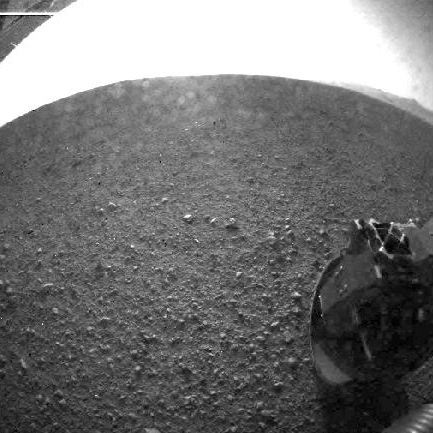
The left eye of the Mast Camera (Mastcam) on NASA’s Mars rover Curiosity took this image of the camera on the rover’s arm, the Mars Hand Lens Imager (MAHLI), during the 30th sol of the rover’s mission on Mars (Sept. 5, 2012).
During the Sept. 6 press conference from NASA’s Jet Propulsion Laboratory (JPL) in Pasadena, Calif., Mars Science Laboratory (MSL) mission scientists discussed updates from Curiosity’s progress in Gale Crater. It’s hard to keep up with the incredible deluge of images and scientific data as the six-wheeled rover roves toward its first target — a geologically interesting location called “Glenelg.” Mission managers hope to use Curiosity’s drill for the first time when the rover arrives. Expect mission updates and some pretty cool photos to appear on Discovery News throughout the day.
There was one photograph, however, imaged by the rover’s Mastcam that was showcased in today’s briefing that fascinated me. Shown above, the Mars Hand Lens Imager (MAHLI) can be seen on the rover’s robotic arm (with dust cap still in place). All the instrumentation and wiring has a very cool Steampunk-esque quality to it.
When I “met” Curiosity at the JPL clean room last year, I was also fascinated by its ugly functionality. By “ugly,” I don’t mean repulsive, I actually fell in love with the robot that day. But with any space mission, function succeeds form and Curiosity is no different. Instruments jut out from a central box; cables snake over all surfaces; gold and silver components are scattered across the deck like opulent jewels; and the whole thing is supported by some seriously heavy duty wheels that wouldn’t look out of place attached to a Bentley cruising through Los Angeles.
Back then, I stared at the Mars exploration machine, whose one purpose is to do science in an alien land, and thought how alien the thing looked. But in all the ugliness of an apparently random assortment of instrumentation, Curiosity has an undeniably beautiful character. Also, it has a WALL-E-like “head” in the form of the blocky ChemCam atop its mast. And now I know what its character is after seeing this latest robotic arm photo; it’s a creation that wouldn’t look out of place in a Steampunk museum or imagined in a H. G. Wells novel. However, this isn’t sci-fi, this is real. We have a nuclear-powered rover on Mars. Sometimes it’s too hard to put such awesomeness into words.
NASA’s Mars Science Laboratory “Curiosity” has landed inside Gale Crater in a damn-near perfect entry, descent and landing (EDL). What’s more, the first photos from the Martian surface were also received only minutes after confirmation of touchdown, depicting a wonderfully smooth plain littered with small rocks.
The first low resolution photo from Curiosity’s hazcam showed a horizon plus one of the rover’s wheels. And then a higher-resolution hazcam view streamed in. Then another — this time showing the shadow of the one-ton rover — an image that will likely become iconic for tonight’s entire EDL. The concerns about the ability of NASA’s orbiting satellite Mars Odyssey to relay signals from Curiosity rapidly evaporated.
Curiosity had landed and it was already taking my breath away.
After a long night in the “Media Overflow” trailer at NASA’s Jet Propulsion Laboratory, I felt overwhelmed with emotion. On the one hand, I was blown away by ingenuity of mankind — the fact we can launch such ambitious missions to other worlds is a testament to exploration and science in its purest form. But I was also overwhelmed by the spirit of JPL’s scientists and engineers who made this happen. I was humbled to be a member of the media covering the event from mission control. It was an experience I’ll never forget.
Tonight is a night to forget politics, this is a night to celebrate NASA and the incredible things they do.
I’ll post more soon, including photos from the event, but for now I need sleep.
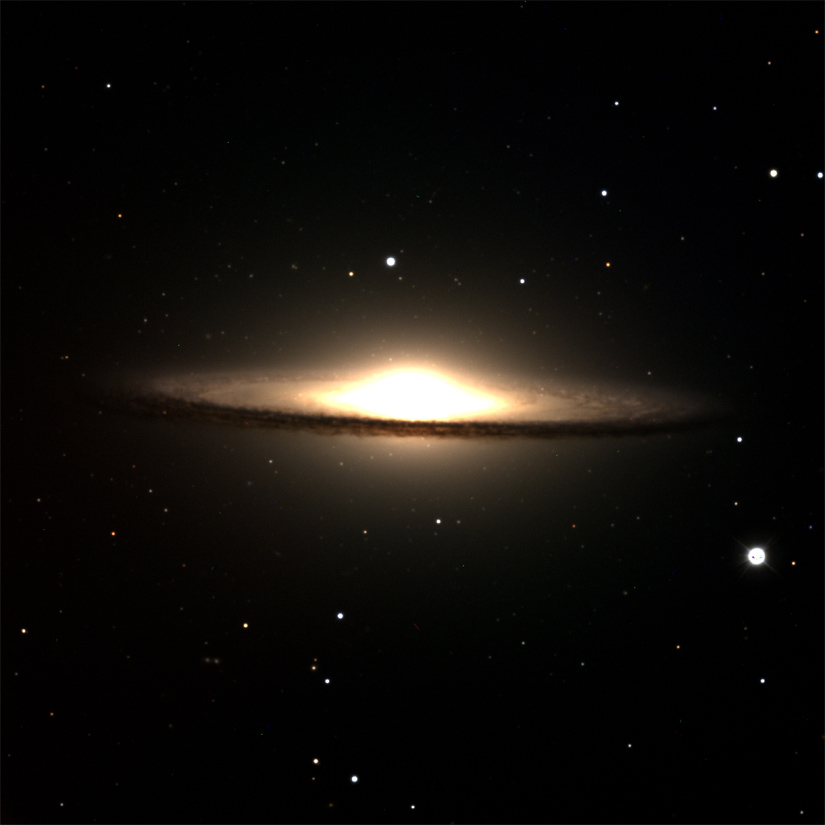
M104, “The Sombrero Galaxy” as seen through the DCT. Credit: Lowell Observatory/DCT
Since I started working as Space Producer at Discovery News in 2009, there’s always been a major project humming in the background. But on Saturday, that hum evolved into a monster roar when astronaut legend Neil Armstrong spoke at Lowell Observatory, near Flagstaff, Ariz., to introduce the $53 million 4.3-meter Discovery Channel Telescope. Seeing photographs of the ‘scope and its “first light” observations gave me goosebumps.
But this is only the beginning. As the fifth largest optical telescope in the continental USA, the DCT has a packed science schedule and I am in a very privileged position to report on the exciting discoveries that will be made by “our” telescope.
Congratulations to everyone at Lowell Observatory on a job well done!
Real superstars: Peter Higgs congratulates ATLAS experiment spokesperson Fabiola Gianotti after she announced her collaboration’s discovery of a Higgs-like particle. Credit: CERN/ATLAS/Getty
I am endlessly baffled by modern society.
We have reality TV stars whose only talent is to shock and annoy, and yet inexplicably have millions of adoring fans. We also have sports superstars who get paid tens of millions of dollars to play a game they love, and yet they still get elevated to God-like status.
And then there’s Professor Peter Higgs, arguably the biggest science superstar of recent years.
The 83-year-old retired theoretical physicist was one of six scientists who, in the 1960s, assembled the framework behind the Higgs boson — the almost-unequivocally-discovered gauge particle that is theorized to carry the Higgs field, thereby endowing matter with mass. The theory behind the Higgs boson and all the high-energy physics experiments pursuing its existence culminated in a grand CERN announcement from Geneva, Switzerland, on Wednesday. With obvious emotion and nerves, lead scientist of the Large Hadron Collider’s CMS detector Joe Incandela announced what we’ve all been impatiently waiting for: “We have observed a new boson.”
So, we now have evidence for the existence of the Higgs boson — or a Higgs boson — to a high degree of statistical certainty, ultimately providing observational evidence for a critical piece of the Standard Model. This story began half a century ago with Prof. Higgs’ theoretical team, and it culminated on July 4, 2012, when results from a $10 billion particle accelerator were announced.
After the historic events of the last few days, one would think Peter Higgs would have been at least treated to a First Class flight back to his home in Scotland. But true to form, Higgs had other ideas:
Later, Higgs’s friend and colleague Alan Walker recounted the low-key celebration they held after learning of the breakthrough, one of the most important scientific discoveries of recent years.
Walker said he and Higgs were flying home from CERN in Geneva this week on budget airline easyJet when he offered Higgs a glass of Prosecco sparkling wine so they could toast the discovery.
Higgs replied: “‘I’d rather have a beer’ and popped a can of London Pride,” Walker said.
In a world where “celebrities” are hailed as superhuman, to hear that potential Nobel Prize candidate Peter Higgs took a budget airline home, after history had been made, typifies the humble nature of a great scientist and puts the world of celebrity to shame. Money and fame matters little to the people who are unraveling the fabric of the Universe.
On a different (yet related) note, Motherboard interviewed people on the streets of Brooklyn and asked them if they knew what the Higgs boson is. Most had never heard of it, let alone understood it (which, let’s face it, isn’t a surprise — many science communicators still have problems explaining the Higgs mechanism). But I wonder if the same group of people were asked if they knew what a “Snookie” was; I’m guessing they’d have no problem answering.
People may not read the news, but they sure have an innate knowledge of who’s in the gossip columns.
Yes, the Higgs boson has been discovered… or, to put it more accurately, something that looks like a Higgs boson has been discovered. But is it a Higgs boson? There’s a very high probability that it is, but in the world where theory meets high-energy physics, it pays to be completely sure about what you’re looking at.
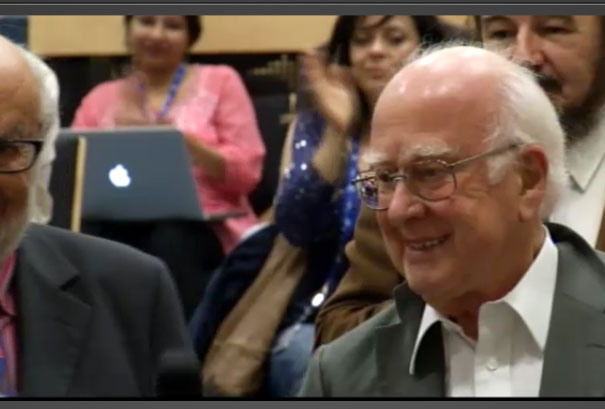
Prof. Peter Higgs, theoretical theorist, receives applause at the CERN event.
But for the ATLAS and CMS collaborations at the Large Hadron Collider in CERN, near Geneva, Switzerland, who held a rapturous conference at CERN and in Australia this morning, they’re pretty damned sure they are looking at a bona fide Higgs boson discovery.
“We have observed a new boson,” said CMS lead scientist Joe Incandela.
“We observe in our data clear signs of a new particle, at the level of five sigma, in the mass region around 126 GeV,” confirmed ATLAS lead scientist Fabiola Gianotti.
“I think we have it,” said CERN Director-General Rolf Heuer. “We have discovered a particle that is consistent with a Higgs boson.”
Why all the certainty? Well, it all comes down to statistics, and all the statistics seem to show a defined “bump” in the CMS and ATLAS data around the mass-energy of 125-126 GeV/c2 — to a statistical certainty of 4.9 and 5 sigma. 125-126 GeV/c2 just so happens to be one of the theorized masses of a Higgs boson — placing the Higgs’ mass at 133 times that of a proton. This particular boson is therefore the most massive boson ever detected.
This video has been doing the rounds, so I posted it on Discovery News on Tuesday. My favorite comment from a reader was: “I need a clean pair of shorts.” That means only one thing; it’s time for some epic NASA-created CGI of the entry, descent and landing (a.k.a. “EDL”) of the Mars Science Laboratory “Curiosity” set for landing on the Red Planet on August 5 at 9:30 p.m. (PST). To be honest, the video speaks for itself, so I’ll hand over to EDL Engineer Adam Stelzner (who really needs his own TV show — love his monolog).
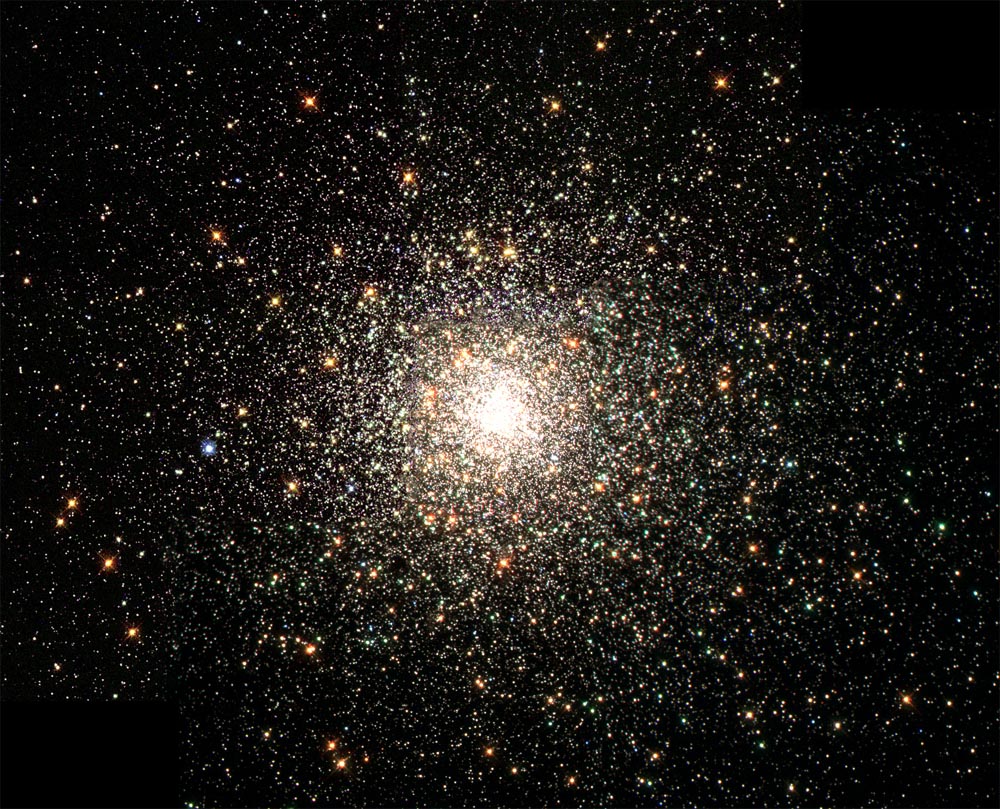
M80 — an old globular cluster in the Milky Way — is full of metal-poor stars. Do they still have exoplanetary potential? (NASA)
The galaxy may be brimming with habitable small worlds and many older star systems could possess the conditions ripe for advanced alien civilizations to evolve. This prediction comes in the wake of new analysis of data from NASA’s Kepler space telescope and ground based observatories by a team of Danish and American astronomers.
Led by Lars Buchhave of the Niels Bohr Institute in Copenhagen, the team has revealed that stars containing low quantities of heavy elements — known as “metal poor” stars — are still capable of nurturing exoplanets with Earth-like qualities.
“I wanted to investigate whether planets only form around certain types of stars and whether there is a correlation between the size of the planets and the type of host star it is orbiting,” Buchhave said.
After analyzing the elemental composition of stars hosting 226 small exoplanets — some as small as the rocky planets in the Solar System — Buchhave’s team discovered that “unlike the gas giants, the occurrence of smaller planets is not strongly dependent on stars with a high content of heavy elements. Planets that are up to four times the size of Earth can form around very different stars — also stars that are poorer in heavy elements,” he concluded.
The Kepler mission, for example, is actively carrying out a search for exoplanets that pass in front of their host stars (events known as “transits”). With Kepler’s sensitive eye, it is capable of detecting exoplanets of similar size to Earth, or even as small as Mars.
Interestingly, as it surveys Sun-like stars, Kepler can detect tiny, rocky worlds that orbit within the “habitable zones” of their stars. It’s no huge leap of the imagination to think alien life may have evolved on some of these worlds.
But a problem facing astronomers hunting for bona fide “Earth-like” exoplanets is that many older stars have low quantities of heavier elements (such as the silicon and iron) that small rocky worlds need to become… well… rocky. But Buchhave’s discovery suggests that stars once considered infertile may in fact have a shot at birthing small exoplanets.
Jill Tarter, Chair of the SETI Institute, points out that this could be a boon for the search for intelligent extraterrestrials. “The idea that very old stars could also sport habitable planets is encouraging for our searches,” she said in a SETI press release on Wednesday.
Tarter also highlights the fact that life took a long time to evolve into an advanced technological state on Earth. Therefore, should there be small habitable rocky worlds orbiting ancient stars (as this research suggests), perhaps alien life far older and more technologically advanced than ourselves are out there.
Although this seems to make logical sense, it may not make biological sense. Metal-poor stars might have the ability to create small worlds, but just because there are likely many small worlds out there, it doesn’t mean life can be nurtured. But then again, regions of the Milky Way once considered to be devoid of exoplanets may now have a stab at providing a planetary habitat for extraterrestrial biology to gain a foothold. Whether or not these metal poor stars host the right ingredients for the building blocks of life probably won’t be known for some time.
In 2009, I wrote an article (see “Life Is Grim On The Galactic Rim“) that grabbed the attention of National Geographic writer Ken Croswell who quoted my Astroengine.com article in the December 2010 edition of the magazine. In the text, I discussed some research that investigated the strange lack of protoplanetary disks around a selection of metal-poor star clusters in the outermost regions of the galaxy. The lack of a protoplanetary disk means a lack of exoplanet-birthing potential and a grim outlook for life to evolve in regions of the galaxy distant from the galactic core.
The conclusion of this 2009 work appears to contradict these most recent findings and the suggestion that advanced alien civilizations may have evolved around metal-poor stars. Whether these stars are the exception rather than the rule, or whether their low metallicity influences the size or visibility of their protoplanetary disks would be an interesting factor to consider.
Although SETI searches have yet to turn up any signal from an advanced alien technology, Kepler is proving that stars — regardless of their metallicity — have the ability to host small rocky worlds. Should life have taken hold on these worlds, then perhaps, some day, we may intercept an interstellar phone call from one of them.
UPDATE: After tweeting this article, @spacearcheology retweeted my link with the following comment:
More grim! This exacerbates the Fermi Paradox RT @astroengine Life May Not Be So Grim On The Galactic Rim, After All http://t.co/BLT6KOJy
— Space Archaeology (@spacearcheology) June 15, 2012
This is something I neglected to consider in the original post. If there are indeed many more small rocky worlds out there — particularly around metal-poor stars that are, by their nature, ancient — why the heck haven’t we detected any ancient extraterrestrial intelligences yet? This has just become the Fermi Paradox PLUS…
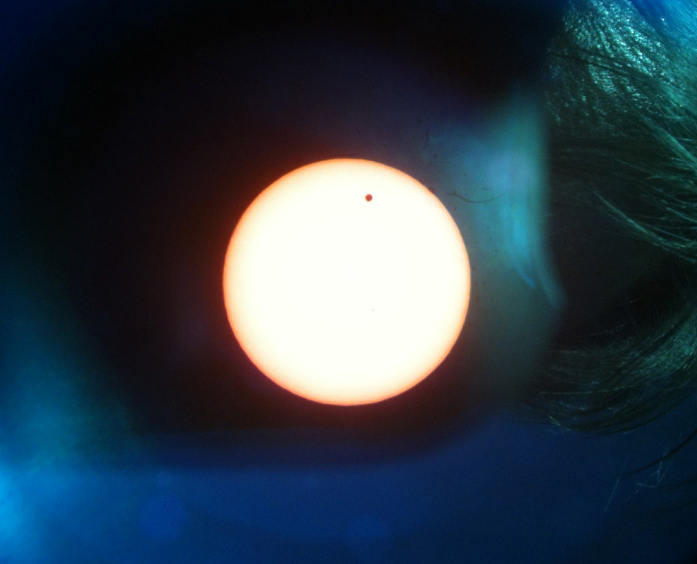
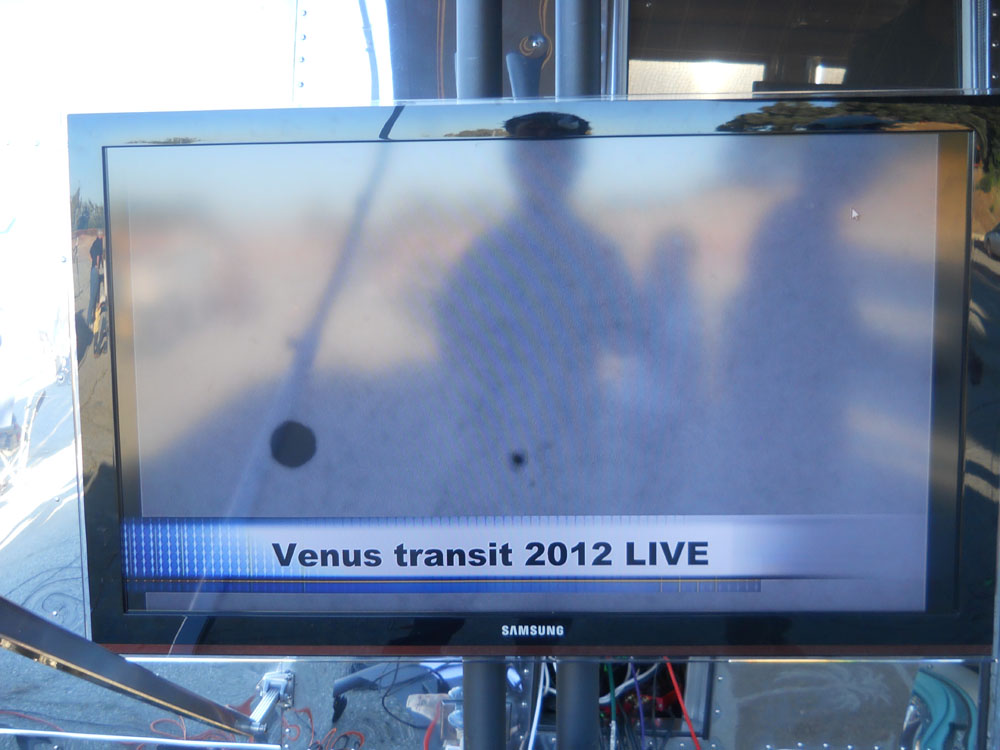
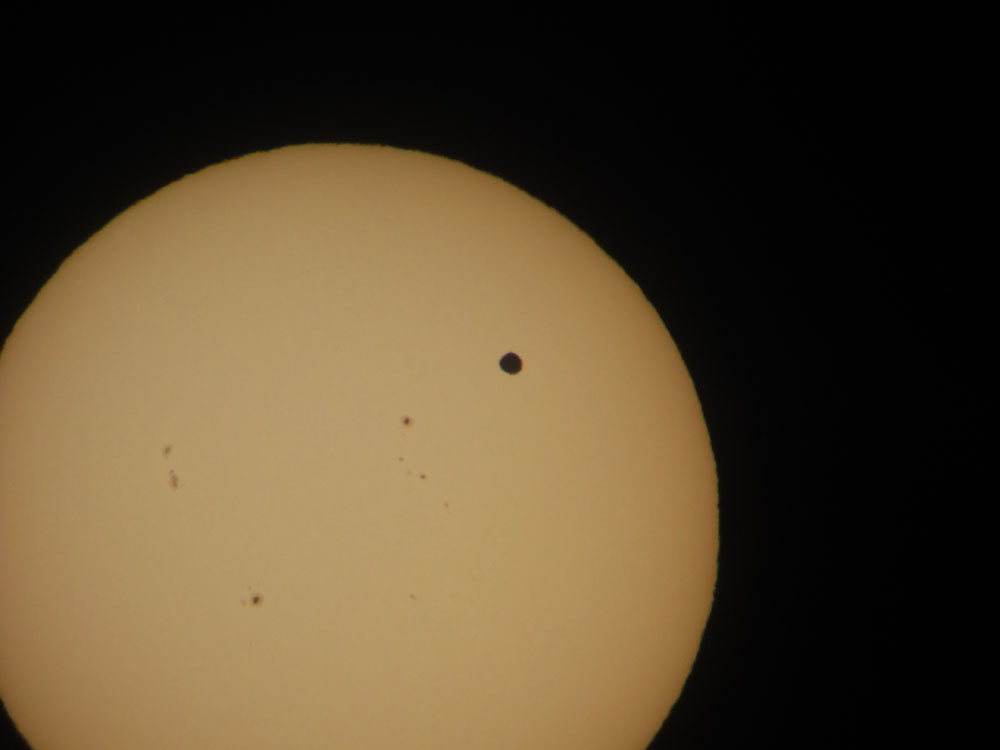
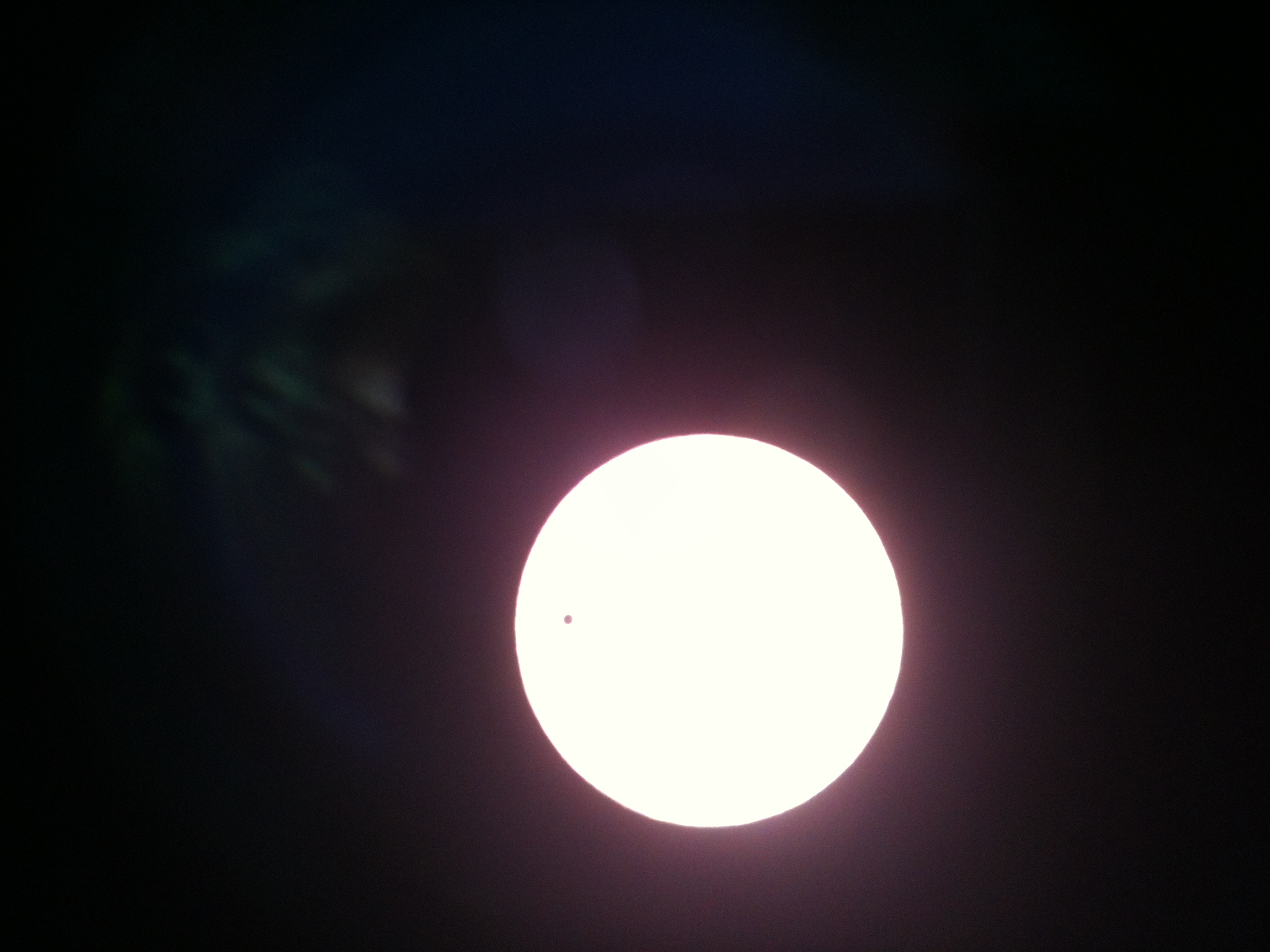
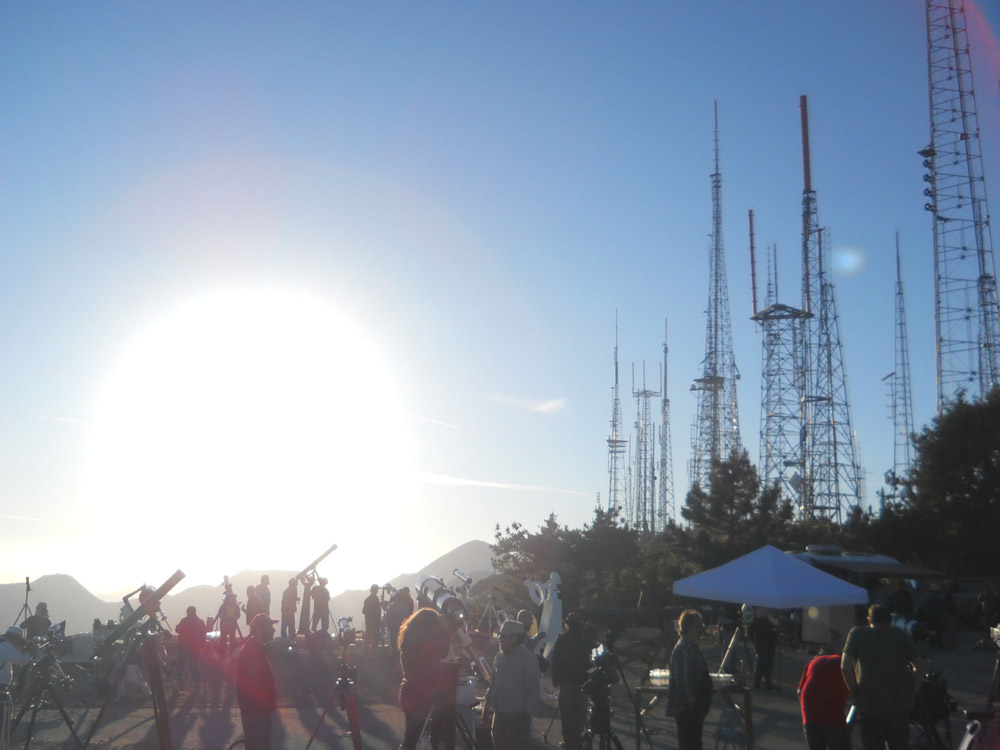
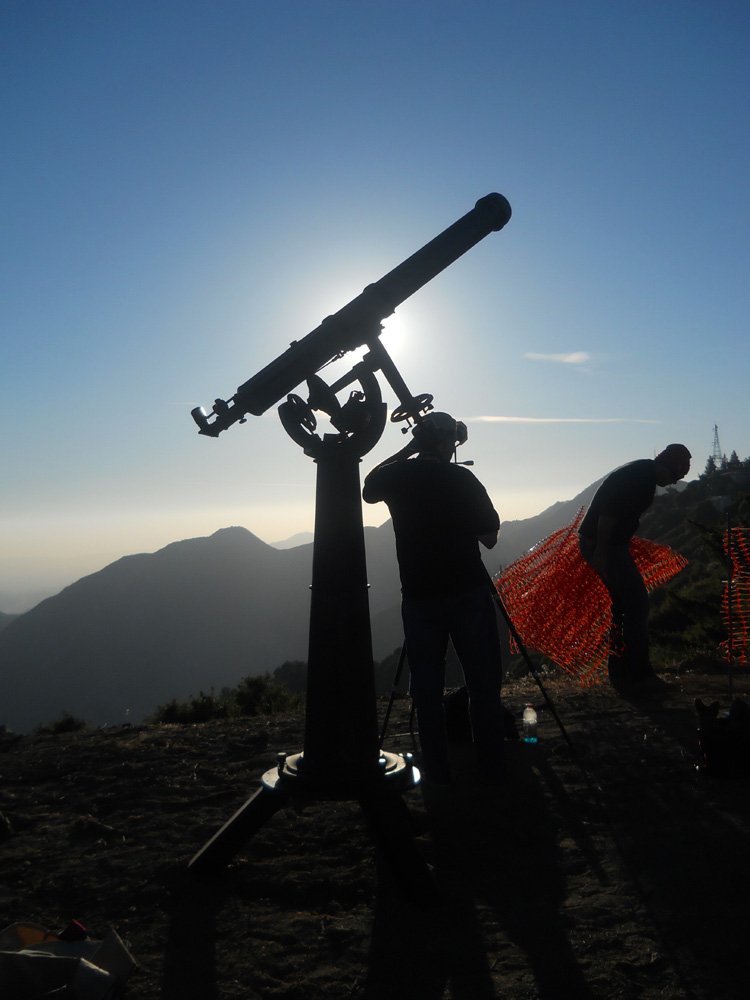
Interestingly, my favorite photos were taken using my trusty old iPhone 3GS through the eyepieces of random telescopes (pictured top), but here are some more from that awesome day.
For more, read my recent Discovery News articles based on the 2012 Venus transit:
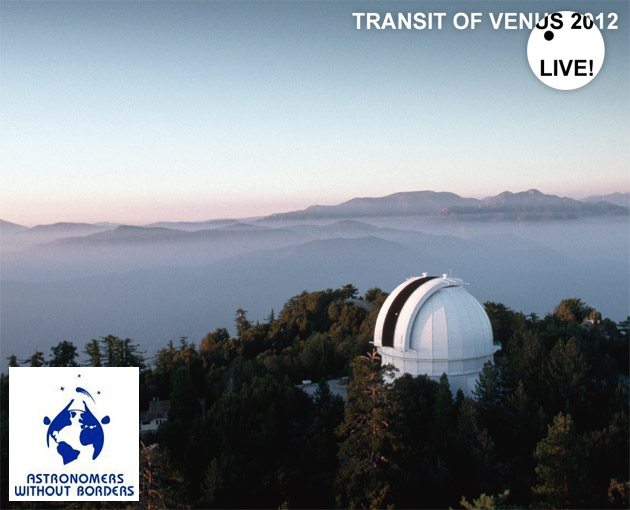
Today, at 2:45 p.m. PDT (5:45 p.m. EDT or 10:45 p.m. GMT), be sure to tune into the extra special Venus transit live video feed from the famous Mt. Wilson Observatory. I will be there, co-hosting a pretty awesome live event from the historic site with Mike Simmons, President and Founder of Astronomers Without Borders. We also have a surprise, rather sci-fi announcement in store too. For a run-down of all the festivities and the live feed, take a look at the AWB transit pages.
I will be surrounded by real astronomers with huge telescopes, so there will likely be lots of opportunities to see me geek out over some awesome views of this once-in-a-lifetime event (well, two if you saw the 2004 transit… or if you’re really young and live to see the 2117 Venus transit!). I will also be taking my patented “eclipse viewing” kit — a $1 pair of eclipse glasses and my Nikon CoolPix camera — to see if I can get a very amateur photo of Venus’ silhouette!
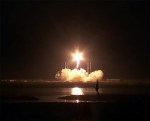
Space Exploration Technologies, or SpaceX, saw a perfect launch of its Falcon 9 rocket. Sporting nine Merlin engines — engines designed and built in-house — the rocket blasted off exactly as planned even though the first launch attempt on Saturday was scrubbed. The “failed” attempt — that was aborted automatically in the last second due to a faulty valve in number 5 engine — was actually a success unto itself; a means of ensuring the launch abort systems were working as they should.
But Saturday is a distant memory as, at right at this moment, there’s an unmanned spacecraft chasing after the International Space Station set for a historic orbital rendezvous in three days time. The Falcon 9 operated as it should and so has the Dragon capsule. So far.
Assuming everything else goes to plan, what does this mission mean for the future of spaceflight?
This is no silver bullet to solve all our spaceflight woes, but it could be the start of something a little bit special. Elon Musk, Internet entrepraneur and SpaceX CEO, has no qualms about thinking big. His enthusiasm for space exploration is infectious and his eye for applying a business model to rocket science is, so far, genius. In a world driven by politics and money, he’s found a way of tying the two together to give the noble effort of pushing mankind’s frontiers an accelerated start. He’s eying Mars. If SpaceX can build rockets and spaceships, perhaps companies, governments and institutions will buy his company’s services to travel through interplanetary space.
Does this mean Mars “taxi rides” are in our future? Perhaps.
But spaceflight history is littered with failed start-ups, accidents and expense, so time will only tell how far SpaceX and other private spaceflight companies can push mankind’s exploration envelope.
I can’t help but be enthusiastic for Musk’s endeavour, however. Remember Sept. 28, 2008, when SpaceX became the first company to launch its own rocket into orbit? That was only four short years ago.
It may be too early to get excited over seeing the Dragon docked to the ISS, but the importance of such an event shouldn’t be ignored. Once SpaceX proves it can be done, this could be a paradigm shift. Space exploration could be driven by enterprise and exploration, potentially transforming us into a multi-planetary species.















 astroengine.com