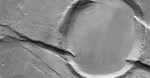
A curiously shaped Mars dune (NASA/JPL/University of Arizona)
Is that a bird? Yes, I can see a bird! A bird on Mars! Aliens must have created it to send us a message! Actually, no, it’s a curiously shaped dune on the Martian surface. My subconscious brain has just processed a familiar shape and my conscious brain did the rest.
Captured by the HiRISE camera aboard NASA’s Mars Reconnaissance Orbiter (MRO), this dune is located in the north polar sand sea (commonly referred to as the “north polar erg”) and it is undergoing the process of defrosting. As the Red Planet’s northern hemisphere is entering springtime, the increased intensity of sunlight is causing carbon dioxide ice (and some water ice) to sublimate into the atmosphere. The ice can be seen as frosty white patches, whereas the dark patches are likely freshly deposited particles from carbon dioxide geysers erupting from the surface.
This is all well and good — how amazing it is to be witnessing the onset of Martian spring at such high resolution! — but it’s the bird head (possibly some kind of falcon?) that drew me into reading about this fascinating HiRISE update in the first place.
This is a fantastic example of pareidolia, a psychological phenomenon that makes us see familiar images in apparently random assortments of shapes. It’s the same phenomenon that makes us see the shapes of bunnies in clouds and the face of Jesus in burnt toast. Interestingly, the HiRISE folks didn’t point out the bird head in this particular photo, but considering they recently brought us the “Elephant On Mars,” I’m thinking this is no coincidence. Those sneaky scientists. During the fun elephant escapade earlier this month, HiRISE scientist Alfred McEwen decided to use the “elephantolia” as an opportunity to teach some really cool Martian geology and make us aware of Martian pareidolia. (Apparently an elephant couldn’t outrun an ancient flood of Mars lava, who knew!)
Right around the same time, images were released of the shape of a parrot in a Martian mesa. Unfortunately, the parrot researchers weren’t joking — they seem to wholeheartedly believe some form of alien intelligence is involved. But as demonstrated by the new HiRISE image, the parrot research is totally based on pareidolia (or “parrotolia”). They saw a parrot, and they have spent years proving it’s a parrot. The logical misstep is astonishing.
In fact, I found this whole thing so astonishing that I plucked this particular parrot to death in my most recent Al Jazeera English op-ed. And yes, I used Monty Python to emphasize my point.
The strange cloud-like protursion above Mars' limb (around the 1 o'clock point). Credit: Wayne Jaeschke.
Last week, amateur astronomer Wayne Jaeschke noticed something peculiar in his observations of Mars — there appeared to be a cloud-like structure hanging above the limb of the planet.
Many theories have been put forward as to what the phenomenon could be — high altitude cloud? Dust storm? An asteroid impact plume?! — but it’s all conjecture until we can get follow-up observations. It is hoped that NASA’s Mars Odyssey satellite might be able to slew around and get a close-up view. However, it appears to be a transient event that is decreasing in size, so follow-up observations may not be possible.
For the moment, it’s looking very likely that it is some kind of short-lived atmospheric feature, and if I had to put money on it, I’d probably edge more toward the mundane — like a high-altitude cloud formation.
Despite the lack of a global magnetic field like Earth’s magnetosphere, Mars does have small pockets of magnetism over its surface. When solar wind particles collide with the Earth’s magnetosphere, highly energetic particles are channeled to the poles and impact the high altitude atmosphere — aurorae are the result. On Mars, however, it’s different. Though the planet may not experience the intense “auroral oval” like its terrestrial counterpart, when the conditions are right, solar particles my hit these small pockets of magnetism. The result? Auroral umbrellas.
The physics is fairly straight forward — the discreet magnetic pockets act as bubbles, directing the charged solar particles around them in an umbrella fashion. There is limited observational evidence for these space weather features, but they should be possible.
As the sun is going through a period of unrest, amplifying the ferocity of solar storms, popping off coronal mass ejections (CMEs) and solar flares, could the cloud-like feature seen in Jaeschke’s photograph be a bright auroral umbrella? I’m additionally curious as a magnetic feature like this would be rooted in the planet’s crust and would move with the rotation of the planet. It would also be a transient event — much like an atmospheric phenomenon.
The physics may sound plausible, but it would be interesting to see what amateur astronomers think. Could such a feature appear in Mars observations?
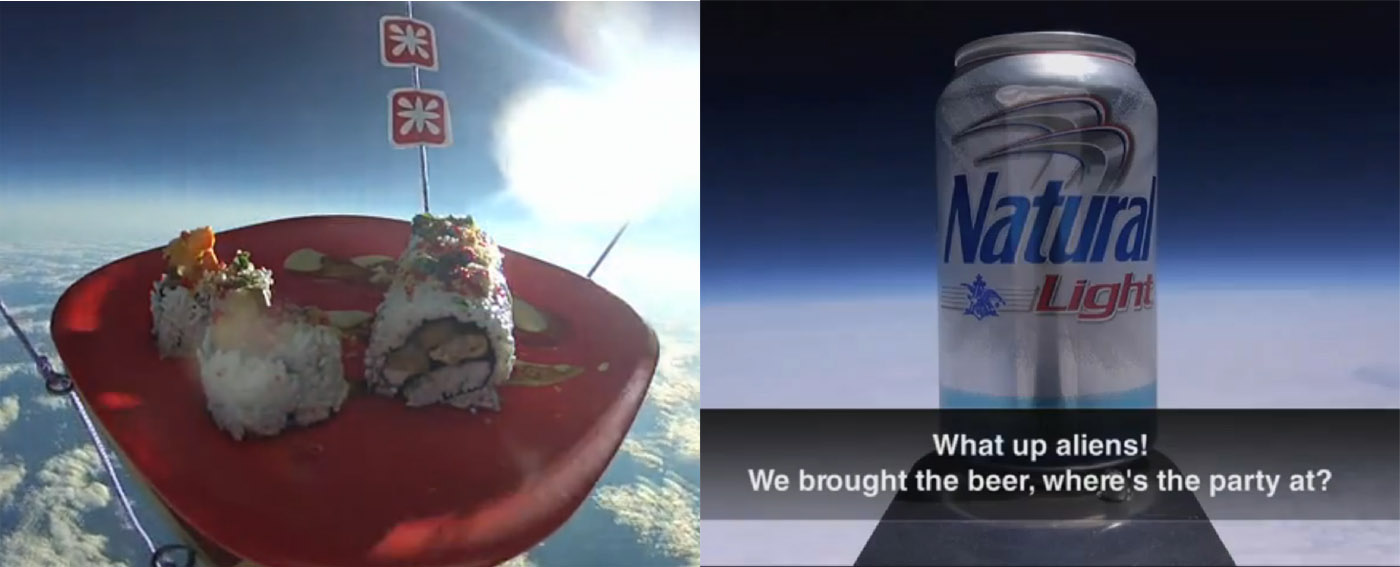
What the hell is going on with this weather balloon craze? It seems that everything from beer to sushi is being sent “into space” these days. There’s only one problem… weather balloons don’t go into space!
Just because you have a small camera with a gazillion megapixels, a credit card and a GPS tracker, the logic of buying a huge balloon and filling it with helium, strapping your camera to it and then running across the countryside to retrieve the wreckage seems silly. Sure, you get some nice video of cloud tops from an altitude of 20 miles, but you’re not the first to do this!
Having said all that, if you do feel compelled to create yet another YouTube video of a weather balloon launch, knock yourself out. But please, please, please don’t include the word “space” in the title, even the BBC gets confused (apparently, that weather balloon-launched Lego man went “into orbit”!). Space starts above 62 miles (known as the Kármán line). Weather balloons can make it to around 25 miles before popping. By no stretch of the imagination can balloons make it into “space.”
Also, weather balloons don’t take stuff on a “suborbital flight.” That’s about as “suborbital” as me taking a flight to Vegas.
In case you haven’t heard, one of the Republican presidential candidate hopefuls, Newt Gingrich, has stellar plans for the U.S. in space. Should he make it though the GOP primaries and beat President Obama in this year’s presidential elections and make it to a second second term in office, the United States of America is going back to the Moon! *applause* *cheers* *ticker tape raining down on Times Square*
“By the end of my second term, we will have the first permanent base on the moon and it will be American!” Gingrich declared on Wednesday when he was outlining his plans for NASA and the U.S. space industry during his Florida GOP campaign.
A lot of what Gingrich said seemed to make sense — less NASA bureaucracy, more commercial investment, space prizes — but the one thing the majority of the media fixated on is the “Moon base” thing.
Generally speaking, any promises made during a presidential campaign, let alone a GOP presidential candidate primary, should be taken with a big pinch of salt. Gingrich, who has been hammered by bad press and negative ad campaigns by opponent Mitt Romney, decided to go “all in” during his Space Coast speeches in the hope of persuading Florida — a key swing state — that he was their man to reinvigorate the state’s major industry.
But it looks like his promises have gone a little too far.
Sending men to the moon during the Apollo era cost the U.S. $170 billion (in today’s money). This cost encompassed the development of manned space flight technology — from the massive Saturn V rockets to the Lunar Modules. But to set up a Moon base (an American Moon base no less) the costs of developing the technology, building the base, creation of a Earth-Moon transportation infrastructure and maintaining lunar assets for many years would spiral into hundreds of billions of dollars.
But it’s OK, NASA wouldn’t be expected to pick up the bill, which is fortunate as the U.S. space agency’s budget stands at less than $18 billion (for 2012). In 1966, 60 percent of NASA’s entire budget was pumped into the Apollo Program, so if that were to happen again, NASA science would be a thing of the past.
Using incentives, Gingrich’s plan is to heavily involve private industry. 10 percent of NASA’s budget will be set aside for industrial “prizes” — presumably X PRIZE-like programs. Also, the lunar surface would be a “free-for-all” — corporations would dig in, mine and pillage the lunar surface for its treasures. And then there’s science! Don’t forget the science! SCIENCE will be done, because science is all kinds of awesome.
But there’s a juicy fly in the ointment that Gingrich appears to be ignoring: Where’s the incentive?
As we’ve already established, spaceflight is really, really expensive. Setting up a Moon base would be really, really, really expensive. The International Space Station (ISS) took international collaboration to build and maintain (not forgetting that NASA can’t even access this huge chunk of orbiting real estate without asking Russia for a hand), so whether or not you think $100 billion is a lot of dough for an orbiting outpost, “hundreds of billions” seems like a reasonable estimate for a Moon base. NASA simply can’t “go it alone” to set up an American base, it would need to be an international collaboration, or there would need to be a huge investment made by U.S. commercial interests.
Now, I’m no businessman, so I might be wrong, but companies like to see a return on their investments, right?
We could see similar deals between NASA and private space companies to courier people and cargo into space (like the COTS program that invigorates partnerships like the one between NASA and SpaceX), but again, we’d need to see significant investment by a government agency: NASA. How to get out of this government-funded loop? Let companies profit from the Moon’s resources — there must be gazillions of dollars to be made from that, right?
No.
You’ll hear many people discuss Helium-3 with huge enthusiasm, which is found in abundance on the lunar surface. Helium-3 is the much-touted fuel for fusion power plants. Fusion power is the world’s cleanest, most abundant energy resource; whoever controls the supply of Helium-3 from the surface of the moon could stand to make trillions!
What about using the Moon as a massive resource of precious metals? After all, the moon is made from the same stuff Earth is made of, gold and platinum should be hiding in that Moon rock. Why not set up vast strip mines and refineries? Hell, it would be far easier to extract raw materials and refine them in-situ on the Moon than mining asteroids.
But once again, there’s a big problem; it would cost far more to extract, refine and transport the material back to Earth (let alone the huge health & safety/insurance concerns with flying the stuff back to Earth, reentering tons of materials over populated regions) than the profit a company could stand to make from such an operation.
So, in summary, to build a Moon base it would cost a lot of money. In the current political and financial climate, there isn’t a cat in hell’s chance of seeing a U.S. government agency like NASA footing the bill. Private investment would need to be found. But companies don’t like risking tens (to hundreds) of billions of dollars unless they can see some potential for profit. A Moon base, for now, is not an investment.
Also, the Outer Space Treaty forbids any nation from “owning” any portion of the Moon — so sending U.S. companies to mine the Moon could be a pretty awkward scenario. This alone invalidates the “American Moon base” idea if it was being used for anything other than science purposes. Seeing a mining operation pop up in the Sea of Tranquility would be like BP building a refinery in the Antarctic. Sure, it can be done, but the international fallout would be horrendous (another factor that might dissuade corporate investment in the first place).
The modern world’s economy is based on growth, profit and the politics they motivate. Making money from space, in the near term, doesn’t involve bases on the Moon. Profit and growth can be found in government contracts and investment in cheap space launch alternatives. Space tourism, in the near-term, is also showing some promise. These areas of growth focus on basic space infrastructure — simply blasting stuff into orbit is a difficult and expensive task, private enterprise is currently innovating to fulfill this need. And they are doing it for profit.
A few decades from now, when our planet finally has a viable, sustainable infrastructure in space, talk of Moon bases and company profits may make more sense. But talk of building a base (let alone a Moon colony) when we don’t even have the rockets or spacecraft to get us there, is a bit like saying I’m moving to Hawaii, but there’s no aircraft or boats to get me there and… oh, by the way… I have to ship the bricks of my house to the middle of the Pacific Ocean so I can actually build a house when I get there.
Try selling that profit-making scheme to the CEO of Home Depot.
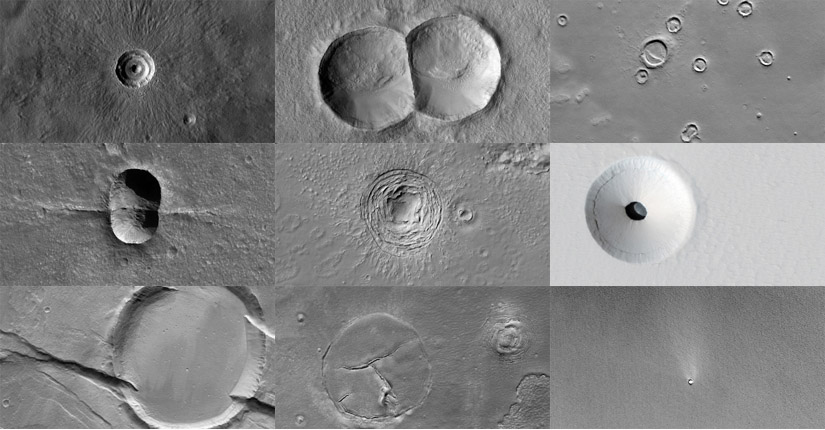
A menagerie of strange divots (NASA/HiRISE/Univ. of Arizona)
As 2011 draws to a close, it’s time to reflect on my absenteeism from Astroengine. But it’s not my fault, I’ve been typing like a madman for these guys.
But that’s enough excuses, 2012 promises to be a huge year for space, and if I get my time management skills back up to scratch, there will be a whole lot more of the blogging thing going on over here too. So to kick things off I thought I’d share a cool slide show I’ve been working on for Discovery News with Ari Espinoza of the High-Resolution Imaging Science Experiment (HiRISE) — the awesome camera currently orbiting Mars aboard NASA’s Mars Reconnaissance Orbiter (MRO).
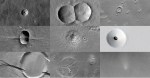
With the help of Ari, we managed to collect some weird-looking Mars craters (for the hell of it) and create a slide show with some of the strangest. Below are a few of my favorites, but be sure to check out the full slide show for more oddities!
Bulls-eye! (NASA/JPL/Univ. of Arizona)
Affectionately known as the “Push-Up Craters” (NASA/JPL/Univ. of Arizona)
This crater has a serious fault (NASA/JPL/Univ. of Arizona)
A menagerie of strange divots (NASA/HiRISE/Univ. of Arizona)
A comparison between an observation of the sun using the ATA's 2.75 GHz band (left) and SOHO's 195A filter. Both are near-simultaneous observations on Oct. 1, 2009 (Saint-Hilaire et al., 2011).
And no, “aliens” isn’t the answer.
The Allen Telescope Array (ATA), located near Hat Creek, California, isn’t only used by the SETI Institute to seek out signals from extraterrestrial civilizations. The 42 6.1-meter antennae form an interferometer that can be used for a variety of astronomical studies — in reality, this is the main focus of the project. SETI studies “piggyback” the active astronomical research, passively collecting data.
Due to the radio interferometer’s wide field of view, one surprising use of the ATA is solar astronomy — at radio frequencies. The ATA can be used to simultaneously observe the whole of the solar disk at a range of frequencies rarely studied. As outlined in a recent arXiv publication, a University of California, Berkeley, team of astronomers headed by Pascal Saint-Hilaire have carried out the first ATA solar study, producing images of the sun in a light we rarely see it in (shown above).
According to the paper, active regions were observed at radio and microwave frequencies, spotting the emissions associated with bremsstrahlung — electromagnetic radiation generated by accelerated charged particles caught in intense magnetic fields, a feature typical inside solar active regions. Also, coronal interactions, or gyroresonance, between solar plasma and plasma waves (propagating along magnetic field lines) was detected.
There are now more than 700 confirmed exoplanets in the database. The latest addition is the planet HD 100655 b.
— announced via the Exoplanet iPhone app
The first exoplanet was discovered orbiting a Main Sequence star in 1995, and the rate of exoplanet detections has been accelerating ever since.
It is worth noting that hundreds more candidate exoplanet detections have been made, many of which have been spotted by NASA’s Kepler space telescope. Kepler is staring at the same patch of sky, waiting for alien worlds to cross the line of sight between their parent star and Earth, registering a slight dip in starlight brightness. The 1,235 candidates will be confirmed (or denied) as Kepler awaits future transits.
Detecting the slight dimming of starlight isn’t the only tool exoplanet hunters have to spot these alien worlds. The “radial velocity” method — as employed by systems such as the ESO’s HARPS — can detect the slight “wobble” of stars as orbiting worlds gravitationally “tug” on their parent stars. Both methods have their advantages and both are notching up an impressive exoplanet count. “Microlensing” has also been employed to spot a handful of exoplanets, as has direct imaging.
Exoplanetary studies are amongst the most exciting astronomical projects out there. Not only are we realizing there is a veritable zoo of worlds — some Earth-sized, others many times the mass of Jupiter — we are also pondering the most profound question: could extraterrestrial life inhabit these worlds?
For now, we have no clue, but life as we know it has a habit of springing up where we least expect it, it’s only a matter of time before we start to have some clue as to the existence of life as we don’t know it.
Some galaxies undergo a rapid star formation phase, losing stellar gases to intergalactic space, others choose to recycle, thereby extending their star forming lifespans (NASA, ESA, and A. Feild (STScI))
It sounds like an over-hyped public service announcement: If you don’t recycle, you’ll die a premature death.
But in the case of galaxies, according to three new Science papers based on Hubble Space Telescope data, this is a reality. Should a galaxy “go green,” reusing waste stellar gas contained within huge halos situated outside their visible disks, they will fuel future star-birth cycles, prolonging their lifespans.
Sadly for “starburst” galaxies — galaxies that undergo rapid star generation over very short time periods — they care little for recycling, resulting in an untimely death.
Using data from Hubble’s Cosmic Origins Spectrograph (COS), three teams studied 40 galaxies (including the Milky Way) and discovered vast halos of waste stellar gases. Contained within these spherical reservoirs — extending up to 450,000 light-years from their bright disks of stars — light elements such as hydrogen and helium were found to be laced with heavier elements like carbon, oxygen, nitrogen and neon. There’s only one place these heavy elements could have come from: fusion processes in the cores of stars and supernovae.
Interestingly, the quantity of heavy elements contained within the newly-discovered halos is similar to what is contained in the interstellar gases within the galaxies themselves.
“There’s as much heavy elements out in the halos of the galaxies as there is in their interstellar medium, that is what shocked us.” said Jason Tumlinson, an astronomer for the Space Telescope Science Institute in Baltimore, Md., in an interview for my Discovery News article “Galaxies That Don’t Recycle Live Hard, Die Young.”
But these heavy elements are stored in halos outside the galaxies; how the heck did it get there?
According to the researchers, powerful stellar winds jetting into intergalactic space have been observed, transporting the heavy elements with them. But there’s a catch. If the outflow is too strong, waste stellar gases are ejected from the galaxies completely. Unfortunately for one sub-set of galaxies, powerful stellar outflows come naturally.
Starburst galaxies rapidly generate stars, ejecting speedy streams of stellar waste gas. Some of these streams have been clocked traveling at 2 million miles per hour, escaping from the galaxy forever. In the case of a starbust galaxy, a “recycling halo” cannot be re-supplied — future star birth is therefore killed off.
“We found the James Dean or Amy Winehouse of that population, you know, the galaxies that lived fast and died young,” Tumlinson pointed out. “(Todd) Tripp’s team studied that in their paper.”
“That paper used a galaxy that is known as a ‘post-star burst galaxy’ and its spectrum showed that it had a very robust star burst (phase),” he continued. “It was one of those live fast, die young galaxies.”
Although fascinating, one idea struck me the hardest. On asking Tumlinson to speculate on how galactic recycling of stellar material may impact us, he said:
“Your body is 70 percent water and every water molecule has an oxygen atom in it. The theorists say the recycling time (in the Milky Way’s halo) is approximately a billion years, so that means — potentially — that some of the material (oxygen) inside your body has cycled in and out of the galaxy ten times in the history of the galaxy. At least once, maybe up to ten times.”
As Carl Sagan famously said: “We’re made of star stuff;” perhaps this should be rephrased to: “We’re made of recycled star stuff.”
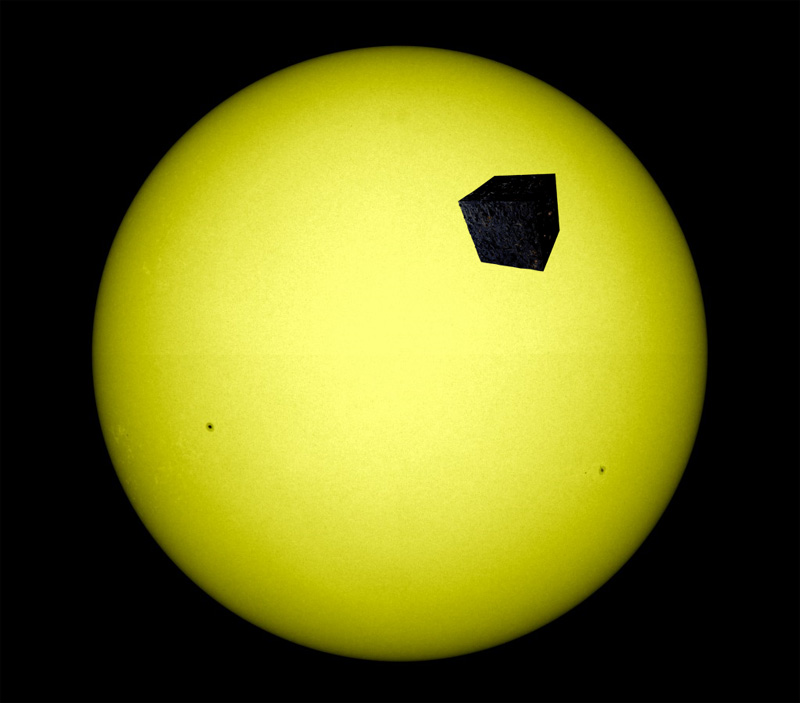
Assuming Star Trek‘s Borg Collective went into overdrive and decided to build a huge cube a few thousand miles wide, then yes, the exoplanet-hunting Kepler space telescope should be able to spot it. But how could Kepler distinguish a cube from a nice spherical exoplanet?
The big assumption when looking for exoplanets that drift between distant stars and the Earth — events known as “transits” — is that the only shape these detectable exoplanets come in are spheres. Obvious really.
As a world passes in front of its parent star, a circular shadow will form. However, from Earth, we’d detect a slight dimming of the star’s “light curve” during the transit, allowing astronomers to deduce the exoplanet’s orbital period and size.
The transit method has been used to confirm the presence of hundreds of exoplanets so far, and Kepler has found over 1,200 additional exoplanet candidates. But say if astronomers paid closer attention to the shape of the received light curve; spherical objects have a distinct signature, but say if something looked different in the transiting “planet’s” light curve? Well, it could mean that something non-spherical has passed in front of a star. And what does that mean? Well, that would be a pretty convincing argument for the presence of a huge planet-sized artificial structure orbiting another star. Artifical structure = super-advanced alien civilization.
Arnold tested his theory that all manner of shapes could be detected by Kepler, assuming the transiting structure was on the scale of a few thousand miles wide. In this case, Arnold was testing his hypothesis to see whether we could detect an advanced civilization’s “shadow play.” Perhaps, rather than beaming messages by radio waves, an advanced civilization might want to signal their presence — SETI style — by blocking their sun’s light with vast sheets of lightweight material. As the shape passes in front of the star, the slight dimming of starlight would reveal an artificial presence in orbit.
By putting a series of these shapes into orbit, the aliens could create a kind of interstellar Morse code.
Of course, this is a rather “out there” idea, but I find it fascinating that Kepler could detect an alien artifact orbiting a star tens or hundreds of light-years away. Although this research is only considering orbital “billboards,” I quite like the idea that Kepler might also be able to detect a large structure like… I don’t know… a big Borg mothership. Having advanced warning of the presence of an aggressive alien race sitting on our cosmic doorstep — especially ones of the variety that like to assimilate — would be pretty handy.
Publication: Transit Lightcurve Signatures of Artificial Objects, L. Arnold, 2005. arXiv:astro-ph/0503580v1
The video is actually composed of 22,000 high-definition photographs, stitched together is a finely crafted time lapse video. The photographer in question is Terje Sorgjerd who braved -22C temperatures in the Arctic Circle to bring us this stunning perspective of the Aurora Borealis, or the Northern Lights. Throw in the Hans Zimmer “Gladiator” theme tune “Now We Are Free” and we get a timeless classic video that can be watched over and over again and never get bored.
So, sit back and enjoy the Sun-Earth interaction at its most spectacular.





 astroengine.com