Could Genetic Algorithms Boost Space Probe Intelligence?

Voyager carried out a gravitational slingshot manoeuvre past Jupiter (NASA)

Rocket science ain’t easy, but what about celestial navigation? Once you’ve launched your probe into space, surely the hard bit has been done, and we can sit back and relax, happy in the knowledge our technology is out of the Earth’s hefty gravitational well? The robot is coasting through the vacuum of space ready to accomplish some science. Job done. Easy.

As you may have guessed, it isn’t that easy, in fact sending a spaceship on the equivalent of a Solar System-scale game of gravitational ping-pong is highly problematic. What if your launch is delayed? What if the inter-planetary medium (the stuff between the planets) is of a higher density than you expected? Perhaps the Sun has pumped out more particles than you had calculated pre-launch, creating drag and slowing your spaceship down?

Unfortunately, once the spacecraft is on its way, apart from a few minor Earth-commanded corrections allowed by the ship’s thrusters (wasting valuable fuel), the spaceship is by itself, hoping your calculations are as complete as they can be.

When the spaceship in question has to use planetary gravity assists to accelerate or decelerate on its journey to a deep space destination, slight deviations in trajectory than what was calculated can result in inefficient sling-shots or even complete loss of the mission.

Now Ian Carnelli and colleagues from ESA in Noordwijk (Holland) have prepared a publication that details a possible solution using a genetic algorithm. Basically, the computer on board a next generation space probe could simulate multiple autopilots guiding a virtual version of the probe. Each autopilot executes its code and the computer will select which simulated autopilot performs the best (i.e. solutions that waste fuel or find the slowest route will be ignored).

Happy with the best group of simulated solutions, the computer will selectively “breed” them together to develop an optimized pilot, with no need to wait for instructions to be sent from Earth. “After hundreds of generations of the GA you obtain a ‘pilot’ that is an extremely good performer – able to fly the assist trajectory that uses the least propellant while reaching the next target planet faster,” Carnelli says.

Using simulations here on Earth, Carnelli has successfully used his genetic algorithm to optimize the trip of a virtual spaceship to Pluto via Jupiter and another to Mercury via Venus.

Although installing this system on missions in the near future may not be a possibility, it is a tantalizing look into how unnatural selection could be used to optimize, and therefore protecting, expensive pieces of kit in deep space.

Source: New Scientist

Atlantis Launch… Infrared-ed

The STS-125 Atlantis launch today, as seen through the lens of an infrared digital camera (Eliot J. Schechter/Getty Images)

I thought I wouldn’t see anything as impressive as the Space Shuttle Atlantis launch in high-definition, but it appears I was wrong. This is probably one of the most unique views of a shuttle launch I’ve seen to date; a high resolution, infrared photograph of the beginning of the STS-125 mission to the Hubble Space Telescope.

This would make a nice wallpaper… yes, it does 🙂

Source: Gawker

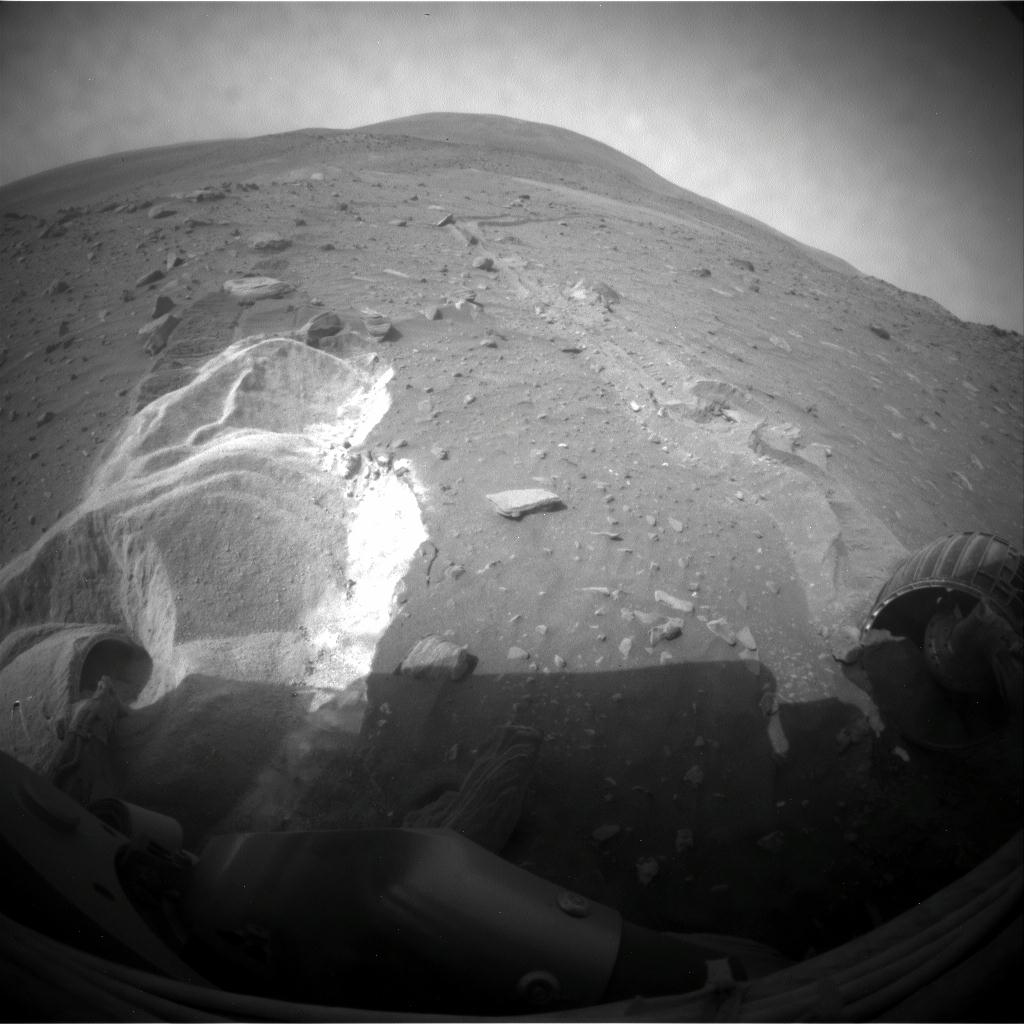
Mars Rover Spirit is Stuck in the Regolith

Spirit is stuck (NASA)

Mars Exploration Rover Spirit is in trouble again. She’s stuck.

The tenacious little robot has suffered traction problems before and has even been dragging around a broken wheel for the last three years, leaving the other five to take up the slack. Then there’s the dust storms that have hindered the life-giving solar panels ability to collect sunlight. And most recently, the on-board computers have been rebooting and Spirit’s flash memory has been forgetting to record data.

A little help here? Spirit has driven into soft ground, burying her wheels halfway. Engineers are working plans to extricate her. –A distress tweet from @MarsRovers

One of Spirit's buried wheels as taken by the front hazard-avoidance camera on Sol 1899, May 6th (NASA)

Now, she’s stuck in the Martian dirt after slipping backwards down a slope during a series of backward drives around a plateau called “Home Plate.”

Spirit is in a very difficult situation,” JPL project manager John Callas said. “We are proceeding methodically and cautiously. It may be weeks before we try moving Spirit again. Meanwhile, we are using Spirit’s scientific instruments to learn more about the physical properties of the soil that is giving us trouble.”

At JPL, a team have been assembled to try to find a solution to the problem with a model of the situation here on Earth. Unfortunately the wheels are stuck fast, half-buried, and scientists are increasingly worried that any attempts to free the struggling rover could make matters worse. The concern is for the chassis under the robot. Should it make contact with the rocks underneath, it would effectively beach itself, completely losing traction that could be used to free the wheels. In short, the situation is not good, but NASA is working overtime to find ways to get the rover on the road once more.

Fortunately, wind has helped the ailing rover recently, clearing excess dust off the solar panels, giving Spirit a much needed energy boost, but will it be enough to get her out of this difficult situation? If there’s a way, Spirit will find it, as let’s face it, she’s lived through a lot of hard knocks…

Source: NASA, AP

Watch Space Shuttle Atlantis Launch in HD

sts-125

Today’s launch of Space Shuttle Atlantis went according to plan and the crew of seven astronauts are now chasing the Hubble Space Telescope for its final servicing mission.

As I’m a little behind the curve on reporting this story, I thought I’d assemble some links to other sites who covered the launch far more expertly that I can at this late stage. However, not to be outdone, I wanted to share this incredible high definition video of the launch. If you want to watch the embedded HD version, look below, but if you want the full, i’m-on-the-edge-of-the-launchpad-oh-my-god-i-can-feel-the-heat wide-screen version, check out the awesome, fully-loaded YouTube HD video.

Links:

Is Pluto Affected by the Pioneer Anomaly?

From Pluto, looking at its icy moons in the Kuiper belt (NASA)

The Pioneer Effect is a mysterious observation of a number of man-made probes that venture through and beyond the Solar System. Originally noticed in the slight drift of the Pioneer 10 and Pioneer 11 spacecraft (launched in 1972 and 1973) from their calculated trajectories, scientists have been at a loss to explain the tiny, yet constant, extra-sunward acceleration.

Some theories suggest that invisible clouds of dark matter are slowing these probes down, causing them to be influenced by the Sun’s gravity more than expected. Other suggestions include ideas that Einstein’s theory of General Relativity needs to be tweaked when considering interplanetary distances.

However, there are other, more mundane ideas. Perhaps there is a tiny fuel leak in the probes’ mechanics, or the distribution of heat through the spacecraft is causing a preferential release of infrared photons from one side, nudging them off course.

Finding an answer to the Pioneer effect probably won’t surface any time soon, but it is an enduring mystery that could have a comparatively simple explanation, within the realms of known science, but there’s also the possibility that we could also be looking at some entirely new physics.

In an attempt to single out whether the Pioneer anomaly is an artefact with the spaceships themselves, or unknown in the physics of the Universe, astronomers decided to analyse the orbits of the planets in the outer Solar System. The rationale being that if this is a large-scale influence, some observable periodic effects should be evident in the orbit of Pluto.

So far, no effect, periodic or otherwise, has been observed in the orbit of Pluto. If the effect isn’t big enough to influence Pluto, does this mean we can narrow the search down to spaceship-specific artefacts?

Not so fast.

Gary Page and John Wallin from George Mason University in Virginia and David Dixon from Jornada Observatory in New Mexico, have published a paper pointing out that the suggestion that the Pioneer effect doesn’t influence Pluto is flawed. Pluto’s orbit is far less understood than the orbits of the inner Solar System planets, as, let’s face it, Pluto is far away.

We simply don’t possess the data required to cancel out the Pioneer effect on planetary bodies in the outer-Solar System to reach the conclusion the anomaly doesn’t influence Pluto.

Of course, this does not mean that the Pioneer effect exists. It does mean that we cannot deny the existence of the Pioneer effect on the basis of motions of the Pluto as currently known.” — Page et al., 2009

So, back to the drawing board. This is a fascinating study into a true Solar System mystery; bets are on as to the real reason why our interplanetary probes are being knocked off course…

Source: The Physics arXiv Blog

Could US Space Tourism be Snuffed Out by Red Tape?

bigelow_sundancer_02

Here’s a problem we didn’t see coming. Actually, we might have guessed it could be an issue, but thought, “no way, this is space travel we’re talking about!” But yes, red tape might get in the way of space tourism interests in the USA. In particularly, if you’re not an American citizen.

US export controls could potentially throw a problem or two into the space tourism mix, preventing non-US fee-paying customers from taking a ride on Virgin Galactic’s SpaceShipTwo, or doing microgravity cartwheels inside Bigelow’s Sundancer space hotel.

Although Richard Branson is building the world’s first spaceport in New Mexico and XCOR has signed up its first Danish space tourist, the International Traffic in Arms Regulation (ITAR) rules might prevent non-US citizens from seeing the insides of space vehicles containing technology or equipment under the jurisdiction of ITAR.

It’s a national security “thing”.

It’s funny how rules and regulations get in the way of things, but this is possibly the worst time for the issue to crop up. US companies are already promoting and selling their tickets for sub-orbital joyrides to international consumers, what if a British $200,000 ticket-holder turns up at their spaceplane, only for space border control to tell you to go home? Not so good for business is it? In fact, that’s the kind of thing that prevents you from doing business with international clients. To make it worse, potential European space tourism companies are marketing “ITAR-free” components and technologies, thereby creating untouchable competition.

However, despite the concern, I’m thinking there will be a few work-arounds for the ITAR. Key to the regulations is that ITAR covers tech and passengers. How about cutting out the “passengers” bit?

One of my favourite spaceflight companies, Bigelow Aerospace, has asked the same question and has been forward-thinking enough to lobby the government to change ITAR rules. “We think hardware should be [covered] under ITAR,” said Michael Gold, director of Bigelow Aerospace’s Washington office, “but passengers should be exempted.”

It would appear Congress needs some convincing that this particular ribbon of red tape needs to be cut.

Congress created a bigger problem than already existed,” said Rep. C.A. Ruppersberger (D-Md.), who oversees these regulations on the House Select Committee on Intelligence. Unless ITAR is reformed, space commercialization could shift toward China or Russia. However, a lot of committees are being consulted and paperwork is being re-shuffled to find a solution to this issue before real damage is done to a (potentially) revolutionary burgeoning industry in the US.

A balance between space commerce and national security needs to be found, without compromising either to international entities.

Source: Aviation Week

The Space Station Flares, Again!

I don’t usually post two identical stories within a few days of one another, but when I saw this image on SpaceWeather.com I had to comment on it. On Friday, I was captivated by the astounding astrophotography by Nicolas Biver as he tracked the space station with video camera and telescope, to capture some great detail of the manned outpost as it passed over France. With a bit of luck and a whole world of skill, Biver observed a bright space station flare.

Next up, it’s the turn of Martin Gembec. On May 2nd, he grabbed this superb trail as the station passed through the distinctive edge-on disk of our galaxy over the Czech Republic. What’s more, the station flared as its huge solar arrays reflected sunlight through Gembec’s ‘scope… right at the moment when the station travelled through the hazy starlit disk of the Milky Way.

The ISS flares as it passes through the Milky Way's disk (©Martin Gembec)

We were watching a bright flyby of the space station when the ISS surprised us with a big flare in the Milky Way,” said Gembec. “At maximum, the ISS reached magnitude -8.”

A magnitude of -8 makes this flare a beast; that’s 25× brighter than Venus and 400× brighter than the star Sirius.

In the photo above, there is a rather ominous piece of kit attached to a boom reaching into the centre of the image. This is a reflection of Gembec’s Canon 30D camera (that took the picture as the ISS passed overhead) in an all-sky mirror. The mirror is in a concave shape to collect the starlight from the sky, bouncing the light into the camera lens. It acts much like a satellite dish; except it doesn’t bounce and focus radio waves into an antenna, the all-sky mirror reflects visible light and focuses it into the open camera shutter. As you can see, the results are visually stunning.

Source: Space Weather

Introducing Little SDO

The Solar Dynamics Observatory (NASA)

Playing on our love for WALL-E, our amazement for the Pixar Lamp and some great animation, Chris Smith, an employee at NASA Goddard Flight Center, has given the upcoming Solar Dynamics Observatory a personality.

Apart from obviously having too much time on his hands, Smith is a very talented guy (as all NASA employees are) and is showing that, once again, the space agency is doing a fantastic job of reaching out to the public.

As proven by the efforts of the Phoenix Mars Lander team in 2008, communication goes a long way and by harnessing social media, NASA can make its missions household names. Phoenix was tweeting, blogging and podcasting to its hearts content for five months, from touchdown to frozen death; it was Big Brother for robots living on Mars.

Now most NASA missions have Twitter feeds and devoted blogs, ensuring everyone’s interest is piqued. It also helps to have a Twitter feed talking in first-person, giving these brave rovers, landers, orbiters and probes a much needed personality.

So now, Chris Smith has done something very cool with the SDO; he’s given it an animated personality in a short animation reminiscent of a movie teaser for an upcoming Disney-Pixar feature film. Behold, the Little SDO:

It’s a really fun little piece,” says Wade Sisler, a television producer for NASA. “And we’re hoping to use it as a way of waking some kids and folks up to solar science.”

And so NASA should, I like it! It’s going to get people interested in a comparatively small mission, and let’s face it, the satellite lacks character (the boxy 4-eyed robot doesn’t do much for me). However, now that Smith has added squeaky solar panel wings, and blinking “eyes” (without changing the design of the craft at all), he’s boosted the SDO’s likeability. Suddenly I care for the little guy. I hope he doesn’t get hit by a solar flare.

Due for launch in October, the SDO will be inserted into a geosynchronous orbit above New Mexico, gathering data from the Sun, so solar physicists can better understand space weather. The cool thing is that with those four eyes, the SDO will capture high-definition images of the Sun continuously.

It might not have the dazzle of the Phoenix Mars Lander, but it has a personality and people will love him (I await the Twitter feed).

Learn more about the Solar Dynamics Observatory »

Source: Wired Science

Space Station Flare Captured On Film

I’ve been watching this short video clip over and over. It may only be two seconds long, but it is such a unique view of the space station that I find it mesmerizing. Each time the animated GIF loops, another detail seems to reveal itself.

The ISS flare, as observed by Nicolas Biver from Versailles, France, on April 28th (©Nicolas Biver)

It’s also kinda hypnotizing in a rhythmic way; the space station appears to turn and boost away into the black of space, but just before its massive solar arrays capture the sunlight, dazzling the observer with a flash.

Is it me, or are those solar panels reminiscent of the sails hoisted up the masts of canon-touting battleships before the age of iron-hulled vessels and steam-powered engines? These slightly fuzzy images could even be from the turn of the 20th Century, when one of the first movie cameras filmed a ship steering out of port.

Of course, this isn’t a wooden ocean-going ship, it’s the space station, in orbit. And the video was taken with a modern digital camera through a 16-inch Dobsonian telescope by a highly skilled amateur astronomer called Nicolas Biver from Versailles, France. The reason why the station appears to “turn” is because the perspective of the observer changes as the station flies overhead, he did a great job of tracking it.

On April 28th, Biver tracked the space station through his ‘scope. Whether it was intentional or not, he was fortunate to capture an intense flare as the space station’s solar panels reflected sunlight at his location. The resulting flare was much brighter than Venus (after the Moon, the station is the second brightest object in the night sky). Usually when I hear about observations of flares made by stuff in orbit, I usually think of Iridium flares that occur at predictable times and locations, providing a target for observers on the ground to capture a meteor-like streak across the sky. The Iridium satellite network provides a great chance for astronomers to see the reflected light when the angle between them, the satellite’s solar panels and Sun is just right.

My astronomer friend Tavi Greiner (who has just joined the Astrocast.TV team as host of Our Night Sky, be sure to check it out!) is very skilled at observing the Iridium flare-ups, and as can be seen in this image, those things are bright.

However, on the 28th, it was the space station’s turn to reflect some light for Nicolas Biver.

In March, Space Shuttle Discovery completed the construction of the ISS solar arrays during the STS-119 mission. Over a series of space walks, the solar array had its area boosted to 16,000 square feet. With this extra surface area, comes the potential for very bright flaring events.

For the chance to view the ISS and possible flaring, check out SpaceWeather.com’s Simple Satellite Tracker.

Source: Space Weather

The Russian Rocket-Powered Lander. What Could Possibly Go Wrong?

russian_spaceship_next

Let’s face it, Soyuz is getting old. It’s not that the spaceships themselves are getting rickety, there have been many incarnations, but the original Soyuz design was first conceived in 1966, so the Russian space agency (Roscosmos) is feeling it’s about time for a change. Soyuz has carried out the most manned missions into space out of any other space flight system (over 100 since the 1960s), so Russia has every right to be proud of its achievements.

So what system does Roscosmos want to replace Soyuz with? Perhaps a bigger version of Soyuz? Perhaps a revolutionary winged spaceplane? Nope. They are currently looking at plans for a Soyuz-esque capsule that will re-enter the Earth’s atmosphere much like before. But due to political pressure (spawning the need to move Roscosmos’ operations out of Kazakhstan), engineers must find a way to land the return vehicle in a minuscule area. Measuring only 2×5 km (yes, that’s a tight 10 km2), the landing strip will be as unforgiving as the new method to land the descent vehicle.

There will be no parachutes and no wings; the new concept will use a rocket-powered landing system alone, creating the first ever rocket-powered Earth-lander. If you thought that was a rather extreme design specification, you might be surprised to hear that engineers want to start firing these landing thrusters when the descent module is only 600-800 metres from the ground
Continue reading “The Russian Rocket-Powered Lander. What Could Possibly Go Wrong?”