The Soyuz TMA-03M spacecraft parachute contrasts with the cloud over Kazakhstan minutes before touchdown. Credit: Bill Ingalls/NASA
In the early hours of Sunday morning (Pacific Time), a Russian cosmonaut, NASA astronaut and a European Space Agency astronaut returned to Earth after a 6-month stay on the International Space Station (ISS). Oleg Kononenko, Don Pettit and Andre Kuipers landed safely on the Kazakhstan steppes after the Soyuz TMA-03M spacecraft fired its soft landing rockets, blasting a cloud of dust into the air. But before touchdown and after the violence of reentry, NASA photographer Bill Ingalls was able to photograph this beautiful aerial view of the Soyuz and deployed parachute above the clouds. What a ride that must have been.
This video has been doing the rounds, so I posted it on Discovery News on Tuesday. My favorite comment from a reader was: “I need a clean pair of shorts.” That means only one thing; it’s time for some epic NASA-created CGI of the entry, descent and landing (a.k.a. “EDL”) of the Mars Science Laboratory “Curiosity” set for landing on the Red Planet on August 5 at 9:30 p.m. (PST). To be honest, the video speaks for itself, so I’ll hand over to EDL Engineer Adam Stelzner (who really needs his own TV show — love his monolog).
Space Exploration Technologies, or SpaceX, saw a perfect launch of its Falcon 9 rocket. Sporting nine Merlin engines — engines designed and built in-house — the rocket blasted off exactly as planned even though the first launch attempt on Saturday was scrubbed. The “failed” attempt — that was aborted automatically in the last second due to a faulty valve in number 5 engine — was actually a success unto itself; a means of ensuring the launch abort systems were working as they should.
But Saturday is a distant memory as, at right at this moment, there’s an unmanned spacecraft chasing after the International Space Station set for a historic orbital rendezvous in three days time. The Falcon 9 operated as it should and so has the Dragon capsule. So far.
Assuming everything else goes to plan, what does this mission mean for the future of spaceflight?
This is no silver bullet to solve all our spaceflight woes, but it could be the start of something a little bit special. Elon Musk, Internet entrepraneur and SpaceX CEO, has no qualms about thinking big. His enthusiasm for space exploration is infectious and his eye for applying a business model to rocket science is, so far, genius. In a world driven by politics and money, he’s found a way of tying the two together to give the noble effort of pushing mankind’s frontiers an accelerated start. He’s eying Mars. If SpaceX can build rockets and spaceships, perhaps companies, governments and institutions will buy his company’s services to travel through interplanetary space.
Does this mean Mars “taxi rides” are in our future? Perhaps.
But spaceflight history is littered with failed start-ups, accidents and expense, so time will only tell how far SpaceX and other private spaceflight companies can push mankind’s exploration envelope.
I can’t help but be enthusiastic for Musk’s endeavour, however. Remember Sept. 28, 2008, when SpaceX became the first company to launch its own rocket into orbit? That was only four short years ago.
It may be too early to get excited over seeing the Dragon docked to the ISS, but the importance of such an event shouldn’t be ignored. Once SpaceX proves it can be done, this could be a paradigm shift. Space exploration could be driven by enterprise and exploration, potentially transforming us into a multi-planetary species.
In case you haven’t heard, one of the Republican presidential candidate hopefuls, Newt Gingrich, has stellar plans for the U.S. in space. Should he make it though the GOP primaries and beat President Obama in this year’s presidential elections and make it to a second second term in office, the United States of America is going back to the Moon! *applause* *cheers* *ticker tape raining down on Times Square*
“By the end of my second term, we will have the first permanent base on the moon and it will be American!” Gingrich declared on Wednesday when he was outlining his plans for NASA and the U.S. space industry during his Florida GOP campaign.
A lot of what Gingrich said seemed to make sense — less NASA bureaucracy, more commercial investment, space prizes — but the one thing the majority of the media fixated on is the “Moon base” thing.
Generally speaking, any promises made during a presidential campaign, let alone a GOP presidential candidate primary, should be taken with a big pinch of salt. Gingrich, who has been hammered by bad press and negative ad campaigns by opponent Mitt Romney, decided to go “all in” during his Space Coast speeches in the hope of persuading Florida — a key swing state — that he was their man to reinvigorate the state’s major industry.
But it looks like his promises have gone a little too far.
Sending men to the moon during the Apollo era cost the U.S. $170 billion (in today’s money). This cost encompassed the development of manned space flight technology — from the massive Saturn V rockets to the Lunar Modules. But to set up a Moon base (an American Moon base no less) the costs of developing the technology, building the base, creation of a Earth-Moon transportation infrastructure and maintaining lunar assets for many years would spiral into hundreds of billions of dollars.
But it’s OK, NASA wouldn’t be expected to pick up the bill, which is fortunate as the U.S. space agency’s budget stands at less than $18 billion (for 2012). In 1966, 60 percent of NASA’s entire budget was pumped into the Apollo Program, so if that were to happen again, NASA science would be a thing of the past.
Using incentives, Gingrich’s plan is to heavily involve private industry. 10 percent of NASA’s budget will be set aside for industrial “prizes” — presumably X PRIZE-like programs. Also, the lunar surface would be a “free-for-all” — corporations would dig in, mine and pillage the lunar surface for its treasures. And then there’s science! Don’t forget the science! SCIENCE will be done, because science is all kinds of awesome.
But there’s a juicy fly in the ointment that Gingrich appears to be ignoring: Where’s the incentive?
As we’ve already established, spaceflight is really, really expensive. Setting up a Moon base would be really, really, really expensive. The International Space Station (ISS) took international collaboration to build and maintain (not forgetting that NASA can’t even access this huge chunk of orbiting real estate without asking Russia for a hand), so whether or not you think $100 billion is a lot of dough for an orbiting outpost, “hundreds of billions” seems like a reasonable estimate for a Moon base. NASA simply can’t “go it alone” to set up an American base, it would need to be an international collaboration, or there would need to be a huge investment made by U.S. commercial interests.
Now, I’m no businessman, so I might be wrong, but companies like to see a return on their investments, right?
We could see similar deals between NASA and private space companies to courier people and cargo into space (like the COTS program that invigorates partnerships like the one between NASA and SpaceX), but again, we’d need to see significant investment by a government agency: NASA. How to get out of this government-funded loop? Let companies profit from the Moon’s resources — there must be gazillions of dollars to be made from that, right?
No.
You’ll hear many people discuss Helium-3 with huge enthusiasm, which is found in abundance on the lunar surface. Helium-3 is the much-touted fuel for fusion power plants. Fusion power is the world’s cleanest, most abundant energy resource; whoever controls the supply of Helium-3 from the surface of the moon could stand to make trillions!
What about using the Moon as a massive resource of precious metals? After all, the moon is made from the same stuff Earth is made of, gold and platinum should be hiding in that Moon rock. Why not set up vast strip mines and refineries? Hell, it would be far easier to extract raw materials and refine them in-situ on the Moon than mining asteroids.
But once again, there’s a big problem; it would cost far more to extract, refine and transport the material back to Earth (let alone the huge health & safety/insurance concerns with flying the stuff back to Earth, reentering tons of materials over populated regions) than the profit a company could stand to make from such an operation.
So, in summary, to build a Moon base it would cost a lot of money. In the current political and financial climate, there isn’t a cat in hell’s chance of seeing a U.S. government agency like NASA footing the bill. Private investment would need to be found. But companies don’t like risking tens (to hundreds) of billions of dollars unless they can see some potential for profit. A Moon base, for now, is not an investment.
Also, the Outer Space Treaty forbids any nation from “owning” any portion of the Moon — so sending U.S. companies to mine the Moon could be a pretty awkward scenario. This alone invalidates the “American Moon base” idea if it was being used for anything other than science purposes. Seeing a mining operation pop up in the Sea of Tranquility would be like BP building a refinery in the Antarctic. Sure, it can be done, but the international fallout would be horrendous (another factor that might dissuade corporate investment in the first place).
The modern world’s economy is based on growth, profit and the politics they motivate. Making money from space, in the near term, doesn’t involve bases on the Moon. Profit and growth can be found in government contracts and investment in cheap space launch alternatives. Space tourism, in the near-term, is also showing some promise. These areas of growth focus on basic space infrastructure — simply blasting stuff into orbit is a difficult and expensive task, private enterprise is currently innovating to fulfill this need. And they are doing it for profit.
A few decades from now, when our planet finally has a viable, sustainable infrastructure in space, talk of Moon bases and company profits may make more sense. But talk of building a base (let alone a Moon colony) when we don’t even have the rockets or spacecraft to get us there, is a bit like saying I’m moving to Hawaii, but there’s no aircraft or boats to get me there and… oh, by the way… I have to ship the bricks of my house to the middle of the Pacific Ocean so I can actually build a house when I get there.
Try selling that profit-making scheme to the CEO of Home Depot.
“A big rusty transporter came over the hill and the Jawas sold it for scrap metal…” — Paul Quinn
NASA is giving Mars rover Spirit one more month to signal that she’s still alive before search operations are scaled back and attention shifted to her sister rover Opportunity. Unfortunately, the prognosis isn’t good. It’s been a little over a year since Spirit last communicated and it’s looking increasingly likely she’s succumbed to a lack of energy and freezing conditions on the Martian surface.
But… something else might have happened.
“A big rusty transporter came over the hill and the Jawas sold it for scrap metal…” — Paul Quinn (via Facebook)
It’s not as if it hasn’t happened before, in a galaxy far, far away…
Credits: Main Mars vista with Spirit superimposed: NASA. Jawa sandcrawler and Jawa figures: LucasArts. Edit: Ian O’Neill/Astroengine.com. Inspiration: My mate Paul Quinn!
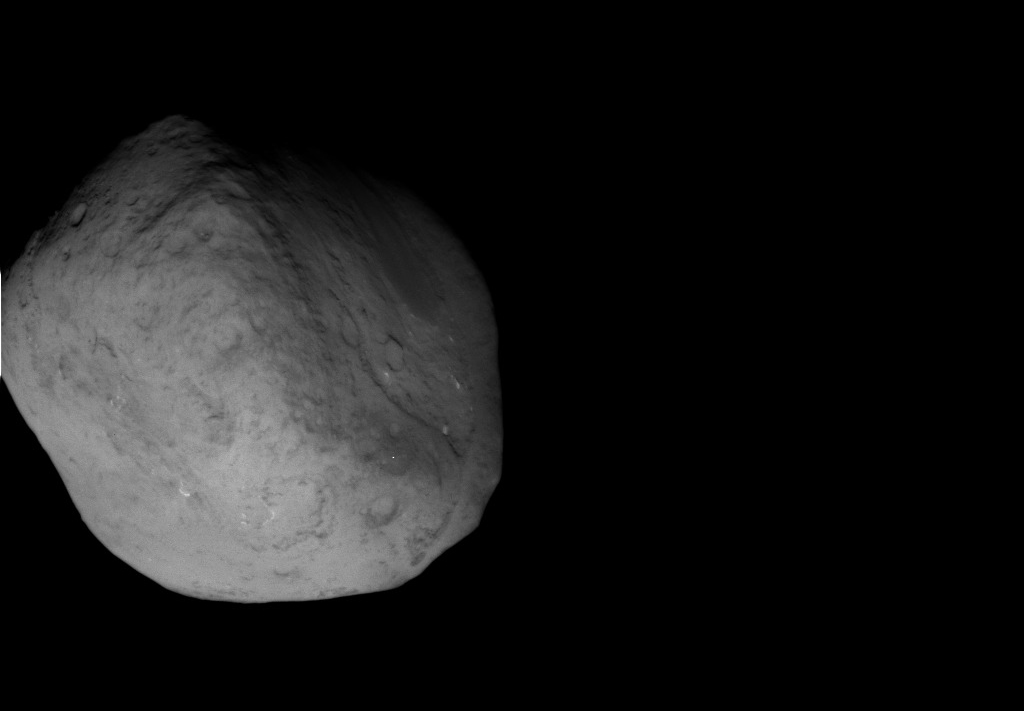
Comet Tempel 1 near Stardust-NExT close approach (NASA)
A NASA spacecraft, a lonely comet and a Valentine’s date with no comparison.
Last night, NASA’s veteran Stardust-NExT mission successfully visited its second comet, Tempel 1. Having already been visited by NASA’s Deep Impact mission in 2005, it’s hard not to wonder whether Tempel 1 was a little apprehensive. Deep Impact did lob a refrigerator-sized copper impactor into the comet’s surface during the 2005 encounter, so I think we can forgive the comet some pre-date jitters.
Fortunately, Stardust was the perfect date (no impactors, silverware, dishes or bottles were thrown), just a peaceful flyby, during which the spacecraft beamed dozens of photos back to Earth. To quote Joe Veverka, Stardust-NExT principal investigator: “It was 1,000 percent successful!”
Alas, although the date was a success, there won’t be the sound of wedding bells any time soon. Stardust is now powering away from the comet at a breakneck speed. Was it something Tempel 1 said?
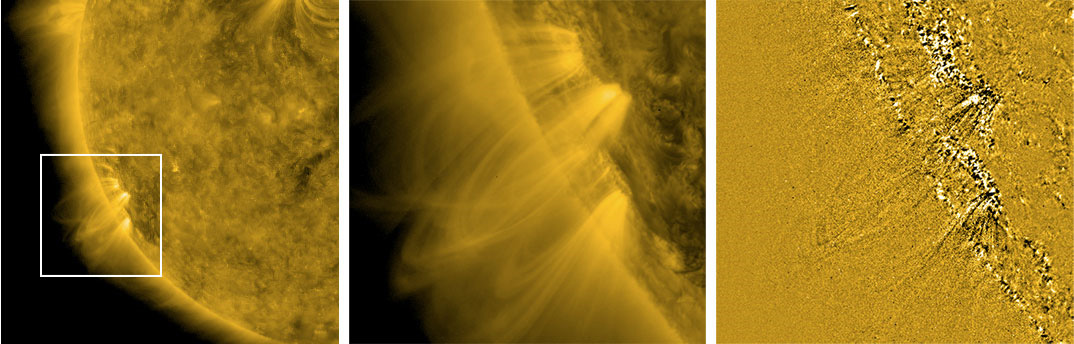
Solar spicules as imaged by NASA's Solar Dynamics Observatory (NASA)
There’s one recurring question I’ve been asking for nearly a decade: Why is the Sun’s corona (its atmosphere) so hot?
When asking this out loud I inevitably get the sarcastic “um, because the Sun is… hot?” reply. Yes, the Sun is hot, really hot, but solar physicists have spent the last half-century trying to understand why the corona is millions of degrees hotter than the solar surface.
After all, if the air surrounding a light bulb was a couple of magnitudes hotter than the bulb’s surface, you’d want to know why that’s the case, right? At first glance, the solar atmosphere is breaking all kinds of thermodynamic laws.
The Sun is a strange beast and because of its magnetic dominance, energy travels through the solar body in rather unfamiliar ways. And today, a group of solar physicists have put forward a new theory as to where the coronal energy is coming from. But they’ve only been able to do this with help from NASA’s newest and most advanced solar telescope: the Solar Dynamics Observatory, or SDO.
Using the SDO’s high-definition cameras and imagery from the awesome Japanese Hinode solar observatory, features previously invisible to solar astronomers have been resolved. The features in question are known as “spicules.” These small-scale jets inject solar plasma from the solar surface into the lower corona, but until now they’ve been considered too cool to have any appreciable heating effect.
That was until a new type of hot, high-speed spicule was discovered.
“It’s a little jet, then it takes off,” solar physicist Scott McIntosh, of the National Center for Atmospheric Research’s High Altitude Observatory, told Discovery News’ Larry O’Hanlon. “What we basically find is that the connection is the heated blobs of plasma. It’s kind of a missing link that we’ve been looking for since the 1960s.”
These Type II spicules blast hot multi-million degree Kelvin plasma at speeds of 100 to 150 kilometers per second (62 to 93 miles per second) into the corona and then dissipate. What’s more, these aren’t isolated events, they’ve been observed all over the Sun. “This phenomenon is truly ubiquitous and populates the solar wind,” said McIntosh.
While this research provides more clarity on coronal dynamics, McIntosh is keen to point out that Type II spicules probably don’t tell the whole coronal heating story.
NASA’s coronal physics heavyweight James Klimchuk agrees. “It is very nice work, but it is absolutely not the final story on the origin of hot coronal plasma,” he said.
“Based on some simple calculations I have done, spicules account for only a small fraction of the hot plasma.”
Klimchuk favors coronal heating through magnetic stresses in the lower atmosphere generating small reconnection events. Right at the base of the corona, loops of magnetic flux channeling multi-million degree plasma high above the Sun’s chromosphere become stressed and eventually snap. These reconnection processes produce sub-resolution nanoflare events — akin to small explosions releasing energy into the solar plasma, heating it up.
Another heating mechanism — a mechanism I studied during my solar research days (.pdf) — is that of wave heating, when magnetohydrodynamic waves (I studied high-frequency Alfven waves, or ion cyclotron waves) interact with the lower corona, heating it up.
But which heating mechanism injects the most energy into the corona? For now, although there’s plenty of theorized processes (including these new transient Type II spicules), we don’t really know. We can only observe the solar corona from afar, so getting a true grasp on coronal dynamics is very hard. We really need a probe to dive deep into the solar atmosphere and take a measurement in-situ. Although the planned Solar Probe Plus will provide some answers, it may still be some time before we know why the corona is so hot.
But it is most likely that it’s not one coronal heating mechanism, but a combination of the above and, perhaps, a mechanism we haven’t uncovered yet.
Oh yes, and that little dot ahead of the falling debris? That’s the sample return capsule before it was found int he Outback safely. Thank goodness its parachute worked (presumably).
Hayabusa re-enters over the Australian Outback, generating a bright fireball (screen grabs from the JAXA video feed)
Staring hard at the live streaming video of the black Australian skies, I was hoping to see a faint streak of light glide across the camera’s field of view.
But no, it wasn’t that subtle.
Shortly after 9:51 am EDT on Sunday morning (or, for me, a far more civilized 2:51 pm GMT), the Japanese space agency’s (JAXA) Hayabusa’s mission officially came to an end, burning up in the atmosphere. However, a few hours before, the spacecraft released a 40 cm-wide capsule, sending it ahead of the main spacecraft. This sample return capsule would have a very different re-entry than its mothership.
As I watched the small dot of light on the horizon of the streaming video getting brighter and brighter — feverishly hitting the PRTSC button and using some rapid cut&paste-fu in Photoshop — suddenly it erupted, shedding light on the distant clouds that had been invisible in the night.
Far from the re-entry being a faint or dull event, it was dazzling (as seen in the screen grabs to the right).
So, after seven dramatic years in space, the Hayabusa mission has come to an end.
For the full story about how Hayabusa got hit by the largest solar flare in history, limped to visit an asteroid called Itokawa and how its sample-collecting kit malfunctioned, have a read of my main article on Discovery News: Hayabusa Generates Re-Entry Fireball Over Australia
The interstellar probes are still operational (NASA)
The Voyager 2 spacecraft has been speeding through the Solar System since 1977 and it’s seen a lot. Besides scooting past Jupiter, Saturn, Uranus and Neptune, the probe is now passing through the very limit of the heliosphere (called the heliopause) where it has begun to detect a magnetic field beyond the Solar System. The fact we have man-made objects exiting our star system is something that makes me goosebumpily.
For some perspective, Voyager 2 is so far away from Earth that it takes nearly 13 hours for commands sent from Earth to reach the probe.
After decades of travel, the NASA spacecraft continues to relay data back to us, making it one of the most profound and exciting space missions ever launched. Perhaps unsurprisingly, the aging explorer recently experienced a glitch and the data received by NASA was rather garbled.
Naturally, the conspiracy theorists were out in force quickly pointing their sticky fingers at a possible encounter of the 3rd kind. How these ‘aliens’ found the probe in the first place and reprogrammed the transmission for it to appear corrupt Earth-side is beyond me, but according to an ‘expert’ in Germany, aliens (with an aptitude for reprogramming 30 year old Earth hardware, presumably) were obviously to blame.
One of the alien implication articles came from yet another classic ‘science’ post thrown together by the UK’s Telegraph where they decided to take the word of a UFO expert (obviously a viable source) without any kind of counter-argument from a real expert of real science. (But this is the same publication that brought us other classics such as the skull on Mars and the Doomsday Turkey, so it’s not too surprising.)
As I discussed in a recent CRI English radio debate with Beyond Beijing hosts Chris Gelken and Xu Qinduo, the Voyager-alien implication is beyond funny; an entertaining sideline to poke fun at while NASA worked out what actually went wrong. But the big difference was that Chris and Xu had invited Seth Shostak (from the SETI Institute) and Douglas C. Lin (from the Kavli Institute for Astronomy and Astrophysics at Peking University) to join the fun. No UFO expert in sight, so the discussion was biased toward science and logic, not crazy talk.
So what did happen to Voyager 2? It turns out that aliens are not required to answer this cosmic mystery.
On Tuesday, NASA announced that Voyager 2 had flipped one of its bits of memory the wrong way. “A value in a single memory location was changed from a 0 to a 1,” said JPL’s Veronia McGregor.
This glitch was thought to occur in the flight data system, which formats information for transmission to Earth. Should something go wonky in its memory allocation, the stuff it transmits can be turned into gibberish.
Although it isn’t known how this single bit was flipped (and we may never know, as Voyager 2 is an awful long way from home), it sounds very much like a cosmic ray event interfering with the onboard electronics. As cosmic rays are highly energetic charged particles, they can penetrate deep into computer systems, causing an error in calculations.
And this situation isn’t without precedent either. Recently, NASA’s Mars Reconnaissance Orbiter (MRO) was hit by a cosmic ray event, causing the onboard computer to switch to “safe mode.” Also, Voyager 2 is beginning to exit the Sun’s outermost sphere of influence, where turbulence and confused magnetic fields rule. If I had to guess, I’d say — statistically-speaking — the probe might have a greater chance of being hit by the most energetic cosmic rays from deep space.
Just because something “mysterious” happens in space doesn’t mean aliens, the Illuminati or some half-baked doomsday phenomenon caused it. Before jumping to conclusions it would be nice if certain newspapers and UFO experts alike could look at the most likely explanation before pulling the alien card.
Alas, I suspect that some things will never change.









 astroengine.com