Some Galaxies Die Young… Others Recycle

Some galaxies undergo a rapid star formation phase, losing stellar gases to intergalactic space, others choose to recycle, thereby extending their star forming lifespans.
Some galaxies undergo a rapid star formation phase, losing stellar gases to intergalactic space, others choose to recycle, thereby extending their star forming lifespans (NASA, ESA, and A. Feild (STScI))

It sounds like an over-hyped public service announcement: If you don’t recycle, you’ll die a premature death.

But in the case of galaxies, according to three new Science papers based on Hubble Space Telescope data, this is a reality. Should a galaxy “go green,” reusing waste stellar gas contained within huge halos situated outside their visible disks, they will fuel future star-birth cycles, prolonging their lifespans.

Sadly for “starburst” galaxies — galaxies that undergo rapid star generation over very short time periods — they care little for recycling, resulting in an untimely death.

Using data from Hubble’s Cosmic Origins Spectrograph (COS), three teams studied 40 galaxies (including the Milky Way) and discovered vast halos of waste stellar gases. Contained within these spherical reservoirs — extending up to 450,000 light-years from their bright disks of stars — light elements such as hydrogen and helium were found to be laced with heavier elements like carbon, oxygen, nitrogen and neon. There’s only one place these heavy elements could have come from: fusion processes in the cores of stars and supernovae.

Interestingly, the quantity of heavy elements contained within the newly-discovered halos is similar to what is contained in the interstellar gases within the galaxies themselves.

“There’s as much heavy elements out in the halos of the galaxies as there is in their interstellar medium, that is what shocked us.” said Jason Tumlinson, an astronomer for the Space Telescope Science Institute in Baltimore, Md., in an interview for my Discovery News article “Galaxies That Don’t Recycle Live Hard, Die Young.”

But these heavy elements are stored in halos outside the galaxies; how the heck did it get there?

According to the researchers, powerful stellar winds jetting into intergalactic space have been observed, transporting the heavy elements with them. But there’s a catch. If the outflow is too strong, waste stellar gases are ejected from the galaxies completely. Unfortunately for one sub-set of galaxies, powerful stellar outflows come naturally.

Starburst galaxies rapidly generate stars, ejecting speedy streams of stellar waste gas. Some of these streams have been clocked traveling at 2 million miles per hour, escaping from the galaxy forever. In the case of a starbust galaxy, a “recycling halo” cannot be re-supplied — future star birth is therefore killed off.

“We found the James Dean or Amy Winehouse of that population, you know, the galaxies that lived fast and died young,” Tumlinson pointed out. “(Todd) Tripp’s team studied that in their paper.”

“That paper used a galaxy that is known as a ‘post-star burst galaxy’ and its spectrum showed that it had a very robust star burst (phase),” he continued. “It was one of those live fast, die young galaxies.”

Although fascinating, one idea struck me the hardest. On asking Tumlinson to speculate on how galactic recycling of stellar material may impact us, he said:

“Your body is 70 percent water and every water molecule has an oxygen atom in it. The theorists say the recycling time (in the Milky Way’s halo) is approximately a billion years, so that means — potentially — that some of the material (oxygen) inside your body has cycled in and out of the galaxy ten times in the history of the galaxy. At least once, maybe up to ten times.”

As Carl Sagan famously said: “We’re made of star stuff;” perhaps this should be rephrased to: “We’re made of recycled star stuff.”

Publications:

When an Astrophysicist Needs a Star Map

Stars of the Northern Hemisphere, Ashland Astronomy Studio

Imagine the scene: I’m having a romantic walk on a clear night with my wife along the beach. We see a brief flash of light and Deb says, “Hey, a meteor!” I then proceed to tell her that most meteors are actually no bigger than a grain of sand and they originate from comets, even though she already knew that. Feeling quite chuffed with myself that I was able to describe a nugget of atmospheric dynamics in 2 minutes, Deb then points up again and says, “There’s Orion. What constellation is that one?”

“Um. I have no idea,” I reply, feeling less smug. “I know how those things work, but I don’t know what they look like.”

I don’t own a telescope (yet) and I only took one course in university on practical astronomy, everything else was astrophysics. So the sad thing is that I know how stars work — from the nuclear fusion in their core to coronal dynamics (the latter of which I did my PhD in) — but if anyone asked me to point out a constellation or the location of a star… I wouldn’t have a clue.

Sure, there are the old favorites, like Orion, the Big Dipper (or Plough) and bright Polaris, but my expertise in night sky viewing is pretty limited. Although I’d usually refer any astronomy-related questions to BBC astronomy presenter (and Discovery News writer) Mark Thompson, I’d love to learn more. So, firstly, I needed a star chart.

Luckily, a few weeks ago, I received a random email from Erik Anderson from Ashland Astronomy Studio asking whether I’d like a copy of his company’s new star map poster. Being eager to boost my pitiful knowledge of the constellations, I jumped at the chance. Soon after, my poster arrived through the post.

Now this is where things got really cool. Although Erik had titled his email to me “Star Map with Exoplanet Hosts,” I’d forgotten about the “exoplanet” part. On the clear, yet detailed Ashland star map, all the major constellations and stars are plotted, along with the time of the year (in the Northern Hemisphere) they can be seen. But also, there’s a symbol representing the hundreds of stars that are known to have exoplanetary systems orbiting.

Over the last couple of weeks, I’ve been referring to my newly-framed star map, and can now confidently point into the sky, not only identifying the constellations but also some stars that possess exoplanets. Only last night, I pointed up in the general vicinity of the star 61 Virginis (near the blue giant Spica) and said, “That star has 3 worlds orbiting it.”

I’m not sure if Deb was overly impressed with my exoplanet knowledge, but I was happy to be smug again.

Although it’s only a very small part of an astronomer’s tool kit, a star map is essential. Although you can get apps for your iPhone, you can’t beat a poster that isn’t only functional, but also looks very attractive on your office wall.

The very cool Ashland Astronomy Studio Star Map can be purchased from Amazon.

Could Kepler Detect Borg Cubes? Why Not.

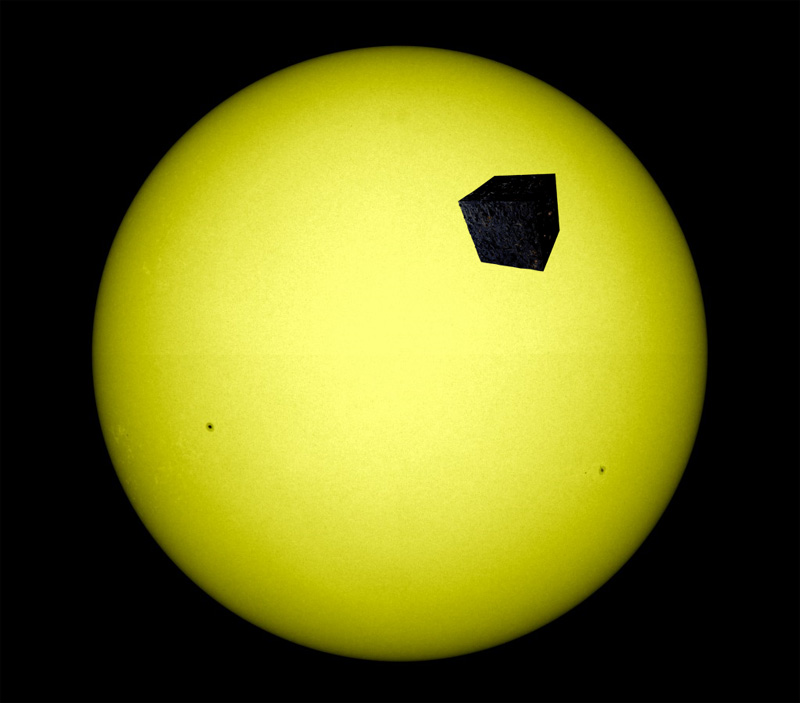
That's no sunspot.
"That's no sunspot."

Assuming Star Trek‘s Borg Collective went into overdrive and decided to build a huge cube a few thousand miles wide, then yes, the exoplanet-hunting Kepler space telescope should be able to spot it. But how could Kepler distinguish a cube from a nice spherical exoplanet?

With the help of Ray Villard over at Discovery News, he did some digging and found a paper dating back to 2005 — long before Kepler was launched. However, researcher Luc Arnold, of the Observatoire de Haute-Provence in Paris, did have the space telescope in mind when he studied what it would take to distinguish different hypothetical shapes as they passed in front of his theoretical stars.

The big assumption when looking for exoplanets that drift between distant stars and the Earth — events known as “transits” — is that the only shape these detectable exoplanets come in are spheres. Obvious really.

As a world passes in front of its parent star, a circular shadow will form. However, from Earth, we’d detect a slight dimming of the star’s “light curve” during the transit, allowing astronomers to deduce the exoplanet’s orbital period and size.

The transit method has been used to confirm the presence of hundreds of exoplanets so far, and Kepler has found over 1,200 additional exoplanet candidates. But say if astronomers paid closer attention to the shape of the received light curve; spherical objects have a distinct signature, but say if something looked different in the transiting “planet’s” light curve? Well, it could mean that something non-spherical has passed in front of a star. And what does that mean? Well, that would be a pretty convincing argument for the presence of a huge planet-sized artificial structure orbiting another star. Artifical structure = super-advanced alien civilization.

Arnold tested his theory that all manner of shapes could be detected by Kepler, assuming the transiting structure was on the scale of a few thousand miles wide. In this case, Arnold was testing his hypothesis to see whether we could detect an advanced civilization’s “shadow play.” Perhaps, rather than beaming messages by radio waves, an advanced civilization might want to signal their presence — SETI style — by blocking their sun’s light with vast sheets of lightweight material. As the shape passes in front of the star, the slight dimming of starlight would reveal an artificial presence in orbit.

By putting a series of these shapes into orbit, the aliens could create a kind of interstellar Morse code.

Of course, this is a rather “out there” idea, but I find it fascinating that Kepler could detect an alien artifact orbiting a star tens or hundreds of light-years away. Although this research is only considering orbital “billboards,” I quite like the idea that Kepler might also be able to detect a large structure like… I don’t know… a big Borg mothership. Having advanced warning of the presence of an aggressive alien race sitting on our cosmic doorstep — especially ones of the variety that like to assimilate — would be pretty handy.

Publication: Transit Lightcurve Signatures of Artificial Objects, L. Arnold, 2005. arXiv:astro-ph/0503580v1

Want to Feel Good? Watch the Aurora Borealis in HD

The Aurora from Terje Sorgjerd on Vimeo.

I actually posted this jaw-dropping video on Discovery News last month, but today it got picked up on Digg, so I was reminded why I had to feature it.

The video is actually composed of 22,000 high-definition photographs, stitched together is a finely crafted time lapse video. The photographer in question is Terje Sorgjerd who braved -22C temperatures in the Arctic Circle to bring us this stunning perspective of the Aurora Borealis, or the Northern Lights. Throw in the Hans Zimmer “Gladiator” theme tune “Now We Are Free” and we get a timeless classic video that can be watched over and over again and never get bored.

So, sit back and enjoy the Sun-Earth interaction at its most spectacular.

For more of Sorgjerd’s work, check out his Facebook page.

Special thanks to my good friend Geir Barstein, science journalist at the Norwegian newspaper Dagbladet for originally writing about Sorgjerd’s work.

Screaming Exoplanets: Detecting Alien Magnetospheres

Exoplanets may reveal their location through radio emissions (NASA)

In 2009, I wrote about a fascinating idea: in the hunt for “Earth-like” exoplanets, perhaps we could detect the radio emissions from a distant world possessing a magnetosphere. This basically builds on the premise that planets in the solar system, including Earth, generate electromagnetic waves as space plasma interacts with their magnetospheres. In short, with the right equipment, could we “hear” the aurorae on extra-solar planets?

In the research I reviewed, the US Naval Research Laboratory scientist concluded that he believed it was possible, but the radio telescopes we have in operation aren’t sensitive enough to detect the crackle of distant aurorae. According to a new study presented at the RAS National Astronomy Meeting in Llandudno, Wales, on Monday, this feat may soon become a reality, not for “Earth-like” worlds but for “Jupiter-like” worlds.

“This is the first study to predict the radio emissions by exoplanetary systems similar to those we find at Jupiter or Saturn,” said Jonathan Nichols of the University of Leicester. “At both planets, we see radio waves associated with auroras generated by interactions with ionised gas escaping from the volcanic moons, Io and Enceladus. Our study shows that we could detect emissions from radio auroras from Jupiter-like systems orbiting at distances as far out as Pluto.”

Rather than looking for the magnetospheres of Earth-like worlds — thereby finding exoplanets that have a protective magnetosphere that could nurture alien life — Nichols is focusing on larger, Jupiter-like worlds that orbit their host stars from a distance. This is basically another tool in the exoplanet-hunters’ toolbox.

Over 500 exoplanets have been confirmed to exist around other stars, and another 1,200 plus exoplanetary candidates have been cataloged by the Kepler Space Telescope. The majority of the confirmed exoplanets were spotted using the “transit method” (when the exoplanet passes in front of its host star, thereby dimming its light for astronomers to detect) and the “wobble method” (when the exoplanet gravitationally tugs on its parent star, creating a very slight shift in the star’s position for astronomers to detect), but only exoplanets with short orbital periods have been spotted so far.

The more distant the exoplanet from its host star, the longer its orbital period. To get a positive detection, it’s easy to spot an exoplanet with an orbital period of days, weeks, months, or a couple of years, but what of the exoplanets with orbits similar to Jupiter (12 years), Saturn (30 years) or even Pluto (248 years!)? If we are looking for exoplanets with extreme orbits like Pluto’s, it would be several generations-worth of observations before we’d even get a hint that a world lives there.

“Jupiter and Saturn take 12 and 30 years respectively to orbit the Sun, so you would have to be incredibly lucky or look for a very long time to spot them by a transit or a wobble,” said Nichols.

By assessing how the radio emissions for a Jupiter-like exoplanet respond to its rotation rate, the quantity of material falling into the gas giant from an orbiting moon (akin Enceladus’ plumes of water ice and dust being channeled onto the gas giant) and the exoplanet’s orbital distance, Nichols has been able to identify the characteristics of a possible target star. The hypothetical, “aurora-active” exoplanet would be located between 1 to 50 AU from an ultraviolet-bright star and it would need to have a fast spin for the resulting magnetospheric activity to be detectable at a distance of 150 light-years from Earth.

What’s more, the brand new LOw Frequency ARray (LOFAR) radio telescope should be sensitive enough to detect aurorae on Jupiter-like exoplanets, even though the exoplanets themselves are invisible to other detection methods. Nice.

As we’re talking about exoplanets, magnetospheres and listening for radio signals, let’s throw in some alien-hunting for good measure: “In our Solar System, we have a stable system with outer gas giants and inner terrestrial planets, like Earth, where life has been able to evolve. Being able to detect Jupiter-like planets may help us find planetary systems like our own, with other planets that are capable of supporting life,” Nichols added.

Although Nichols isn’t talking about directly detecting habitable alien worlds (just that the detection of Jupiter-like exoplanets could reveal Solar System-like star systems), I think back to the 2009 research that discusses the direct detection of habitable worlds using this method: Aliens, if you’re out there, you can be as quiet as you like (to avoid predators), but the screaming radio emissions from your habitable planet’s magnetosphere will give away your location…

Sometimes, You Just Have To Make Chocolate Mars Rover Cake

chocolatemer
Credit: Will Gater

OK, so Astroengine has been a little quiet of late due to some uber-cool space news writing over at Discovery News, but to kick off an era of increased productivity (and not just Photoshop fun), I just had to share this superb chocolate-covered tribute to Mars Exploration Rover Spirit.

Created by my mate Will Gater, science writer and editor of Sky at Night Magazine, this is Mars rover Spirit, complete with silica-churned (white chocolate) Mars regolith in its tire tracks. I’ll be back in the UK next week Will, I hope you saved me a slice!

Latest news on Spirit: Mars Rover Down? Spirit Stays Silent

Speaking of Mars rovers, in case you missed it, I had the awesome fortune to visit the next Mars rover to be launched to the Red Planet later this year. Seeing the nuclear-powered, laser-toting, car-sized rover up close is something I’ll never forget. For more, take a look at the Discovery News slide show I created with pictures from my NASA Jet Propulsion Laboratory adventures.

This is me, in the NASA JPL clean room housing Mars rover Curiosity. As you can see, I'm very happy to be there.
This is me, in the NASA JPL clean room housing Mars rover Curiosity. As you can see, I’m very happy to be there.

What Happened to Mars Rover Spirit?

“A big rusty transporter came over the hill and the Jawas sold it for scrap metal…” — Paul Quinn

NASA is giving Mars rover Spirit one more month to signal that she’s still alive before search operations are scaled back and attention shifted to her sister rover Opportunity. Unfortunately, the prognosis isn’t good. It’s been a little over a year since Spirit last communicated and it’s looking increasingly likely she’s succumbed to a lack of energy and freezing conditions on the Martian surface.

But… something else might have happened.

“A big rusty transporter came over the hill and the Jawas sold it for scrap metal…” — Paul Quinn (via Facebook)

It’s not as if it hasn’t happened before, in a galaxy far, far away…

Credits: Main Mars vista with Spirit superimposed: NASA. Jawa sandcrawler and Jawa figures: LucasArts. Edit: Ian O’Neill/Astroengine.com. Inspiration: My mate Paul Quinn!

The Ultimate Paternity Test: Are We Martian?

"Dad?" A scene from War of the Worlds.

This rather outlandish, sci-fi notion comes straight from the fertile minds of researchers from MIT, the Massachusetts General Hospital and Harvard University who are proposing a biology experiment that could be sent on a future Mars surface mission. If their hypothesis is proven, we wouldn’t only have an answer for the age old question: Are we alone? but we’d also have an answer for the not-so-age-old question: Did life from Mars spawn life on Earth?

The idea goes like this: countless tons of material from Mars has landed on Earth. We know this to be true; meteorites have been discovered on Earth that originate from the Red Planet. These rocks were blasted from the Martian surface after eons of asteroid impacts, and the rocks then drifted to Earth.

If there was once life on Mars — a concept that isn’t that far-fetched, considering Mars used to boast liquid water in abundance on its surface — then perhaps some tiny organisms (not dislike the hardy cyanobacteria that is thought to have been one of the earliest forms of life to evolve on our planet) hitched a ride on these rocks. If some of these organisms survived the harsh conditions during transit from Mars to Earth and made it though the searing heat as the meteorite fell through our atmosphere, then perhaps (perhaps!) that is what sparked life on Earth.

You may have heard a few variations of this mechanism, it is of course the “panspermia” hypothesis. Panspermia assumes that life isn’t exclusive to just one rocky body like Earth, perhaps life has the ability to hop from one planet to the next, helped on its way by asteroid impacts. Not only that, but perhaps (perhaps!) tiny microorganisms could drift, encased in interstellar dust, akin to pollen drifting in the wind, seeding distant star systems.

Naturally, when considering the distance between the planets (let alone the light-years between the stars!), one might be a little skeptical of panspermia. But it certainly would help us understand how life first appeared on Earth. After all, it’s not as if the solar system has a natural quarantine system in place — if Mars had (or has) bacteria on its surface, perhaps they have been spread to Earth, like an interplanetary flu bug. Also, as experiments are showing us, microorganisms have an uncanny ability to survive in space for extended periods of time.

So, according to my esteemed Discovery News colleague Ray Villard, the MIT team led by Christopher Carr and Maria Zuber and Gary Ruvkun, a molecular biologist at the Massachusetts General Hospital and Harvard University, are proposing to build an instrument to send to Mars. But this instrument won’t be looking for signs of life, it will be testing the hypothetical Martian DNA and RNA. Should this interplanetary paternity test prove positive, proving a relationship between Earth Brand™ Life and Mars Brand™ Life, then this could be proof of some extraterrestrial cross-pollination.

Although this is complete conjecture at this time, as there is no proof that life has ever existed on Mars (despite what research in dodgy research journals tell us), it is certainly an interesting idea that would not only test the hypothesis of panspermia, but also give us a clue about the potential human colonization of Mars.

To quote Ray:

This could give us pause about sending humans to a germ-laden alien world. It would be an ironic twist on the H.G. Wells classic 1898 novel “The War of the Worlds,” where invading Martians succumb to the common cold from Earth microbes.

See, Wells’ Martian warriors should have done genome testing first.

The Day Aliens Invaded… [UPDATE]

UPDATE (Mon. 9:50 a.m. PT): Shocker. NASA refutes Hoover’s claims. Apparently his paper failed peer review for publication in the International Journal of Astrobiology… in 2007! More here: “NASA Refutes Alien Discovery Claim — Discovery News

Original post: On Saturday, a NASA astrobiologist announced his “irrefutable proof” that aliens — the size of bacteria — exist. Using a sophisticated electron microscope, Richard Hoover looked deep into meteorite samples to see complex fossilized microscopic structures that looked suspiciously like bacteria found here on Earth.

Some of the suspect alien microorganisms even resemble cyanobacteria, a basic microorganism that helped make early-Earth hospitable to life by producing oxygen. Cyanobacteria can live in space for extended periods of time; tests on the International Space Station have shown the single-celled specks are hardy little buggers, surviving in a kind of “suspended animation,” sleeping for months (even years) in vacuous, frozen, high-radiation conditions. When brought back to Earth, the critters come back to life.

Needless to say, when Hoover announced this discovery of “alien” microbes, I wasn’t the only one who was thinking panspermia, the hypothetical mechanism where life — in the form of a microbe like cyanobacteria — hops from one planet to the next encased inside meteoroids.

Is this really proof of aliens? Is it evidence for panspermia? Does this mean life on Earth may have been seeded by alien microbes stowing away inside chunks of space rock? Does mankind need to invent an anti(alien)bacterial handwash?! (I’ve watched The Andromeda Strain.)

As mentioned in my Discovery News article on the subject, I’m skeptical about Hoover’s claims. This isn’t because I think Hoover’s work is rubbish (I have yet to finish digesting his lengthy paper), it’s just the way he decided to publish his work. The online Journal of Cosmology isn’t exactly the best place to submit your paper if you want your research to be taken seriously. And why the hell he gave FOX News the “exclusive,” I have no idea.

Sure, Hoover has discovered some odd-looking, alien-looking, bacteria-sized shapes in meteorite samples (he’s even done some interesting chemical analysis on the micro-“fossils”), but he’s going to have to do a far better job at convincing the scientific community that they are extraterrestrials.

Personally, I think these dinky “fossils” are a little too well preserved. Perhaps a far simpler explanation can be found? *cough* Contamination. *cough*

I’d love to know what NASA’s official line is, they seem to be staying remarkably quiet considering one of their employees has just announced the discovery of ET…

Read more: “Has Evidence for Alien Life Been Found?

When Stardust Met Tempel, a Love Story

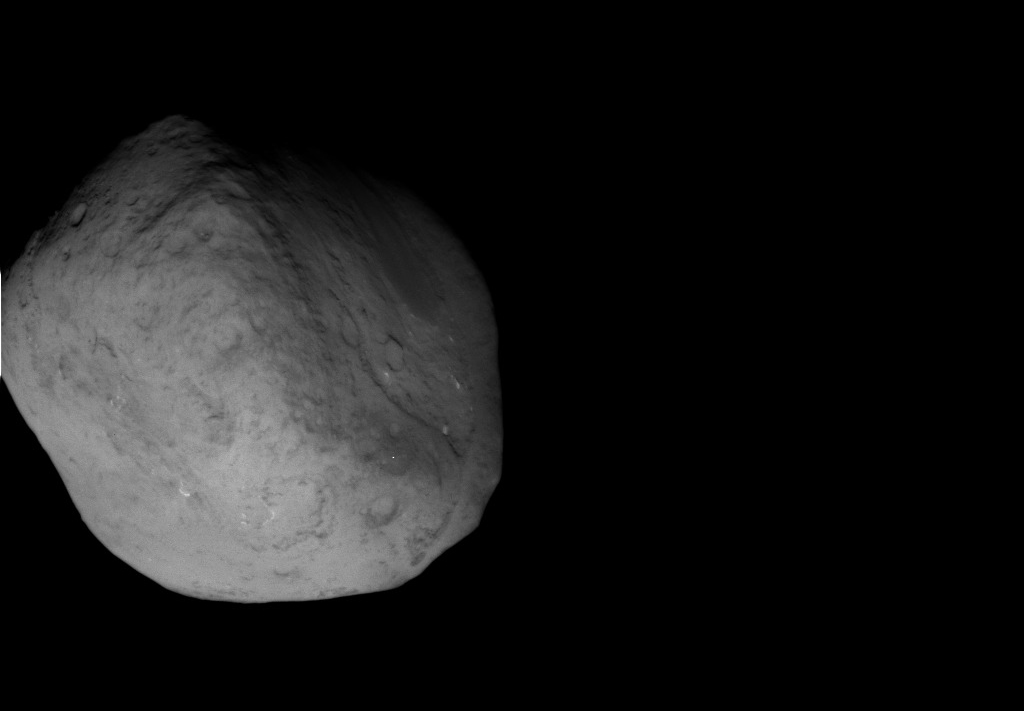
Comet Tempel 1 near Stardust-NExT close approach (NASA)

A NASA spacecraft, a lonely comet and a Valentine’s date with no comparison.

Last night, NASA’s veteran Stardust-NExT mission successfully visited its second comet, Tempel 1. Having already been visited by NASA’s Deep Impact mission in 2005, it’s hard not to wonder whether Tempel 1 was a little apprehensive. Deep Impact did lob a refrigerator-sized copper impactor into the comet’s surface during the 2005 encounter, so I think we can forgive the comet some pre-date jitters.

Fortunately, Stardust was the perfect date (no impactors, silverware, dishes or bottles were thrown), just a peaceful flyby, during which the spacecraft beamed dozens of photos back to Earth. To quote Joe Veverka, Stardust-NExT principal investigator: “It was 1,000 percent successful!”

Alas, although the date was a success, there won’t be the sound of wedding bells any time soon. Stardust is now powering away from the comet at a breakneck speed. Was it something Tempel 1 said?

For more on this Valentine’s rendezvous, have a read of my Discovery News article “Stunning Photos from a Comet Near-Kiss.”

Oh yes, and I got bored, so I created a rough animation of the flyby. Enjoy!