Atlantis Launch… Infrared-ed

The STS-125 Atlantis launch today, as seen through the lens of an infrared digital camera (Eliot J. Schechter/Getty Images)

I thought I wouldn’t see anything as impressive as the Space Shuttle Atlantis launch in high-definition, but it appears I was wrong. This is probably one of the most unique views of a shuttle launch I’ve seen to date; a high resolution, infrared photograph of the beginning of the STS-125 mission to the Hubble Space Telescope.

This would make a nice wallpaper… yes, it does 🙂

Source: Gawker

Mars Rover Spirit is Stuck in the Regolith

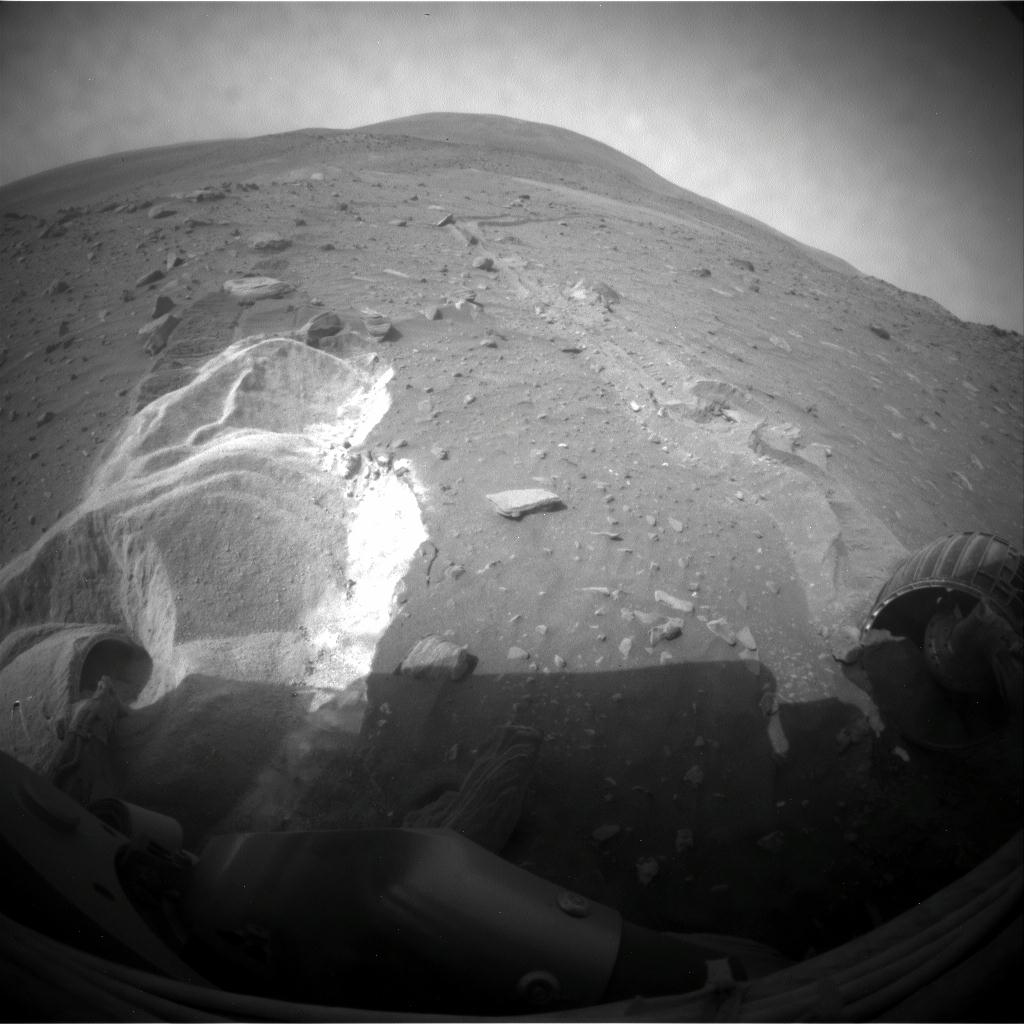
Spirit is stuck (NASA)

Mars Exploration Rover Spirit is in trouble again. She’s stuck.

The tenacious little robot has suffered traction problems before and has even been dragging around a broken wheel for the last three years, leaving the other five to take up the slack. Then there’s the dust storms that have hindered the life-giving solar panels ability to collect sunlight. And most recently, the on-board computers have been rebooting and Spirit’s flash memory has been forgetting to record data.

A little help here? Spirit has driven into soft ground, burying her wheels halfway. Engineers are working plans to extricate her. –A distress tweet from @MarsRovers

One of Spirit's buried wheels as taken by the front hazard-avoidance camera on Sol 1899, May 6th (NASA)

Now, she’s stuck in the Martian dirt after slipping backwards down a slope during a series of backward drives around a plateau called “Home Plate.”

Spirit is in a very difficult situation,” JPL project manager John Callas said. “We are proceeding methodically and cautiously. It may be weeks before we try moving Spirit again. Meanwhile, we are using Spirit’s scientific instruments to learn more about the physical properties of the soil that is giving us trouble.”

At JPL, a team have been assembled to try to find a solution to the problem with a model of the situation here on Earth. Unfortunately the wheels are stuck fast, half-buried, and scientists are increasingly worried that any attempts to free the struggling rover could make matters worse. The concern is for the chassis under the robot. Should it make contact with the rocks underneath, it would effectively beach itself, completely losing traction that could be used to free the wheels. In short, the situation is not good, but NASA is working overtime to find ways to get the rover on the road once more.

Fortunately, wind has helped the ailing rover recently, clearing excess dust off the solar panels, giving Spirit a much needed energy boost, but will it be enough to get her out of this difficult situation? If there’s a way, Spirit will find it, as let’s face it, she’s lived through a lot of hard knocks…

Source: NASA, AP

Watch Space Shuttle Atlantis Launch in HD

sts-125

Today’s launch of Space Shuttle Atlantis went according to plan and the crew of seven astronauts are now chasing the Hubble Space Telescope for its final servicing mission.

As I’m a little behind the curve on reporting this story, I thought I’d assemble some links to other sites who covered the launch far more expertly that I can at this late stage. However, not to be outdone, I wanted to share this incredible high definition video of the launch. If you want to watch the embedded HD version, look below, but if you want the full, i’m-on-the-edge-of-the-launchpad-oh-my-god-i-can-feel-the-heat wide-screen version, check out the awesome, fully-loaded YouTube HD video.

Links:

Sunday Opinion: Astroengine Gets Vaccinated

pin-up-nurse-white

NOTE: This post is a little light on the space science, but keep reading, you’ll see why I’m making such a big thing out of my trip to the doctors…

Yesterday was supposed to be a very productive blog-writing day, however, like all good plans, the day didn’t turn out the way I’d hoped.

For a start, I heard news about a wildfire on my doorstep (it started literally a few hundred metres from my house, and I was only alerted to this fact via Twitter – I wondered what all those helicopters were doing), which prompted me to run outside looking for an ominous smokestack, only to find I was an hour too late and the blaze had been put out by the superb LAFD.

Then I had to play babysitter to Astroengine.com’s server in the hope I was going to get hit by a flood of Digg traffic some… time… soon…

Then I had to let the rabbits out for a run. Barney felt the need to stick his head in the pool, so I decamped my office into the garden so I could make sure he didn’t decide to take a swim. Oh, there’s a lizard! She’s massive! Where’s my camera?

Then I had to run to the bank.

Oh yes, then I had to get to my appointment at the docs to have my tetanus vaccine booster.

Of all the things I hate in the world, syringes come a frightening third after slugs and tall buildings (don’t ask, just look up batophobia). However, these are phobias. If I start using logic and seriously consider all the scary stuff that could happen to me, I’d be most reluctant to become horribly sick and be responsible for infecting others with a nasty, preventable illness.

Hence the vaccine. And the achy arm.

I actually have a strange love for doctors surgeries, as soon as I walk through those doors, I hand all responsibility for my body to the specialists in white white and blue coats. If anything health-wise should happen, at least I have a team that can diagnose me and hopefully repair me. Yes, bad things happen in medical centres, but I’d much rather take my chances with highly professional individuals with years of training and a huge stack of qualifications, than leave things “to chance”.

So there I was sitting in the waiting room, trying to stay calm as I saw the nurse fill up the syringe with fluid from a tiny vial.

Naturally, I started chatting to try to distract myself from thinking too much about the jab. “Do you get many people not wanting to take vaccines?” I asked the nurse.

What do you mean?

Well, there’s this growing anti-vaccination movement I’ve read so much about,” I said, a little surprised she appeared to be genuinely surprised by the notion. “Some celebrities have taken it upon themselves to spread misinformation about the link between vaccines and the onset of autism in children.”

I heard about that,” she said, realizing what I was nervously talking about while staring at the needle in her hands. “But they are crazy, right? I mean, since when did they know anything about medicine?

As it turns out, the only complaint she’d heard from parents about the need to vaccinate their children is the cost, but even then there are options for financial help.

When I left the medical centre with a sore arm, I felt a little different than I had done in the past.

When getting my vaccinations in the UK, it was always a routine affair that required no thought, it was just one of those things you needed to function in society. It’s one of those things I had to do. Looking at my medical records, I received my first vaccine when I was a baby and throughout my life I’ve had regular shots (or as I call them “jabs” which my Mrs Astroengine finds highly amusing). I can quite safely say that I will never catch mumps, measles, rubella, hepatitis and a whole host of other nasties, because my immune system has been bolstered by a history of vaccinations.

Vaccines are highly successful, almost too successful.

Many life-threatening diseases have been wiped out by the widespread use of vaccines, leading to some misinformed individuals to believe vaccines are no longer needed (on the contrary). Then there’s the misplaced (and completely wrong) notion that vaccines are somehow linked with childhood autism. This is a topic that is as insane as it is bewildering, and what’s worse, Los Angeles has become a hothouse of stupid celebrities who think they have every right to be peddling their belief that parents should not vaccinate their kids.

Having seen Jenny McCarthy on the TV a LOT (no red carpet is safe from her Christian Diors), I’m quickly realising the media has a lot of sympathy for her views about the connection between autism and the MMR vaccine. Unfortunately, this makes her extremely vocal in my neck of the woods, and many of her anti-science remarks blend in with her celebritydom, so her message is very well polished, and very… reasonable. People listen to her, and when hubby Jim Carrey wades in with his crazy take of reality on the biggest blogging platforms, even more parents start to think twice about their choice to protect their children against deadly viruses.

If all of this is news to you I urge you to read up on it via Phil Plait’s Bad Astronomy. Phil has been bringing this topic up a lot, and at first I wondered what all the fuss was about. Then I had conversations with neighbours and family and many of them are concerned about Jenny et al.’s views on the topic. Fortunately, they all have the common sense to talk to a medical professional before making any rash decisions about boycotting vaccines. Their concerns were laid to rest by the GPs, nurses and healthcare professionals who don’t have the celebrity soap box so many of the famous are using for their personal crusades. So we need more professionals and scientists like Phil who actually know what they are talking about.

Science is a collection of facts, not a collection of personal opinions and beliefs, a notion many people don’t seem to understand. And judging by the density of palm-readers and psychics in my neighbourhood, there’s a lot of people who choose belief of the paranormal over logic.

So, when I walked away from the medical centre, marvelling at the protective injection I had just received (a little bit proud about how I didn’t pass out at the sight of the needle), I felt sad for the kids out there whose parents deemed it necessary to listen to the idiocy spewing from the plumped lips of an ex-Playboy model. Those children could become ill due to negligence (it is parental negligence), and there are an increasing number of deaths associated with diseases that were once unheard of in modern society.

I don’t have children, but when I do, I’ll make sure I’d read up on all the scientific facts first, but they will certainly be vaccinated. For me, vaccines are imperative for “herd immunity” and essential for a healthy society. Individuals who are un-vaccinated could easily become carriers of deadly diseases. In my eyes, an un-vaccinated child could be viewed as a potential weapon. If they are immunized at an early age, their bodies have the ability to fight off contagious disease, preventing unnecessary suffering and, ultimately, improve the health of society as a whole.

Conclusion

So why did I bother to go off-piste and discuss my concern about antivaxxers?

We live in a revolutionary age for mankind. We are exploring space, we have unbelievable technology, we are processing data at a faster rate than ever before. We communicate globally. Medical technology is helping us live for longer than ever before. We are stronger and more intelligent. On paper, mankind is doing pretty well. Yes, there are massive issues challenging us (climate change, economic crises, disasters, overpopulation etc.), but never before have we been able to confront these problems so well. If we had infinite resources and a strong political direction, the Universe could be our oyster.

But as with the antivax movement, anti-science and religious interference with science could undermine our very existence on this planet. Imagine a future where we have constructed a low-Earth orbit infrastructure, sending probes into deep space; we have quantum computing and fusion power. And yet a large portion of the “developed” world distrusts science at its core. Every year there’s a doomsday prophecy. Despite all the scientific evidence against, classrooms are teaching evolution along-side “intelligent design”. Some kids think the Universe is 6,000 years old, others know it is in fact 13.73 billion years old.

And then there’s the Jenny McCarthy’s of this world, spreading nonsense about why we should fear immunization. The media eats that stuff for breakfast, can you imagine what the media could be eating for dinner in a decade? The physical health of entire nations could be put in jeopardy. Who can advance mankind when borders are closed and our brightest minds are dying because of a pandemic caused by a mutated strain of a virus that should have been controlled decades ago?

Having fought a pitched battle with 2012 doomsday advocates for the last year, I’m seeing a pattern emerge. Anti-science is rocking the foundations of mankind, and if you don’t believe me, you need to spend some more time on the internet (a medium by which everyone has a voice, no matter how insane). For every science website, there’s ten websites with pseudo-science ramblings. Unfortunately, now that bigger entities are finding new and inventive ways to make money from people’s fear, I get the feeling we’ve seen nothing yet…

So, that was my big day of getting vaccinated. Interestingly, the most profound moment came at the medical centre as I was leaving with a Band Aid on my arm. The nurse who injected me, obviously thinking about what we were talking about in the waiting room said something very interesting. She asked me why people thought there was some elevated risk associated with vaccinations, after all, all medication carries some kind of “risk” (but the probability of anything bad happening is very, very small). As researched by my friend Greg Fish, these “toxins” don’t sound half as bad if you understand exactly what those scary-sounding ingredients actually are, and in what quantities they are administered.

Do these people have any idea how many toxins they breathe in every day?” the nurse asked as I walked out the door, referring to McCarthy and Carrey. Pointing at the traffic outside she added, “LA isn’t exactly known for it’s clean air!

Good point, I thought.

See that Red Splodge? That’s Where Captain Jack Is

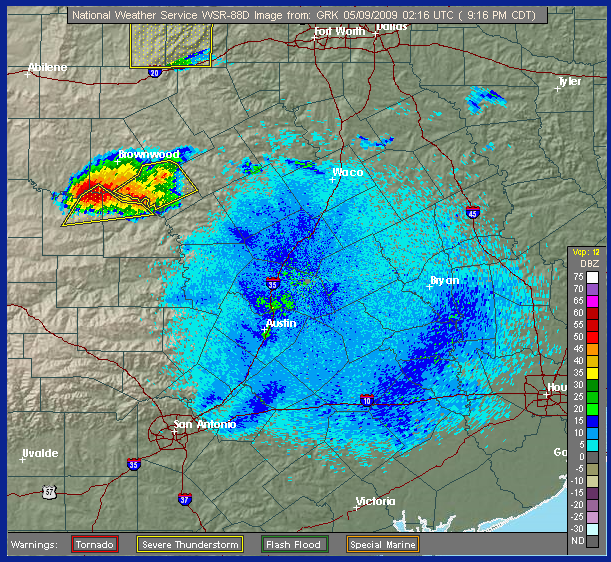
jack_tornado

Captain Jack at Badlands Radio (formerly Paranormal Radio) has been evacuated from the WPRT studios in Central Texas as tornadoes are sweeping through the area. His show is being covered by me until he can return, so be sure to tune in to find out more!

Last thing I heard was that Jack was in Brownwood (in what appears to be some pretty terrible conditions, looking at the radar picture above), attempting to return to the studio…

Listen to Badlands Radio NOW »

UPDATE: After 5 hours on the air, I get news from Jack that he and Selene are doing fine and returning to the studios. Be sure to check out the Badlands Radio for Jack’s eyewitness account of the tornado that caused so many problems in Central Texas.

Astroengine Live Bonus Show, Today at 4pm PST/7pm EST

You may have noticed I’ve been a little quiet on the airwaves these last couple of weeks. This doesn’t mean all the space news of the world has slowed, or I’ve been any less active article writing, it’s just that life seems to happen during my regular Wednesday slot and I have to keep cancelling!

But not today, I’ll be on the air at 4pm PST/7pm EST for an extra special show, just before Captain Jack hits the mic in his brand new and shiny Badlands Radio (formally known as Paranormal Radio).

For more information about how you can listen in to today’s Astroengine Live, go to the Astroengine Live section of Astroengine.com »

Forget Black Holes, Let’s Look For Black Rings

A bubble ring. Could a black hole take on this shape at higher dimensions? (©letsdiveguam.com)

Black holes are as extreme as anything can get. When a massive structure can no longer sustain its own gravity, it will collapse to a point known as a singularity. For example, a massive star after it has gone supernova may leave one of these singularities behind, a remnant of massive star death, sucking any local matter into a one-way trip to the guts of space-time.

At a certain point, when light itself succumbs to the black hole’s gravity, an event horizon forms, beyond which universal physics breaks down; we have very little idea about what lies inside the event horizon. All we do know is that you don’t want to fall into one, you’d be stretched and spaghettified. Spaghettification is due to extreme (and when I say extreme, I mean as-extreme-as-it-can-get) tidal forces between your head to your toes.

So, the message is: Don’t play with black holes, it can only end in tears.

Now the Black Hole Health & Safety lecture is over, it’s time to talk about “black rings”. Under certain conditions, black holes may not be the mathematical singularities we once knew and (thought we) understood.

In a recent publication by Masashi Kimura at Osaka City University in Japan, the black ring idea is explored in 5-dimensional space. In the space-time we know and love, there are three spatial dimensions and one temporal dimension. We are four-dimensional creatures. When string theory came along in the 1980’s we really began to appreciate that there could be more than the four dimensions we live in.

Previously, cosmologists have entertained the thought that black rings may exist in our 4D space-time. However, the big problem comes when trying to understand how these structures maintain their shapes; surely they should simply collapse and form your regular black holes? Actually, it depends on how big they are and how the competing forces balance out.

As the Universe is expanding, it is thought black rings could exist if they are of scales similar to the cosmological constant (this constant was derived by Einstein to explain a “flat” Universe, but later it was found the constant was required to characterize the universal expansion as observed by Edwin Hubble in 1929). If a black ring exists in 4D space-time, its gravitational collapse would be countered by the expansion of space-time (as characterized by the cosmological constant).

A bubble ring, as made by a dolphin, for fun (©deepocean.net)

The only analogy I can relate this to in the terrestrial world is bubble rings (or, indeed, smoke rings). When under water, a bubble will rise to the surface. However, under the constriction of surface tension, the bubble will form the smallest possible shape. When a bubble ring is produced, there needs to be a balance between surface tension and a vortex. The surface tension pulls in, while the vortex maintains the bubble ring shape, pushing out.

In the case of the black ring, gravity is pulling inward, while the expansion of space-time is countering it, pushing out. In this situation, in an expanding Universe, there could be enduring examples of black rings out there.

In Kimura’s research, not only are black rings a possibility, there could be a number of different complex shapes that could form when considering these extra dimensions. When the Universe was young, multiple interacting black rings may have been possible, eventually coalescing to form black holes.

Although this research is very interesting, it is hard to imagine how we could observe these higher-dimensional black rings. Would we see them as a singularity (i.e. a black hole) in our 4D space-time? Or would they even be unobservable for lower-dimensional beings such as ourselves?

Publication: Dynamical Black Rings with a Positive Cosmological Constant, Masashi Kimura, 2009. arXiv:0904.4311v2 [gr-qc]

Via: arXiv blog

Deflecting Doomsday Asteroids… and Plundering Them

A metorite impact would be very bad, but using asteroid deflection techniques could provide mankind with a lucrative opportunity (©Discovery Channel)

I’ve always found asteroids to be fascinating. They are often surprisingly big, they contain a wealth of information about the history of the Solar System… and, let’s be honest, they’re frightening.

There are thousands of asteroids out there, often collecting in clearly defined belts or gravitationally stable regions known as Lagrangian points. However, many are not so well behaved; they seem to have their own agenda, flying around the Solar System in their own orbits, sometimes buzzing the Earth.

Fortunately, the vast majority of these rocks are harmless; if they hit our atmosphere they might create a dazzling light show, burning up, possibly even exploding as a fireball. Sometimes though, a big asteroid might be observed and astronomers become a little concerned. The next known threat that might hit us is the famous asteroid named Apophis that is expected to make an uncomfortably close encounter with Earth on April 13th, 2036. The odds of Apophis hitting us in 2036 (not 2029 as quoted in the above video) are 45,000:1, which may sound fairly unlikely, but if you start comparing those odds with dying in a plane crash, or being hit by a car, you’ll see that actually, a one in 45,000 chance are the kind of odds you’d happily quote when placing a bet in a Vegas casino. I have a chance!

Yes, and there’s also a chance of a 350 metre-wide asteroid hitting us in 2036, so perhaps we should start planning for the worst?

Fortunately, we have some lead time on Apophis, and we’ll learn more about the chunk of rock when it flies past the Earth in 2029. And that’s what it’s all about: lead time. If mankind spots a potentially deadly asteroid approaching us, we’ll need as much time as possible to nudge it off course.

In a video I just stumbled across on Discovery.com, Joseph A. Nuth III from NASA Goddard Spaceflight Center shares his views on what we could do to prevent a potential asteroid catastrophe. By developing asteroid deflection techniques, we’ll also be presented with an opportunity. As pointed out by Nuth, if we have the ability to deflect an asteroid, perhaps we can steer it into lunar orbit, so we can carry out mining operations…

Is Pluto Affected by the Pioneer Anomaly?

From Pluto, looking at its icy moons in the Kuiper belt (NASA)

The Pioneer Effect is a mysterious observation of a number of man-made probes that venture through and beyond the Solar System. Originally noticed in the slight drift of the Pioneer 10 and Pioneer 11 spacecraft (launched in 1972 and 1973) from their calculated trajectories, scientists have been at a loss to explain the tiny, yet constant, extra-sunward acceleration.

Some theories suggest that invisible clouds of dark matter are slowing these probes down, causing them to be influenced by the Sun’s gravity more than expected. Other suggestions include ideas that Einstein’s theory of General Relativity needs to be tweaked when considering interplanetary distances.

However, there are other, more mundane ideas. Perhaps there is a tiny fuel leak in the probes’ mechanics, or the distribution of heat through the spacecraft is causing a preferential release of infrared photons from one side, nudging them off course.

Finding an answer to the Pioneer effect probably won’t surface any time soon, but it is an enduring mystery that could have a comparatively simple explanation, within the realms of known science, but there’s also the possibility that we could also be looking at some entirely new physics.

In an attempt to single out whether the Pioneer anomaly is an artefact with the spaceships themselves, or unknown in the physics of the Universe, astronomers decided to analyse the orbits of the planets in the outer Solar System. The rationale being that if this is a large-scale influence, some observable periodic effects should be evident in the orbit of Pluto.

So far, no effect, periodic or otherwise, has been observed in the orbit of Pluto. If the effect isn’t big enough to influence Pluto, does this mean we can narrow the search down to spaceship-specific artefacts?

Not so fast.

Gary Page and John Wallin from George Mason University in Virginia and David Dixon from Jornada Observatory in New Mexico, have published a paper pointing out that the suggestion that the Pioneer effect doesn’t influence Pluto is flawed. Pluto’s orbit is far less understood than the orbits of the inner Solar System planets, as, let’s face it, Pluto is far away.

We simply don’t possess the data required to cancel out the Pioneer effect on planetary bodies in the outer-Solar System to reach the conclusion the anomaly doesn’t influence Pluto.

Of course, this does not mean that the Pioneer effect exists. It does mean that we cannot deny the existence of the Pioneer effect on the basis of motions of the Pluto as currently known.” — Page et al., 2009

So, back to the drawing board. This is a fascinating study into a true Solar System mystery; bets are on as to the real reason why our interplanetary probes are being knocked off course…

Source: The Physics arXiv Blog

Colbert: Entomologists Succeed Where NASA Failed, Introducing The Agaporomorphus Colberti

Agaporomorphus colberti, a diving beetle from Venezuela (Kelly Miller and Quentin Wheeler)

You remember last month’s fuss over a certain component of the International Space Station, don’t you? You know, the NASA node-naming competition that a certain US comedian managed to dominate, ultimately winning the popular vote to name the node after himself? Come on, you must remember? The vote that NASA ultimately decided wasn’t very suitable and went with “Tranquillity” instead? Ah yes, that competition!

Although Stephen Colbert, presenter and award-winning comedian on “The Colbert Report”, was denied having Node 3, NASA did recognise his efforts and named the brand new microgravity treadmill after him. The Combined Operational Load Bearing External Resistance Treadmill (or COLBERT), is not only to remember Stephen’s landslide public vote, it is also a marvel in acronym construction.

Although space scientists are not so keen on naming components of the space station after Colbert, zoologists don’t have the same concerns about naming something after a living person. Two entomologists, Quentin Wheeler at Arizona State University and Kelly Miller at the University of New Mexico, have named a Venezuelan diving beetle after him, the mighty Agaporomorphus colberti. This is in honour of Colbert’s 45th birthday on May 13th.

Although it is great to be named after a small creature that enjoys paddling in the depths of South American ponds, I wonder if it’s any match for being named after an orbiting running machine for astronauts? After reading the honours list in the beetle world, I think I’d still prefer to have the unique privilage of astronauts saying, “I’m off to the COLBERT to stave off any muscle wastage…”

The pair have named beetles to honor the late rock ‘n’ roll legend Roy Orbison and his widow Barbara (Orectochilus orbisonorum); for fictional “Star Wars” character Darth Vader (Agathidium vaderi); and for former President George W. Bush, former Vice President Dick Cheney, and former Secretary of Defense Donald Rumsfeld (Agathidium bushi, A. cheneyi and A. rumsfeldi).

Agathidium vaderi? No way! Can I get one as a pet?

Still, good for Wheeler and Kelly. They’ve drummed up some interest in diving beetles and created some popular media attention for their area of science.

What does this have to do with space? Not a lot, just thought Agaporomorphus colberti sounded cool.

Source: Physorg.com