An Explanation For Solar Sigmoids

Hinode X-ray observation of a solar sigmoid (David McKenzie/Montana State University)

Sigmoids in the solar corona have been studied for many years, but little explanation of their formation or why they are often the seed of powerful solar flares have been forthcoming. Using high-resolution X-ray images from the Japanese-led solar mission Hinode (originally Solar-B), solar physicists have known that these very hot S-shaped structures are composed of many highly stressed magnetic flux tubes filled with energized plasma (also known as ‘fibrils’), but until now, little was known about the formation and flare eruption processes that occur in sigmoids.

Now, a team of solar physicists from the University of St Andrews believe they have found an answer using powerful magnetohydrodynamic (MHD) computer models, aiding our understanding of coronal dynamics and getting us one step closer to forecasting space weather…

Continue reading “An Explanation For Solar Sigmoids”

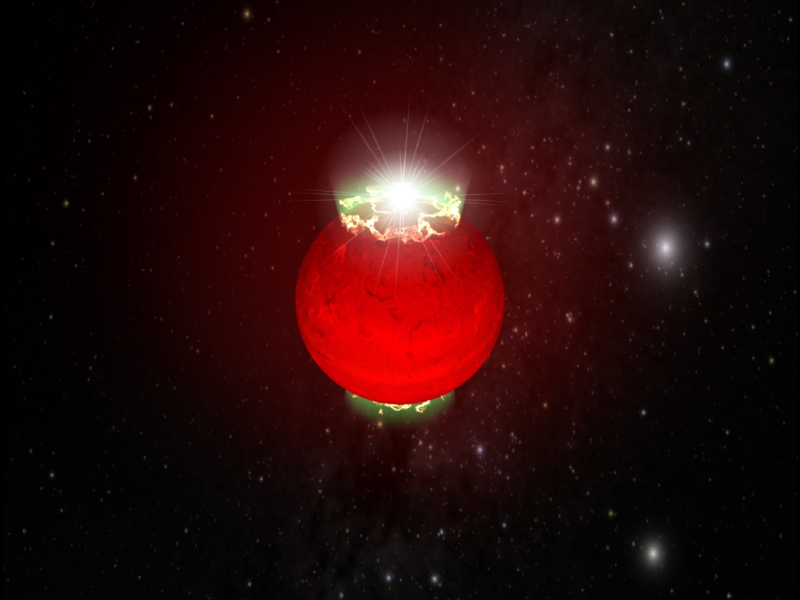
Are Brown Dwarfs More Common Than We Thought?

A brown dwarf plus aurorae (NRAO)

In 2007, a very rare event was observed from Earth by several observers. An object passed in front of a star located near the centre of the Milky Way, magnifying its light. Gravitational lensing is not uncommon in itself (the phenomenon was predicted by Einstein in 1915), but if we consider what facilitated this rare “microlensing” event, things become rather interesting.
Continue reading “Are Brown Dwarfs More Common Than We Thought?”

Astroengine 3.0

ae31

Now we’re cookin’… Welcome to the new-look Astroengine.com!

As you may have noticed I’ve been a little patchy with blog posts of late and now you can see why. I decided to migrate the entire Astroengine installation to a brand new server after the site suffered some serious downtime after a recent article (“Where is Planet X? Where is Nemesis?“) was slammed by Digg traffic. Now we are on a sparkling new server with a brand new design. I told you this year was going to be a big year for Astroengine, this officially marks the beginning of a new era

After asking readers about suggestions for a new direction in design, it was Darnell Clayton (Colony Worlds) who came up with the winning suggestion. He pointed me in the direction of the designs by Elegant Themes and once I saw a design called StudioBlue, I was hooked. A few modifications later and I arrived at what you see here, Astroengine 3.0. It has a fresher, more magazine/blog vibe, so I hope you like it.

With all the technical stuff calming down, I can now get back to what I’m here for. Expect a tonne of space science articles over the coming months – 2009 is going to be a big year.

Thank you for your support (and patience!).

Cheers, Ian

A Change Is Coming…

Apologies for the break in Astroengine transmission, a change is brewing.

I’m currently migrating my WordPress installation over to a brand new server. This is primarily due to the huge increase in traffic Astroengine has been experiencing in recent months. All great news, but something had to give and it was my shared hosting account that eventually broke.

To celebrate the new server and faster delivery of content, I’ve also been working on a redesign. Expect a big change sometime between now and whenever I finish uploading the thousands of files to their new home (hopefully within the next day).

Thank you for your continuing loyal support.

A new era for Astroengine.com awaits…

Cheers, Ian

In the Cosmos/Iridium Collision, Which Satellite Won?

©Stratfor Global Intellegence

When two satellites collide at 790 km above the Earth’s surface, who really cares which satellite “won”? It’s going to be a mess; chunks of metal and shards of solar panels exploding to life after their once-solid satellite structures impacted at a velocity of 11 km/s (that’s kilometres per second). Both satellites are losers, twisted, shattered remains of their former selves, cluttering Earth-orbit, causing all kinds of stress for other vehicles flying around in orbit.

However, when the Iridium communications satellite was hit by the defunct Russian Cosmos 2251 on February 10th, it turns out there was a “winner” in the satellite demolition derby (although I am using the word “winner” very loosely)…
Continue reading “In the Cosmos/Iridium Collision, Which Satellite Won?”

Space Experts to Discuss Threat of Asteroid Impact

Artist impression of a gravitational tractor deflecting the path of an NEO (Dan Durda/B612 Foundation)

Imagine you’re an astronomer who discovered an asteroid. Happy days, you might be able to name it after yourself (99942 O’Neill has a certain ring to it, don’t you think?). At first you feel little concern, after all, we are getting better at spotting near-Earth objects. But when you get news from another observatory that they had been tracking the same object weeks earlier, your interest is piqued. On the one hand, you didn’t technically discover it, but you did confirm its existence. Unfortunately this is probably the one observation you really didn’t want to make. It turns out that this chunk of rock is heading in our direction. And unlike the Earth-grazers that have come before, this asteroid isn’t going to drift past our planet, it isn’t even going to skip off our atmosphere, it’s going to hit us.

Now imagine you are the president of a nation determined to stop the asteroid from hitting Earth. What do you do? Naturally you’d call your team of oil drillers scientific advisors to present your options. One space scientist suggests sending a rocket to the asteroid, strapping it on in the hope it might be nudged out of harms way. The astronomer who made the discovery of the killer asteroid is having a nervous break down in the corner of the room. Your military advisor is urging you to attach a nuclear warhead to your most powerful rocket, in an attempt to obliterate the target. The Secretary of State is calling for restraint; we need to collaborate with other nations, blasting nuclear missiles in to space would violate all kinds of international treaties, wars have been started for less, perhaps someone else has a better idea…?

Although I doubt we’ll ever be fully prepared to act swiftly and decisively in the event of discovering a civilization-ending asteroid, we can at least try. Defending the planet against the ever-present threat of impact is one of the most critical abilities we must develop as a race, ensuring the long-term future of our species. Fortunately, a team of scientists, engineers, policy makers and lawyers (lawyers?) are teaming up to confront this problem…
Continue reading “Space Experts to Discuss Threat of Asteroid Impact”

Colbert Report: Stephen Receives the Bittersweet News About Node 3

The Colbert Report aired last night and astronaut Suni Williams appeared on the show to announce the official name of Node 3. Like breaking news to a 5 year-old that Christmas has been cancelled, Williams did her best to be as gentle as she could be. Fortunately, Stephen Colbert soon cheered up when he found out that the “shoes inside the box” (the new treadmill) would be named after him. As always, very funny.

Unfortunately, I can’t help but think that “Tranquility” is a little lame. It just adds to the forgettable names of the other nodes I don’t remember…

…what’s the name of that node again?

Thanks Bente for the tip off!

Astroengine Live Show #16: Planet X Returns!

promo10

No, no, no, don’t panic! The ‘evil’ Planet X is still a figment of some doomsayer’s crazed imagination. I’m talking about the search for other large planets we have yet to discover in our Solar System. Although the hunt for Planet X probably ended in 1930 with the discovery of Pluto, it’s still fun to see what else is out there in the inky blackness of space. As a recent Astroengine article went crazy on Digg.com yesterday, I thought I’d showcase that little story on today’s Astroengine Live!

Expect a wholesome mix of space science too. Although I haven’t prepared a thing (and it’s fast approaching 5am!), I’m sure the live event will go without a hitch and it will be awesome listening fun. So be sure to tune in! 4pm (PST), 7pm (EST), midnight (GMT) and all the timezones elsewhere…

Get Involved!

Have any articles or stories you want to contribute? Have an opinion on anything in the world of space? Email me on astro@wprtradio.com and I’ll be sure to give it a mention. Eventually, I hope to have telephone call-ins, but for now, email will do.

Listen to Astroengine Live using the Paranormal Radio player. Or, pick up the podcast feed to activate your favourite audio software.

Not “Serenity”, Not “Colbert”… Node 3 Will Be Named “Tranquility”

Node 3 will be called Tranquility (NASA)

Deciding against the popular vote, NASA has made up its mind and gone in a completely different direction (who would have guessed?). The new addition to the International Space Station, will be named “Tranquility” (in honour of the 40th anniversary of the first manned base on the Moon this July), ignoring the clear winner in the “please help us name Node 3” competition. Obviously concerned about the role Stephen Colbert’s celebrity status had securing so many votes, the space agency looked as if they might go for one of the official suggestions, the second place “Serenity”.

This didn’t happen either.

They decided to go with a more suitable public suggestion, about half-way down the top ten chart. Tranquility will join similar nodes called Unity and Harmony, sounding more and more like the components of a Japanese Zen garden every day.

But there is a consolation prize for the award-winning presenter and comedian, the new running machine will be called the Combined Operational Load Bearing External Resistance Treadmill (or COLBERT), proving once again that a lot of effort goes into NASA’s acronyms…

For more, check out the news on CollectSPACE.com »

Where is Planet X? Where is Nemesis?

Artists impression of the hypothetical star, Nemesis (Anynobody on Wikipedia)

Before Pluto was discovered, the world’s astronomers were captivated by the possibility of finding another massive planet beyond the orbit of Neptune. In 1930, Pluto was discovered lurking in what was considered to be the edge of the Solar System. However, it quickly became apparent that Pluto was tiny; it wasn’t the Planet X we were looking for. For the last 80 years, astronomers have been looking for a large planet that might go to some way of explaining interplanetary features such as the “Kuiper Cliff”, but Planet X has not been found. Unfortunately, the word “Planet X” has now become synonymous with conspiracy theories and doomsday, almost as notorious as the word “Nemesis”.

Nemesis is another unanswered question hanging over Solar System evolution: does the Sun have a binary twin? Is there a second, dim, hidden “sun” stalking it’s brighter counterpart from over a light year away? Some scientists have come forward to suggest that the existence of a hypothetical second sun — embodied as a brown dwarf or red dwarf — could explain some cyclical effects here on Earth (i.e. mass extinctions occurring with a strange regularity). Naturally, the discussion about Nemesis (like the discussion about the possibility of a massive Planet X) is purely academic, and only based on indirect observations and anecdotal evidence. Just because they might exist, doesn’t mean they do.

In a publication recently published to the arXiv database, one Italian researcher has dusted off this topic and asked a very basic question: Can we constrain the possible locations of Nemesis and/or Planet X if they did exist? His results are fascinating…
Continue reading “Where is Planet X? Where is Nemesis?”