Forget building gravitational wave detectors costing hundreds of millions of dollars (I’m looking at you, LIGO), make use of the most accurate cosmic timekeepers instead and save a bundle.
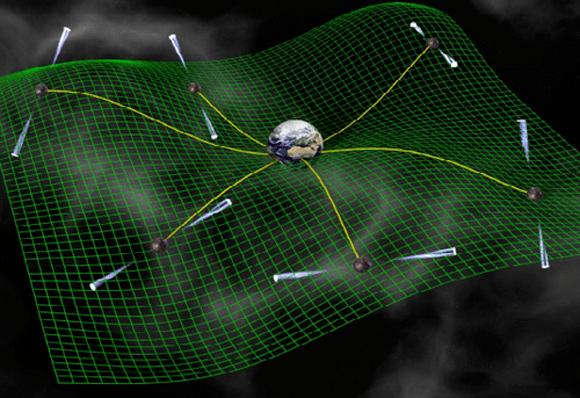
The North American Nanohertz Observatory for Gravitational Waves (NANOGrav) is a proposal that involves closely monitoring the regular flashes of spinning neutron stars (or pulsars) to detect very slight “shimmers” in their signal. Although the physics is crazy-complex, by tracking these shimmers over a suitably distributed number of pulsars could reveal the passage of gravitational waves.
The problem is that you need to closely monitor rapidly-spinning millisecond pulsars, which are (a) tough to find (only 150 have been found over nearly three decades since pulsars were first discovered), and (b) not very plentiful in the part of the night sky of interest to scientists (northern hemisphere). They tend to clump together in globular star clusters, which makes them useless for detecting gravitational waves.
However, according to results announced by the National Radio Astronomy Observatory (NRAO) at this week’s American Astronomical Society (AAS) meeting in Washington D.C., they’ve discovered 17 new pulsars with the help of NASA’s Fermi Gamma-Ray Space Telescope.
In addition to recent Fermi telescope pulsar discoveries, it would appear that the number of potential targets for NANOGrav are increasing, making a stronger case for the 10 year, $65 million project…
The strange objects orbiting the two stars could be mangled white dwarfs... but the jury is still out (NASA)
The first results from NASA’s Kepler exoplanet hunter are in and a perplexing early result has been announced. Yes, the space telescope is working fine, and no, it hasn’t spotted an alien homeworld (yet), but the Kepler team have uncovered something pretty cool.
Kepler may have discovered a new class of celestial object (possibly).
But before we start scratching our heads in confusion or popping the champagne corks in celebration, let’s try to work out what Kepler has observed.
Kepler is currently monitoring 100,000 stars in an effort to seek out extra-solar planets (or “exoplanets”) orbiting these stars. Although Kepler was only launched in March 2009 and early doubts about the observatory’s capabilities caused some low-level concern, Kepler appears to be functioning well and mission controllers are already reporting early results.
In sifting through the Kepler data taken so far, postdoctoral student Jason Rowe found a very curious light signature. When an object passed behind its central star, the light from the system dropped significantly. This means the object — called KOI 74b — must be glowing fiercely with its own light that was blocked out when the object was eclipsed.
Hold up, the light dimmed when the exoplanet passed behind its parent star? Something’s not right here. Kepler detects exoplanets when the worlds pass in front of their parent stars, thereby dimming the starlight, not vice versa!
Actually, this is exactly what’s happened. The “exoplanets” orbiting two otherwise ordinary stars appear to be brighter — and hotter — than their host stars. It’s as if the roles of the stars and the exoplanets have been reversed; the stars are dimming the exoplanetary light as the exoplanet passes behind the star.
Needless to say, there is currently no stellar model that predicts this kind of behavior from extra-solar planetary systems.
This means the object — called KOI 74b — must be glowing fiercely with its own light that was blocked out when the object was eclipsed […] It is seething at 70,000 degrees Fahrenheit while the parent star is 17,000 degrees Fahrenheit. The strange object can’t be a star because the transit data show that it is no bigger than Jupiter. —Ray Villard, Discovery News.
One theory is that KOI 74b (and the other strange object, KOI 81b) could be a white dwarf star that migrated close to its stellar partner. Through binary interactions, the white dwarf was stripped of some of its mass, causing it to puff up and appear like a gas giant exoplanet. That would certainly go to some way of explaining why these two “exoplanets” are so hot.
Of course, the other option is that Kepler has made a groundbreaking discovery and identified a whole new class of celestial object… but I suspect there are other, more mundane reasons for these observations.
I suppose we’ll just have to wait and see until followup observations are made…
If you know me, you’ll probably know that my passion for communicating space exploration is matched by one thing and one thing only: trance music. Interestingly the crossovers between space and music are many and trance is often the choice backing music of many space-based videos.
So here’s one of my favorite trace groups who were asked by Virgin Galactic to perform their kick-ass tune “Buzz” at the official unveiling of SpaceShipTwo in the Mojave Desert last month. I actually saw Above & Beyond live at Global Gathering in 2006, and I can confirm that they are as awesome as they sound.
When Virgin Galactic were looking for some atmospheric music to herald the launch of their ground-breaking ‘SpaceShipTwo,’ they turned to Above & Beyond. At an event hosted by Richard Branson in the Mojave Desert, the track chosen to accompany the official unveiling of SpaceShipTwo was Above & Beyond’s club anthem ‘Buzz’, which was inspired by the Apollo 11 moon-landing. After the unveiling of the world’s first space tourism spacecraft, Above & Beyond performed an exclusive DJ set in front of an audience of 800 dignitaries, celebrities and soon-to-be astronauts, plus the assembled global media.
Apophis is a 300 meter wide asteroid that caused a stir back in 2004. When NASA discovered the near-Earth asteroid (or NEO), it appeared to be tumbling in our direction Armageddon-style and the initial odds for a 2029 impact were 1-in-37. Understandably, people got scared, the media went nuts and astrophysicists were suddenly very interested in space rock deflection techniques.
It’s important to note that NASA didn’t just pull these numbers out of a hat; the space agency has been tracking Apophis intently since its discovery, plotted its position and projected its location to a very high degree of precision. The more we watch Apophis, the more the world’s scientists are convinced that the asteroid poses a very tiny risk to life on Earth. In fact, giving anything a 1-in-250,000 chance of happening is more of a courtesy than a ‘risk.’ Granted, we’re talking about a global catastrophe should Apophis hit, but would you ever bet on those kinds of odds?
Apparently, the Russian space agency thinks it’s more of a game of Russian Roulette than NASA thinks.
“I don’t remember exactly, but it seems to me it could hit the Earth by 2032,” said Anatoly Perminov, the head of Roscosmos, on December 30, 2009. “People’s lives are at stake. We should pay several hundred million dollars and build a system that would allow to prevent a collision, rather than sit and wait for it to happen and kill hundreds of thousands of people.”
Wait a minute. Does Perminov know something NASA doesn’t? Is he even referring to Apophis? You know, the same asteroid NASA has calculated that has a cat in hell’s chance of causing bother in 2036? And what’s this about the year 2032?
Just for the record, Perminov is indeed referring to Apophis, but he got the date wrong (Apophis does not make a flyby in 2032). Perminov also puts a price on saving hundreds of thousands of people… “several hundred million dollars” should do it, apparently.
On the one hand I’m impressed that Roscosmos is calling for some kind of anti-asteroid shield, but on the other, Perminov’s concern is terribly misplaced (and potentially damaging). His statement sounds as if he’s only just heard about Apophis and then thrown into a press conference unprepared, then asked what he’s going to do about this impending doom. Naturally, in that situation he would have blurted out the first thing that popped into his head: We need to save the world! However, this isn’t the first time he’d heard about Apophis.
Boris Shustov, the director of the Institute of Astronomy under the Russian Academy of Sciences, tried to repair the damage pointing out that Perminov was just using Apophis as a “symbolic example, there are many other dangerous objects we know little about.”
However, saving the world from a theoretical “dangerous object” that may or may not hit us for the next few hundred/thousand/million years is less likely to get funding that an imminent 2032… sorry, 2036 impact.
Although Perminov might sound reasonable in asking for asteroid deflection funding, using sensationalist means to try to leverage funding only serves to make the same funding hard to come by.
In the AGU 2009 meeting in San Fransisco last month, ex-Apollo astronaut Rusty Schweickart outlined his organization’s plans to deflect an asteroid should it pose a threat to Earth. The B612 Foundation points out that there is a ~2% chance of Earth being involved with an “unacceptable” collision in the next century (not by Apophis, but by another undiscovered asteroid), but Schweickart and his colleagues want to emphasize urgency, not panic.
An infrastructure needs to be put in place to deal with asteroid deflection, but this goal will only be hindered by unwarranted alarm by the likes of Perminov. Asteroid detection and deflection will be two critical skills mankind will need to develop for the long-term survival of life on Earth, but the head of Roscosmos is running the risk of making the issue sound more like a crazed rant than anything of substance.
Besides, when Perminov says, “Everything will be done according to the laws of physics,” perhaps he shouldn’t be in charge of messing around with the orbits of NEOs after all…
A space station in the movie '2001: A Space Odyssey.' It's hard to believe that by 2015 we might not have any manned outpost in orbit (sci-fi writers never saw that coming).
I was only half joking when I tweeted, “Vote for your favorite NASA accomplishment in 2009: http://bit.ly/83xWlJ [x] Still existing.” I was referring to a vote that is being held over on iTWire, where they’ve listed an array of NASA endeavors and then asked their readers to pick their favorite mission/discovery.
To be honest, I wouldn’t have a clue about how to choose between a Mercury flyby, precision-bombing of the Moon or detection Martian methane; all endeavors have enormous merit and each have vastly improved our knowledge of the Universe. Each is as profound as the other. But it’s not the vote of a 3 page list of NASA achievements that I found myself most uneasy with, it’s the fact that none of these achievements can make the future of the world’s premier space agency any more secure, especially when we are talking about orbiting U.S. astronauts.
There’s a strange dichotomy of opinion: NASA is globally renowned and respected for carrying out outstanding science, and yet it is constantly lambasted (often unfairly) for its spaceflight ineptitude.
Shuttle Out. Space Station Out?
The catalyst to NASA’s human spaceflight problems is of course the retirement of the shuttle next year. We’ve seen it coming for a long time and yet the “5-year gap” hasn’t budged, in fact, it’s become a lot bigger. This gap is the number of years between the shuttle being retired and the proposed completion of NASA’s next launch system, Constellation. To fill this gap, the U.S. must use the Russian Soyuz vehicle at a premium rate. One can only imagine the diplomatic fun NASA has in store for the next few years.
And why should NASA maintain its human spaceflight program anyway? You remember the International Space Station (ISS), right? Well, it’s a good idea to have access to the biggest space station ever constructed in Earth-orbit after spending billions to build the thing. Unfortunately, the very foundations of the ISS are looking a little shaky.
Here we are with the world’s most expensive real estate zooming over our heads, and the U.S. Government Accountability Office (GAO) has just told the White House that the U.S. taxpayer is getting a raw deal from International Space Station (ISS) science. This obviously doesn’t sound good for the ISS’ future beyond 2015. (That is, if you can still comprehend that the space station is still slated for decommissioning in five years time.)
Slight-Of-Hand Rocketry
I only have a general idea about what information the GAO has access to, but I know that the ISS is doing continuous science in microgravity to better our understanding about how we operate in space and use instrumentation that have a huge advantage over ground-based techniques. Unfortunately, NASA is a political entity and politicians are eying the space station with more than a little skepticism. As pointed out by Greg Fish over at Weird Things, wasn’t the ISS supposed to the stepping stone to the Moon… or even Mars by now? Not so long ago I remember intense excitement for how the ISS was going to change the world. Shockingly, now I sometimes hear people say: “we have a space station?!”
To make matters worse, the shuttle replacement is underfunded and behind schedule and the shadow of doubt over Constellation is becoming blacker than a moonless night. NASA triumphantly launched the Ares I-X, only for the celebrations to be quenched by critics (including ex-Apollo astronaut Buzz Aldrin calling it “slight-of-hand rocketry“) pointing out that the Ares test launch was a publicity stunt at best. At worst, the space agency was conning the American public into thinking progress was being made.
Whether NASA makes any kind of Constellation progress or continues to perform outstanding science on the ISS, it seems that there is a widening disconnect between NASA science and the perception of what NASA is trying to do. Many argue that NASA is just really bad at communicating science to a public audience, but I would say that the agency is doing more than ever to communicate their stuff. Also, NASA does an awful lot more than just getting astronauts into space — their robotic missions, observatories, space telescopes and research are breaking new ground every day. So why the huge question mark hanging over NASA’s human spaceflight plans?
Myopic Politics
Well, getting man into space is dangerous, it’s expensive and it’s long-term. All of which are not good for the political nature of NASA. In 2004, President Bush made the gargantuan promise that the US would make it back to the Moon by 2020 (and Mars soon after). This sounds great, but there was no money. Bush had made a political decision based on his term in office, he had also made it after the Space Shuttle Columbia tragedy when seven astronauts lost their lives. Back then, NASA needed direction more than ever, especially as the shuttle fleet was grounded.
Although the shuttle missions recommenced and NASA got back to leading space station construction, by 2009 Bush’s “Vision” has become nothing more than a pipe dream. The money that was promised never materialized and it is now up to President Obama to get NASA’s human spaceflight plans back on its feet. But the damage has been done and the U.S. has an ailing economy and lumped with an overpriced Constellation Program. Changes need to be made.
Personally, I don’t see the Constellation Program getting off the starting blocks. But I don’t think this is due to any kind of technical or design issue, it will be purely political. Funds are tight, Constellation is too expensive. Sadly, adding insult to injury, the ISS is also in the firing line.
So now the responsibility for U.S. participation in the ISS falls on the shoulders of the burgeoning private spaceflight sector, which in itself could be a revolution in the making. Wouldn’t it be great if there was a real commercial answer to the human spaceflight problem? Using companies like SpaceX to ferry astronauts to-and-from the ISS makes a lot more sense than NASA doing the same job for way more money.
But again, I have that nagging feeling about a genuine disconnect between the public and the importance of spaceflight. Not only can human spaceflight advance human experience, it can boost our economy, education and technology. Last time I looked, those were very political sectors, it’s just unfortunate that politicians and many voters will never understand the correlation.
There I was idly checking out SpaceWeather.com, seeing whether there was any sunspot activity going on… and then I saw this. At first, I assumed it was a highly symmetrical sunspot, but no! It was something far more sinister, but I didn’t recognize the hallmark signature. Neal Wiser saw it instantly and informed me via Twitter. A Borg Cube!
Of course it isn’t a Borg Cube (it’s just missing data), but this little Twitter joviality reminded me of the 2012/Planet X doomsday conspiracy theorists who seem to have the uncanny ability to read anything into, well, anything. Take the observations made by the Solar and Heliospheric Observatory (SOHO) which have been used over and over again as “proof” that UFOs and other scary things are orbiting the Sun, preparing for Armageddon… or the next Star Trek movie.
This week has been a horrid few days for UK physics. The Science and Technology Facilities Council (STFC) announced on Wednesday that it was going to plug a hole in their funding deficit by withdrawing the UK’s participation in a number of astronomy, nuclear and particle physics projects.
This measure will have a huge impact on the number of PhD and postdoc positions that will be available for students pursuing research training. In fact, a whopping 25% of fellowships and student grants for PhD projects will be eliminated next year.
On reading some of the reports, anyone would think the UK’s institutions are pissing their funds away Enron-style. How many billions of pounds is the STFC hoping to hide from these money-hungry physicists? After all, tea breaks and lasers don’t come cheap.
£115 million.
WTF?
Perhaps I’m just a little numb of hearing national debt topping “hundreds of billions” and “trillions,” but doesn’t £115 million sound petty by today’s standards? In a world where banks have vaporized zillions of pounds/dollars/euros and world governments are baling them back out again, just over one hundred million pounds doesn’t strike me as a huge number by a nation’s standards.
It’s okay, let’s pass the mic over to Prime Minister Gordon Brown for an explanation, surely he has a clue why baling out banks is better than baling out a research funding body? Actually, I think he’s got his work cut out in Copenhagen at the moment, but he seemed pretty upbeat about science in Feb. 2009 when he made the grand statement, “The [economic] downturn is no time to slow down our investment in science but to build more vigorously for the future.”
This statement came after a fairly ratty time during 2008 when I had a rant (across a series of articles) about the UK government’s stupidity when handling astronomy funding. The STFC — a then-recently appointed funding body that was formed after the merging of PPARC and CCLRC — had announced to the world that the UK was going to back out of its commitment as joint funding nation for the Gemini observatories in Hawaii and Chile.
Astronomer outrage and ceremonial Union Jack Flag-burning ensued.
In an effort to plug an £80 million hole in the STFC’s budget, the funding body appeared to slam the door shut on Gemini. But that was the straw that broke the camel’s back and after huge protests by astronomers, the UK’s involvement in Gemini was reinstated. Good times.
SOHO, a collaboration between ESA and NASA, was to study the structure of the sun and its solar wind. The loss of Venus Express again puts Britain on the back foot when it comes to the exploration of other planets. Withdrawing from ALICE at CERN means that Britain will lose influence at the site of the largest experiments ever conducted and the Boulby underground laboratory is one of the leading centres of research on dark matter.
SOHO? Cassini? Venus Express? ALICE? It’s beginning to sound like a Who’s Who of projects you would never withdraw from. This shouldn’t be a budget cut hit list. Granted, all the projects, no matter how big or small, will be an irreplaceable loss for all scientists involved.
The Institute of Physics President Prof. Dame Jocelyn Bell Burnell echoed some of my points in a recent statement, but also highlighted a fundamental flaw in this STFC strategy (emphasis added):
The greatest shame about today’s announcement is the reduced investment in people. With all of the challenges we face, from climate change and energy security to a rapidly ageing population, we urgently need individuals well-trained in physics. Today’s announcement, which includes a 25 per cent reduction in studentships and fellowships, runs counter to this need.
The amount needed to avoid this unfortunate cut is minor in comparison to the huge sums of money spent saving the financial sector, surely money can be found to avoid it.
Money to one side, this is the thing that worries me the most: If the STFC cuts back on the research opportunities available to postgrads and postdocs, the UK’s future in a huge swathe of physics disciplines could be crippled. If you start weakening the UK’s ability to lead, or at least be involved with, international physics projects, you ultimately damage the nation’s competitive edge. This impacts employment, innovation, industry, education and the economy.
Although it is fairly easy to paint the STFC with an incompetence gloss, it is really the UK government that’s screwing up. I’d find it insane if any government didn’t step in to fill a science funding deficit of this size (yes, the money could be found), but for the UK — a world leader in science and technology innovation — to stand by, citing the current economic climate as a reason for not investing in the future, is idiotic.
Unfortunately, politics is short-sighted and politicians have a shelf-life of a few years, it’s too easy to let the next administration sweep up the mess.
The president chose the new direction for the U.S. human space flight program Wednesday at a White House meeting with NASA Administrator Charles Bolden, according to officials familiar with the discussion. NASA would receive an additional $1 billion in 2011 both to get the new launcher on track and to bolster the agency’s fleet of robotic Earth-monitoring spacecraft.
In a nutshell, NASA would get an additional $1 billion in funding and start work on a new (yet undetermined) heavy-lift launch system. Good news for NASA, but not-so-good news for the Ares I (and possibly Ares V, although the larger rocket wasn’t mentioned). Also, this magical silver bullet of a “new” launch vehicle would be ready for blast-off in 2018.
NASA and White House officials claim such reports are mere speculation, but they are providing no information on when a decision could be announced. The administration will file its fiscal year 2011 budget request in February.
Still mulling over the findings from the Augustine Commission report, Obama and Bolden have yet to arrive at an agreement as to how to progress with NASA’s human spaceflight plans. It’s now very clear that ex-President Bush’s bold “Vision for Space Exploration” was lacking a little thing called money, and the commission’s findings indicated that NASA needs an extra $3 billion in funding to keep the agency’s human spaceflight plans alive.
Although these anonymous sources are no doubt credible, it’s wise to wait until the final word from the White House is known before saying “bye-bye” to Ares.
The mysterious cloud spiral that appeared over Norway at 7.50am on Wednesday morning took the internet by storm.Every major news outlet was talking about it and Google Search was stuffed full of results.
Like with any unexplained phenomenon, the knee-jerk reaction of conspiracy theorists (and tabloid press, naturally) was that the beautiful blue-white glowing spiral was either of UFO origin (no, not of the “unidentified kind”, but of the “probing-alien kind”), top secret “energy weapon” origin, LHC origin (yes, the Large Hadron Collider black holes are back) or some other supernatural origin. Well, it would appear that only one of those options are partially correct.
Although it might be tempting to rush to the extraterrestrial reasons for the spiral, it would appear the missile scenario is the most plausible answer.
But… there’s a chance that it could have been a wormhole opening up from another universe, allowing the Annunaki to return to Earth ahead of their Planet X invasion force in 2012, but I’ll leave that theory for the doomsday wingnuts to mull over.
Having seen some footage of the South African fireball last weekend, I thought it was quite impressive. However, a new video looking along a Johannesburg motorway has appeared online, and it’s superb.
I can’t find much information about this event, but it happened on November 21st and no fragments have been found so far.
Just in case you were in any doubt as to how much energy is released when a chunk of rock hits our atmosphere, this should give you a good impression:
I could almost feel the heat and hear the *KABLAAAM*.



 astroengine.com
