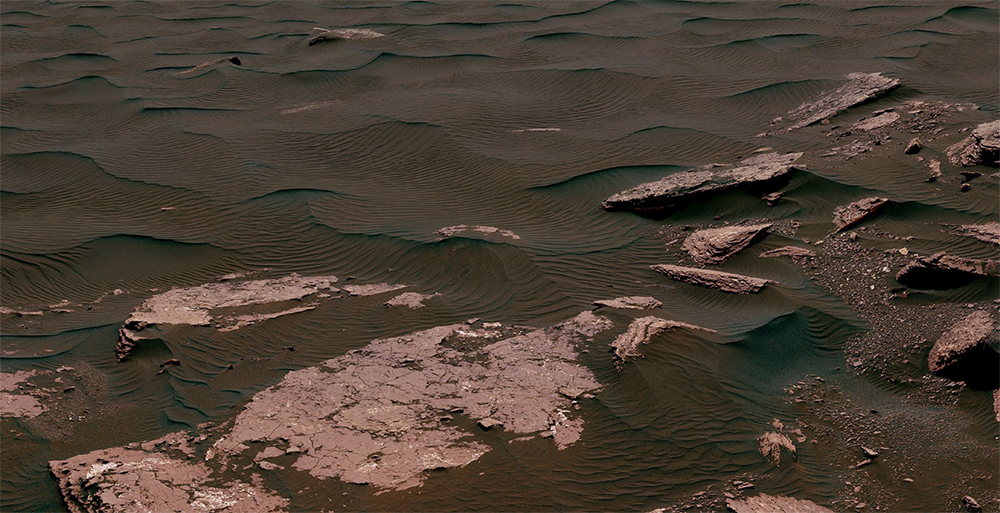
There are few sights on Mars more satisfying than its oddly familiar — yet weirdly alien — dunes.
On the one hand, the Martian dunes look much like the dunes we have on Earth — aeolian (“wind-driven”) formations undulating across the landscape have similarities regardless of which planet they were blown on.
But there’s something uncanny about Martian dunes. Maybe it’s the “extra” tiny ripples that NASA’s Curiosity itself discovered — a phenomenon that is exclusive to the Martian atmosphere. Or maybe it’s just that I know these dunes are being seen through synthetic eyes on a world millions of miles across the interplanetary void.
Who knows.
But right now, the six-wheeled robot is sampling grains of wind-blown regolith from a linear dunes on the slopes of Mount Sharp to help planetary scientists on Earth build a picture of how this ancient landscape was shaped.
Curiosity scooped samples of linear dune material into the rover’s Sample Analysis at Mars (SAM) so they could be compared with material from other dunes it had visited in 2015 and 2016. Samples are also planned to be delivered to the mission’s Chemistry and Mineralogy (CheMin) instrument. As NASA points out, this is the first ever study of extraterrestrial dunes. (Dune fields also exist on Saturn’s moon Titan, but as recent research indicates, those are very different beasts and haven’t been directly sampled.)
“At these linear dunes, the wind regime is more complicated than at the crescent dunes we studied earlier,” said Mathieu Lapotre, of the California Institute of Technology (Caltech), in Pasadena, Calif., who led the Curiosity dune campaign. “There seems to be more contribution from the wind coming down the slope of the mountain here compared with the crescent dunes farther north.”
All of the dunes Curiosity has sampled are a part of the Bagnold Dunes, a dune field that stretches up the northwestern flank of Mount Sharp. Within the field, depending on the wind conditions, different types of dunes have been found.
“There was another key difference between the first and second phases of our dune campaign, besides the shape of the dunes,” said Lapotre in a NASA statement. “We were at the crescent dunes during the low-wind season of the Martian year and at the linear dunes during the high-wind season. We got to see a lot more movement of grains and ripples at the linear dunes.”
It’s official, there’s a whole lot of nothing in Saturn’s innermost ring gap.
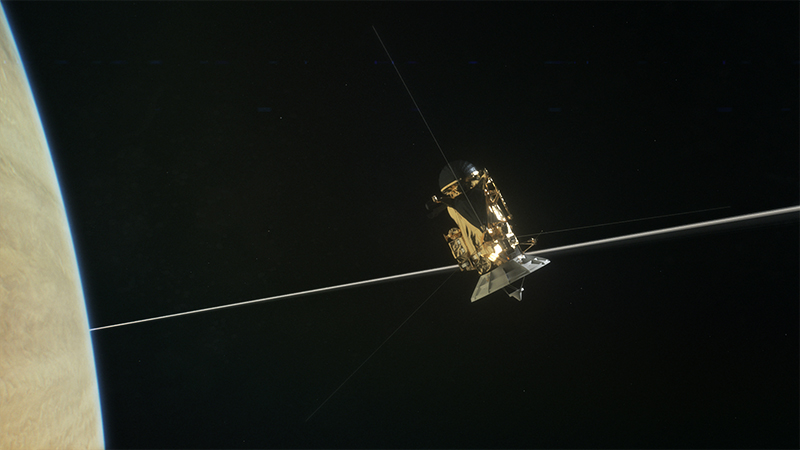
This blunt — and slightly mysterious — conclusion was reached when scientists studied Cassini data after the spacecraft’s first dive through the gas giant’s ring plane. At first blush, this might not sound so surprising; the 1,200-mile-wide gap between Saturn’s upper atmosphere and the innermost edge of its rings does appear like an empty place. But as the NASA spacecraft barreled through the gap on April 26, mission scientists expected Cassini to hit a few stray particles on its way through.
Instead, it hit nothing. Or, at least, far fewer particles than they predicted.
“The region between the rings and Saturn is ‘the big empty,’ apparently,” said Earl Maize, Cassini’s project manager at NASA’s Jet Propulsion Laboratory in Pasadena, Calif. “Cassini will stay the course, while the scientists work on the mystery of why the dust level is much lower than expected.”
Using Cassini’s Radio and Plasma Wave Science (RPWS), the scientists expected to detect multiple “cracks and pops” as the spacecraft shot through the gap. Instead, it picked up mainly signals from energetic charged particles buzzing in the planet’s magnetic field. When converted into an audio file, these signals make a whistling noise and this background whistle was expected to be drowned out by the ruckus of dust particles bouncing off the spacecraft’s body. But, as the following audio recording proves, very few pops and cracks of colliding debris were detected — it sounds more like an off-signal radio tuner:
Compare that with the commotion Cassini heard as it passed through the ring plane outside of Saturn’s rings on Dec. 18, 2016:
Now that is what it sounds like to get smacked by a blizzard of tiny particles at high speed.
“It was a bit disorienting — we weren’t hearing what we expected to hear,” said William Kurth, RPWS team lead at the University of Iowa, Iowa City. “I’ve listened to our data from the first dive several times and I can probably count on my hands the number of dust particle impacts I hear.”
From this first ring gap dive, NASA says Cassini likely only hit a handful of minute, 1 micron particles — particles no larger than those found in smoke. And that’s a bit weird.
As weird as it may be, the fact that the region of Cassini’s first ring dive is emptier than expected now allows mission scientists to carry out optimized science operations with the spacecraft’s instruments. On the first pass, Cassini’s dish-shaped high-gain antenna was used as a shield to protect the spacecraft as it made the dive. On its next ring dive, which is scheduled for Tuesday at 12:38 p.m. PT (3:38 p.m. ET), this precaution is evidently not needed and the spacecraft will be oriented to better view the rings as it flies through.
So there we have it, the first mysterious result of Cassini’s awesome Grand Finale! 21 ring dives to go…
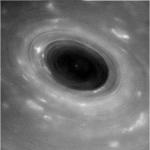
UPDATE (1:30 a.m. PT): A firehose of Cassini data has opened up and raw images of the spacecraft’s approach to the ring plane are coming in at a rapid pace. You can see the raw images appear online at the same time Cassini’s science team sees them here. At time of writing (and without any scientific analysis) the images have been of Saturn’s polar vortex and various views of the planet’s upper atmosphere. It’s going to take some time for more detailed views to become available, but, wow, it’s exhilarating to see Cassini images arrive at such a rate. Here are a few:
Original: As NASA planned, just before midnight on Wednesday (April 26), the veteran Cassini spacecraft made radio contact with the Goldstone 70-meter antenna in California, part of the Deep Space Network (DSN), which communicates with missions in space. Within minutes, Goldstone was receiving data, meaning the spacecraft had not only survived its first ring dive of the “Grand Finale” phase of its mission, but that it was also transmitting science data from a region of space that we’ve never explored before.
“We did it! Cassini is in contact with Earth and sending back data after a successful dive through the gap between Saturn and its rings,” tweeted the official NASA Cassini account just after the DSN confirmed it was receiving telemetry.
“The gap between Saturn and its rings is no longer unexplored space – and we’re going back 21 times,” they added.
Around 22 hours prior to Cassini’s signal, the spacecraft made its daring transit through the gap between Saturn’s upper atmosphere and innermost ring after using the gravity of Titan on Friday (April 21) to send it on a ballistic trajectory through the ring plane. But during that time the spacecraft went silent, instead devoting resources to carrying out science observations during the dive.
Of course there was much anticipation for Cassini to “phone home” tonight and it did just that right on schedule and now we can look forward to another 21 dives through Saturn’s rings before Cassini burns up in the gas giant’s upper atmosphere on Sept. 15, ending its epic 13 year mission at the solar system’s ringed planet.
“No spacecraft has ever been this close to Saturn before. We could only rely on predictions, based on our experience with Saturn’s other rings, of what we thought this gap between the rings and Saturn would be like,” said Earl Maize, Cassini Project Manager at NASA’s Jet Propulsion Laboratory in Pasadena, Calif., in a statement. “I am delighted to report that Cassini shot through the gap just as we planned and has come out the other side in excellent shape.”
So now we wait until images of this never-before-explored region of Saturn are released.
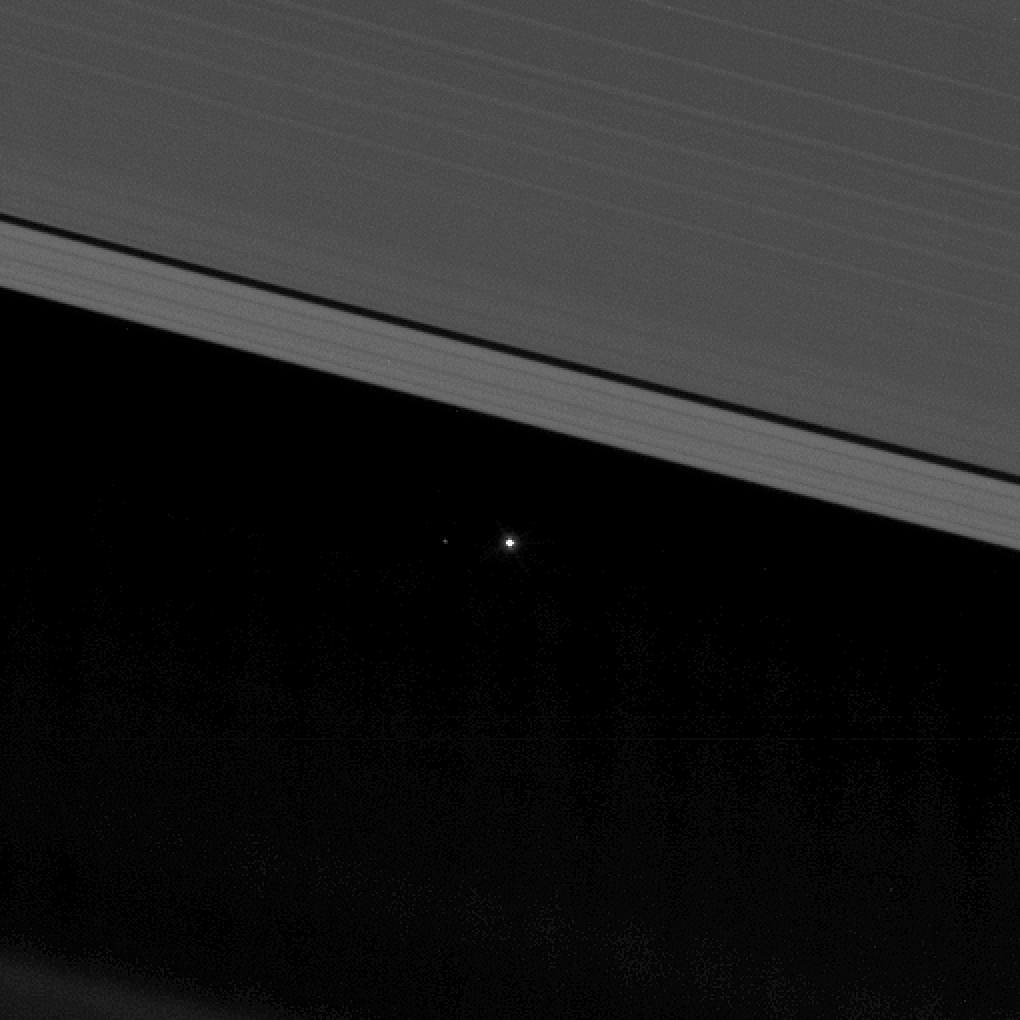
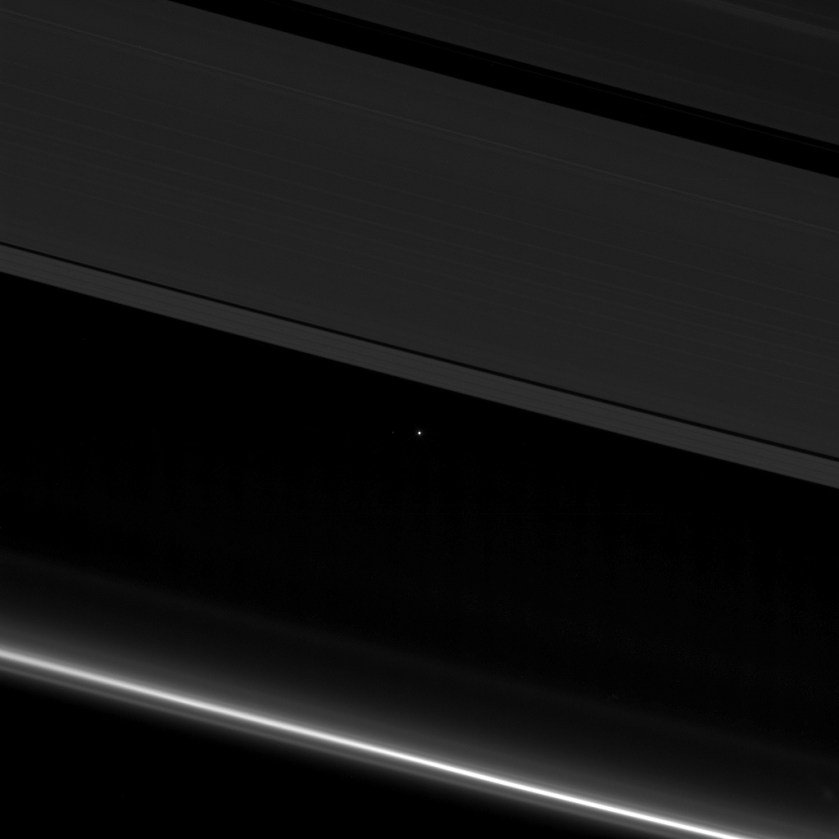
NASA’s Cassini mission sure has a knack for putting stuff into perspective — and this most recent view from Saturn orbit is no different. That dot in the center of the image isn’t a dud pixel in Cassini’s camera CCD. That’s us. All of us. Everyone.
To quote Carl Sagan:
“Look again at that dot. That’s here. That’s home. That’s us. On it everyone you love, everyone you know, everyone you ever heard of, every human being who ever was, lived out their lives…”
Sagan wrote that passage in his book “Pale Blue Dot: A Vision of the Human Future in Space” when reflecting on the famous “Pale Blue Dot” image that was beamed back to Earth by NASA’s Voyager 1 spacecraft in 1990. That’s when the mission returned a profound view of our planet from a distance of 3.7 billion miles (or 40.5AU) as it was traveling through the solar system’s hinterlands, on its way to interstellar space. Since then, there’s been many versions of pale blue dots snapped by the armada of robotic missions around the solar system and Cassini has looked back at us on several occasions from its orbital perch.
Now, just before Cassini begins the final leg of its Saturnian odyssey, it has again spied Earth through a gap between the gas giant’s A ring (top) and F ring (bottom). In a cropped and enhanced version, our moon is even visible! The image is composed of many observations captured on April 12, stitched together as a mosaic when Saturn was 870 million miles (roughly 9.4AU) from Earth.
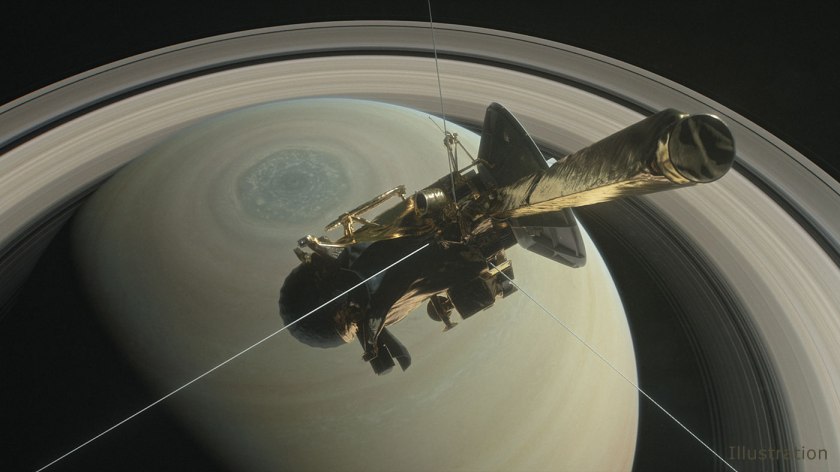
On April 20 (Friday), Cassini will make its final flyby of Titan, Saturn’s largest moon, using its gravity to fling itself through Saturn’s ring plane (on April 26) between the innermost ring and the planet’s cloudy upper atmosphere, revealing a view that we’ve never before seen. For 22 orbits, Cassini will dive into this uncharted region, possibly revealing new things about Saturn’s evolution, what material its rings contain and incredibly intimate views of its atmosphere.
This daring maneuver will signal the beginning of the end for this historic mission, however. On Sept. 15, Cassini will be intentionally steered into Saturn’s atmosphere to burn up as a human-made meteor. It is low in fuel, so NASA wants to avoid the spacecraft from crashing into and contaminating one of Saturn’s potentially life-giving moons — Titan or Enceladus.
So, appreciate every image that is captured by Cassini over the coming weeks. The pictures will be like nothing we’ve seen before of the ringed gas giant, creating a very bittersweet phase of the spacecraft’s profound mission to Saturn.
Artist impression of ESA LISA Pathfinder in interplanetary space (ESA)
Imagine speeding down the highway and plowing into an unfortunate swarm of mosquitoes. Now imagine that you had the ability to precisely measure the mass of each mosquito, the speed at which it was traveling and the direction it was going before it exploded over your windscreen.
Granted, the technology to accomplish that probably isn’t feasible in such an uncontrolled environment. Factors such as vibration from the car’s motor and tires on the road, plus wind and air turbulence will completely drown out any “splat” from a minuscule insect’s body, rendering any signal difficult to decipher from noise.
The European LISA Pathfinder spacecraft is a proof of concept mission that’s currently in space, orbiting a region of gravitational stability between the Earth and the sun — called the L1 point located a million miles away. The spacecraft was launched there in late 2015 to carry out precision tests of instruments that will eventually be used in the space-based gravitational wave detector eLISA. Inside the payload is a miniaturized laser interferometer system that measures the distance between two test masses.
When launched in 2034, eLISA (which stands for Evolved Laser Interferometer Space Antenna) will see three spacecraft, orbiting the sun at the L1 point, firing ultra-precise lasers at one another as part of a space-based gravitational wave detector. Now we actually know gravitational waves exist — after the US-based Laser Interferometer Gravitational-wave Observatory (or LIGO) detected the space-time ripples created after the collisions of black holes — excitement is building that we might, one day, be able to measure other phenomena, such as the ultra-low frequency gravitational waves that were created during the Big Bang.
But the only way we can do this is to send stunningly precise interferometers into space, away from our vibration-filled atmosphere to stand a chance of detecting some of the faintest space-time rumbles in our cosmos that would otherwise be drowned out by a passing delivery truck or windy day. And LISA Pathfinder is currently out there, testing a tiny laser interferometer in a near-perfect gravitational free-fall, making the slightest of slight adjustments with its “ultra-precise micro-propulsion system.”
Although LISA Pathfinder is a test (albeit a history-making test of incredible engineering ingenuity), NASA thinks that it could actually be used as an observatory in its own right; not for hunting gravitational waves, but for detecting comet dust.
Like our mosquito-windscreen analogy, spacecraft get hit by tiny particles all the time, and LISA Pathfinder is no exception. These micrometeoroides come from eons of evaporating comets and colliding asteroids. Although measuring less than the size of a grain of sand, these tiny particles zip around interplanetary space at astonishing speeds — well over 22,000 miles per hour (that’s 22 times faster than a hyper-velocity rifle round) — and can damage spacecraft over time, slowly eroding unprotected hardware.
Therefore, it would be nice if we could create a map of regions in the solar system that contain lots of these particles so we can be better prepared to face the risk. Although models of solar system evolution help and we can estimate the distribution of these particles, they’ve only ever been measured near Earth, so it would be advantageous to find the “ground truth” and measure them directly from another, unexplored region of the solar system.
This is where LISA Pathfinder comes in.
As the spacecraft gets hit by these minuscule particles, although they are tiny, their high speed ensures they pack a measurable punch. As scientists want the test weights inside the spacecraft to be completely shielded from any external force — whether that’s radiation pressure from the sun or marauding micro-space rocks — the spacecraft has been engineered to be an ultra-precise container that carefully adjusts its orientation an exact amount to directly counter these external forces (hence the “ultra-precise micro-propulsion system”).
When LISA Pathfinder is struck by space dust, it compensates with its ultra-precise micro-thrusters (ESA/NASA)
This bit is pretty awesome: Whenever these tiny space particles hit the spacecraft, it compensates for the impact and that compensation is registered as a “blip” in the telemetry being beamed back to Earth. After careful analysis of the various data streams, researchers are learning a surprising amount of information about these micrometeoroides — such as their mass, speed, direction of travel and even their possible origin! — all for the ultimate goal of getting to know the tiny pieces of junk that whiz around space.
“Every time microscopic dust strikes LISA Pathfinder, its thrusters null out the small amount of momentum transferred to the spacecraft,” said Diego Janches, of NASA’s Goddard Space Flight Center in Greenbelt, Md. “We can turn that around and use the thruster firings to learn more about the impacting particles. One team’s noise becomes another team’s data.”
So, it turns out that you can precisely measure a mosquito impact on your car’s windshield — so long as that “mosquito” is a particle of space dust and your “car” is a spacecraft a million miles from Earth.
NASA put together a great video, watch it:
Aside: So it turned out that I inadvertently tested the “car-mosquito” hypothesis when driving home from Las Vegas — though some of these were a lot bigger than mosquitoes…
A little frozen Saturn moon, with a diameter that could easily fit inside the state of New Mexico, holds some big promises for the possibility of finding basic alien life in our solar system.
Enceladus is often overshadowed by its larger distant cousin, Europa, which orbits Jupiter and the Jovian moon’s awesome potential has been widely publicized. But Enceladus has one thing Europa doesn’t — it has been visited very closely by a robotic space probe that could take a sniff of its famous water vapor plumes. And this week, there was much excitement about another facet of the moon’s complex subsurface chemistry, thanks to analysis carried out on data gathered by NASA’s Cassini mission.
But before we get into why this new discovery is so cool, let’s take a very quick look at the other signs of Enceladus’ life-giving potential.
The Cocktail Of Life
Being living, breathing creatures on a habitable planet, it may not come as a surprise to you that for biology to evolve, it needs a few basic ingredients. Liquid water is a definite requirement, of course. Heat also helps. Throw some organic chemistry into the mix and we have a party.
Enceladus, however, is a tiny icy globe, there’s no sign of liquid water on its surface. But when Cassini arrived at Saturn in 2004, Enceladus revealed some of its best-kept secrets. Firstly, it may be a smooth ice ball, but the moon has a large quantity of water under its surface. This water even escapes as geysers, through fissures in its icy crust, producing stunning plumes that eject material hundreds of miles high and into Saturn’s rings.
Before Cassini was launched to Saturn, we had little clue about Enceladus’ watery potential — though this finding explained why Enceladus appeared so bright and how it contributes material to Saturn’s E-ring. Fortunately, the spacecraft has an instrument on board — a mass spectrometer — that could be used to “taste” the watery goodness of these plumes. During its Enceladus flybys, Cassini was able to fly through the plumes, revealing a surprisingly rich chemical cocktail — including a high concentration of organic chemistry.
It’s as if all the building blocks of life have been thrown into a small icy cocoon, shaken up and gently heated from within.
Now, another fascinating discovery has been made. Further analysis of Cassini data from its last 2015 plume fly-through, molecular hydrogen has been detected and planetary scientists are more than a little excited to add this to Enceladus’ habitable repertoire.
Deep In The Enceladus Abyss
“Hydrogen is a source of chemical energy for microbes that live in the Earth’s oceans near hydrothermal vents,” said Hunter Waite, principal investigator of Cassini’s Ion Neutral Mass Spectrometer (INMS) at the Southwest Research Institute (SwRI), in a statement on Thursday (April 13). “Our results indicate the same chemical energy source is present in the ocean of Enceladus.”
This hydrogen could be a byproduct of chemical reactions going on between the moon’s rocky core and the warm water surrounding it. And there’s a lot of hydrogen gas being vented, probably enough to sustain basic lifeforms deep in the Enceladus abyss.
“The amount of molecular hydrogen we detected is high enough to support microbes similar to those that live near hydrothermal vents on Earth,” added co-author Christopher Glein, who specializes in extraterrestrial chemical oceanography, also of SwRI. “If similar organisms are present in Enceladus, they could ‘burn’ the hydrogen to obtain energy for chemosynthesis, which could conceivably serve as a foundation for a larger ecosystem.”
Yes, we’re talking alien microbes. (Also, “extraterrestrial chemical oceanography” — oceans on other worlds! — is one hell of a mind-blowing topic to specialize in, just sayin’.) And did he mention “larger ecosystem”? Why yes! Yes he did.
So, in short, we know Enceladus has a liquid water ocean. We know that it has an internal heat source (hence the liquid oceans). We also know there’s organic chemistry. And now there’s solid hints that there’s water-rock interactions going on that terrestrial microbes living at Earth’s ocean vents like to munch on. If that’s not a huge, blinking neon sign pointing at Enceladus, saying: “We need a surface mission here!” I don’t know what is.
Although the researchers are keen to emphasize that alien microbes have not been found (because Cassini isn’t capable of looking for life), the universe has given us a moon-sized Petri dish where an “ecosystem” may have taken hold. All the ingredients are there, wouldn’t it be cool to find out if Enceladus could be another place in the solar system where life may be hanging out?
For the first time, astronomers have detected an atmosphere around a small (and likely) rocky exoplanet orbiting a star only 39 light-years away. Although atmospheres have been detected on larger alien worlds, this is the smallest world to date that has been found sporting atmospheric gases.
Alas, Gliese (GJ) 1132b isn’t a place we’d necessarily call “habitable”; it orbits its red dwarf a little too close to have an atmosphere anything like Earth’s, so you’d have to be very optimistic if you expect to find life (as we know it) camping there. But this is still a huge discovery that is creating a lot of excitement — especially as this exo-atmosphere has apparently evolved intact so close to a star.
The atmosphere was discovered by an international team of astronomers using the 2.2 meter ESO/MPG telescope at La Silla Observatory in Chile. As the exoplanet orbited in front of the star from our perspective (known as a “transit”), the researchers were able to deduce the physical size of the world by the fraction of starlight it blocked. The exoplanet is around 40 percent bigger than Earth (and 60 percent more massive) making it a so-called “super-Earth.”
Through precision observations of the infrared light coming from the exoplanet during the 1.6 day transits, the astronomers noticed that the planet looked larger at certain wavelengths of light than others. In short, this means that the planet has an atmosphere that blocks certain infrared wavelengths, but allows other wavelengths to pass straight through. Researchers of the University of Cambridge and the Max Planck Institute for Astronomy then used this information to model certain chemical compositions, leading to the conclusion that the atmosphere could be a thick with methane or water vapor.
Judging by the exoplanet’s close proximity to its star, this could mean that the planet is a water world, with an extremely dense and steamy atmosphere. But this is just one of the possibilities.
“The presence of the atmosphere is a reason for cautious optimism,” writes a Max Planck Institute for Astronomy news release. “M dwarfs are the most common types of star, and show high levels of activity; for some set-ups, this activity (in the shape of flares and particle streams) can be expected to blow away nearby planets’ atmospheres. GJ 1132b provides a hopeful counterexample of an atmosphere that has endured for billion of years (that is, long enough for us to detect it). Given the great number of M dwarf stars, such atmospheres could mean that the preconditions for life are quite common in the universe.”
To definitively work out what chemicals are in GJ 1132b’s atmosphere, we may not be waiting that long. New techniques for deriving high-resolution spectra of exoplanetary atmospheres are in the works and this exoplanet will be high on the list of priorities in the hunt for extraterrestrial biosignatures. (For more on this, you can check out a recent article I wrote for HowStuffWorks.)
Although we’ll not be taking a vacation to GJ 1132b any time soon, the discovery of an atmosphere around such a small alien world will boost hopes that similar sized super-Earths will also host atmospheres, despite living close to red dwarf stars that are known for their flaring activity. If atmospheres can persist, particularly on exoplanets orbiting within a star’s so-called habitable zone, then there really should be cause for optimism that there really might be an “Earth 2.0” out there orbiting one of the many red dwarfs in our galaxy.
NASA’s Chandra X-ray Observatory has detected a mysterious explosion in deep space and, although astronomers have some suspected causes for the incredibly powerful event, there’s a possibility that it could be something we’ve never witnessed before.
The signal is the deepest X-ray source ever recorded and it appears to be related to a galaxy located approximately 10.7 billion light-years away (it therefore happened 10.7 billion years ago, when the universe was only three billion years old). Over the course of only a few minutes in October 2014, this event produced a thousand times more energy than all the stars in its galaxy. Before that time, there were no X-rays originating from this location and there’s been nothing since.
The explosion occurred in a region of sky called the Chandra Deep Field-South (CDF-S) — the event was therefore designated “CDF-S XT1” — and archived observations of that part of the sky by the NASA/ESA Hubble Space Telescope and NASA’s Spitzer space telescope revealed that it originated from within a faint, small galaxy.
“Ever since discovering this source, we’ve been struggling to understand its origin,” said Franz Bauer of the Pontifical Catholic University of Chile in Santiago, Chile, in a statement. “It’s like we have a jigsaw puzzle but we don’t have all of the pieces.”
One possibility is that we could be looking at the effects of a huge stellar explosion, known as a gamma-ray burst (GRB). GRBs are caused when a massive star implodes and blasts powerful gamma-rays as intense beams from its poles — think super-sized supernova on acid. They can also be caused by cataclysmic collisions between two neutron stars or a neutron star and black holes. Should one of those beams be directed at Earth, over 10.7 billion light-years of travel, the gamma-ray radiation would have dispersed and arrived here at a lower, X-ray energy, possibly explaining CDF-S XT1.
Alternatively, the signal may have been caused by the rapid destruction of a white dwarf star falling into a black hole. Alas, none of these explanations fully fit the observation and it could, actually, be a new phenomenon.
“We may have observed a completely new type of cataclysmic event,” said Kevin Schawinski, of ETH Zurich in Switzerland. “Whatever it is, a lot more observations are needed to work out what we’re seeing.”
So, in short, watch this space.
The research will be published in the June edition of the journal Monthly Notices of the Royal Astronomical Society and is available online.
An artist’s impression of a planet, comet and debris field surrounding a white dwarf star (NASA/ESA)
As if paying tribute, exoplanets orbiting white dwarfs appear to be throwing their exomoons into hot atmospheres of these stellar husks.
This fascinating conclusion comes from a recent study into white dwarf stars that appear to have atmospheres that are “polluted” with rocky debris.
A white dwarf forms after a sun-like star runs out of hydrogen fuel and starts to burn heavier and heavier elements in its core. When this happens, the star bloats into a red giant, beginning the end of its main sequence life. After the red giant phase, and the star’s outer layers have been violently ripped away by powerful stellar winds, a small bright mass of degenerate matter (the white dwarf) and a wispy planetary nebula are left behind.
But what of the planetary system that used to orbit the star? Well, assuming they weren’t so close to the dying star that they were completely incinerated, any exoplanets remaining in orbit around a white dwarf have an uncertain future. Models predict that dynamical chaos will ensue and gravitational instabilities will be the norm. Exoplanets will shift in their orbits, some might even be flung clear of the star system all together. One thing is for sure, however, the tidal shear created by the compact white dwarf will be extreme, and should anything stray too close, it will be ripped to shreds. Asteroids will be pulverized, comets will fall and even planets will crumble.
Stray too close to a white dwarf and tidal shear will rip you to shreds (NASA/JPL-Caltech)
Now, in a science update based on research published late last year in the journal Monthly Notices of the Royal Astronomical Society, astronomers of the Harvard-Smithsonian Center for Astrophysics (CfA) have completed a series of simulations of white dwarf systems in an attempt to better understand where the “pollution” in these tiny stars’ atmospheres comes from.
To explain the quantities observed, the researchers think that not only is it debris from asteroids and comets, but the gravitational instabilities that throw the system into chaos are booting any moons — so-called exomoons — out of their orbits around exoplanets, causing them to careen into the white dwarfs.
The simulations also suggest that as the moons meander around the inner star system and fall toward the star, their gravities scramble to orbits of more asteroids and comets, boosting the around of material falling into the star’s atmosphere.
So there you have it, planets, should your star turn into a white dwarf (as our sun will in a few billion years), keep your moons close — your new stellar overlord will be asking for a sacrifice in no time.




 astroengine.com