“Shades of Ignorance” by CraftLass (Interview)

In this very special Astroengine.com (and long overdue) post, I had the great fortune to catch up with singer/song writer CraftLass who wrote a very cool song about science, ignorance and the general state of society. I am particularly honored as CraftLass was inspired by my blog (amongst others) when she wrote this wonderfully catchy tune. As you can tell by the link below, she has a huge talent — follow her (yep, she’s one of my favorite tweeps) and hopefully you’ll get the chance to see her perform live. I’m hoping I’ll make it to New York soon so I can do just that.

“Shades of Ignorance” by CraftLass (streaming audio)

“Shades” is just one of many songs CraftLass has written and performed, so be sure to listen to all her work and buy her album, you won’t be disappointed (I’m a big fan).

Q: Mainly, what was your inspiration behind writing the song?

A: There were a few involved in this one, all inspired by reading. The main thrust of the song came from reading your blog as well as a few others like Bad Astronomy and marveling at the comments from people who truly believe in everything that has little to no evidence while refusing to believe what can actually be proven or at least has plenty of evidence that anyone is free to look at.

I think some people are convinced that the job of scientists, no matter the field, is to hide truth when it’s exactly the opposite. This annoys me to no end, especially when it actually hurts people, as in the case of people who hurt innocent children educationally by wanting creationism taught in the science classroom, or physically by refusing to immunize them because other people with a lack of credentials just happen to be effective communicators.

I guess I’d like to try to level the playing field on that one, communicate truths in a format that most people can understand and enjoy, since the other side tends to have “cool” celebrities popularizing their ideas. As much as I hate the sway pop culture has, it’s important to fight fire with fire.

The other big inspiration was the way people in America embraced politicians like George W. Bush and Sarah Palin, I’m very politically aware and very independent (not a Democrat), these two and a few others make me sick because they are poster children of smart people who CHOOSE ignorance, willfully.

Leaders should be elected for having the brains and open-mindedness to make real decisions for themselves based on actual facts and Bush, in particular, was elected for being stubborn to the point of harm for not only this nation but the whole world. Elected for the exact quality that is worst in a leader. I’ve been trying to convey my feelings on that for many years and it just seemed to fit into the theme as I was working on this song. “Stubborn is not the same as strong,” is a line I’m particularly proud of since so many people seem to confuse the two.

Q: How has it been received (particularly when performing at a live venue)?

A: I’m astounded at the reception! It’s consistently one of the first songs that people come up to talk to me about. I’m lucky that I live in a pretty highly educated part of the country (the NYC metro area) and quite a few people have said it’s a message they hadn’t been able to put into words, which is extremely gratifying.

It also makes people dance, and I think that when people dance and start singing along the message sinks deeper, so I’m hoping it might somehow reach further into the public to the very people it’s about, perhaps inspire them to question blind beliefs. At some point I would like to record a full-band version to increase that effect!

The other cool thing has been the number of closet science geeks it’s brought out, people who come up to me and say it’s great to see someone wear her love for the subject proudly, makes them feel like it’s okay to love it, too. If more people were honest with themselves (including me) we would probably have a lot less of the brain drain effect in STEM. (It also doesn’t hurt that I’m a cute and social chick with a guitar, not exactly the old stereotype of science geek. LOL.)

Q: What are your thoughts on science communication in general (i.e. is it handled well by the media)?

A: Well, there are so many levels of media right now, we’re pretty lucky. Mass media has been pretty terrible at science communication for most of my life, at least, they tend to prefer stories of failure than anything that goes right, so many areas of science end up looking rather useless (this is particularly true when it comes to NASA and CERN for some reason) and you’ll never hear about the coolest things in traditional media other than the NY Times science section (which has now been gutted, anyway).

On the other hand, the fact that Discovery now has many channels and even created the Science Channel to air more science shows and competitors keeps springing up proves that people have been hungry to learn more than what the networks are willing to give them. These companies are filling the void pretty nicely with good introductions to many areas.

I get most of my science news from the internet, though, as it is the only place to find up-to-the-minute news and deeper information. The problem there is you really have to wade through a lot of garbage to find the good nuggets and read a lot of too-dry-for-non-scientists pieces to find ones that can engage and help someone self-educated like I am. There are quite a few modern-day Carl Sagans out there, though, who can communicate science beautifully, and it’s a very good thing they can publish whether or not they have backing from a major organization. The next thing we need is more clearly defined resources to match the audience with the scientist or writer.

Q: Are you a regular reader of science blogs?

A: Yes, well, when I have the time. Ironically, singing and writing about science has been tearing me away more than I’d like! I try to read at least a few articles every day over coffee, and every so often I’ll just devour everything I’ve missed on a site. I also research what I’m writing, so I’ll search the blogosphere for interesting facts and tidbits on whatever subject I’m working on (right now my obsession is Spirit as I have a song about her half-done, so I’m reading every post I can find).

A couple of lines for “Bake Sale for NASA” were inspired directly by a post by Wayne Hale (one of my favorite blog writers) about NASA satellites saving the American wheat crop, a story I had never known and found absolutely brilliant. My most consistent blogs include NASA blogs, Discovery News, Bad Astronomy, World of Weird Things, Noisy Astronomer, the Skylogs at Astronomy.FM, and, of course, Astroengine.

Q: What surprises you most about some of the comments you read on science blogs?

A: The way that so many people apparently seek out these blogs simply to rant against them. I like to read opposing viewpoints but I don’t understand the amount of time and energy people put into pure hatred. If you are so annoyed by what you are reading why don’t you read other websites? There are millions!

I’m also stunned that people can read the same things I read and just dismiss them. Learning is a lifelong experience and discoveries are constantly made that change what we know, why be so stubborn in clinging to old information and ways of thinking? Living in a time where there is so much exploration and so many ways to disseminate what is learned means we need to stop believing in belief itself and open up our minds to endless possibilities. That should be a cause for celebration rather than anger, and far too many people are in the latter category.

Compex Magnetic Eruption Witnessed by Solar Observatories

sunnow
Solar Dynamics Observatory view of the solar disk shortly after eruption (NASA).

This morning, at 08:55 UT, NASA’s Solar Dynamics Observatory (SDO) detected a C3-class flare erupt inside a sunspot cluster. 100,000 kilometers away, deep within the solar atmosphere (the corona), an extended magnetic field filled with cool plasma forming a dark ribbon across the face of the sun (a feature known as a “filament”) erupted at the exact same time.

It seems very likely that both events were connected after a powerful shock wave produced by the flare destabilized the filament, causing the eruption.

A second solar observatory, the Solar and Heliospheric Observatory (SOHO), then spotted a huge coronal mass ejection (CME) blast into space, straight in the direction of Earth. Solar physicists have calculated that this magnetic bubble filled with energetic particles should hit Earth on August 3, so look out for some intense aurorae, a solar storm is on its way…

For more on this impressive solar eruption, read my Discovery News article, “Incoming! The Sun Unleashes CME at Earth

Military “Black Ops” on Mars. Really?

The Aram Chaos region of Mars, as seen by the HiRISE camera on board NASA's Mars Reconnaissance Orbiter (NASA)

There’s a military operation on Mars!

How do we know this? Psychics — or “military grade remote viewers” as they like to be called — “saw” it, and their vision corroborated a Mars satellite photo that shows “man-made domes,” “pipelines” and a “huge nozzle shooting liquid spray.”

That’s according to the guy that runs the Farsight Institute anyway.

Before we get bogged down with the details, let’s get one thing straight: remote viewing is not a scientific tool and has never been proven to work. It is pseudoscience. Sure, the U.S. military became interested in investigating remote viewing as a spying weapon (unsurprisingly, the superpowers were pretty keen on investigating every avenue to spy on the enemy during the Cold War), but funding was withdrawn in the 90’s as it was proven remote sensing was ineffective and any positive results could not be replicated.

Most recently, the U.K.’s Ministry of Defence carried out a suite of experiments on a group of remote viewers to see how their brains reacted during the viewing phase. There appeared to be no measurable change in brain activity, and besides, none of the psychics tested could access the desired targets anyway, rendering the whole thing pointless.

But these facts don’t seem to dissuade Dr. Courtney Brown from trying to justify a scientific basis for his “Evidence for Artificiality on Mars” presentation. Not surprisingly, one of the Examiner’s “Exopolitics” writers is very exited about this non-research, saying, “An apparent active industrial site on the surface of Mars with a “large nozzle shooting a liquid spray” onto an apparent industrial waste area has been successfully located and explored in a remote viewing study conducted by the Farsight Institute in March 2010 using nine highly trained remote viewers and methodologies developed by the U.S. military.”

Here’s the region of Mars we’re talking about, helpfully labeled to show the targets for the remote viewers. These targets are obviously highly suspicious, they look nothing like the rest of the Aram Chaos region of Mars (*squints*):

Take a look at the original Mars Global Surveyor images of the site. It might take a couple of minutes to find the area of interest, which isn’t surprising as it looks like the rest of Mars.

But no, there is something of vast interest in this particular photo. It’s an industrial complex! On Mars! Not inhabited by those pesky aliens we’ve seen hanging out on the Martian surface, but by humans!

Now the remote viewers have their targets, the Farsight Institute carried out some kind of experiment and Dr. Brown — a guy with a book to sell (where have we seen that before?) — discusses the astonishing results. In case you think I’ve eaten a funny-looking mushroom or been lobotomized by a trained hamster, this “evidence” for remote viewing is listed on the Farsight Institute’s webpages. I’m not making this up.

In the Mars orbiter photo (above), a spraying fountain of some “liquid” (target 1a) can be seen. In fact, this is the whole reason why Brown has taken an interest in this region. “We wouldn’t be interested in these domes if it wasn’t for the spray,” he said, “but the spray really caught our attention.” This spray is being ejected by a mountain-shaped dome (target 1b) via a horizontal “pipe.” There is a shadow under the spray indicating it is being ejected at some height. There is also another “highly reflective” dome below the other dome (target 1c). “It looks like it’s made out of some kind of resin material,” Brown remarks.

So, using their psychic powers, the military-grade remote viewers managed to access some fascinating details about the site — they even drew some vague scribbles of their visions.

These are my favorite conclusions from this fascinating experiment:

The artificial structures on Mars were originally built by ancient builders and the current occupants do not understand its technology. They need spare parts, but don’t have any. The mystery technology in operation generates power and there are intense flashing lights at the site. The occupants on site — of which there are more men than women — are despondent (because there are more men than women? Because no one knows they’re there? There’s no good coffee in the canteen? Just guessing). The occupants, assumed to be human, are in a lot of hardship and they aren’t allowed to return home.

Apart from sounding like a sweat house scene ripped straight from an 18th Century Jane Austin novel, the very idea the U.S. military has some kind of black operation on the Red Planet is hilarious. But to single out one tiny region of the planet by pure chance (because Brown thinks he sees a pipe gushing water over the landscape) and creating a fantasy world using zero logical thought is amazing to me.

The “gushing fluid” feature could be any one of a huge number of geological features. To me, it looks like a landslide; lighter material that has been dislodged, causing rubble to tumble down the slope. It could even be ice mixed in with regolith after an avalanche, ice crystals falling from the top of the mesa (a hill; not what Brown describes as anything man-made) scattering over the darker colored material further down the slope.

The shadow Brown points to is not caused by this “spraying liquid” feature, it’s simply darker-colored material in the Martian soil. There goes that theory. As for the other suggestions of man-made structures… well, that’s just Brown’s vivid imagination. I’m finding it hard to see any man-made domes. They’re just hills.

This crazy theory could be picked at for hours, but I’m still in amazement that people like Brown can discuss a subject like this with such conviction. There is overwhelming evidence that easily debunks the idea that there is an industrial complex on Aram Chaos. Unfortunately, for people peddling their pseudo-scientific ideas, common sense and logical thought seem to be concepts they have trouble grasping.

via Universe Today and SciGuy

Strasbourg July Lightning

A bolt of lightning strikes over Strasbourg, France (Ian O'Neill)

As you may have noticed, things have been rather quiet on Astroengine of late. This is partly due to my pan-European trek and my work on Discovery News, but mainly due to my horrid affliction of procrastination. Hence why I’m late in posting this pretty awesome picture of a lightning bolt blasting across the French skies.

What was I doing in France? Well, I was asked to do a lecture all about asteroid mining and space commercialization at this year’s Space Studies Program 2010 (SSP10) at the International Space University (ISU) in Strasbourg earlier this month.

It was an incredible experience and I got to meet some incredible people. Hoping to get a blog post up about the whole thing some time over the coming days, but for now, I’ll leave you with this picture of the storm that hit Strasbourg while I was there. For the full set, check out my Posterous gallery.

Hayabusa Re-Entry Video: Spacecraft Destruction at its Best

There’s not a lot to add to this video, it’s too awesome.

It was captured by NASA’s converted DC-8 jet that was flying over Australia when the Japanese Hayabusa spacecraft broke up during re-entry. I’ll let the video do the rest of the talking:

Oh yes, and that little dot ahead of the falling debris? That’s the sample return capsule before it was found int he Outback safely. Thank goodness its parachute worked (presumably).

For more spacecraft demolition awesomeness, read “NASA Aircraft Videos Hayabusa Re-Entry

Awesome.

The Moon, Space Shuttle Atlantis, an aurora plus Kibo, all in one breathtaking scene (Soichi Noguchi)

The instant I saw this photograph I realized I was seeing something so beautiful, I’d have a hard job writing something to accompany it.

Coming straight from the Twitter feed of Soichi Noguchi, Japanese astronaut and social-media-in-space-photography-guru, this single photograph has captured the moon, an aurora hanging above the Earth’s limb, a docked space shuttle Atlantis and the International Space Station’s Kibo module (plus a bonus robotic arm and solar panel).

This picture is awesome on so many levels. And to be honest, this should be the photograph of Atlantis’ final mission. It encapsulates so much; a testament to what mankind is capable of and a tribute to the men and women who are currently in space, risking their lives for the advancement of our race.

There’s not much else to say, except: wow.

Black Holes, Aurorae and the Event Horizon Telescope

My impression as to how a black hole 'aurora' might look like near an event horizon (Ian O'Neill/Discovery News)

Usually, aurorae happen when the solar wind blasts the Earth’s atmosphere. However, black holes may also have a shot at producing their very own northern lights. What’s more, we might even be able to observe this light display in the future.

Accretion Disks and Magnetic Fields

Simulating a rapidly spinning black hole, two researchers from Japan modeled an accretion disk spinning with it.

Inside this disk would be superheated plasma and as it rotates it might act like a dynamo, charged particles generating a magnetic field looping through the disk. But this magnetic field wont stay confined to the disk for long. Due to inertial effects, the magnetic field would be dragged into the event horizon, causing the magnetic fieldlines to ‘attach’ themselves to the black hole.

Assuming the accretion disk continues to generate a continuous magnetic field, a global black hole ‘magnetosphere’ would result.

A diagram of the black hole's magnetosphere (Takahashi and Takahashi, 2010)

A Plasma Hosepipe

As you’ve probably seen in the striking imagery coming from the high-definition movies being produced by the Solar Dynamics Observatory, magnetic fieldlines close to the solar surface can fill with solar plasma, creating bright coronal loops. This hot plasma fills the loops, feeding around the magnetic field like a hosepipe filling with water.

The same principal would apply to the black hole’s magnetosphere: the looped magnetic field feeding from the accretion disk to the event horizon filling with plasma as it is sucked out of the disk (by the black hole’s dominating gravitational field).

As you’d expect, the plasma will fall into the black hole at relativistic speeds, converted into pure energy, blasting with intense radiation. However, the Japanese researchers discovered something else that may happen just before the plasma is destroyed by the black hole: it will generate a shock.

As predicted by the model, this shock will form when the plasma exceeds the local Alfven speed. For want of a better analogy, this is like a supersonic jet creating a sonic boom. But in the plasma environment, as the plasma flow hits the shock front, it will rapidly decelerate, dumping energy before continuing to rain down on the event horizon. This energy dump will be converted into heat and radiation.

This fascinating study even goes so far as predicting the configuration of the black hole magnetosphere, indicating that the radiation generated by the shock would form two halos sitting above the north and south ‘poles’ of the black hole. From a distance, these halos would look like aurorae.

Very Large Baseline Interferometry

So there you have it. From a spinning black hole’s accretion disk to shocked plasma, a black hole can have an aurora. The black hole aurora, however, would be generated by shocked plasma, not plasma hitting atmospheric gases (as is the case on Earth).

This all sounds like a fun theoretical idea, but it may also have a practical application in the not-so-distant future.

Last year, I wrote “The Event Horizon Telescope: Are We Close to Imaging a Black Hole?” which investigated the efforts under way in the field of very large baseline interferometry (or “VLBI”) to directly observe the supermassive black hole (Sagittarius A*) living in the center of our galaxy.

In a paper written by Vincent Fish and Sheperd Doeleman at the MIT Haystack Observatory, results from a simulation of several radio telescopes as part of an international VLBI campaign were detailed. The upshot was that the more radio antennae involved in such a campaign, the better the resolution of the observations of the ‘shadow’ of the black hole’s event horizon.

If the black hole’s event horizon could be observed by a VLBI campaign, could its glowing aurorae also be spotted? Possibly.

For more, check out my Discovery News article: “Can a Black Hole Have an ‘Aurora’?” and my Astroengine.com article: “The Event Horizon Telescope: Are We Close to Imaging a Black Hole?

Was Voyager 2 Hijacked by Aliens? No.

The interstellar probes are still operational (NASA)

The Voyager 2 spacecraft has been speeding through the Solar System since 1977 and it’s seen a lot. Besides scooting past Jupiter, Saturn, Uranus and Neptune, the probe is now passing through the very limit of the heliosphere (called the heliopause) where it has begun to detect a magnetic field beyond the Solar System. The fact we have man-made objects exiting our star system is something that makes me goosebumpily.

For some perspective, Voyager 2 is so far away from Earth that it takes nearly 13 hours for commands sent from Earth to reach the probe.

After decades of travel, the NASA spacecraft continues to relay data back to us, making it one of the most profound and exciting space missions ever launched. Perhaps unsurprisingly, the aging explorer recently experienced a glitch and the data received by NASA was rather garbled.

Naturally, the conspiracy theorists were out in force quickly pointing their sticky fingers at a possible encounter of the 3rd kind. How these ‘aliens’ found the probe in the first place and reprogrammed the transmission for it to appear corrupt Earth-side is beyond me, but according to an ‘expert’ in Germany, aliens (with an aptitude for reprogramming 30 year old Earth hardware, presumably) were obviously to blame.

One of the alien implication articles came from yet another classic ‘science’ post thrown together by the UK’s Telegraph where they decided to take the word of a UFO expert (obviously a viable source) without any kind of counter-argument from a real expert of real science. (But this is the same publication that brought us other classics such as the skull on Mars and the Doomsday Turkey, so it’s not too surprising.)

As I discussed in a recent CRI English radio debate with Beyond Beijing hosts Chris Gelken and Xu Qinduo, the Voyager-alien implication is beyond funny; an entertaining sideline to poke fun at while NASA worked out what actually went wrong. But the big difference was that Chris and Xu had invited Seth Shostak (from the SETI Institute) and Douglas C. Lin (from the Kavli Institute for Astronomy and Astrophysics at Peking University) to join the fun. No UFO expert in sight, so the discussion was biased toward science and logic, not crazy talk.

(It was an awesome show by the way, and you can check out the recording via my Discovery News article.)

So what did happen to Voyager 2? It turns out that aliens are not required to answer this cosmic mystery.

On Tuesday, NASA announced that Voyager 2 had flipped one of its bits of memory the wrong way. “A value in a single memory location was changed from a 0 to a 1,” said JPL’s Veronia McGregor.

This glitch was thought to occur in the flight data system, which formats information for transmission to Earth. Should something go wonky in its memory allocation, the stuff it transmits can be turned into gibberish.

Although it isn’t known how this single bit was flipped (and we may never know, as Voyager 2 is an awful long way from home), it sounds very much like a cosmic ray event interfering with the onboard electronics. As cosmic rays are highly energetic charged particles, they can penetrate deep into computer systems, causing an error in calculations.

And this situation isn’t without precedent either. Recently, NASA’s Mars Reconnaissance Orbiter (MRO) was hit by a cosmic ray event, causing the onboard computer to switch to “safe mode.” Also, Voyager 2 is beginning to exit the Sun’s outermost sphere of influence, where turbulence and confused magnetic fields rule. If I had to guess, I’d say — statistically-speaking — the probe might have a greater chance of being hit by the most energetic cosmic rays from deep space.

Just because something “mysterious” happens in space doesn’t mean aliens, the Illuminati or some half-baked doomsday phenomenon caused it. Before jumping to conclusions it would be nice if certain newspapers and UFO experts alike could look at the most likely explanation before pulling the alien card.

Alas, I suspect that some things will never change.

The Astroengine Universe is Expanding*

Astroengine.com is now being syndicated by The Christian Science Monitor! The CSM has been around for ever (well, since 1908) and it’s a publication that’s won seven Pulitzer Prizes. That’s all kinds of awesome. Personally, I’ve been following CSMonitor.com for some time and their coverage of all things science is excellent — I’m very excited to be a part of their new “Cool Astronomy” section.

But I’m not alone! You’ll find many familiar faces in this new superblog, many of which you can see in Astroengine’s blogroll.

What does this mean for Astroengine? Well, nothing is going to change, except I’ll be less lazy and write more. My plan for Astroengine’s global domination is on track!

*I stole this title from a Chipotle ad, but it’s a great ad (and an awesome Mexican take out), so why not? Unfortunately the burritos aren’t free in the Astroengine Universe.

Israel ‘Meteorite’ Isn’t a Meteorite [UPDATE]

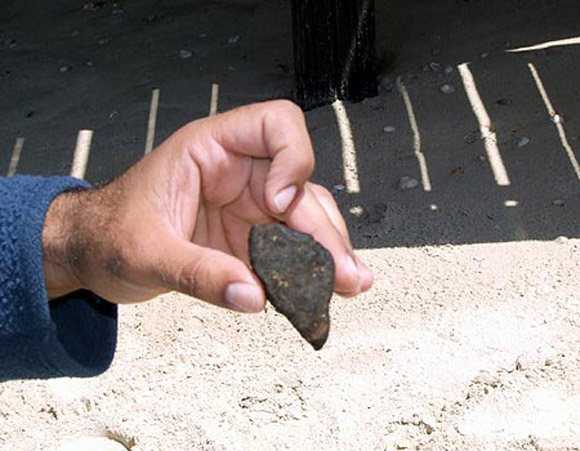
That's no space rock: The Israeli 'meteorite' that never was (Ilan Lilush, Tel Aviv Police).

UPDATE (April 25): The unidentified combustible object has been identified as being “man made” rather than anything cosmic in origin.

“It is definitely not a meteor and not a different natural substance – somebody created it, and it did not appear from outer space,” said Ittai Gavrieli of the Geological Survey of Israel when reporting after analysis of the ‘meteorite.’

Also, it looks like my original assertion that this resembled an incendiary device wasn’t far off. This object contained high quantities of phosphorus, a chemical commonly used in incendiary weapons.

“The object had high concentrations of phosphorus, which is naturally ignited when it comes in contact with air and with inflammatory material,” Gavrieli added.

However, I still stand by my theory that the Moonpeople are behind it.

(Once again, thanks Avi for keeping me in the loop of these meteorite misadventures!)

[Original post below]

ORIGINAL POST: It has all the hallmarks of being a meteorite: It’s on fire! There’s smoke! Hell, even the BBC is reporting about it!

That’s right, isn’t it? When a chunk of rock flies through the Earth’s atmosphere it burns bright, sometimes exploding during re-entry, scattering the ground like a hellish incendiary device? Scary stuff if you’re standing underneath the cosmic fireball.

It seems that some surfers on the beach near the town of Bat Yam, near Tel Aviv, Israel had a lucky escape when an unidentified-smoldering object punched a hole through a surfboard and then sat, for some time, burning amongst the seashells. Lots of excitement ensued, and the whole event was captured on videophone. The Israeli police are investigating, saying the unidentified object “fell from the sky.”

However, looking at the video above, that’s no meteorite.

Sure, when a chunk of space rock enters the Earth’s atmosphere it produces light and flame due to atmospheric ram pressure heating the outer layers, producing a trail of ionized gas. But it’s also worth remembering that space rock is very cold (as it’s been deep frozen in space), so the brief heating during re-entry will not heat the cold rock up substantially when it makes landfall, definitely not enough to make it combust when it lands. Re-entry happens for a very short time, although the shell of the meteorite might heat up a little, the insides of the meteorite remain very cold. Even if the rock was heated up during those few fiery seconds of re-entry, it will decelerate very quickly, falling to the ground at terminal velocity. This would have the effect of cooling it down some more.

In fact, it’s been reported that frost has formed on meteorites as soon as they land. That’s radically different to what we’re seeing here.

Even if this could possibly be a meteorite, what’s burning? Last time I checked, space rock didn’t burn like a firework and produce smoke like a signal flare. And meteorites certainly don’t contain any nitroglycerin. That is unless the Moonpeople are throwing bombs at us again, but I’ll save that theory for another day.

Thanks Avi Joseph for pointing me to this video!